
If you owe money on more than one thing, the first real decision is which one to clear first. Two answers are famous. The debt avalanche says pay the highest interest rate first. The debt snowball says pay the smallest balance first. People argue about them online as though only one of them can be right.
They are answering two different questions. Avalanche answers: which order costs me the least? Snowball answers: which order will I actually finish? A plan you give up on in month 4 saves you nothing, so the second question matters as much as the first.
Here is the fair version of both, and a short way to decide using your own balances.
What the avalanche and the snowball actually mean
Both start the same way. You pay the minimum on every debt — the smallest amount your lender will accept in a month — and put every spare bit of money on one debt until it is gone. Then the whole amount you were paying on it moves to the next debt. The only argument is about which debt goes first.
Avalanche: highest interest rate first. A 36% card before a 12% personal loan before a 7% car loan, whatever the balances are. On paper nothing beats it: you pay the least interest, and you finish soonest.
Snowball: smallest balance first. You clear the 8,000 car loan before the 60,000 card, even if the card charges 5 times the interest. On a spreadsheet that looks like a mistake. In real life it often isn't.
A study of people in a debt-settlement programme found that closing individual debts predicted getting out of debt, whatever the size of the balances closed (Gal and McShane, 2012).

What the spreadsheet can't see
The snowball's case is about people, not numbers. Paying off debt takes years, and people keep going when they can see it working.
Clear the smallest debt early and three real things change: one less minimum payment to find, one less statement arriving, one account that used to make you wince now closed. It is not a big win, but it is a finished one. Finished wins are what convince you the plan is working on the days you are tired of it.
The avalanche can spend a whole year on one huge high-rate balance, moving it from enormous down to slightly less enormous. It is right the whole time. It just does not feel like progress. And it is how it feels, not what it costs, that decides whether you keep going.
The best payoff method is not the one that saves the most interest on paper. It's the one still running in month 19.
So what does the snowball actually cost you? Usually less than the argument online suggests. With real balances the difference is often a few months and a modest amount of interest. Sometimes it is genuinely large. The only way to know is to put your own debts in front of you.
We built Wealth Mutant to make that comparison easy: it is a personal finance app where every card and every loan sits as a real account with its own balance and rate, so you can see what each one is costing you. You add your spending yourself, a few seconds a purchase, and nothing ever asks for your bank login.
Ready to take control?
See your budgets, cards, loans and net worth in one place. One payment, yours for life.
Buy — $99 onceHow to pick your order
List every debt: balance, rate, minimum
All of them, including the ones you would rather not write down. Seeing the whole list in one place is uncomfortable for about a minute, and then it is the most useful page you own.
Check for an emergency
A debt charging more than about 20% a year (normal for a credit card you are carrying a balance on) is not a strategy question. It goes first, whichever method you pick.
Work out what each order really costs
Add up the total interest under each order, using your actual balances. If the two come out close, pick the one you will stick with, and do not feel bad about it. If avalanche saves you a lot, go avalanche and take one trick from the snowball: clear one of the smallest debts first, for the lift it gives you.
Choose by what you know about yourself
Have you given up on plans before? Go snowball. Does watching a total interest figure fall keep you going? Go avalanche. Either way the rule is the same: pay the minimum on everything, and put every spare amount on one debt.
Take the three debts in the diagram as an example: a card of 60,000 at 36% (at least 2,400 a month), a personal loan of 25,000 at 12% (830 a month) and a car loan of 8,000 at 7% (360 a month). With 4,500 going to debt every month and each minimum staying the same, step 3 comes out like this:
| Order | Debt-free in | Total interest |
|---|---|---|
| Avalanche: card, personal loan, car loan | 29 months | 33,034 |
| Snowball: car loan, personal loan, card | 30 months | 40,994 |
| Hybrid: car loan, then card, then personal loan | 29 months | 35,887 |
The avalanche saves about 8,000 over the snowball here. The snowball closes its first debt in month 7. The avalanche's first closed debt comes in month 24, and it is the car loan, finished by its own payments; the card it is attacking closes in month 27. The hybrid keeps the month-7 win for about 2,850 more than the avalanche, and it finishes in the same month (the avalanche's last payment there is only about 34).
Either way, you have to see the numbers
Both methods need the same unglamorous thing: knowing your numbers, all the way through. You need to know which debts sit at which rates, what this month's interest actually cost you, and whether the extra payment really went out. A plan you are guessing at turns back into minimum payments without you noticing.
When we watched 17 people explain how they got into debt, not one of them could say where the money went.
This is where tracking earns its keep. In Wealth Mutant, each loan and card is an account with its real balance; payments are simple transfers; loan interest posts itself monthly so you see the cost you're fighting (a number that makes motivation surprisingly easy); and the prepayment simulator, on any loan you give a rate and a payment day, shows exactly what one extra payment does to the timeline. That's the avalanche argument, personalized, in one slider.
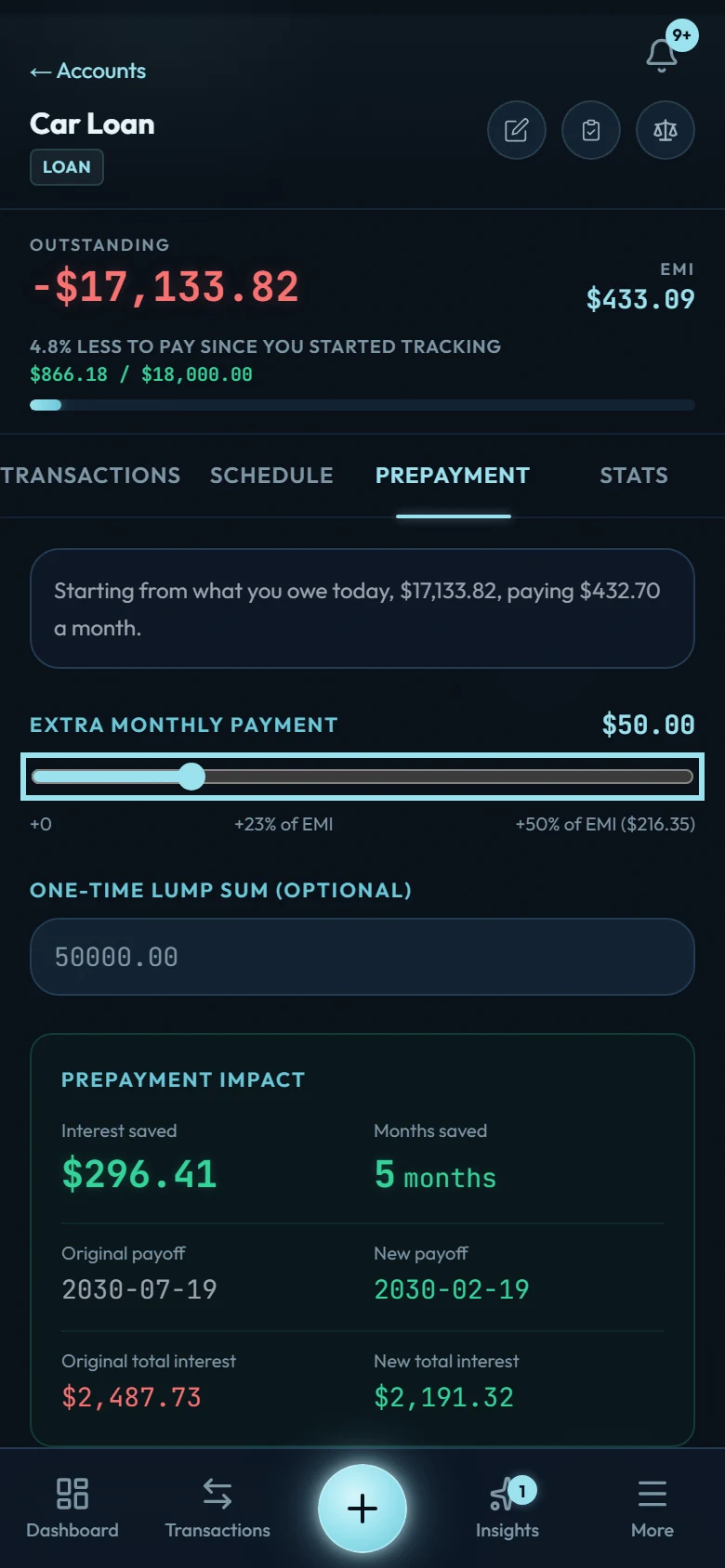
To try the same sum on any loan first, use the free loan prepayment calculator.
Pick the order you will actually finish. Then let the rolling payment do its work: every debt you clear makes the next one fall faster. Both sides of the argument agree on that part.
What the app does for someone clearing debt is set out on one page: paying off debt with Wealth Mutant.
The next step is a short one. Add your debts as accounts, one at a time, with the balance and the rate on each. Once they are all in, the order you pay them in stops being an argument you read about and becomes something you can read off a screen. The trial runs 7 days, needs no card, and nothing charges you when it ends.