
Write down what you spend, and you start spending differently. Nobody has to tell you to cut back, and nothing has to be taken away from you: the act of recording a behavior changes the behavior. Researchers have been testing that for decades.
A 2016 review of experiments on progress monitoring found the effect was larger when the information was physically recorded (Harkin and colleagues, 2016). The name for it is self-monitoring, and all it means is that you keep the record yourself.
The effect shows up wherever they look for it. People who keep a food diary eat differently before anyone gives them a word of diet advice. People who log their workouts train more often than people on the same plan with no log. The record itself is what does the work.
Money works the same way, and this article explains why. Once you can see the reason, writing a purchase down stops feeling like admin.
Why writing down your spending changes it
First, writing it down makes you look at the purchase. Spending is built to be effortless: tap, done, forgotten. Writing it down puts one step back in, and for a few seconds the purchase is in your head: an amount, a category, a moment where you actually look at it. Nothing changes without attention, and writing something down produces a little of it every time. A 220 taxi fare you type in yourself gets a few seconds of your attention. The same 220 arriving in a bank feed gets none.
Second, writing it down gives you a memory you can trust. Spending you don't record gets remembered wrong. Everyone carries a flattering estimate of their own habits: "I hardly ever order delivery", or "the kids' stuff isn't that much". The difference between the guess and the truth is where the money goes missing. A written record puts the fact where the guess was. You don't have to be talked into anything after that.
Third, you start thinking about it before you buy. Once the habit settles, something happens in the moment just before you spend: you already know you will be typing this one in tonight. That thought arrives just ahead of the tap, and it forbids nothing. What it does is put a question in front of you that was not there before. Do I actually want this?
The notebook doesn't judge you. It does something more effective: it remembers accurately.
Why the effect dies under automation
All three of those come from the act of writing it down, not from having a record afterwards. That is the part finance apps leave out.
A bank-synced transaction list is a complete record that never passed through your attention. You didn't look at any of it, so you built no memory of it, and the flattering guesses survive. Nothing happened in the moment before you bought anything, because none of it involved you. All the data is there. The part that changes anything is missing. We took that argument apart fully in Why Automated Budgeting Apps Don't Change Your Spending.
It is also why you can't hand the job to someone else, whether that is a partner who "handles the money" or a piece of software. Someone else can keep the record. Nobody can pay attention on your behalf.
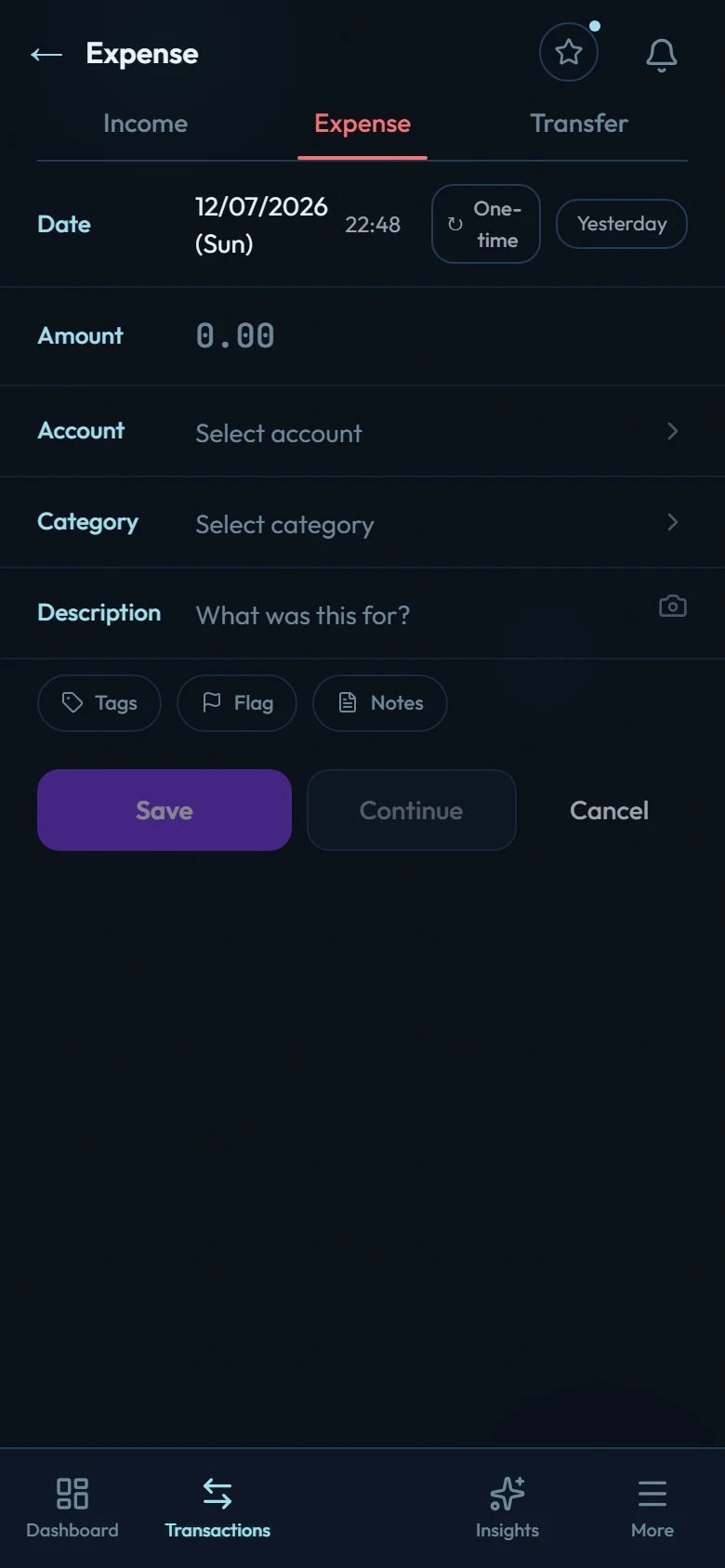
We built Wealth Mutant around that one act, as a personal finance app where you do the recording: a few seconds, an amount, a category. The app does everything after it. There is no bank linking in it at all, and you pay for it once.
Ready to take control?
See your budgets, cards, loans and net worth in one place. One payment, yours for life.
Buy — $99 onceMaking it work in real life
The research version of self-monitoring is a paper diary. A version you will still be doing in a month has to survive commutes, queues and being too tired to care, which means it has to be fast enough to do standing at the counter. Here is what that looks like:
Record at the moment, or at a daily anchor
Best: 5 seconds when you pay, while it's fresh. Good: a 2-minute run-through each evening, at the same time every day. Both work, so pick the one you'll keep up.
Capture amount and category, nothing more
The effect comes from looking at it, not from the detail. Notes and tags are for the entries that deserve them; speed is what protects the habit.
Skip perfection deliberately
Missed yesterday? Let it go and record today. Missing some days does not undo the effect. What kills the habit is deciding you have to go back and fill in a whole week before you can start again.
What you get after a few months
The obvious payoff is the data: real numbers to budget from, categories that match what you bought, a month you can see. The bigger payoff is slower. After a few months you become someone who knows where their money goes, without having to look it up. That sounds minor until you notice how much money worry comes from not knowing.
That is what Wealth Mutant is for: a personal finance app built for people who track by hand. Typing a purchase in takes a few seconds: you can do the sums inside the amount field, and a bookmark fills in anything you buy often in 2 taps. Nothing syncs in from a bank, so the only spending in there is spending you looked at.
If you want to see where the habit leads, the Mutation Path lays it out over 9 levels, and Level 1 is 5 saved transactions with no deadline. The rest of this article fits in three words: write it down.