
Zero-based budgeting sounds stricter than it is. The name makes people think of cutting everything, and the people who love it often talk about it like a sport. The idea underneath is simple, and it is worth knowing even if you never adopt the whole method.
Here it is: before the month starts, you give every part of your income a job. Rent has a job. Groceries have a job. Savings is a job too, and so is fun money. When every part is assigned, nothing is left unplanned, and that is all the "zero" means.
This article covers how a zero-based month actually runs, what it costs you in attention, who it fits, and a gentler 3-month way in.
What it actually means
Think of your income as a group of people arriving on payday. Most budgets hand a job to two or three of them and let the rest stand around. Zero-based budgeting gives every one of them a job: this much is rent, this much is groceries, this much goes to the emergency fund, this much is fun money with no questions asked, and this much is next year's insurance. Nobody is left standing around.
What changes is how a decision feels. When every part of your income is already spoken for, going over in one place is not a vague failure. It is a choice to take the money from somewhere else. Want the extra dinner out? Fine — where does it come from: the trip fund or the clothes money? That shift, from limits to trade-offs, is the whole point of the method. People who stick with zero-based budgeting usually say it made money feel like a set of choices rather than a set of rules.

What a month actually looks like
Here is one made-up month, so you can see the arithmetic. The take-home pay is 3,000, in whatever currency you use, and every part of it has a job:
| Job | Amount |
|---|---|
| Committed: rent 1,100, utilities and phone 200, a loan payment 150, subscriptions 50 | 1,500 |
| Living, sized from the last 2 months: groceries 400, transport 150, eating out 150, everything else 100 | 800 |
| Next year's insurance: 600 a year, divided by 12 | 50 |
| Emergency fund | 250 |
| Trip fund | 250 |
| Fun, no questions asked | 150 |
| Every part has a job | 3,000 |
You get there in 5 steps.
Start with real income
What actually lands this month. Paid irregularly? Use what you actually earned last month, not what you hope to earn this month. For freelancers this one change is what makes the method work.
Assign the committed jobs first
Housing, utilities, debt payments, insurance, subscriptions — the spending that's already decided. For most people this is about half the month's income.
Assign the living jobs
Groceries, transport, dining, fun. Use what these actually cost you in past months, not what you would like them to cost. This is where a month or two of tracked spending pays for itself.
Assign every remainder a job, including rest
Savings goals, a buffer for next month — money set aside so the month starts with a cushion — and the guilt-free category. Yearly bills need a job too: insurance that costs 600 once a year is 50 a month, the line most first budgets forget. When every part of your income has a job, the plan is done.
Reassign as the month happens
Family comes to stay and groceries run 400 over? Move 400 on purpose: in the example, 150 from eating out, since everyone ate at home, and 250 from the trip fund, so the trip waits a month. Moving money like this is the method, not a sign that it failed.
That last step is the one beginners miss. A zero-based budget is not a plan you set once and then try not to break. It is a plan you move around every week. The plan changing is the plan working.
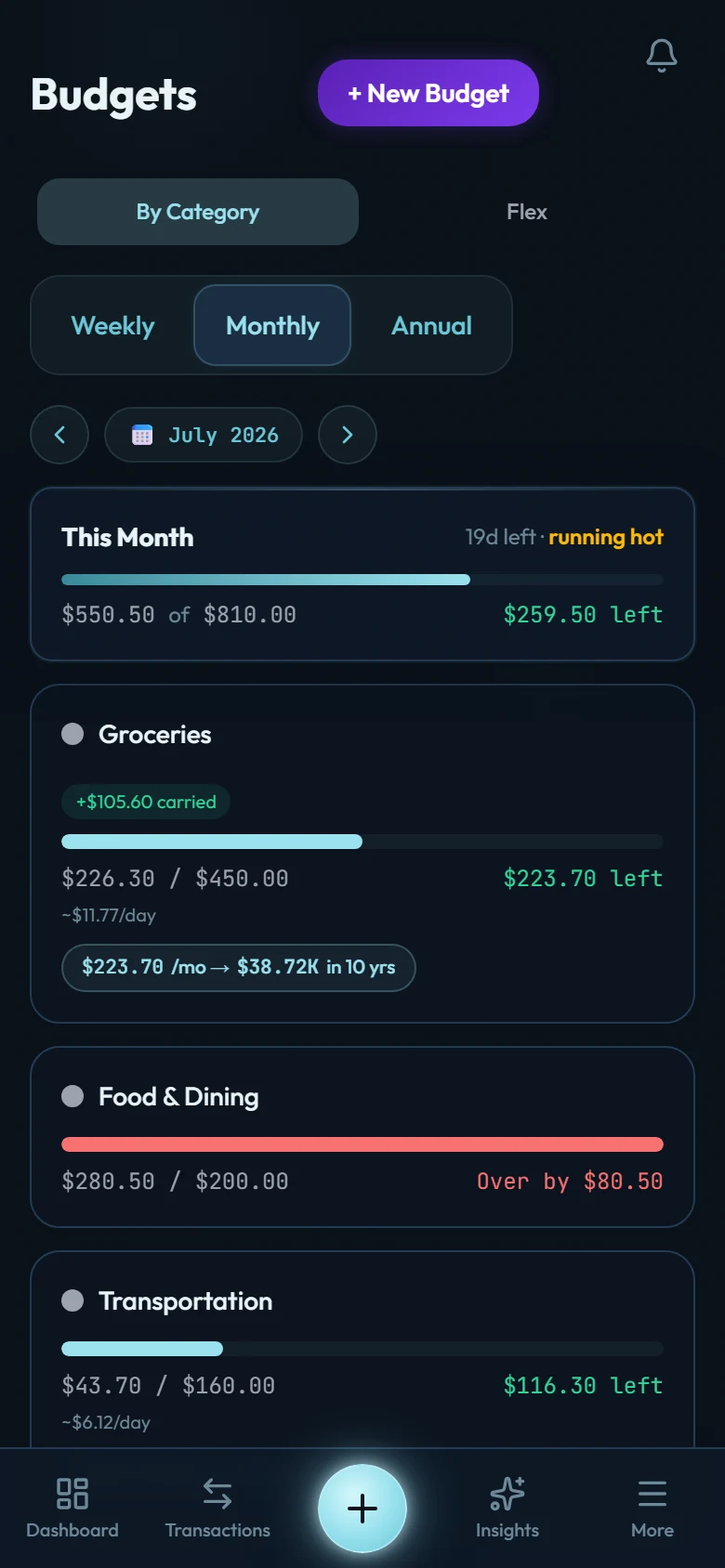
In our personal finance app, Wealth Mutant, the parts of this that are just arithmetic happen on their own. You record what you spend, and the app keeps each category's running total, carries what you did not spend into next month if you want it to, and posts your recurring bills for you. Each purchase takes a few seconds to add, your bank stays out of it, and you pay for it once.
Ready to take control?
See your budgets, cards, loans and net worth in one place. One payment, yours for life.
Buy — $99 onceIf you know zero-based budgeting from YNAB, here is how Wealth Mutant compares with YNAB.
The honest costs
Zero-based budgeting asks more of you than any other method. Pretending otherwise is how people burn out a month or two in:
- It wants attention. Weekly check-ins, and real moves between categories. Skip three weeks and the plan no longer describes your month.
- It needs real numbers to start. If the amounts you assign are guesses, the plan falls apart in the first week. If you don't yet know what groceries actually cost you, build the looking habit first. A month of tracking makes your first zero-based month far easier.
- It can feed perfectionism. Some people turn the zero into a test they have to pass. If moving money between categories feels like admitting a failure, step back; that's the shame talking, not the method.
An easier way in
You do not have to do all of it at once. Here is a 3-month version that keeps what is useful and skips the burnout:
Month 1: just track. Record everything and assign nothing. You are gathering the real numbers the method will need. Month 2: assign the 4 biggest. Housing, groceries, transport, fun. Everything else stays loose. Practise moving money between them once a week. Month 3: go to zero. By now your numbers come from real months, and moving money between categories feels normal.
If you get to month 3 and want the trade-offs without keeping 20 categories alive, there is a lighter method with the same idea inside it: Flex budgeting puts everything into 3 buckets and asks you to watch one number. Wealth Mutant runs both styles on top of the spending you record, so the only part left for you is the part that was ever worth your time: deciding where the money goes.