
There's a specific person classic budgeting keeps failing: the one who sets up twenty category limits in an optimistic hour, tends them for three weeks, misses one week, discovers the whole board needs re-planning, and quietly never opens the budget tab again. If that's you, twice maybe, the problem probably isn't your discipline. It's that you were sold a control panel when what you needed was a dashboard light.
Flex budgeting is the dashboard-light version. It compresses the entire monthly question into three buckets and, really, one number.
The three buckets
Every expense you have belongs to one of three temperaments:
Fixed: the committed money. Rent, utilities, insurance, subscriptions, debt payments. It's decided before the month starts; watching it daily adds nothing.
Non-Monthly: the irregular-but-inevitable. Repairs, gifts, annual fees, the dentist. Not monthly, absolutely not optional; the bucket exists so these stop registering as emergencies.
Flex: everything discretionary. Groceries, dining, fun, the texture of daily life. This is the only bucket where your daily choices actually move the needle.
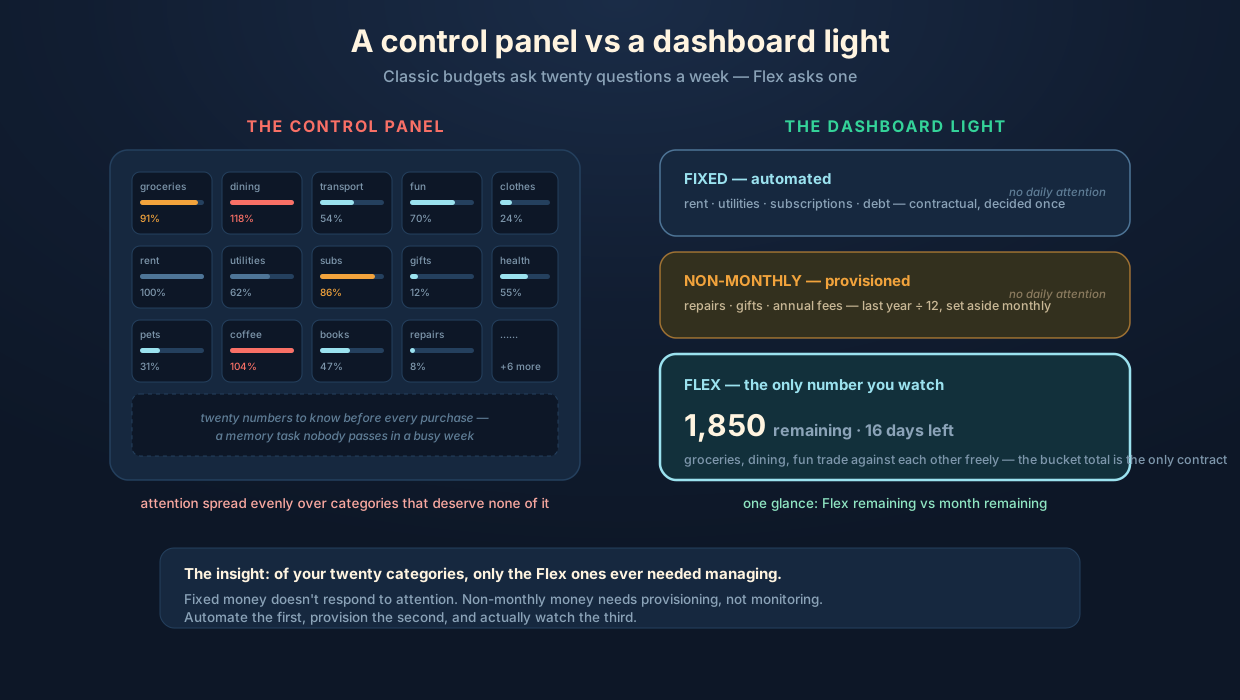
And that asymmetry is the whole insight: of your twenty budget categories, only the Flex ones ever needed managing. Fixed money doesn't respond to attention; it's contractual. Non-monthly money needs provisioning rather than monitoring. The classic budget's fatal flaw was spreading your limited attention evenly across categories that deserve none of it and categories that deserve all of it.
Flex budgeting reallocates the attention: automate the Fixed, provision the Non-Monthly, and actually watch one number — what's left in Flex this month.
A month in the life
Income lands. Fixed claims its share automatically. You already know that number. A slice goes to the Non-Monthly pool and a slice to savings, both decided once. What remains is your Flex number for the month — say, 1,850.
From there the entire practice is one glance: Flex remaining, versus month remaining. Halfway through the month with 60% of Flex left? You're coasting — say yes to the dinner. Day nine with half of Flex gone? No shame, no category autopsy, just a lighter fortnight, visible in advance instead of discovered at the end.
Groceries versus dining versus fun stops mattering as a compliance question. They're all Flex; trade them against each other freely. The only contract is the bucket total.
Classic budgets ask twenty questions a week. Flex asks one: how's the number?
Ready to take control?
Track your spending without linking your bank. One payment, yours for life.
Buy — $99 onceSetting it up honestly
Sort your categories by temperament
Go through your actual spending and label each category Fixed, Flex, or Non-Monthly. (In Wealth Mutant this is a one-time settings pass — each category carries its bucket.)
Size the Non-Monthly pool from history
Add up last year's irregulars (repairs, gifts, renewals) and divide by twelve. That's the monthly provision that turns future surprises into planned withdrawals.
Let Flex be what genuinely remains
Income − Fixed − Non-Monthly provision − savings = your Flex number. Resist rounding it up to what you wish it were; the number only protects you if it's true.
Check one number, a few times a week
Flex remaining vs month remaining. That's the entire ongoing practice.
Who should still budget classically
Fairness requires the counter-case. Category-level budgets earn their overhead when a specific category needs discipline (you want dining specifically fenced, not just Flex overall), when money is tight enough that every category is a real trade-off, or when you're running a deliberate savings sprint and want maximum visibility. Wealth Mutant runs both modes side by side: Flex for the whole-month picture, with the option of a classic budget on any single category that's earned special attention. Many people land exactly there: Flex as the default lens, one or two watched categories on top.
The real pitch
Flex budgeting is easier, and more to the point it's sustainable: a structure light enough to survive your busiest month, which means it's still running in month eight when the classic board would be long abandoned. A budget's value is its uptime.
Three buckets, one number, one glance. See it running on real entries.