
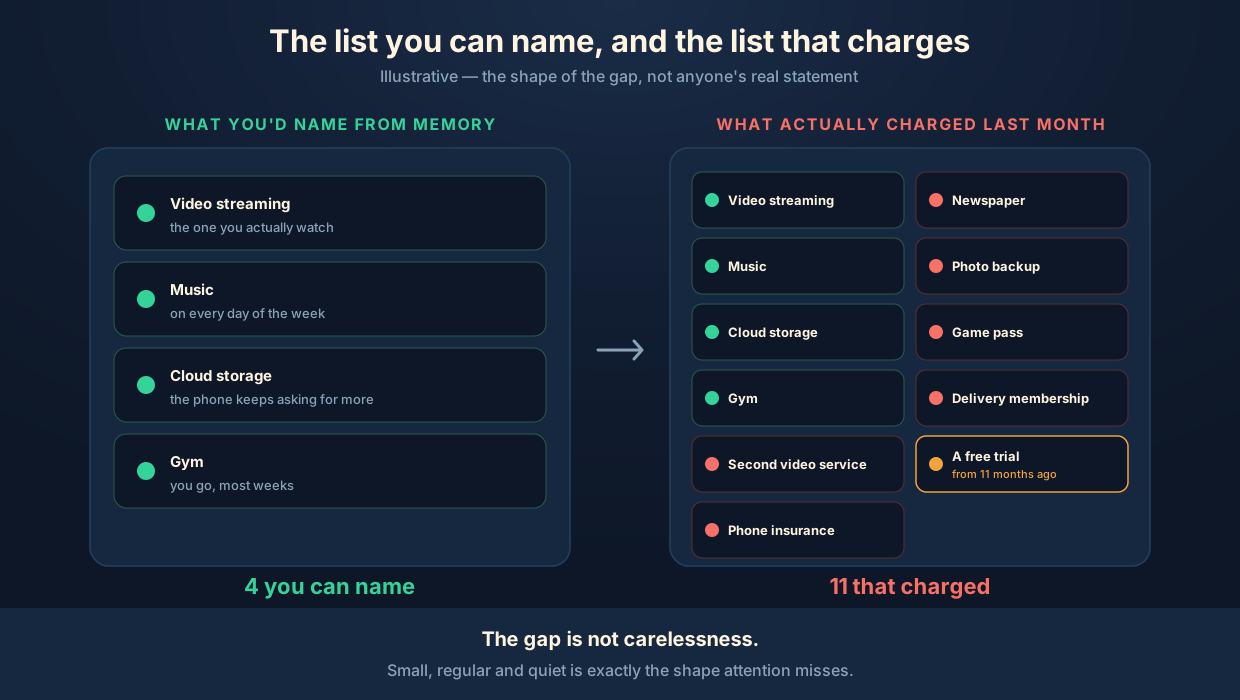
Try this before you read on. Without opening your bank app, name every subscription you pay for. Most people run out of names before they run out of subscriptions, and the tired feeling that follows has a name of its own: subscription fatigue.
It is not about any one charge. Each one is minor, each one made sense on the day you said yes, and each one still arrives. The problem is that nobody is counting, and the companies collecting the money would rather you didn't start.
This article covers how we got here, what those charges add up to over the years you actually keep them, and a 20-minute way to see the whole list as one number. It also covers the moment where owning something beats renting it, with the arithmetic laid out, because that is the decision underneath all of this.
How everything became a subscription
Not long ago you bought things. A film on a disc, a piece of software in a box, a razor. You paid once, and it was yours until it wore out. Then one company after another worked out that the same product sold as a monthly fee is worth far more over time, and that a customer who pays every month is a customer who rarely leaves.
Software went first, because software is easy to switch off. The editing program that once came on a disc for one price became a monthly plan, and the plan never ends. Then the idea spread to things you can hold. There is a printer that stops printing when its ink plan lapses, even with full cartridges inside it, because the cartridges answer to a monthly payment rather than to you. There is a car with heated seats already built into it, where the seats only warm up if you pay a fee each month. You paid for the seat. You are renting the switch.
The pattern is easy to see once you know what to look for. A subscription makes an expensive thing feel cheap, because 10 a month is an easier yes than 1,200 up front. It gives the company steady income instead of good months and bad months. And it keeps a relationship open, so there is always a next thing to sell you.
A 2021 survey of US consumers by the consulting firm West Monroe put the average monthly subscription spend at about 273, and found that people guessed their own total low by about 133 a month. The exact numbers will differ where you live. The shape will not: people pay for more than they know, and the gap is not a rounding error.
Why subscription fatigue costs more than the money
There is a reason the tired feeling arrives before the number does.
Minor amounts slip under attention. A charge of 9 or 14 is not worth stopping for. Your mind files it as noise and moves on. Twelve charges like that in a month are not noise, but you never see them together, so they never become a total.
Being forgotten is part of the design. Many services can tell when you have stopped using them. The ones that want your money more than your loyalty go silent at exactly that point. No reminders, no "we miss you", nothing that might prompt you to look at the charge and ask what it is for. The hope is that you keep paying for something you forgot you had.
You stop owning things. This is the part that costs more than money. When the printer only works while the plan is paid, and the film disappears when the service drops it, you do not own any of it. You have access, for as long as you keep paying and for as long as the company decides to keep the servers on. Ownership used to be the default. Now you have to choose it.
For your money, the practical problem is simpler than all of that. Recurring payments are the easiest money in your life to see, because they announce their own schedule in advance. They are also, for most people, the least seen, because no single line on the statement is large enough to make you stop and read it.
What a subscription really costs
The honest way to price a subscription is not the monthly figure. It is the monthly figure multiplied by how long you will actually keep it, which for most people is far longer than they expect, because cancelling takes a decision and continuing takes none.
So 10 a month is 120 a year. Kept for 10 years, which is not unusual for a service you like, it is 1,200. Three of those and you have paid 3,600 for things you may have stopped using halfway through.
There is a second way to price it that we find even clearer: in hours of your own life. If you know what you earn per hour, every recurring charge is a fixed number of hours a year, paid whether you use the thing or not. A service you open twice a month can cost you a working day a year. Seen that way, some subscriptions are obviously worth it. Others are obviously not. The point is to see it.
When owning beats subscribing
Not every subscription is a bad deal. If a service genuinely improves every month, or you only need it for a season, renting it is the right call. The moment to stop and think is when you are renting something whose job does not change, for years, and where a one-time version exists.
Money apps are the clearest example, which is awkward for us to point out, so here is the arithmetic in full. These are the list prices the two best-known budgeting apps publish, and what they come to over the years people typically keep a money app:
| After 1 year | After 3 years | After 5 years | |
|---|---|---|---|
| YNAB, at 109 a year | 109 | 327 | 545 |
| Monarch, at 99.99 a year | 99.99 | 299.97 | 499.95 |
| Wealth Mutant, one payment | 99 | 99 | 99 |
We checked both against their own pricing pages on 19 September 2026, and either can change them, so check before you decide. Monarch also runs a half-price first year from time to time, which changes the first row and none of the others. Our price where you are is on the pricing page, and it is one payment wherever you live. We keep a full, fact-checked comparison of each: against YNAB and against Monarch.
The gap is not really the money. It is what the money buys. A subscription app has to keep earning its fee every month, which sounds like a good thing until you notice what it means: its income depends on you staying subscribed, not on you getting to a point where money is no longer something you worry about. We did not want to build something whose business model was in tension with what it was supposed to help you do.
A subscription is a decision you made once and keep paying for every month you don't decide again.
Wealth Mutant is built to put that decision back in front of you. You record what you spend, anything that repeats goes in as a recurring rule, and every subscription then sits on one list with one monthly total. When that total moves, the app tells you. There is no bank linking, and the app is a one-time purchase: you buy it once and it is yours for life.
Ready to take control?
Track your spending without linking your bank. One payment, yours for life.
Buy — $99 onceYour subscriptions, one search away
Here is the part that makes the difference, and it takes 2 seconds per purchase to set up.
When you record a subscription, tag it subscription. That is the whole setup. From then on, one search for that tag answers the question this article started with, for any period you pick.
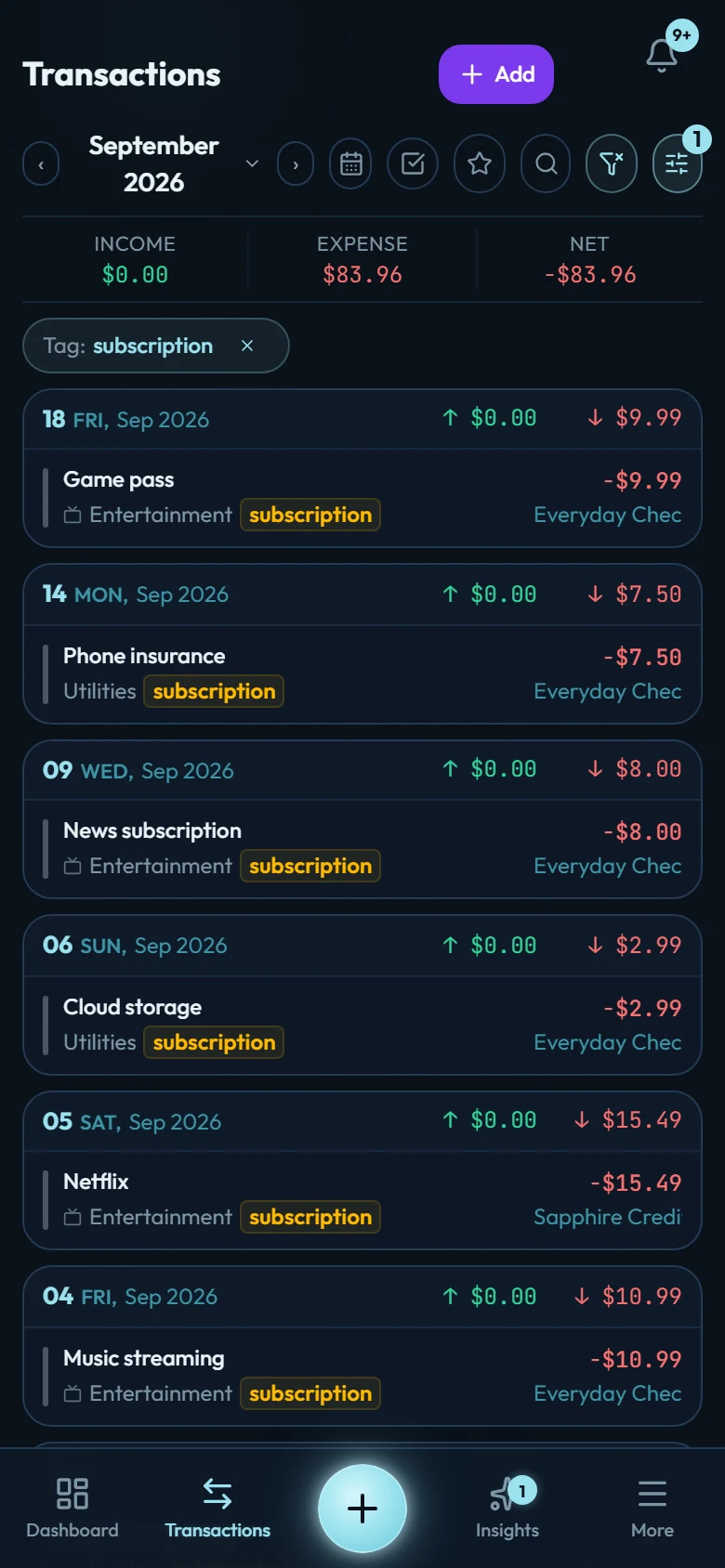
Look at what that list is doing. The gym sits in Health. The streaming sits in Entertainment. Cloud storage sits in Utilities. One is on a card, the rest on the current account. In every other view they are scattered, which is exactly why nobody can count them. The tag cuts straight across categories and accounts and gathers them into one list, with the total for the period sitting above it.
Change the month and the same list answers for a different one. Widen the date range and it answers for a quarter or a year, which is the number that really lands: not what subscriptions cost this month, but what they cost you last year.
That total is the thing the whole article is about, and the statement never shows it to you, because a statement is a list of dates rather than a list of commitments.
And the ones that have not charged yet
The other half is what is coming. Every subscription you set up as a recurring rule appears in one place with its own monthly total, so a new charge cannot slip in unannounced.
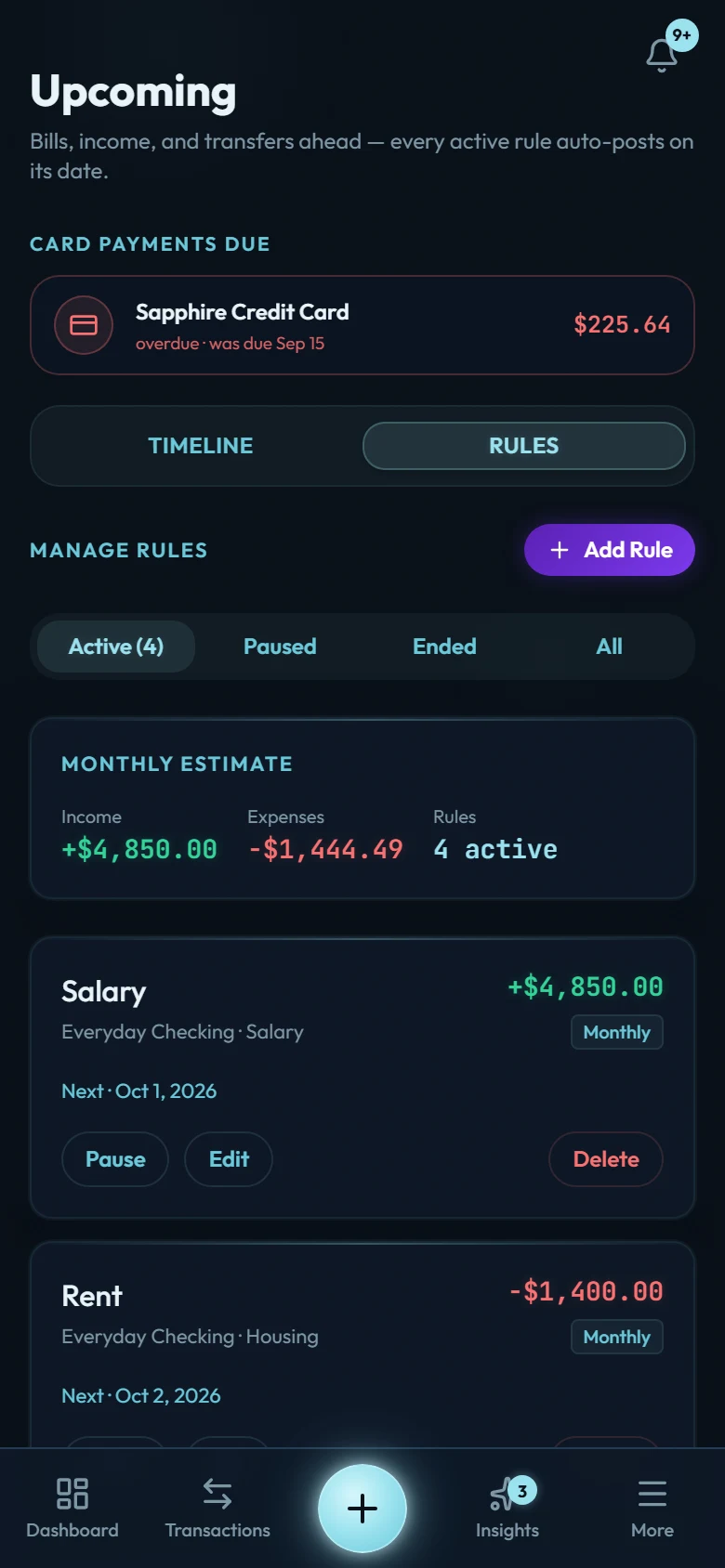
Between the two, you can answer both questions that matter: what have my subscriptions actually cost me, and what is about to charge me next.
The 20-minute subscription audit
You do not need any app to do this first pass. You need 20 minutes and your last 3 months of statements.
Find every charge that repeats
Go through 3 months of bank and card statements and mark anything that appears more than once at a similar amount. Include yearly charges, which are the ones people forget: a domain, an antivirus, a warranty, an app you tried in a free trial 11 months ago. Write each one down with its amount and how often it charges.
Add them up as one monthly number
Turn yearly charges into monthly ones by dividing by 12, then add the whole list. Say the number out loud. For most people this is the moment subscription fatigue turns into something more useful, which is a decision.
Ask one question of each line
Not "is this good value?", which everything answers yes to. Ask: "If this cancelled itself tonight, would I sign up again tomorrow?" Keep the ones you would. Cancel the ones you wouldn't. Pause the ones you are not sure about and see if you miss them.
Tag the keepers, once
In Wealth Mutant, add the tag
subscriptionto each one as you record it. That single word is what makes one search return every subscription you have, in any period, with its total — no matter which category or account each one lives in.Let the predictable ones enter themselves
Anything on a fixed schedule can also become a recurring rule: open Upcoming, go to the Rules tab, and add it once. It then posts itself on its date, shows up in the Timeline before payday, and counts towards the monthly estimate. When that estimate shifts, a Smart Insight points it out.
Pick a date to look again
Yearly renewals are how subscriptions come back. Choose one month a year to repeat the audit. It gets faster every time, because the list is already written down.
What changes when the list is one number
The subscriptions you keep stop being a low hum of guilt and become things you chose. The ones you cancelled free up an amount you can name. The next free-trial button gets a pause in front of it, because you know where that charge will show up and what it will do to the total.
None of this asks for willpower. It asks for a list, and for the list to be in one place where you look.
If you want that list to keep itself, that is what we built. Wealth Mutant is one payment, yours for life, with no bank linking and nothing that renews. Your first evening with it is the audit above, done once, after which the total maintains itself.
If the slow growth of little charges felt familiar, it is a cousin of lifestyle creep, where a rising income quietly raises normal spending with it. If you have never recorded your spending at all, the 30-second habit is where the whole thing starts. And if you are wondering why we don't just connect to your bank and find the subscriptions for you, that article explains what bank linking costs you.
Common questions
How do I find all my subscriptions?
Go through 3 months of bank and card statements and mark every charge that repeats at a similar amount, including yearly ones. Then check the subscription pages in your phone's app store settings, which list app subscriptions you may have forgotten. Add the whole list up as a monthly figure.
Is it cheaper to pay monthly or to buy once?
For anything you will use for more than a couple of years, buying once is almost always cheaper, because a subscription keeps charging for as long as you forget to cancel it. Multiply the monthly price by the number of months you realistically expect to keep it and compare that with the one-time price. For money apps specifically, the two best-known subscriptions are 109 and 99.99 a year, so 3 years is around 300 and 5 years is around 500.
Does Wealth Mutant have a subscription?
No. Wealth Mutant is a one-time purchase: you pay once and the app is yours for life, including the core updates that follow.