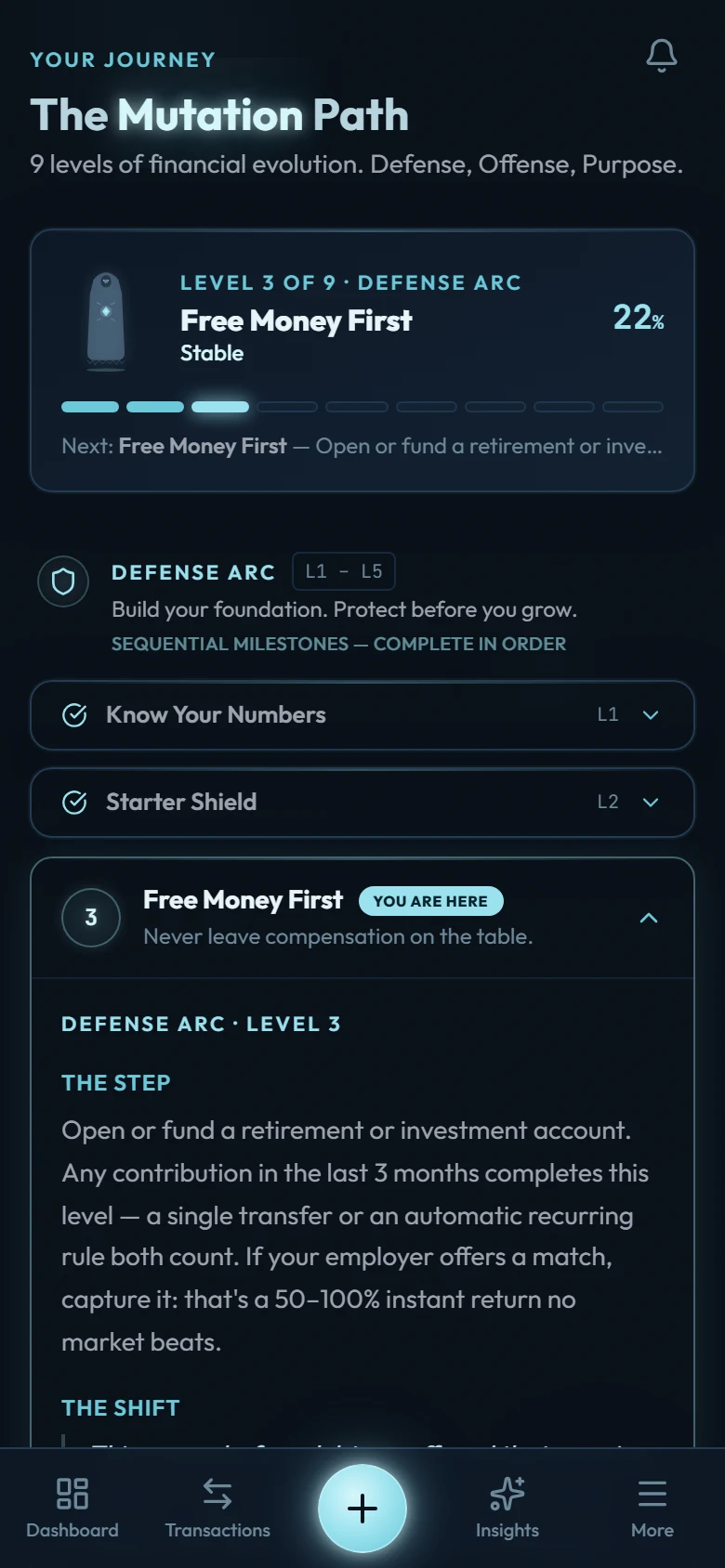
The Mutation Path is Wealth Mutant's answer to the question every finance app leaves hanging: "I'm tracking my money — now what?" It's a 9-level progression from financial chaos to work-optional, and the app detects your progress from your real data. You live your financial life, and the Path recognizes it. Each level is judged from your accounts, transactions, loans and goals as they already are. A few things the app can't see for itself are yours to set, such as which accounts count toward your emergency fund, which loans you can't clear early, which income is passive and which goals are long-term. And until you've added a loan or a card, Debt Purge asks you once whether you have any.
The three arcs
The nine levels group into three arcs, each answering one question:
- Defense (Levels 1–5): "Am I safe?" Awareness, a starter emergency buffer, getting money into a retirement or investment account (401k, RRSP, ISA, Super, EPF, CPF; the vehicle varies by country, the principle doesn't), clearing your debts, and finishing with a full emergency fund, the capstone that opens the next arc. The buffer, the investing and the debt levels all run at once; only the full fund waits on the three of them.
- Offense (Levels 6–7): "Am I building?" Growing your net worth, now that your safety net is complete.
- Purpose (Levels 8–9): "What is it for?" Funding your future explicitly and reaching the point where work is a choice.
Every level completes on a fact the app can check, and it re-checks daily. Level 1 completes at 5 saved transactions. Level 5 completes when the accounts you count as your emergency fund hold six months of your average spending. A few levels need a stretch of history before they can be measured at all. Levels 6 and 7 can be completed two ways: growing your net worth over a year, which needs 12 months of entries, or already owning 10 or 15 years of your average spending as net worth, which can be read after 3 completed months with entries. Both level guides spell out every criterion and what the app needs before it can judge one: the Defense arc, Levels 1–5 and Offense & Purpose, Levels 6–9.
Level 1 is deliberately humble
Level 1 completes when you've saved five transactions. However they arrive, they count: typed in as you go, or brought over from your old app in a single import. No streak, no window, no deadline, no punishment for a busy week. Level 1 is also standalone: it gates nothing, so if your finances already satisfy later levels you progress on those independently.
Two readings: the date you reached it, and where you stand today
The date you first reach a level becomes permanent within a month: if the numbers behind it stop holding in that first month, the date comes off, and you take it again when you're back over the target. Beside it, every level from 2 upward carries a live reading of whether its condition still holds, because a fortress you spent in March is not a fortress in June and a screen that says otherwise is lying to you. Level 8 is the one exception: when a long-term goal that held it has done its job and you mark the goal as done, the level stays fulfilled, because spending that money on what it was saved for is the point.
So the Path shows you two numbers. Highest reached is the furthest you have been. It moves down only if a level you reached in the last month comes off. Standing today counts Levels 2, 3 and 4 in order. Above them, it is the highest level that holds while every level it needs holds too (Level 8 needs Level 6, and Level 9 needs Level 7). When they disagree, the level that slipped names what happened, what closes the gap, and what comes back with it. A level well under its target (below 85% of it) for a few weeks reads Slipping and holds nothing back; only after a month under it (14 days for Levels 3 and 4, which are yes or no) do the levels above go On hold, and at once while it is waiting on data; they return the day that level holds again. Debt Purge is the one level that asks before it judges: until you've added a loan, a card or an overdraft, its sheet asks whether you have any, and if you have none, I have no loans or cards answers it in one tap.
Life happens: job loss, a big expense, a hard year. Nothing you built is lost, and the Path says so in those words.
The map, not the compass
The Path shows where you've been, the work already done. Its sibling surface, Future Self, shows where you're heading. They use the same six identities but answer different questions: see Map vs Compass.