
Somewhere in your extended circle there is a person with a plain watch, a paid-off car and the same modest flat they have lived in for 15 years, and you would never pick them out of a crowd as wealthy. They are the most likely person in the room to actually be wealthy. The friend with the leased German car and the endless holiday photos is, more often than anyone would guess, one missed salary from trouble.
That is stealth wealth: money that does not announce itself. It is not the same as being cheap, and it is not a style. It is a way of spending, in a fixed order, that the truly wealthy tend to arrive at and the rest of us can borrow long before we have their money.
This article covers what that order is, why the people who can afford anything choose to look like they can't, and why the hardest part is not the money. It is the audience, and there is something you can do about that.
Rich is a spending pattern. Wealthy is a number nobody can see
We cannot see wealth. We can only see what people spend: the car, the clothes, the restaurant photos. So the mind does the obvious thing and treats spending as a sign of wealth. But spending is what wealth is made of, so every unit spent on being seen is a unit that is no longer building anything. Past a point, looking rich and being rich stop being related. Then they start pulling against each other.
Researchers who surveyed the wealthy directly, most famously in The Millionaire Next Door, kept finding the same unglamorous profile: used cars kept for years, a modest home in a decent area, ordinary watches, a high savings rate. These were fortunes built by teachers and small-business owners. Meanwhile, the visibly rich in the expensive postcodes often carried startling debt. The show, it turned out, was frequently financed: the look of wealth, bought on terms that prevent the real thing.
Stealth wealth is not being cheap
This is the first thing people get wrong. Some of the wealthiest people spend more, not less, to stay unnoticed. The nicest houses in the world cannot be seen from the road, and a house hidden behind land and trees costs more than one with a grand front. The point is not to save money. The point is to buy a life instead of a performance.
The people who do this have usually worked out an order of spending, and the order matters more than the amount.
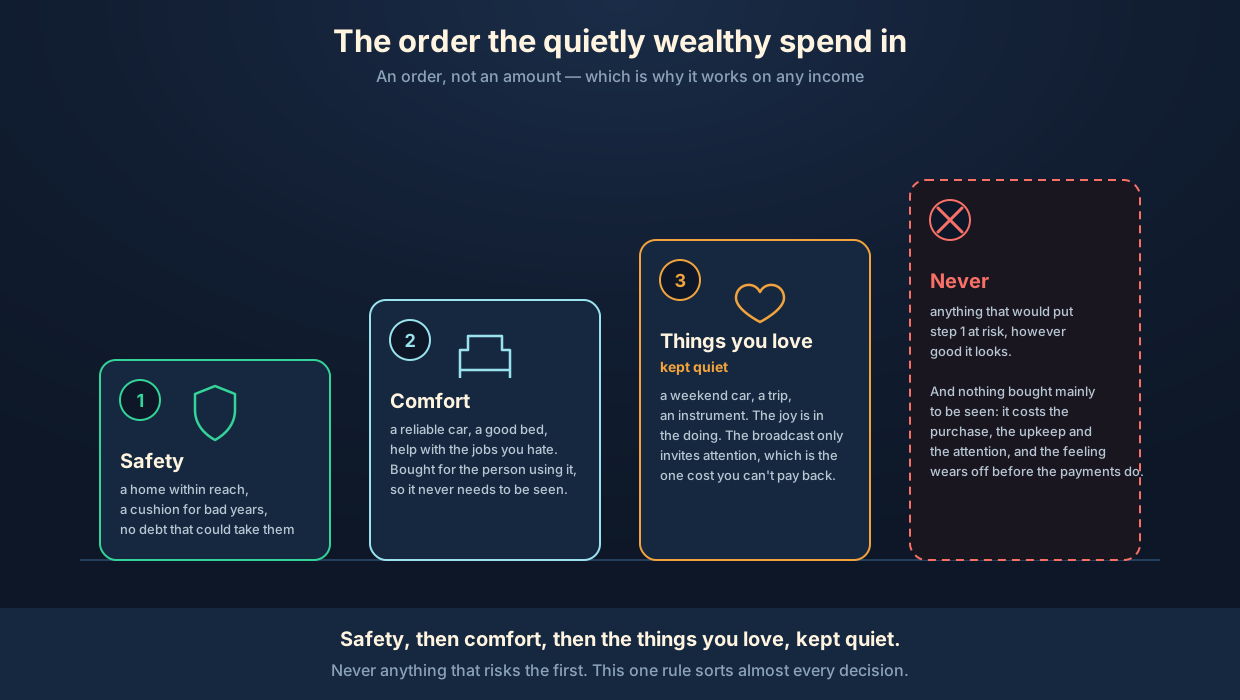
First, safety. For themselves and the people who depend on them: a home that is paid for or well within reach, a cushion that turns a bad year into an inconvenience, no debt that could take any of that away.
Then comfort. The things that make a day easier: a reliable car, a good bed, help with the jobs they hate. Comfort is bought for the person using it, so it does not need to be seen.
Then the things they love, kept private. Expensive hobbies are not against the rules. A weekend car, a trip, an instrument. What the wealthy tend not to do is turn the hobby into a broadcast. The joy is in the doing, and the broadcast only invites the one cost that cannot be paid back, which is attention.
Never, anything that risks the first step. No purchase that would put the cushion or the home in danger, however good it looks. This one rule sorts almost every decision.
Why the wealthy stay unseen
Display buys you jobs. A flashy car needs a second, practical car, so people do not assume the first was repossessed. Two good cars want a bigger garage, which wants a bigger house, which wants more furniture, cleaning and upkeep, which wants staff, which wants managing. Each purchase makes the things around it look cheap and asks for the next one. People who wanted money so they could relax end up with a calendar full of things to look after.
Attention has a price. A car that turns heads also starts conversations at every fuel stop. A public windfall brings letters, requests, and worse. One lottery winner whose state required the prize to be announced lost the money, a business and much of his family within a decade, and said afterwards he wished he had torn up the ticket. That is the extreme. The everyday version is smaller and constant: once people know what you have, every relationship gets a little more complicated.
The gap is where wealth lives. Wealth is built in the space between what you earn and what you spend, and every visible upgrade narrows that space for good, because comfort adapts within weeks and the new normal never goes back. The wealthy who stay unseen did not resist 100 temptations one at a time. They just never started the escalator, so every raise flowed into the invisible pile instead.
Freedom outbids the car. Every visible luxury competes with an invisible one: the fund that makes work optional, the buffer that makes bad news survivable, the years of growth that only asked for time. Once someone has felt what those buy, which is sleep, options and the ability to walk away, the car loses the argument. Reliably.
The real obstacle is the audience
If the order is that simple, why do so few people follow it?
Because the order asks you to give something up that has nothing to do with money. It asks you to stop being seen. The raise nobody notices, the promotion with no new car, the holiday with no photos. Most of us want to be rich at least partly so that the people who doubted us can watch. That is not a character flaw. Wanting to be recognised is as human as wanting to be safe, and an enormous industry exists to sell you things that satisfy it for about a fortnight.
The trouble is that recognition bought in public is the most expensive kind. It costs the purchase, the upkeep and the attention, and the feeling wears off long before the payments do.
So the practical question is not "how do I stop wanting to be seen?" Nobody manages that. The question is: where else can that need go?
The urge to show your progress is not the problem. Showing it to the wrong audience is.
This is the part of stealth wealth we think about most, because it is what Wealth Mutant is built around. It gives your progress somewhere private to be seen, every day, by the only person whose opinion changes your balance. There is no feed, no leaderboard and no sharing, which is deliberate: a public scoreboard would just be the same performance in a new place.
Ready to take control?
Track your spending without linking your bank. One payment, yours for life.
Buy — $99 onceA scoreboard only you can see
Let us be concrete about what that actually looks like, because "gamified progress" means nothing on its own.
The path has 9 levels, from your first saved transactions to the point where work becomes optional. Each one is measured from your own numbers rather than a generic target: your 1 month of expenses, your 6 months, your debts cleared, your net worth growing by 15% of what you earn in a year. A level you reach is dated, and the highest one you have reached never moves down. If the number under a level slips, the app says so, and says what brings it back.
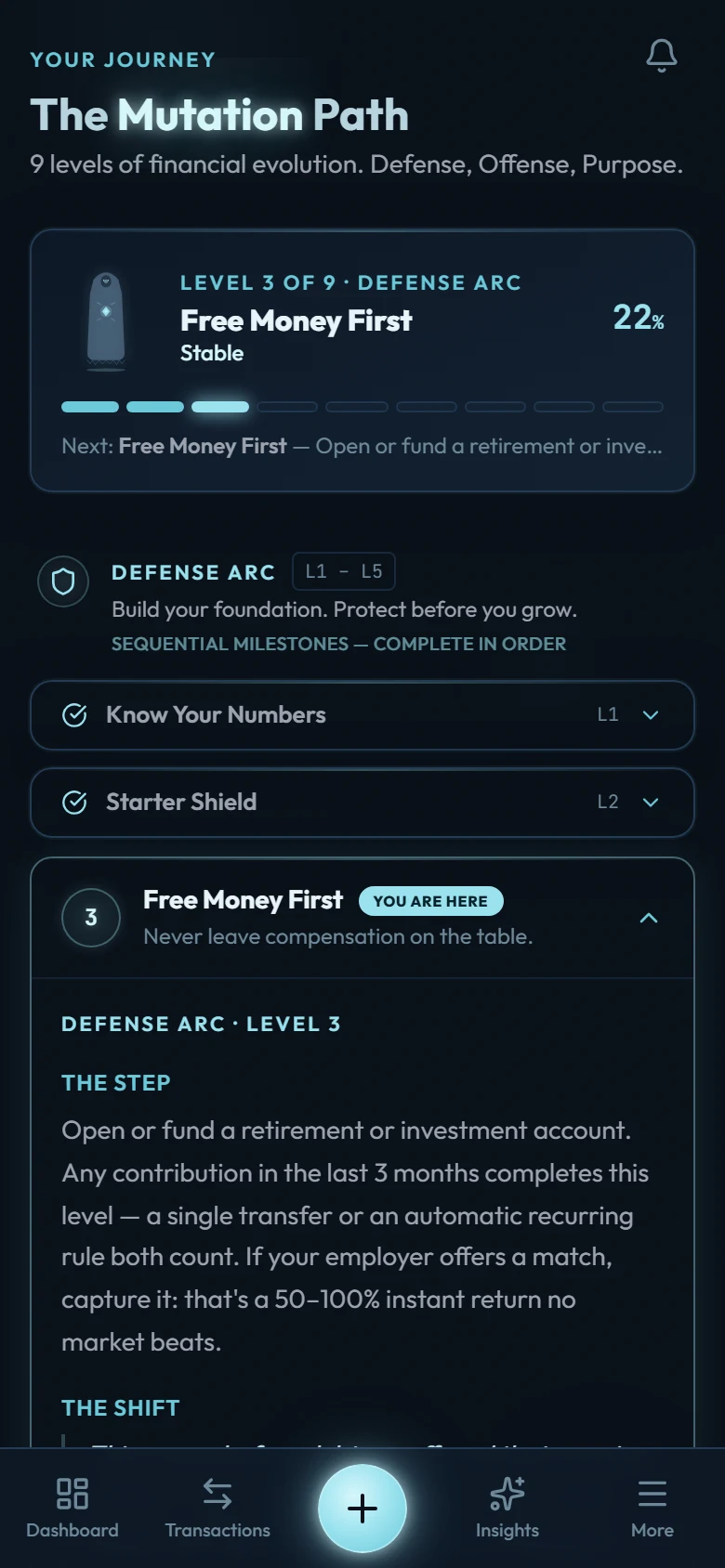
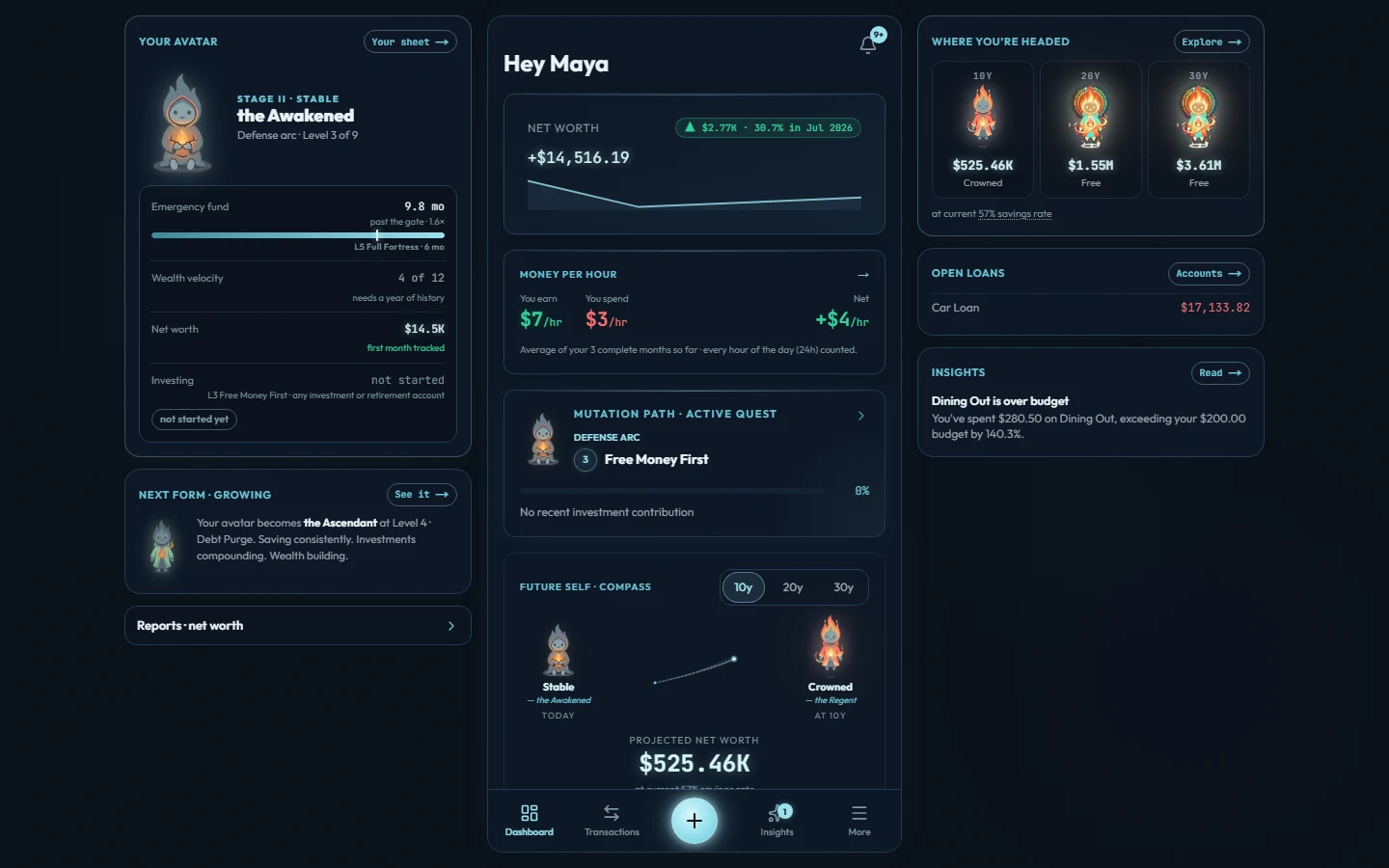
Underneath it sits the number the quietly wealthy actually watch, which is what you own minus what you owe, and the direction it is moving. Not the balance today. The slope.
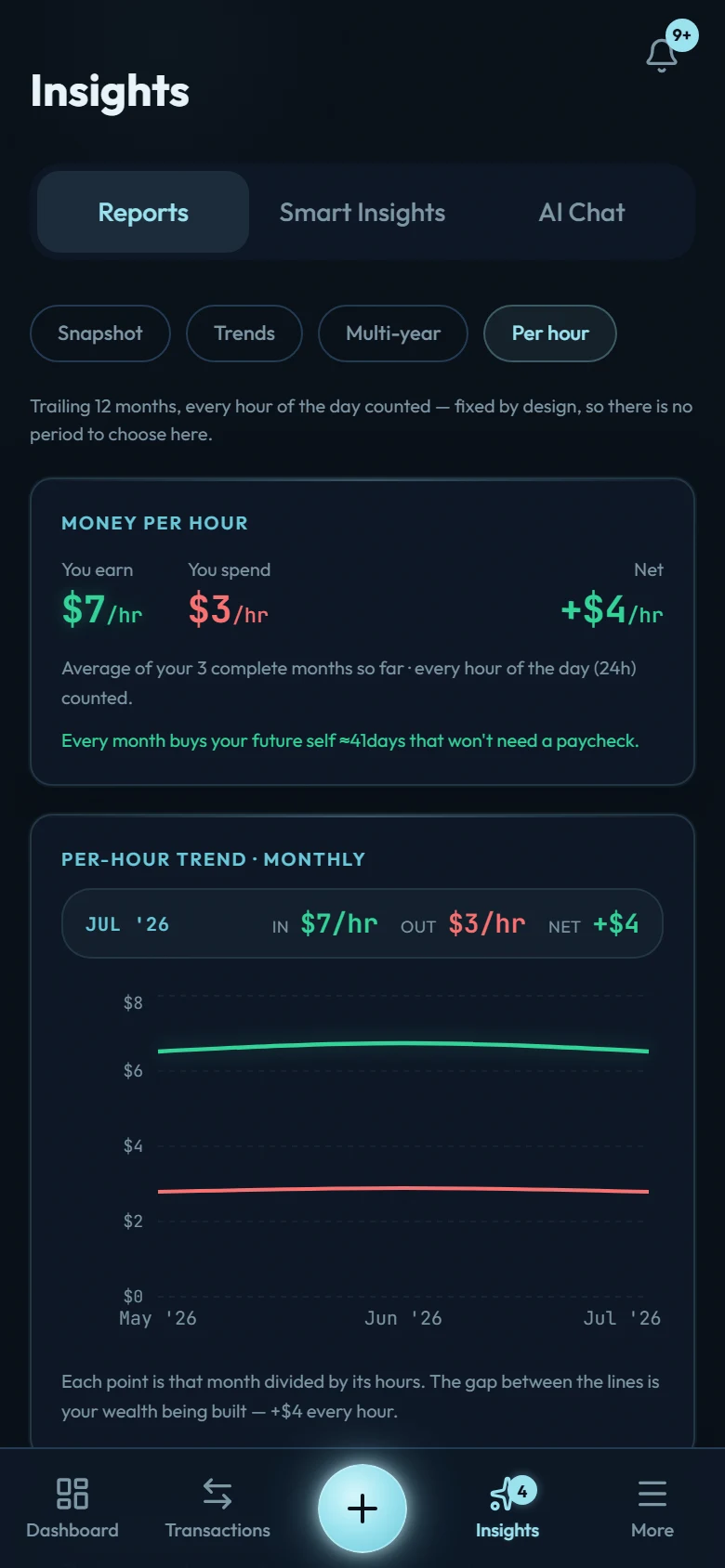
And then the conversion that makes a status purchase hard to justify: your money expressed as hours of your life. Once the app knows your earning rate, a price stops being abstract. The car, the watch, the upgrade you were talked into: each one has an honest length, in hours you will not get back.
We want to be honest about what this can and cannot do. It cannot switch off ego. Nothing does. What it can do is give the need for recognition a place to land that costs nothing. The urge behind a status purchase is a wish to see evidence that you are doing well, and to have that evidence witnessed. A level that clears, a line that rises month after month, a rate that improves: that is the evidence, and you are the witness. When the evidence is already in your hand, the car has less work to do.
There is a second reason it helps, and it is about direction. When your progress is a number you can watch, every visible purchase gets priced against it. Not "can I afford this?", which the answer to is often yes, but "what does this do to the line?" That question is almost impossible to ask without a line to look at. With one, it asks itself.
None of this requires a large income. The order works at any level, because it is an order, not an amount. Someone earning modestly who follows it is building the same invisible pile as someone earning a great deal, just more slowly. And the scoreboard reads the same for both of them: a number going the right way, that nobody else can see.
Borrowing the playbook, without the costume
Stealth wealth is 3 habits, all invisible. Adopting it as a look, with the deliberately old car and the studied plainness, would just be the same performance in reverse.
Keep score on the numbers no one at dinner can see
Your net worth, and the share of what you earn that you keep. Track both honestly and the public scoreboard loses its grip on its own; it is hard to crave a status upgrade once you know exactly what it costs your real score. In Wealth Mutant, both sit on the dashboard, built from what you record.
Make every upgrade prove itself in private
Before a lifestyle purchase, one question: would I still want this if nobody ever saw it? The yeses are real comfort; buy them gladly. The nos were rent paid to an imaginary audience. Price the big ones in hours first, on the Money Per Hour view.
Let your money be boring in public and busy in private
Savings that move by themselves, a guarded gap between income and spending, assets growing where nobody is looking. The most interesting financial lives are almost perfectly invisible for decades, right up until they are suddenly, permanently free. Future Self shows where that line is heading 10, 20 and 30 years out, so the uneventful years have a shape.
The reveal that never comes
The satisfying twist about stealth wealth is that there is no reveal. The ordinary-looking person does not eventually roll up in the expensive car to prove everyone wrong. The payoff arrives as something better and even less visible: the year work became optional and nobody could tell, the crisis absorbed without a ripple, the choices made freely while the leased cars of the world negotiated another term.
They never looked rich. They just finished, without a sound, the game that everyone else was performing. And the arithmetic was never loyal to them in particular. It signs with anyone who keeps the gap.
If you want the scoreboard, it is one payment and it is yours for life. See the 9 levels and where you would stand today, or start with the 1-month cushion that the whole path is built on.