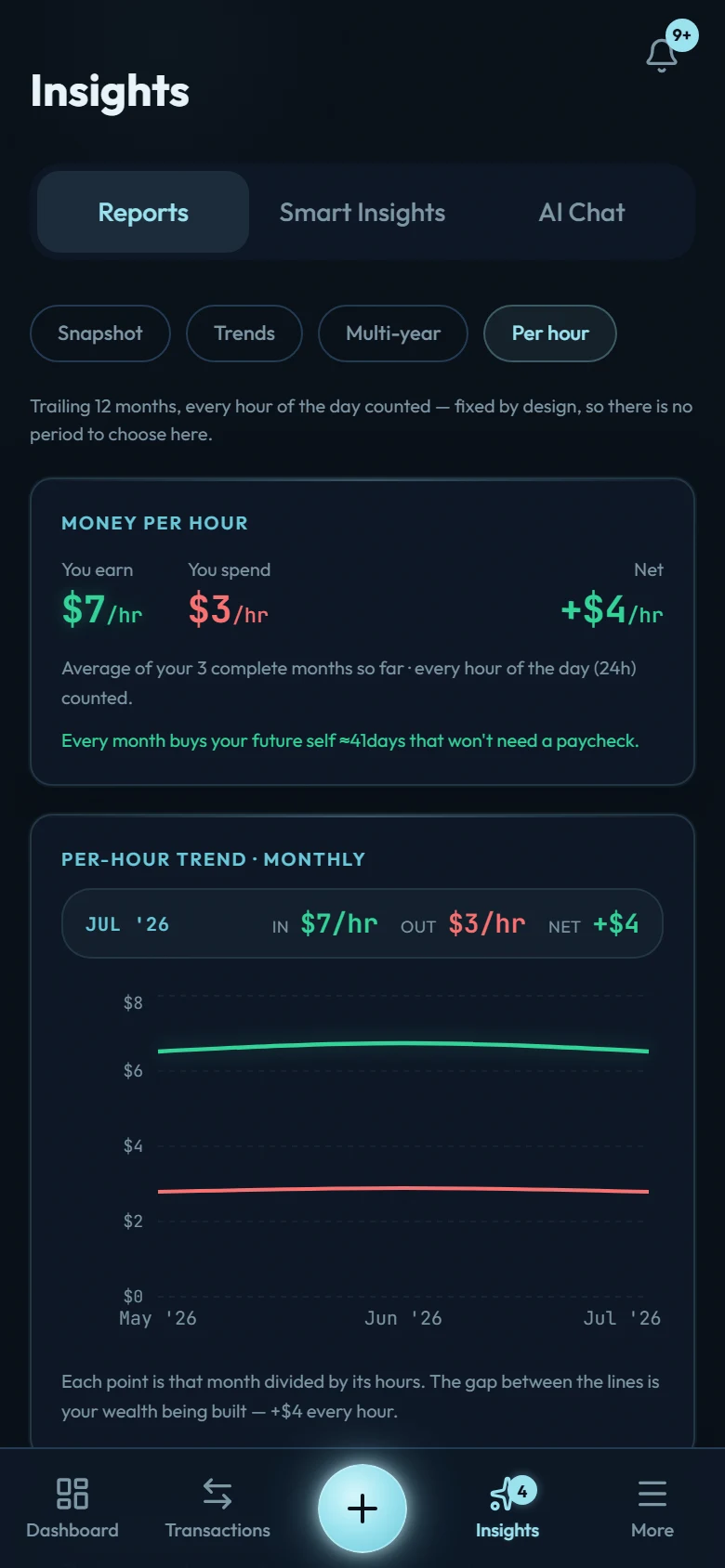
Money Per Hour turns your totals into a rate you can feel: what you earn and what you spend for every hour of your life. Not working hours — all of them. Money moves while you sleep, and the number is only honest if it counts every hour of every day.
The card lives on your dashboard, right under your net worth, and the full view lives under Reports → Per hour.
How the numbers are made
Both rates use a 12-month trailing average: the last 12 finished months of income and expense, divided by the actual hours in those months. If you've tracked for less than a year, it averages the months you have and says so in the caption. It switches to the 12-month view on its own once you get there. Below three finished months, the card doesn't appear yet.
The month you're in never counts until it ends, for the same reason projections ignore it: a half-filled month would make the rate jump around.
The trend
The Per hour view draws each month as its own point — that month's totals divided by that month's hours. The green line is earning, the red line is spending, and the gap between them is the part that becomes your net worth. Watching the gap widen over a year is the whole game.
Hours of your life
Once the app knows your earning rate, any price can be read as time. The "Your hours, priced" card fixes 3 amounts of time: 10 hours, 40 hours (almost 2 days of your life) and 2,000 hours (about 12 weeks of your life). It shows what each is worth at your rate, in your currency. The same conversion appears through the app: category rows in Insights show what each cost in hours, and the What If builder prices a planned purchase in hours of your life before you commit to it.
When the warning appears
If your trailing spending is higher than your trailing income, the card says so plainly: you're spending your future self's time. The number next to it is literal: the monthly shortfall divided by your earning rate is hours of future work already owed. The same warning appears above the Future Self projection and as one line on the net worth report, and it goes away the same way it came: when the trailing window flows the right way again. A falling net worth alone never triggers it: markets moving isn't the same as spending past your income.
When the flow runs the other way, the card notes the reverse: each month of surplus buys your future self days that won't need a paycheck. Those days accumulate into your runway.