
You already keep a manual expense tracker. There's a notebook in the bag, or a spreadsheet with a tab per year and a formula in row 2 you've been meaning to fix since 2023, and you have typed the same rent figure into it every month for longer than most apps have existed.
While the industry spent 15 years promising that nobody would ever have to look at their money again, you kept looking. Nobody needs to sell you on why writing it down works. What you've never had is tooling that treats your method as the point rather than as a fallback. We built Wealth Mutant around that method: a personal finance app in which you keep writing it down, and it does the totals, the bills, the cards and the loans.
What you've been putting up with
Manual trackers survive inside tools built for somebody else. Sync apps bury the add-transaction button three taps deep, because the design assumes the feed does the work. Spreadsheets live on the laptop while the purchases happen at a till in the rain. And then there's the maintenance: the recurring bills you re-enter, the category sums you re-check, the transfer typed twice so both sides balance, the year-end tidy that eats a Saturday. The full spreadsheet ledger, honestly totalled, is here.
Underneath all of it runs the low hum of being told to just link your bank, as if your method were a workaround. It isn't, and the reason automation made people worse with money is worth reading.
Ready to take control?
See your budgets, cards, loans and net worth in one place. One payment, yours for life.
Buy — $99 onceEntry is the main event here
The glowing + sits in the bottom bar of every screen. Tap it and the form is already the right shape: type, amount, account, category, save. The amount field doubles as a calculator, so a receipt with three items goes in as 12.50+8.40+3.20 without you opening anything else. Tags, a flag and notes wait behind small chips, so the fast path stays fast and the detailed path is still there when a purchase deserves it.
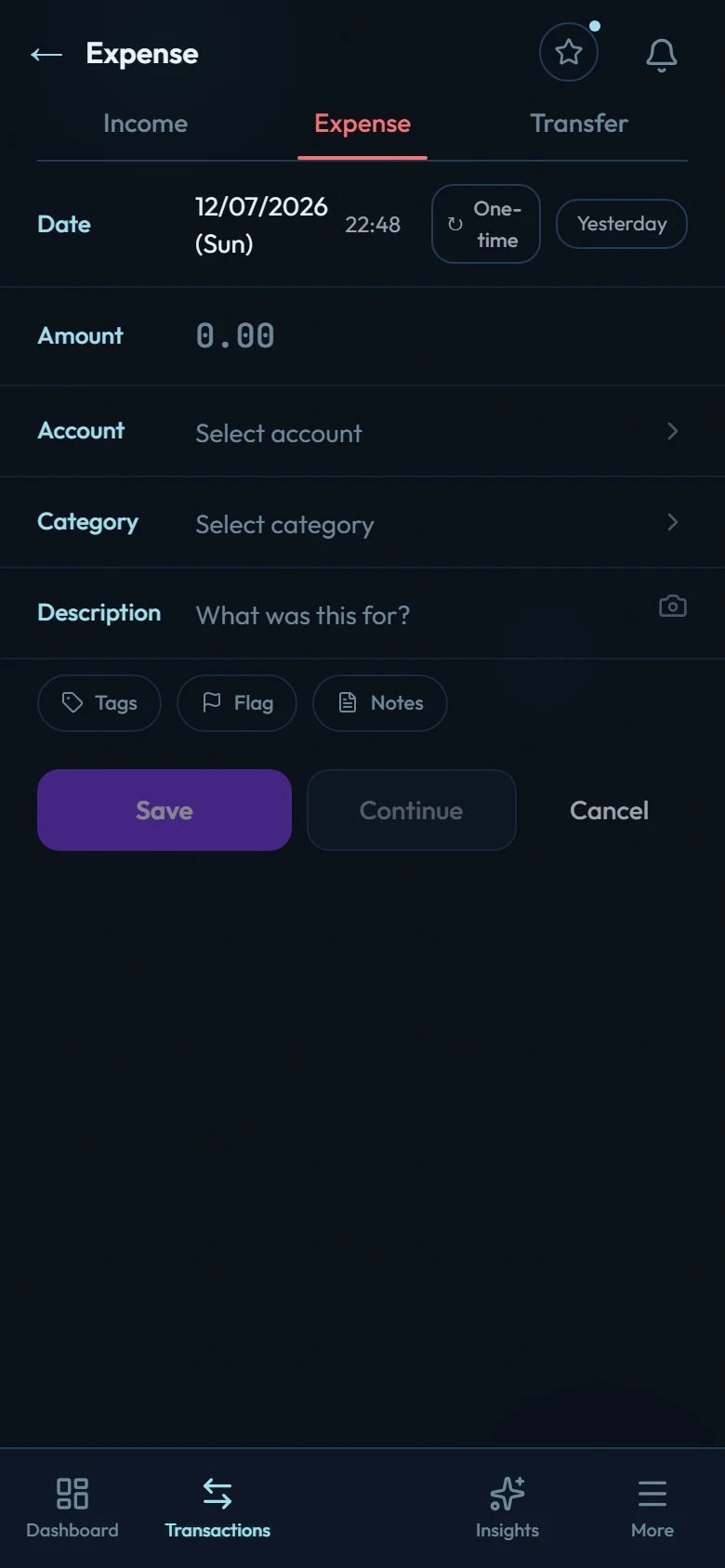
For the purchases that repeat, bookmarks fill in the entry in 2 taps: the same coffee, the same bus fare, everything prefilled but the date. Leave the amount blank on the ones whose price moves, and you only type today's amount.
The engine takes over your maintenance contract
This is the part a spreadsheet can't do — and it's most of the reason to switch.
Recurring rules post themselves on their dates: rent, salary, the subscriptions. Budgets compute as you record, including rollover, so an underspent March quietly grows April instead of resetting it. Transfers are symmetric by construction, which means the double-entry error your spreadsheet is probably carrying right now cannot be made here. Credit card cycles separate what you've spent from what's actually payable, and a loan you've given a rate and a payment day posts its own monthly interest, so you never build another amortisation table by hand. Net worth assembles itself from all of it, every time you save an entry, with no sync step and no recalculation button.
You record decisions. The arithmetic stopped being your job.
And busy weeks stop costing you the streak. Fall a fortnight behind and a statement catch-up reads a bank CSV, matches everything you already recorded, and offers you only the gaps. No Sunday spent reconstructing a week from memory, and no duplicates.
Nobody will ever ask you for a bank login. The feature doesn't exist in the product and isn't planned. The privacy model is written out in full, including the part where support staff can't see your figures unless you grant it.
What the notebook could never give you
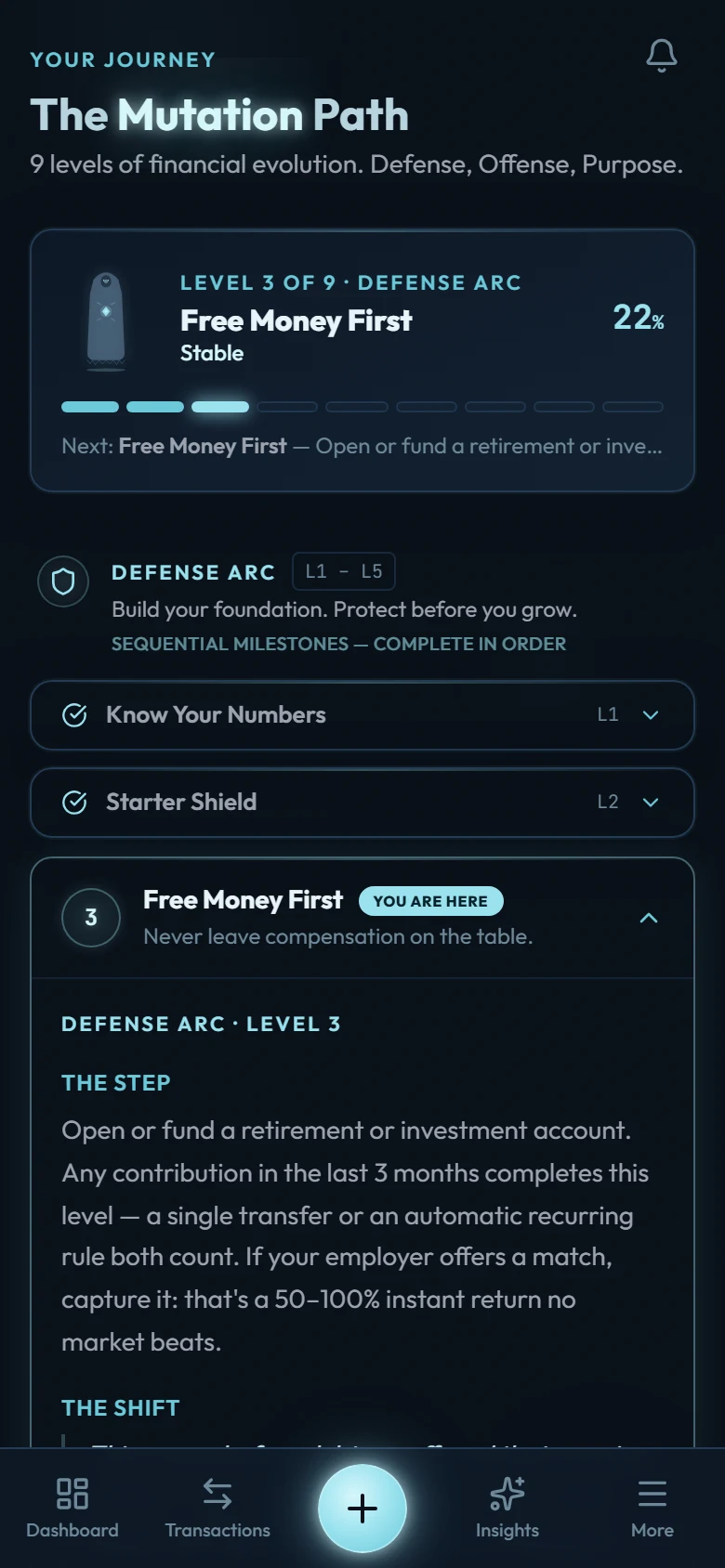
A destination. The entries you're already making feed a 9-level path from knowing your numbers to work-optional, and each level's criterion is a measurable fact about your own data rather than a badge for showing up.
Alongside it, projections take your real savings rate and show where this pace lands in 10, 20 and 30 years. They stay locked until three complete months are recorded, because a forecast built on a fortnight would be decoration.
The habit you've kept for years finally gets a map worth the effort. Take the tour or read what it costs, which is one payment and then nothing. Bring the notebook; it has earned its retirement.
The habit you already keep, with an engine behind it.
One payment, yours for life. Bring the spreadsheet in through the workbook, and take everything back out as CSV any time you like.
or try it free for 7 days · no card neededBuying after a trial is final; buying without one has a 7-day refund.