
Managing money as a couple starts with agreeing on what you spent. One of you is fairly sure groceries run about $600 a month. The other has the receipt from Saturday and a strong memory of the last three Saturdays, and is fairly sure it's closer to $900.
Both of you are remembering honestly. Neither of you is right, because neither of you is holding the whole month. So the conversation that was supposed to be about next year turns into 40 minutes of reconciling two versions of last Tuesday — and by the time you agree on what happened, nobody has the energy left to decide anything.
That argument runs on missing facts. Take the facts away from memory and put them on a screen you both look at, and it loses most of its fuel.
Two shapes that work today
Wealth Mutant is, for now, a personal finance app with a single login, so a couple picks one of two arrangements. Both work; they trade differently.
The shared book. One account, both of you recording into it. The app installs on both phones, and an entry takes seconds. His accounts, her accounts and the joint ones all sit in one picture, with movements between them modelled as transfers rather than as spending. One set of budgets governs the household. Nobody has to ask what the other's account is doing, because it's already on the screen.
The treasurer. One of you keeps the book and both of you read it. This is the honest choice when one person genuinely enjoys the recording and the other genuinely doesn't. The typing isn't shared; the facts still are.
Ready to take control?
See your budgets, cards, loans and net worth in one place. One payment, yours for life.
Buy — $99 onceWhat the monthly conversation turns into
The first thing to go is the gotcha. Nothing is a discovery when everything is already visible, so nobody arrives at the table with evidence.
What's left is short. On a laptop or a tablet the dashboard opens out into two rails, which makes it a good screen to sit in front of together: your net worth and your current level down the middle, and along the right, what's due soon, where the month went, and what your present pace projects at 10, 20 and 30 years.
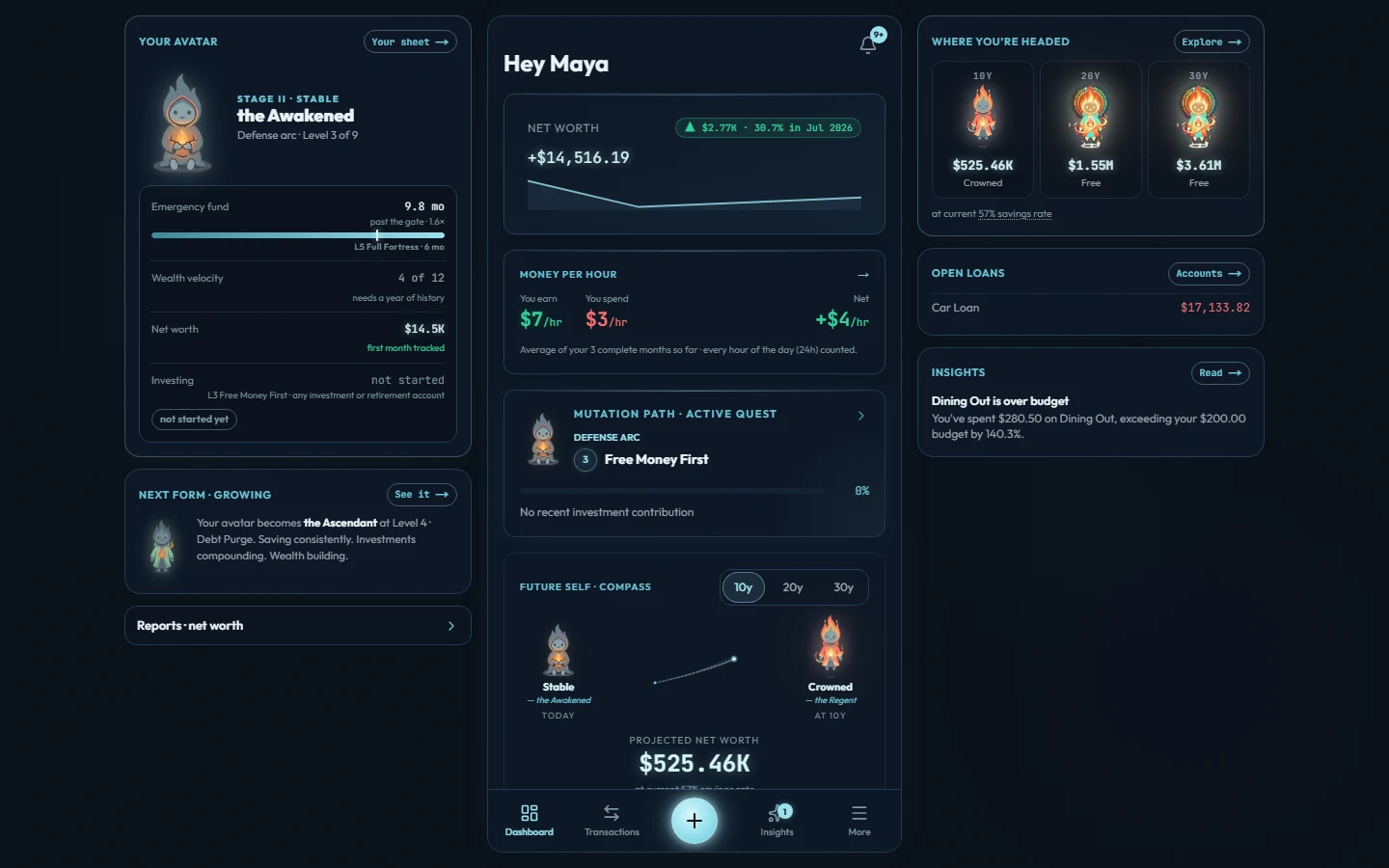
Then the arguing has somewhere better to go. Goals sit on real accounts with bars that fill only when actual money arrives, so the trip fund and the deposit fund stop being competing opinions and start being two bars at 38% and 85%. Budgets come in two styles, including a three-bucket mode for the partner who finds 20 category limits exhausting, and both of you can be looking at the same data through whichever lens you each prefer.
And the long game finally has one scoreboard instead of two: one net worth, one savings rate, one projection you're both bending in the same direction.
The habit is the hard part
The system only works if the entries happen, which is why the recording takes seconds rather than an evening. Each entry is a small act of transparency, and transparency done daily beats transparency performed quarterly by a distance.
One warning worth saying out loud: shared visibility is not a licence to audit each other. The app is deliberately quiet about judgement, because shame is what makes people stop looking, and a partner who feels audited will stop recording within a fortnight. Agree on that before you start.
Give it one honest week of recording together, then have the calmest money conversation you've had in a while. The tour shows every screen if you'd rather look before you buy, and the price is one payment, once.
One ledger, two people, one payment.
A shared picture of your money for a single price, paid once. Household sharing with separate logins arrives later as an optional one-time add-on, never a subscription.
or try it free for 7 days · no card neededBuying after a trial is final; buying without one has a 7-day refund.