
You know roughly what the card says. Somewhere around 400-something, due on the 15th — and you haven't opened the banking app since Tuesday, because you already know it will still be there. Good debt payoff tracking starts with that number, out where you can see it.
The arithmetic of getting out was settled years ago. Highest rate first, or smallest balance first, or the honest hybrid between them. Plans still collapse, in the same three places every time: the balance you stopped looking at, the emergency that refilled the card you had just paid down, and the quiet shame that makes not looking feel like relief.
A payoff tool that only does the maths is a calculator with opinions. Wealth Mutant, the personal finance app we make, is built for the other three.
The numbers stop hiding
Every card and every loan is a real account carrying what you really owe, and all of it counts against your net worth. Nothing sits in a separate, softer part of the app.
Credit cards get the whole cycle modelled. What you've spent since the statement closed and what is actually payable are two different numbers, kept apart on purpose, with the due date attached to the oldest unpaid statement so an older bill can't hide behind a newer one. Paying the bill is a transfer from your bank account to the card, never an expense, so the money is never counted twice. If cycles have always been the confusing part, the mechanics are written up here.
Loans get an engine. Give one a rate and a payment day and it posts each month's interest onto the loan by itself, so the cost of carrying that debt appears as a line in the loan's own history rather than as something you'd have to compute. On the first of every month, an insight adds up what interest cost you across all your loans. It's the number nobody volunteers.
Ready to take control?
See your budgets, cards, loans and net worth in one place. One payment, yours for life.
Buy — $99 onceMomentum, with a picture of it
Finishing anything long runs on visible progress, and debt payoff usually offers none. Here the loan's detail page shows the share of the original you no longer owe, the full schedule with each payment's principal and interest split out, and the total interest the loan will cost across its life.
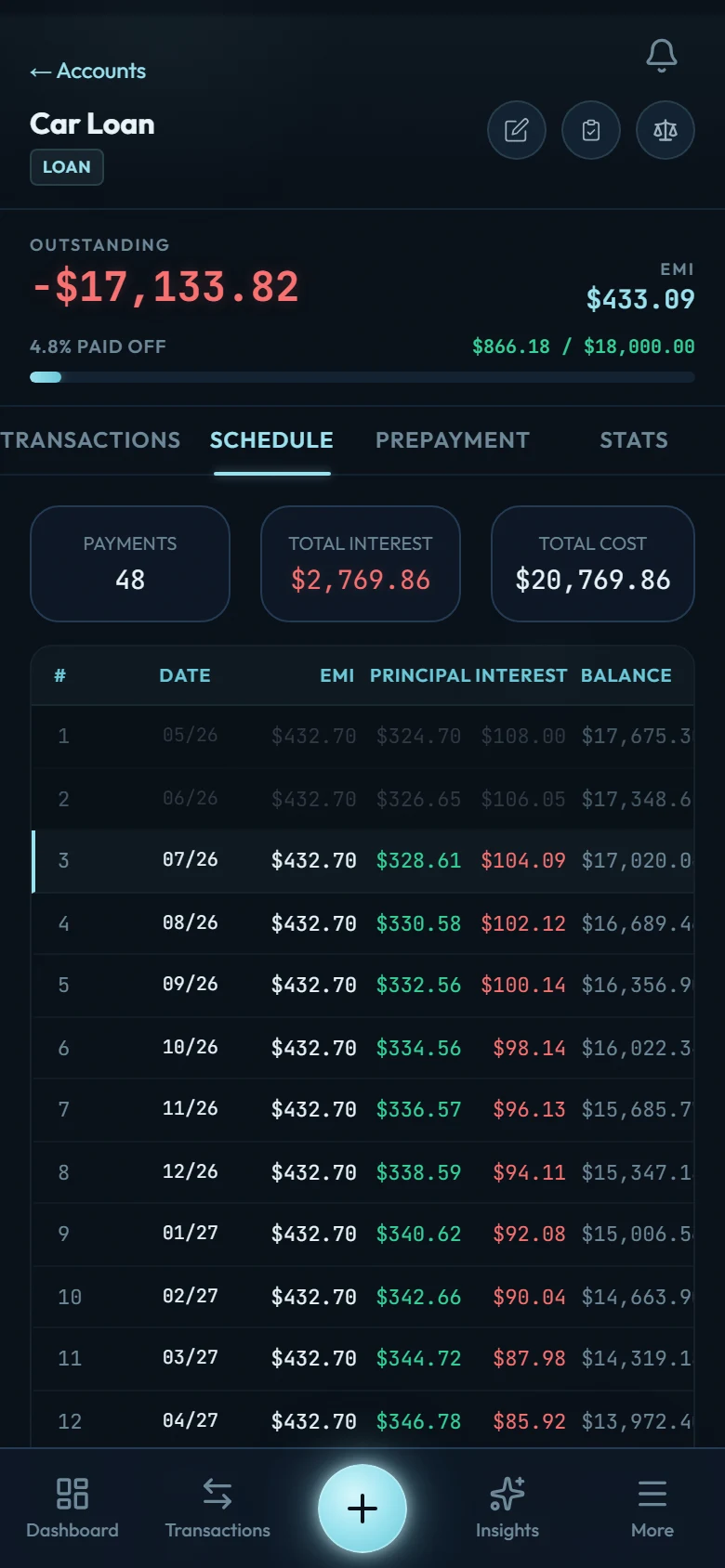
Next to it sits the prepayment slider, which answers the question that fuels every extra payment: what does one more actually do? Move the extra monthly amount and two numbers move with it, in your own figures. Interest saved. Months cut off the end. The full model is here, and small extras early turn out to be worth far more than large ones late. Before you sign up, you can run the same numbers on any loan with the free loan prepayment calculator.
Payments themselves are ordinary transfers, so the day you make one, what you owe drops by exactly that amount.
The plan survives the interruption
Most payoff plans die to a car repair rather than to bad maths. So it helps to build a small cushion first: one month of your ordinary spending, held somewhere separate, tracked as a goal with a real progress bar. With that standing, the next surprise hits the cushion instead of the card you spent 4 months clearing.
Budgets help here by warning early. You get an alert crossing 80% of a budget, while steering is still cheap, and again at 100%. No push notification ever carries an amount, so none of this happens on your lock screen in front of anyone.
Nothing in here scolds you
There is no score, no red-painted history, no cheerful nudge implying you should have known better. The product's whole position on this is that the numbers were unlit, not that you were bad with money, and if debt has been keeping you up at night, that feeling has a name and a mechanism.
Debt Purge is Level 4 of the 9-level path, and it is open from the day you sign up. It holds when nothing it counts is owing: no loan still owing, no card that carried interest on any of its last 3 statements, and no overdraft drawn. Home loans do not count, nor does a loan you have marked as one you cannot clear early. If you have no loans or cards at all, a tap on "I have no loans or cards" tells the level so, and it reads that day. Once it has held for a month, the date you reached it stays, even if a hard year brings a debt back.
Debt is heavy enough without carrying the tracking in your head as well. See the whole system first if you like, or read what the app costs, which is once.
Your full debt picture, visible tonight.
Add every card and loan with its real balance and the cost of carrying them stops being a rumour. One payment for the app, and no renewal after it.
or try it free for 7 days · no card neededBuying after a trial is final; buying without one has a 7-day refund.