
A credit card billing cycle is the stretch between one statement date and the next, usually 28 to 31 days. The statement date is the day the bank closes your bill. Everything you buy in the cycle lands on that one bill, due a few weeks later.
A credit card runs on 4 dates, and most people who carry one have never had them explained. That is how people end up paying interest they never had to pay. The same thing runs through 17 people's own debt stories: the number they needed was there all along, and they saw it too late.
The 4 dates are the billing cycle, the statement date, the due date and the grace period. Here is what each one does, in order, and where the traps sit between them.
It took our founder at least a year of real bills to understand how card interest and the billing cycle work. Nobody had explained them, at school or at home. This takes under 10 minutes to read, and it can save you years of accidental interest.
The 4 moving parts
The billing cycle is a repeating window, roughly a month long. Every purchase you make lands inside the current cycle.
The statement date (or closing date) ends the cycle. The bank stops counting, adds up everything you spent during the cycle, and sends you the bill. That total is your statement balance. Anything you buy after that moment belongs to the next bill.
The due date falls a few weeks after the statement date. This is the deadline for paying the statement balance. That means the total from the closing date, not whatever the card app shows you today.
The grace period is the stretch between the statement date and the due date. It is the reason a credit card can be free to use: everything you bought during the cycle costs zero interest, as long as you pay the full statement balance by the due date. Buy something on day 1 of a cycle and you are using the bank's money, free, for 6 or 7 weeks.
One exception: cash withdrawals, and on many cards balance transfers, get no grace period, and interest on them generally starts the day they happen.
Paid in full, a credit card is a free loan. Paid short, it becomes one of the most expensive debts you can carry.

Some countries set a floor under the time you get to pay:
| Where | Time between statement and due date | The rule behind it |
|---|---|---|
| US | at least 21 days | Regulation Z: the statement must be mailed or delivered at least 21 days before the due date, and the due date stays on the same day each month |
| Canada | at least 21 days without interest on new purchases | the minimum grace period set by the Financial Consumer Agency of Canada |
| India | at least a fortnight before interest, and no late fee or bureau report until more than 3 days past due | the Reserve Bank of India's card directions |
| UK | set by the card company; "up to 56 days" from purchase is the usual promise | the card company's own terms, such as Barclaycard's |
How long is a billing cycle?
Usually 28 to 31 days, which is why it feels like a month. It runs from one statement date to the next, so it follows your statement date rather than the calendar.
That makes the wording on card offers easy to read: 2 billing cycles is about 2 months, and an offer that runs "for 15 billing cycles" lasts about 15 months.
A credit card billing cycle with real dates
Say your statement date is the 5th of the month. One cycle then runs from 6 March to 5 April. On 5 April the bank closes the bill and adds up what you bought in that stretch, and the payment is due on 26 April.
A purchase on 6 March, the first day of the cycle, does not need paying until 26 April. That is about 7 weeks without interest, as long as the full statement balance is paid by then.
The same purchase on 5 April, the last day, gets about 3 weeks. Buy it on 6 April and it goes on the next bill, due in late May.
| Bought on | On the bill dated | Due | Days before payment is due |
|---|---|---|---|
| 6 March | 5 April | 26 April | 51 |
| 20 March | 5 April | 26 April | 37 |
| 5 April | 5 April | 26 April | 21 |
| 6 April | 5 May | 26 May | 50 |
Fill in the same table for your own statement date and due date with the free credit card billing cycle calculator.
Where to find your dates, and can you move them?
Your statement shows both dates, and your card's app or website usually does too. The statement or your card agreement also tells you how long your cycle runs. Each new cycle starts the day after the last statement date: with a statement date on the 5th, every cycle begins on the 6th. On a new card, the first statement arrives roughly a month after opening, and the first payment falls due a few weeks after that.
Can you move them? Often, yes. Many card companies let you change your due date, though how you ask depends on the issuer, and a new date can take a cycle or two to start.
It is worth asking if your due date falls 2 days before your pay arrives, because that timing will catch you out every month. Almost nobody asks.
The billing cycle and your credit score
Your statement date also shapes your credit report. US card companies usually report a card's balance around its statement closing date, according to Experian, so your credit report normally carries the figure from your last statement. Indian lenders update the bureaus twice a month, with balances as they stood on the 15th and at month-end.
That balance, set against your limit, is your credit utilisation, and lower is better: Experian suggests no more than 30% in the US, and below 25% on its UK site. So a card you clear in full each month can still look heavily used when the statement closes right after a big purchase. To report less, send most of the money in ahead of the closing date, then the rest by the due date.
Paying early also hands back spending room on the card, though the limit doesn't refill on any set date: it comes back as each payment goes through.
Where the traps live
Trap 1: paying a different number from the one on the bill. After the statement closes, your card shows a balance that keeps growing with new purchases. Seeing a number bigger than the bill, some people pay all of it. That does no harm. The costly mistake is the other one: paying less than the statement balance because the app showed a smaller figure. Anything short of the full statement balance usually costs you the grace period.
| Balance | What it is | Pay it to |
|---|---|---|
| Statement balance | what the last statement says you owe | keep the cycle free of interest |
| Current balance | everything owed now, including spending since the statement | clear the card completely |
| Minimum payment | the least the bill accepts | stay on time; interest runs on the rest |
Trap 2: what losing the grace period costs. Leave even a small part of a statement balance unpaid and, on most cards, the interest does not stop at that leftover. New purchases start charging interest from the day you buy them, and they keep charging until you have paid the card off in full. One month of paying short can make the months after it expensive too, even if you barely spend.
Trap 3: the minimum payment. The small figure on the bill is the least you can pay without the account falling behind. It is not a recommendation. Pay only that, and you pay the most interest the card can charge you: the short version is that paying the minimum turns an ordinary purchase into a debt that lasts years, at card interest rates.
Wealth Mutant, our own personal finance app, counts a card purchase on the day you make it, so the bill is never a surprise: you watch it build, and the due date sits on the screen well before it matters. Each one goes in by hand, a few seconds at a time, which means no bank login is ever asked for, and one payment covers the app.
Ready to take control?
See your budgets, cards, loans and net worth in one place. One payment, yours for life.
Buy — $99 onceRunning the cycle deliberately
Learn your two dates
Statement date and due date, from your card's app or statement. Write them where you'll see them. Those two dates are the whole cycle.
Pay the statement balance, in full, by the due date
Pay the total from the statement, not the minimum and not the balance the app shows today. This one habit is what keeps the card free.
Treat card spending as spent
The card is a way to pay, not extra money. If you count a purchase on the day you make it, rather than the day the bill arrives, the bill holds no surprises. You already saw it being built.
Where the card payment goes in your budget
A card purchase is spending on the day you make it, because that is when you decided to buy. Paying the bill later is a transfer from your bank account to the card, not a second expense. Count both as spending and every purchase lands in your budget twice.
Wealth Mutant handles cards this way, inside a personal finance app that holds your loans, budgets and net worth too. The card's page keeps what has been billed and is now due, with its date, apart from what you have spent since your latest statement closed.
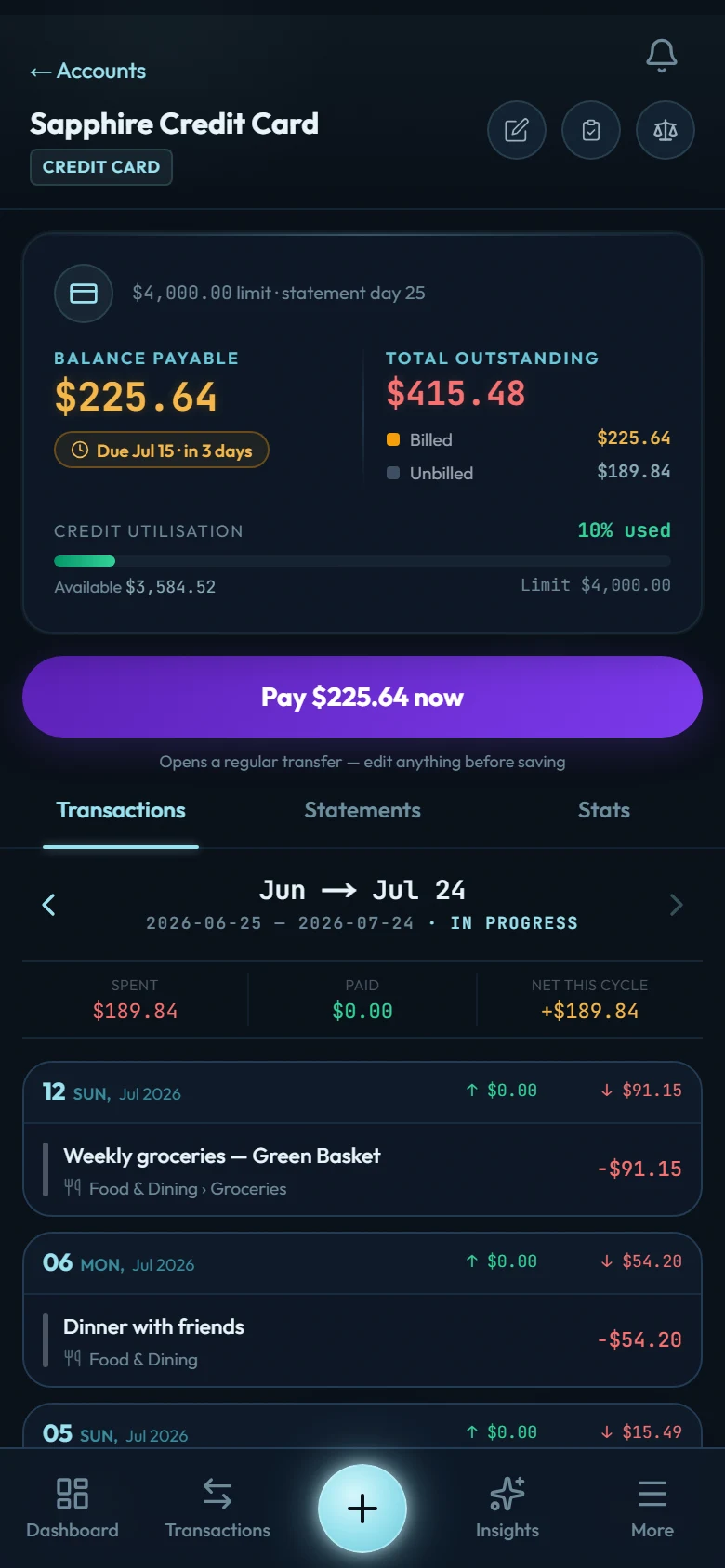
The pay button opens an ordinary transfer, so the money leaves your bank account and what you owe on the card falls by the same amount. The full model is in How credit card accounts work.
Common questions
Is a billing cycle the same as a calendar month?
Not quite. It runs from the day after one statement date to the next, so it starts on whatever day your statement date falls and lasts 28 to 31 days.
What happens to a purchase made on the statement date?
It may land on that bill or the next, depending on when it posts and when the card company closes the day. If it matters, buy the day after.
Do cash withdrawals get the grace period?
Usually not. Interest on a cash advance generally starts on the day you take the money.
Does paying the bill reset my credit limit?
Nothing resets. Your available credit comes back as each payment is processed, which can take a few days.
Can I change my billing cycle?
In India the RBI's rules give you that option at least once. Elsewhere, ask the card company; many will move the due date.
What the cycle is worth to you
Understood, a credit card is a genuinely good deal: a few weeks of free use of the bank's money, the protection that comes with paying by card, and no interest at all. The price is one habit — the full statement balance, by the due date. Misunderstood, the same card is among the most expensive debt ordinary people ever carry.
The difference is the few minutes you just spent, plus the habit of writing purchases down, so you watch the bill grow instead of meeting it at the end. If there is already a balance on the card, none of this is a telling-off. There is a calm order for paying it down, and what you now know about the cycle is what stops the balance building back up behind you.
If you want every card and loan in one place while you pay them down, this is how paying off debt with Wealth Mutant works.