
The other week a few of us spent an evening watching people explain their own debt out loud. Seventeen of them, in half an hour: short clips, replies, people answering questions about their money in public. We meant to watch one and stop. We watched all of it, and then sat around talking about it for longer than the video ran.
Here is what we could not stop noticing. The stories were completely different: a young couple whose side business failed, a family of 6 on a modest income, a woman who had just found out her husband had been gambling, a household earning several times the average who said they were barely surviving. And not one of the 17 could answer the plainest question put to them. Where does the money go?
This article is about what repeated across those 17, why the amount coming in was almost never the real problem, and what would have had to be visible, and when, for most of those stories to have gone another way. It is also about the tools we built for exactly this, because the gap they were all standing in is the reason Wealth Mutant exists.
The question nobody could answer
It came up again and again, and each time there was a pause.
A couple with two young children earned a good deal more than most families and still could not keep up. Their debts, when they listed them, were not large. So where was the rest going? They did not know. Another person, earning far above average, described a monthly take-home most people would call comfortable and said the family was struggling. Asked the same question, they named a few things and then trailed off.
At the other end, a father of 4 on a modest wage was carrying about 3 times his yearly income in debt. He could name every loan and still could not explain how the month disappeared. And a woman whose husband had emptied their savings said the sentence we kept replaying afterwards: she could not even tell us the total.
We want to be careful here, because the comments under these clips were not kind and we have no interest in joining in. None of these people were foolish. They were doing what almost everyone does, which is to live one purchase at a time and never see the purchases together. The money left in modest, reasonable pieces. Nobody added the pieces up.
That is what living above your means usually looks like from the inside. Not a decision to overspend. An absence of a number.
Six doors into debt
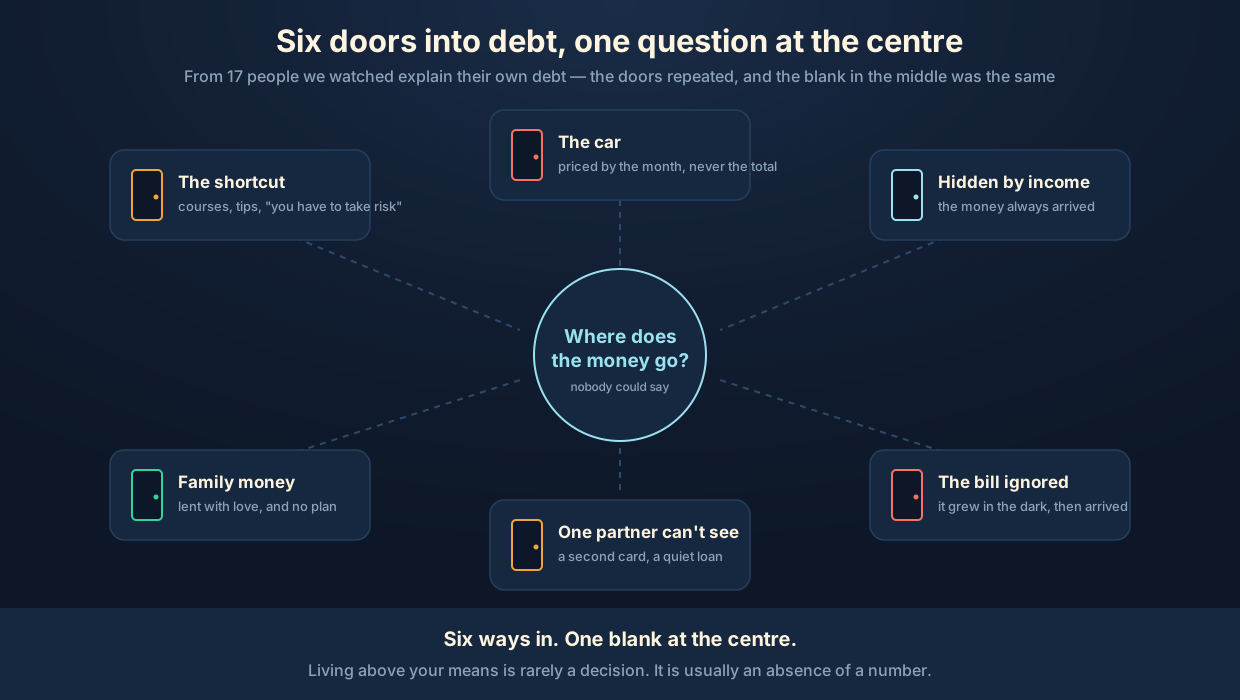
When we listed the 17 stories side by side, they sorted themselves into 6 shapes. Most people had walked through more than one door.
The shortcut. A couple had borrowed heavily to follow online courses promising fast money: short-term rentals, an online shop, a business "system". When the income didn't come, the loans stayed. A young father had put his savings into penny stocks because someone he knew suggested it, and because, in his words, he had read that you need to take risk to get out of the lower class. He had read it in the wrong place. The shortcut is the oldest door, and it is always dressed as courage.
The car. This one came up so often that we started counting. A 23-year-old had leased a luxury car and was still paying for the wear and tear 4 years later. A household earning an ordinary wage had 3 vehicles whose monthly payments came to more than 3 times their rent. Their car was worth more than their home, and they knew it. A car is the one purchase almost everyone prices by the monthly payment and almost nobody prices by the total, or by what else that payment could have been.
Income big enough to hide the problem. Several people earned well. That was the surprise. A high income does not stop you living above your means; it raises the ceiling on what "above" can be, and it makes the problem invisible for years, because the money always arrives. When a raise comes, spending rises to meet it so smoothly that nobody notices the raise was ever there. We wrote about that slide separately, in Lifestyle Creep.
Family money without a plan. A woman going through a divorce needed a very large sum to buy her husband out of their home and business, and had asked her retired parents for half of it from their pension savings. Her sibling had been asked for the other half. Someone else had been asked to co-sign a car loan for a relative who already had a deposit saved, and the obvious answer went unsaid for a long time: if he has the deposit, buy a car with the deposit. Love is not the mistake in these stories. Lending what you cannot see the end of is.
Money one partner could not see. A wife who had discovered, for the 4th time, that her husband had run up debt behind her back. Another who found her husband had gambled away their savings and taken a loan to cover it. And a woman who said, plainly, that she had been given control of the household money and had spent it on herself for a year while her husband thought the bills were paid. Three very different marriages, one shape: money that only one person could see.
The bill ignored until it was enormous. One couple had not filed their tax returns for years, through an illness in the family, and now feared the letter. Another had finally filed and been told they owed more than half a million. A bill you do not look at does not pause. It grows in the dark, at its own rate, and then it arrives all at once.
Why income was almost never the problem
Watching someone be told off for earning a lot and having nothing is good television. It is not good advice, because it points at the wrong number.
Income tells you how much arrives. It says nothing about how much leaves, or where. The people who earned the most were not doing better than the ones who earned the least; several were doing worse, because the higher income had bought them more years of not looking. What every one of them was missing was the same thing: a true picture of a normal month, before the month happened.
Put that picture in the room and the decisions change on their own. The car payment gets seen next to the rent. The course fee gets seen next to the savings it will empty. The little charges get seen as a total. You do not need more discipline for any of that. You need the number to arrive before the money leaves, rather than a year later as a story you tell a stranger.
Nobody in those clips said "I knew, and I did it anyway." They all said some version of "I had no idea it was that much."
This is what Wealth Mutant is for. You record what you spend, in a few seconds, and the app turns those entries into the picture none of them had: what a month really costs, what is about to charge, what each loan and card is actually doing, and what a payment costs in hours of your life. No bank linking, and you buy it once.
Ready to take control?
Track your spending without linking your bank. One payment, yours for life.
Buy — $99 onceThe debt calculator, pointed at your real numbers
Here is the part we think matters most, and it is the part the free tools online cannot do.
Everybody has met a debt payoff calculator: type in a balance, a rate and a payment, and it tells you when you will be free. They are useful once. The trouble is that you have to go and find one, remember your numbers, type them in correctly, and then do it again next month when the balance has moved. Almost nobody does it twice.
Wealth Mutant treats every loan and card as an account with its real balance, so the same arithmetic runs against numbers that are already correct, whenever you want it.
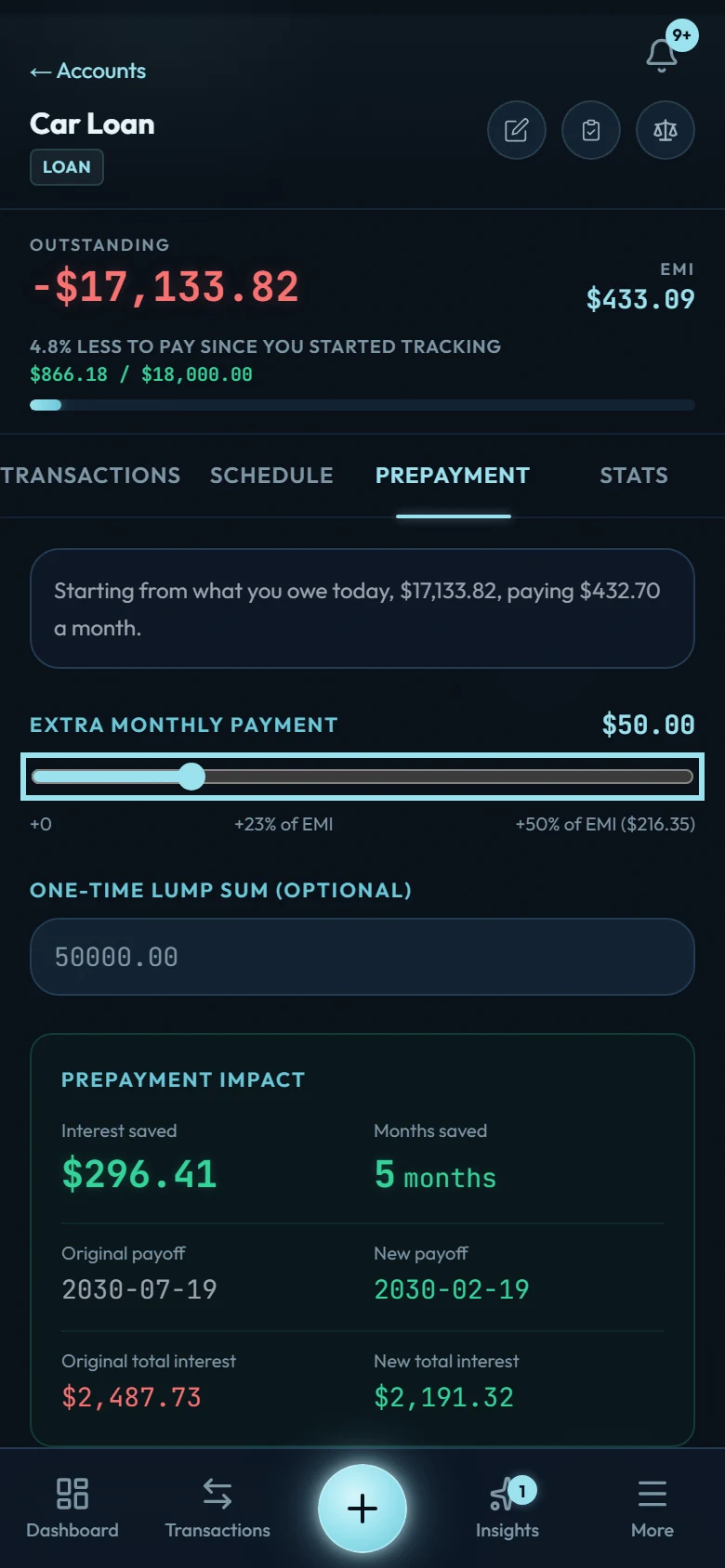
Slide the extra monthly payment and 2 numbers move: what you save in interest, and how much sooner the loan ends. The payoff date changes with them, and a one-off lump sum can be modelled the same way. There is nothing to type, because the balance, the rate and the payment day are already in the app.
The rest of the loan picture works the same way. Each month's interest posts itself onto the loan as an entry you can read, so the cost of the debt stops being invisible. A payment is recorded as a transfer from your account to the loan, so what you owe is always what you started with, plus the interest, minus what you have paid in. And on the 1st of each month, an insight tells you what interest cost you across every loan you hold.
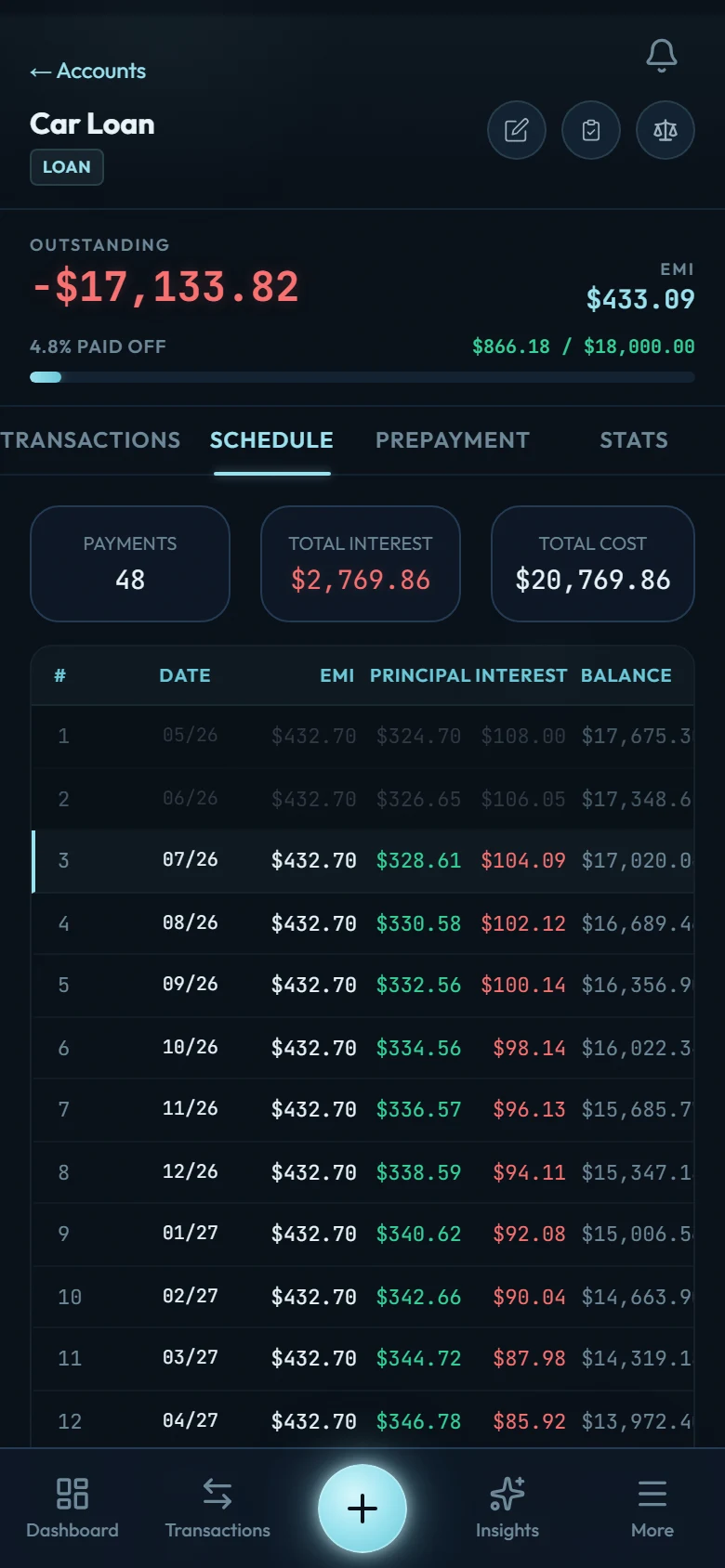
None of that is clever. It is only the arithmetic a debt calculator does, kept current, sitting next to the spending that decides whether you can make the extra payment at all.
What would have had to be visible, and when
We went back through the 17 and asked, for each one, which number would have had to be in the room, and at what moment. Five came up again and again.
A real month, before the shortcut
Before borrowing for a course, a shop or a stock tip, the number that matters is what your life costs for a month and how many months you could cover if the income stopped. Record your spending for 30 days and you have it. In Wealth Mutant, the second level of the Mutation Path is exactly this: 1 month of your own average expenses set aside, worked out from what you actually spend.
The car in hours, before you sign
A monthly payment is the friendliest number in a showroom. Convert it into hours of your own work before agreeing to it. The Money Per Hour view does that conversion from your recorded income, and the What If panel prices a planned purchase in hours before you commit to it.
The interest as a line you can see, every month
Debt feels free while the interest is invisible. For a loan with a rate and a payment day, each month's interest posts itself onto the loan as an entry you can read, and the Prepayment tab shows what one extra payment would do before you make it.
The same month, seen by both of you
Three of the 17 stories were about money one partner could not see. There is no software fix for trust, but there is a habit that makes hiding harder: once a month, sit down with the same recorded month on the table and read it together. When spending is written down as it happens, a second card or a quiet loan shows up as a gap that has to be explained.
The bill you are avoiding, as an ordinary line
A tax bill, an overdue fee, a repair you know is coming: give it a recurring rule with a monthly amount set aside, and it stops being a cloud and becomes a line that fills up. The Upcoming view shows it landing before it lands.
If you are already in it
Here is the part of that evening we liked best. A 42-year-old with three jobs, no savings and a leased car asked whether it was still possible to end up comfortable, and the answer was an immediate yes. Not one of the 17 was told it was too late.
The order that works is the same for nearly everyone. First, a modest cushion, so that the next surprise does not go straight onto a card. Then the expensive debt, paid down in an order you can stick to; we wrote about choosing that order, and the arithmetic and the psychology do not always agree. Then the rest, one debt at a time, while the interest line you can now see gets shorter every month.
In Wealth Mutant that order is built in. The Defense arc of the Mutation Path runs from writing your numbers down, through a 1-month cushion, to owing nothing but a home loan, and then 6 months of cover. It does not sort your debts by rate: outside a home loan, it asks you to clear all of them. Each level is measured from your own numbers rather than a rule of thumb, so it moves when your life does.
The thing we kept coming back to
The people in that video are not different from us, and we would guess they are not different from you. They earned ordinary or good incomes, made ordinary decisions, and had ordinary willpower. What they did not have was the number in the room at the moment it would have mattered.
That is a fixable thing, and it is smaller than it sounds. It starts with writing down what you spent today, and it ends with a screen that tells you what one extra payment is worth before you make it.
Take the tour if you want to see the whole picture in one place first. If you have never recorded your spending, the 30-second habit is the place to begin. And if checking your balance already makes you tense, start here instead.
Common questions
Why do people with high incomes end up in debt?
A high income does not stop overspending; it hides it. When money always arrives, spending rises to meet it and the gap between income and outgoings can stay invisible for years. Among the 17 stories we watched, the highest earners were not doing better than the lowest, because nobody in either group could say what a normal month actually cost them.
What is the first step to get out of debt?
Write down what you spend for one month, so you know what your life actually costs and how many months you could cover if the income stopped. With that number, build a modest cushion first, then pay down the most expensive debt in an order you can stick to. Wealth Mutant's Mutation Path runs in that order and measures each step from your own entries. One difference worth knowing: when it reaches the debt step it asks you to clear everything except a home loan, rather than sorting your debts by rate.
Is there a free debt payoff calculator?
Plenty, and they are fine for a one-off answer. The limitation is that you have to find your balance, rate and payment, type them in, and repeat it every month as the balance moves. Wealth Mutant keeps each loan as an account with its real balance, so the Prepayment tab shows what an extra monthly amount or a lump sum would save in interest and how many months earlier the loan would end, without you typing anything.