Free calculator
Credit Card Billing Cycle Calculator
Type your statement date and your due date. See when your next bill is due, how many days a purchase gets to pay, and what the next 12 months look like.
Nothing you type is saved or sent anywhere, and there is nothing to sign up for. The only copy is one you print or download yourself.
Your answer
Working out your dates.
Next questionWhat happens if you pay after the due date?
What this assumes
- The statement date is the last day of its cycle. A purchase made that day goes on that statement, and the next cycle starts the day after.
- Days to pay are counted from the day after the purchase up to and including the due date.
- If a month has no day of your number, such as the 31st in a month of 30 days, the calculator uses the last day of that month. Your card company may do something else.
- Dates are calendar dates. The time of day is not counted, so a payment cut-off on the due date is not modelled.
- A due date on a weekend or a holiday is flagged, not moved.
What this is not for
This works out dates from the two you type. It does not look up your card, work out interest or fees, or know your card company's own rules.
How the sum works
A card runs in cycles. Your statement date closes one: everything bought up to the end of that day is on that statement, and the next day starts a new cycle. Your due date is the deadline to pay that statement. If your due date is set as a number of days after the statement, the calculator adds them to the statement date.
Days to pay for a purchase are the days from the purchase to the due date, not counting the purchase day. A purchase the day after a statement date gets the most days. One on the statement date gets the fewest. When a month has no day of your number, the last day of that month stands in.
An example
Your statement date is the 5th and due on the 26th of each month. A purchase on 6 Oct 2026 goes on the bill dated 5 Nov 2026, due 26 Nov 2026. That is 51 days to pay. Bought on 5 Nov 2026, it would get 21 days.
The rule, by country
- United States: your statement must be sent at least 21 days before the due date. Regulation Z, section 1026.5
- Canada: federally regulated banks give at least 21 days without interest on new purchases, counted from the last day of the billing period. Financial Consumer Agency of Canada
- India: at least a fortnight to pay before interest starts. Reserve Bank of India card directions
- United Kingdom: your card agreement sets the time. No single rule is shown here.
Your statement wins. If it shows other dates, use those.
Questions people ask
How do I find my statement date and due date?
Both are printed on your last statement, usually near the top. The statement date may be called the closing date, bill date or bill generation date. Type its day of the month, and choose how your due date is set: a fixed day, or a number of days after the statement.
How many days do I have to pay after the statement?
It depends on your card and country. In the US a statement must be sent at least 21 days before the due date (Regulation Z). Canada's federal minimum is 21 days (FCAC). India requires at least a fortnight before interest starts (RBI). In the UK your card terms decide.
How many months is 15 billing cycles?
A billing cycle runs from one statement date to the next, 28 to 31 days, so 15 cycles is about 15 months. The exact end date depends on whether the cycle you start in counts as number 1. The calculator shows both dates.
What if my due date falls on a weekend or holiday?
Your card company decides. The calculator shows the weekday of every due date and does not move it, so you can see a weekend date coming. Your statement has the final date.
What if I buy on my statement date?
This calculator counts the statement date as the last day of the cycle, so a purchase that day goes on that bill and gets the fewest days to pay. A card company can cut the day off earlier or later, so your statement is the last word.
What the app does with your own numbers
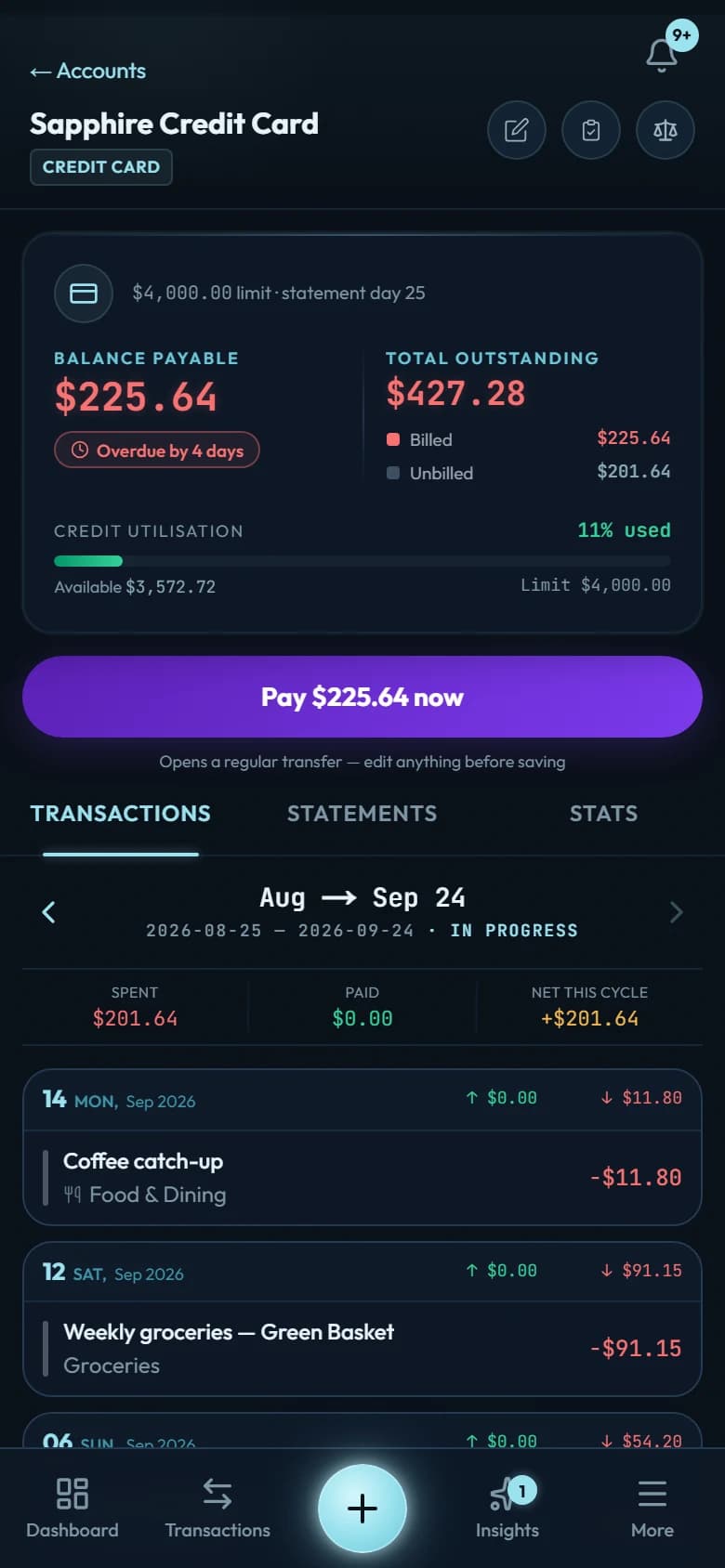
Wealth Mutant is the personal finance app we built for exactly this. You give each card its statement day and payment due day, and the card's page shows what is billed and what is not yet billed, with the due date, and reminds you before it. You note each purchase yourself in a few seconds, a small daily habit that makes you notice, and no bank login is ever shared. You pay for it once.
How credit card accounts work explains the card page, the billed and unbilled lines and the reminders.
Checked on 16 Oct 2026 against Regulation Z, the FCAC credit card page and the RBI card directions, each linked above, and a separate re-count of every date in the example.
More free tools
The same sums, on your real money
or try it free for 7 days · no card neededBuying after a trial is final; buying without one has a 7-day refund.