Free calculator
Runway Calculator: Savings After a Job Loss
Runway is the number of months your savings would cover if you lost your job. Type what you have and what you spend a month, and see the date it runs out.
Nothing you type is saved or sent anywhere, and there is nothing to sign up for. The only copy is one you print or download yourself.
Your answer, example
25 weeks
If nothing else comes in, your money would last 25 weeks.
Shown in weeks when under 6 months, then in months and years, always rounded down.
6 months would need
You have $20,000, which is $400 short.
$20,400
If you also spent less
10% less
$3,060 a month
6 months
25% less
$2,550 a month
7 months
50% less
$1,700 a month
11 months
From your numbers: $20,000 to live on, spending $3,400 a month.
After 3 full months, the app keeps your runway, in months, up to date from your own accounts.
See it in the appAfter a layoff, a redundancy or a notice period
These are the cases the extra boxes are for: pay from someone else in your home that keeps coming, severance or redundancy pay that arrives once, a bill that lands, a loan payment that ends. Each one moves the date, and you see by how much.
What this assumes
- Month by month: your money, plus what comes in, minus what you spend, carried to the next month. The runway ends in the month it would go below 0.
- No interest on your savings and no price rises. For a runway of a year or two they usually move the answer by days, not months.
- Spending stays the same until a cost you set ends.
- Money coming in counts only for the months you set. A benefit may start weeks after you apply, so put it in from the month it starts.
- Tax on severance or a benefit is not worked out. Type what reaches your account.
What this is not for
This counts months of money. It does not say how much to keep, and it does not know how long a job search will take.
How the sum works
Runway is subtraction, one month at a time. Start with the money you could live on. Each month, add what comes in, take off what you spend, and carry the rest forward. The runway is the number of months before the money would go below 0, counting the part of the last month it still covers.
The calculator adds no interest to your savings and no price rises, so the answer is months of money set against months of spending. A one-off amount lands in the month you give it, and a cost that ends stops after the month you set. If you set the spending you cannot cut, the rows that show spending less cut only the rest.
An example
You have $20,000 and spend $3,400 a month, and $850 still comes in each month. You are $2,550 short each month, so $20,000 lasts 7 months. 6 months of your spending would need $15,300.
Questions people ask
How long will my money last after a layoff or redundancy?
Divide the money you could reach within a few weeks by what you spend each month. The calculator does that, then adds what changes it: pay still coming in, redundancy pay or severance, a bill that lands, a payment that ends.
What counts as money I could live on?
Cash, savings, and investments you could sell within a few weeks. A house does not pay for groceries, and a credit limit is borrowed money, so leave both out.
How many months of savings do I need?
There is no single number. How long a job search takes, and what still comes in, both change it. The calculator shows what 6 months of your spending comes to, so you can set it beside what you have.
How do I add severance or a benefit?
Add severance as one-off money in, in the month it arrives, using what reaches your account after tax. A benefit goes in as money coming in each month, from the month it starts, because it may not begin the day you apply.
Does it include interest or rising prices?
No. Each one needs a guess about the future, and neither changes a runway of a year or two by much. Leaving them out keeps the answer plain: months of money against months of spending.
Keep reading
- How much emergency fund do you need? The 3 to 6 months range, with 1 month as the first stop.
- Credit card cash advance: if you are thinking of borrowing on a card to cover the gap, the fee and the interest that starts the same day.
- Minimum payment on a credit card: if a card is covering the gap, how the minimum is set and what paying only that costs.
What the app does with your own numbers
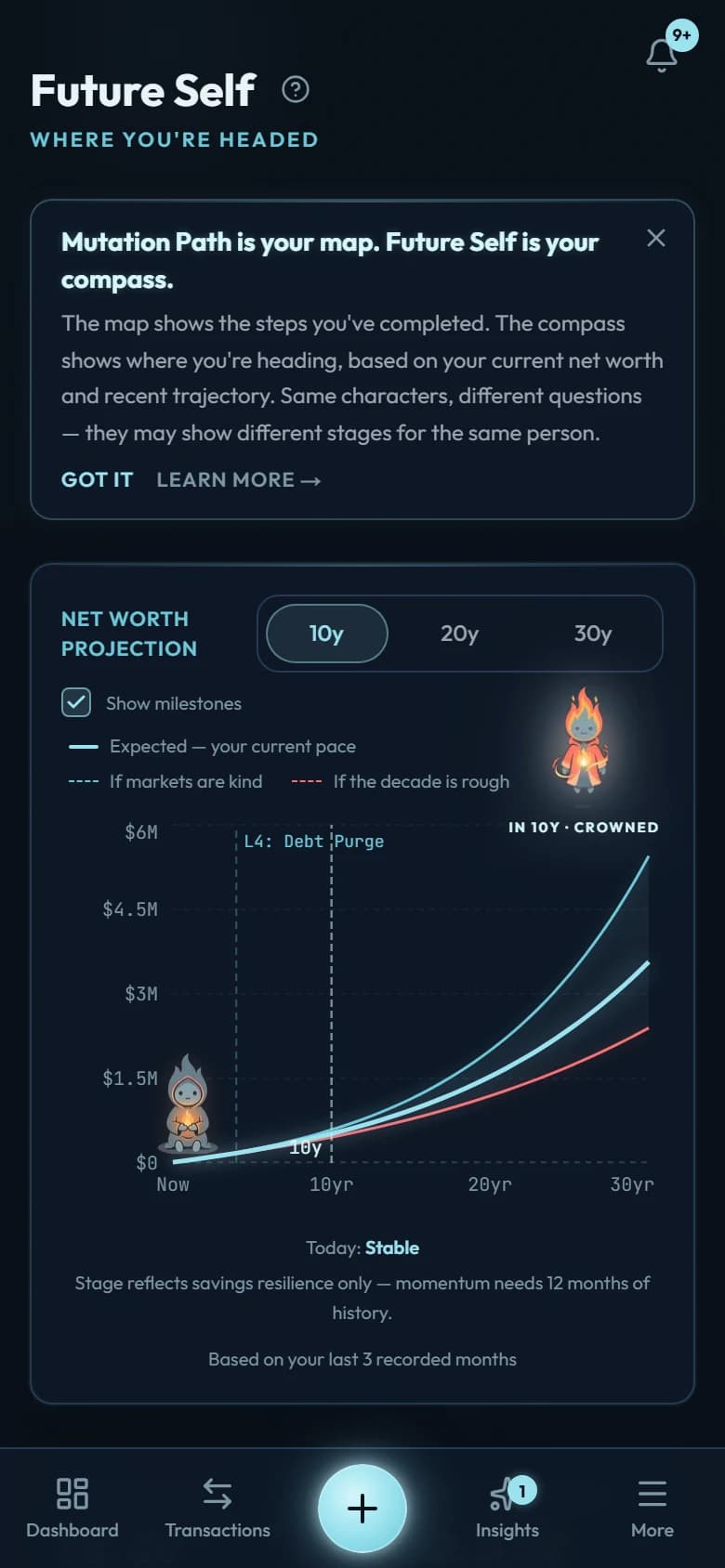
Wealth Mutant is the personal finance app we built for exactly this. Not sure what an average month costs you? It works that out from what you record, and after 3 full months it keeps your runway up to date from your own accounts. You note each purchase yourself in a few seconds, a small daily habit that makes you notice, and no bank login is ever shared. You pay for it once.
Reading Your Projections explains the runway card and the rest of the Future Self page.
Checked on 16 Oct 2026 against a separate re-calculation of every figure in the example.
More free tools
- How much is my hourly pay a year?Hourly to salary calculator
- How many hours of my life does this cost?Hours of your life calculator
- How big should my emergency fund be?Emergency fund calculator
- When will I reach my savings goal?Savings goal calculator
- How long will it take to double my money?Rule of 72 calculator
- When will I be debt free?Debt payoff calculator
- How much interest is my credit card costing me?Credit card interest calculator
- When is my credit card bill due?Credit card billing cycle calculator
- What does paying extra on my mortgage do?Extra mortgage payment calculator
- What is my net worth?Net worth calculator
Next, run these sums on your own money
7 days free · no card needed