Free calculator
Emergency Fund Calculator: How Many Months?
An emergency fund is money set aside for costs you did not plan for. Type a month of essentials and what you have saved to see 3 stages: 1 month, 3 months and 6 months of essentials. Each shows how far along you are and the month you reach it.
Nothing you type is saved or sent anywhere, and there is nothing to sign up for. The only copy is one you print or download yourself.
Your answer, example
3 months
Your first stage is 1 month of essentials, $2,300. You have $1,500, so $800 is still missing, and you reach it in 3 months.
Your savings cover 0.65 months of essentials today.
The 3 stages
1 month of essentials, the starter fund
$2,300. $800 still missing.
in 3 months
3 months of essentials, the low end of the range
$6,900. $5,400 still missing.
in 1 year 6 months
6 months of essentials, the high end of the range
$13,800. $12,300 still missing.
in 3 years 5 months
Month 1 is one month from today. Interest, if you set a rate, is added each month before your amount goes in. Tax and fees are not counted.
From your numbers: a month of essentials of $2,300, $1,500 saved and $300 added each month.
The app counts the accounts you mark as your emergency fund in months of your average spending.
See it in the appWhat this assumes
- A month of essentials is the same every month, and so is the amount you add.
- Your amount goes in at the end of each month. Month 1 is one month from today.
- A yearly rate is growth over 12 months and is added each month before your amount goes in. Tax, fees and rising prices are not counted.
- Nothing is taken out. If you use part of the fund, the dates move later.
- Essentials are the costs you would still pay in a month with no job. The app measures against your average month of all your spending, so its targets can come out higher.
What the guides say
The 3 guides this page and the article rely on, word for word:
“Financial planners often recommend the equivalent of three to six months of living expenses, though those with variable income or specialized careers might need a larger reserve than those with stable jobs.”
FINRA, the US Financial Industry Regulatory Authority. Read on 14 Nov 2026.
“Ideally, you should try to save the equivalent of 3 to 6 months of your regular expenses. You can also aim to save 3 to 6 months of income. Both methods work, so choose the one that is easier for you.”
The Financial Consumer Agency of Canada. Read on 14 Nov 2026.
“Financial experts generally recommend that you have at least six months of living expenses in a federally insured product, such as a savings account or a certificate of deposit (CD).”
The US Federal Deposit Insurance Corporation (FDIC). Read on 14 Nov 2026.
So all 3 name 6 months, and 2 put the low end at 3. The 1 month stage is the first stop on the way, the starter fund.
The guides write "living expenses" or "regular expenses". This page reads that as essentials, the costs you would still pay in a month with no job. Count everything you spend and each target grows, because it includes what you could pause.
What this is not for
This turns a month of essentials into targets and dates. It does not pick a number of months for you, it cannot see a windfall or a bill that has not landed, and it says nothing about where to keep the money.
How the sum works
A target is a month of essentials times the number of months. What is still missing is the target less what you have saved.
How many months you are covered today is what you have saved divided by a month of essentials. The runway calculator runs the same sum.
The month you reach a stage is counted one month at a time. Each month the interest, if you set a rate, is added to the balance, then your monthly amount goes in. The first month the balance is at least the target is the answer, with month 1 one month from today. With no rate that is the missing amount ÷ what you add, rounded up to a whole month, the count a goal card gives in the app.
A yearly rate is read as growth over 12 months, so 4 means 4%. Each month grows by (1 + 4%) to the power of 1 ÷ 12, minus 1: 0.327% a month. Interest is rounded to 2 decimal places each month.
What to add each month is worked the other way round: the least monthly amount, to 2 decimal places, with which the balance reaches the target in 6 or 12 months. With no rate that is the missing amount ÷ 6 or ÷ 12, rounded up to 2 decimal places.
An example
The example from our article on how much emergency fund you need, in dollars: A month of essentials is $2,300. 1 month is $2,300, 3 months is $6,900 and 6 months is $13,800. With $1,500 saved and $300 added each month, 1 month is missing $800: $800 ÷ $300 = 2.67, so it is reached in 3 months. 3 months is missing $5,400: 1 year 6 months. 6 months is missing $12,300: 3 years 5 months.
Questions people ask
How much emergency fund do I need?
A common guide is 3 to 6 months of living expenses, with 1 month as the first stop. This page multiplies a month of your essentials by 1, 3 and 6. Income that swings, one income for the household, people who depend on you or a job that would be hard to replace all point to the higher end.
What counts as essentials?
The costs you would still pay in a month with no job: rent or mortgage, food, utilities, transport, insurance and the minimum payment on each debt. If you are not sure what a normal month costs, add up the essentials on your last 3 months of statements and divide by 3.
Is $1,000 enough for an emergency fund?
It depends on what a month of essentials costs you. In the worked example above, in dollars, a month of essentials is $2,300: $1,000 covers about 2 weeks and $10,000 covers about 4 months. A flat $1,000 can be a first stop, but the first stage here is 1 month of your own essentials.
How long does it take to build an emergency fund?
The target less what you have saved, divided by what you add each month, rounded up to a whole month. In the worked example above, in dollars, with nothing saved, $300 added each month and $2,300 of essentials, 1 month takes 8 months, 3 months takes 23 and 6 months takes 46.
How does interest change the date?
Interest adds to the balance each month, so each stage comes a little sooner. In the worked example above, in dollars, with $1,500 saved, $300 added each month and $2,300 of essentials, 6 months is reached in month 41 with no rate and in month 38 at 4% a year.
Keep reading
- How much emergency fund do you need? The article this page agrees with, with the 3 to 6 months range and where to keep the money.
- What are sinking funds? For a cost you can see coming, such as winter tires, which is not an emergency.
- Savings challenge: a set rule for putting money aside, with the totals worked out.
What the app does with your own numbers
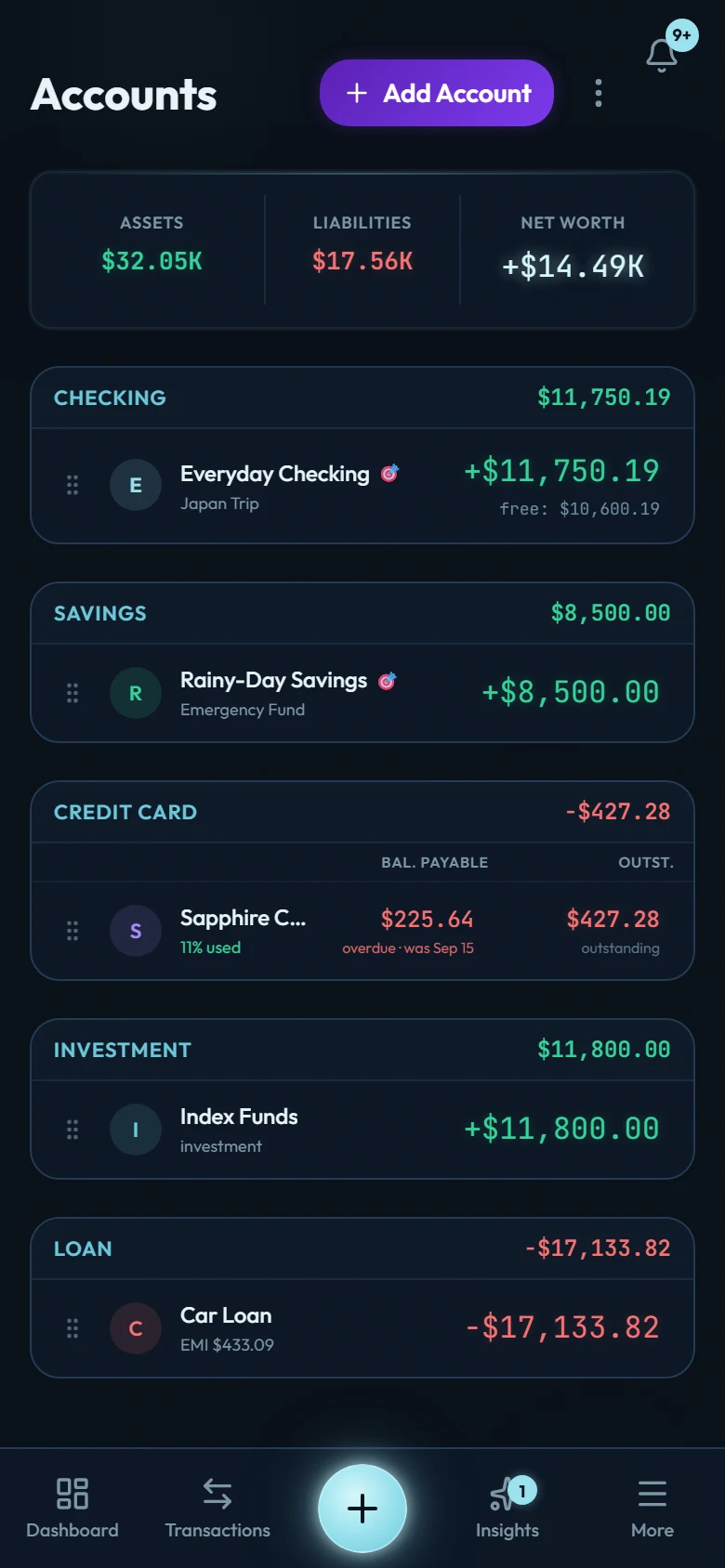
Wealth Mutant is the personal finance app we built for exactly this. An account can carry a "Counts toward my emergency fund" switch on its Edit screen, and cash, checking, wallet and savings accounts start switched on. On the 9-level Mutation Path, Level 2 (Starter Shield) is reached when those accounts hold 1 month of your average spending, and Level 5 (Full Fortress) asks for 6 months. That average is your whole month, worked out from what you record, so it can come out higher than the essentials used here. A goal backed by the savings account shows the month it will be done at your monthly amount. You note each purchase yourself in a few seconds, a small daily habit that makes you notice where the money goes, and no bank login is ever shared. You pay for it once.
The help pages on accounts, goals and the defense levels cover each of these.
More free tools
- How much is my hourly pay a year?Hourly to salary calculator
- How many hours of my life does this cost?Hours of your life calculator
- When will I reach my savings goal?Savings goal calculator
- If I lost my job, how long would my savings last?Runway calculator
- How long will it take to double my money?Rule of 72 calculator
- When will I be debt free?Debt payoff calculator
- How much interest is my credit card costing me?Credit card interest calculator
- When is my credit card bill due?Credit card billing cycle calculator
- What does paying extra on my mortgage do?Extra mortgage payment calculator
- What is my net worth?Net worth calculator
- How much do I need to stop working, and when will I get there?FIRE calculator
- Can I stop saving for retirement yet?Coast FIRE calculator
Checked on 14 Nov 2026 against a separate re-calculation of every figure in the example, and the 3 guides it quotes.
Next, run these sums on your own money
7 days free · no card needed