
What are sinking funds? A sinking fund is money you set aside every month for a cost you know is coming, so the cash is ready when the bill arrives. Car insurance, school costs, gifts and a new phone are typical ones, and each gets a fund of its own.
A bill that flattens a month is often one you could see coming. The insurance renewal, the school term, the festival or birthday season: each sat on the calendar, and none had a share of your pay. A sinking fund gives each one a share. The sum is the same for every bill: its cost divided by the months left.
How does a sinking fund work?
Say your car insurance renews in 12 months and costs $720. Paid in one go, that is $720 out of a single month. As a sinking fund, you put $720 ÷ 12 = $60 a month into a fund of its own. When the renewal comes, the $720 is already there and the month carries on as normal.
The total is the same. What changes is how it lands: one big hit becomes 12 smaller ones. The examples use dollars, and the sums work the same in any currency.
Researchers Abigail Sussman and Adam Alter studied why one-off costs catch people out. Across 7 studies, people were fairly good at predicting what they would spend on ordinary items. On exceptional purchases, the unusual or infrequent ones, they underestimated the total and overspent on each one, partly because each was treated as a one-off.
A year holds a lot of one-offs. Each feels rare, and together they are certain.
The researchers suggest helping people see each exceptional cost as part of a larger set of purchases. A list of sinking funds does that: every one-off on one page.

What are some examples of sinking funds?
Your own list should come from your last 12 months, but the same kinds of costs turn up again and again. These 8 show the sum for each: cost ÷ months left = what goes in every month.
| Sinking fund | Cost and months left | Set aside each month |
|---|---|---|
| Car insurance (yearly) | $720 in 12 months | $60 |
| Car repairs and maintenance | $600 in 12 months | $50 |
| Trip or holiday | $3,000 in 12 months | $250 |
| Gifts and festivals | $480 in 8 months | $60 |
| Annual subscriptions | $120 in 10 months | $12 |
| School costs (fees, uniform, trips) | $900 in 5 months | $180 |
| Home repairs | $1,200 in 12 months | $100 |
| A new phone | $840 in 24 months | $35 |
The costs are examples in round numbers, not averages, so swap in your own. They fall into 3 kinds: bills and occasions with a date (insurance, subscriptions, school costs, gifts), things you plan to buy or do (the trip, the phone), and costs you know will come but not when (repairs). If you work for yourself, a tax payment with a due date belongs on your list too.
All 8 together come to $747 a month, a lot to find at once.
Try a sinking fund on your own bill
Add a goal for a bill you can see coming, set a monthly amount, and the card shows the month it will be fully funded.
No card needed.
Sinking fund vs emergency fund: what is the difference?
A sinking fund is for costs you can see coming. An emergency fund is for costs you cannot. Your $720 insurance renewal belongs to a sinking fund, and a burst pipe belongs to the emergency fund.
Keep them apart on purpose. Spending a sinking fund on its bill means the plan worked, and if the cost comes back, the fund starts again. Spending the emergency fund means something unplanned happened, and it has to be rebuilt. Mix the two and every planned bill takes a bite out of the money meant for the unplanned ones.
Some costs sit in between. You know a car will need repairs but not when, and an appliance will wear out but not which one. Treat the usual amount as a sinking fund, using last year's total as your guide, and let the emergency fund cover the repair that is bigger than the fund.
Where should you keep sinking funds?
In an ordinary savings account, apart from your everyday account (the checking or current account you spend from). Money in your everyday account is easy to spend by accident. A bill with a date on it is also the wrong job for money that can lose value the week before it is due, so leave investments out of it.
You can keep the funds apart in 3 ways. One account per fund is the clearest. If your bank lets you split an account into labelled pots, that does the same with one login. Or keep one account and a written list of what each part is for, as long as the list stays up to date.
Check that the account is covered by deposit insurance, which repays savers up to a limit if a bank fails. The limits differ by country:
- United States: the FDIC covers $250,000 per depositor, per insured bank, for each account ownership category. At a federally insured credit union, the NCUA gives similar cover, with the same $250,000 limit.
- United Kingdom: the FSCS covers £120,000 per eligible person, per bank, building society or credit union.
- Canada: CDIC insures each category of deposits separately up to 100,000 Canadian dollars, at each member institution.
- India: the DICGC insures each depositor in a bank up to Rs 5 lakh (Rs 500,000), counting the interest earned as well as the money put in.
At any one bank, the savings and everyday accounts in your own name share one limit, and so do the pots inside them.
How do you keep track of several sinking funds at once?
The trouble starts once you have a few funds. Your savings account shows one balance, and the car, the trip and the gifts all want a share of it. After a few months it is hard to remember which part is whose.
A written list fixes that. Give each fund a row: the cost, the due date, the months left, the monthly amount and what is saved so far. Update it every payday and redo the sum whenever a cost changes. A notebook or a spreadsheet does the job, and the weak spot is the redoing: one skipped month leaves a fund behind schedule.
An app can do the redoing for you. On a Goals screen, each fund is a card with its monthly amount and the month it will be fully funded at that pace.
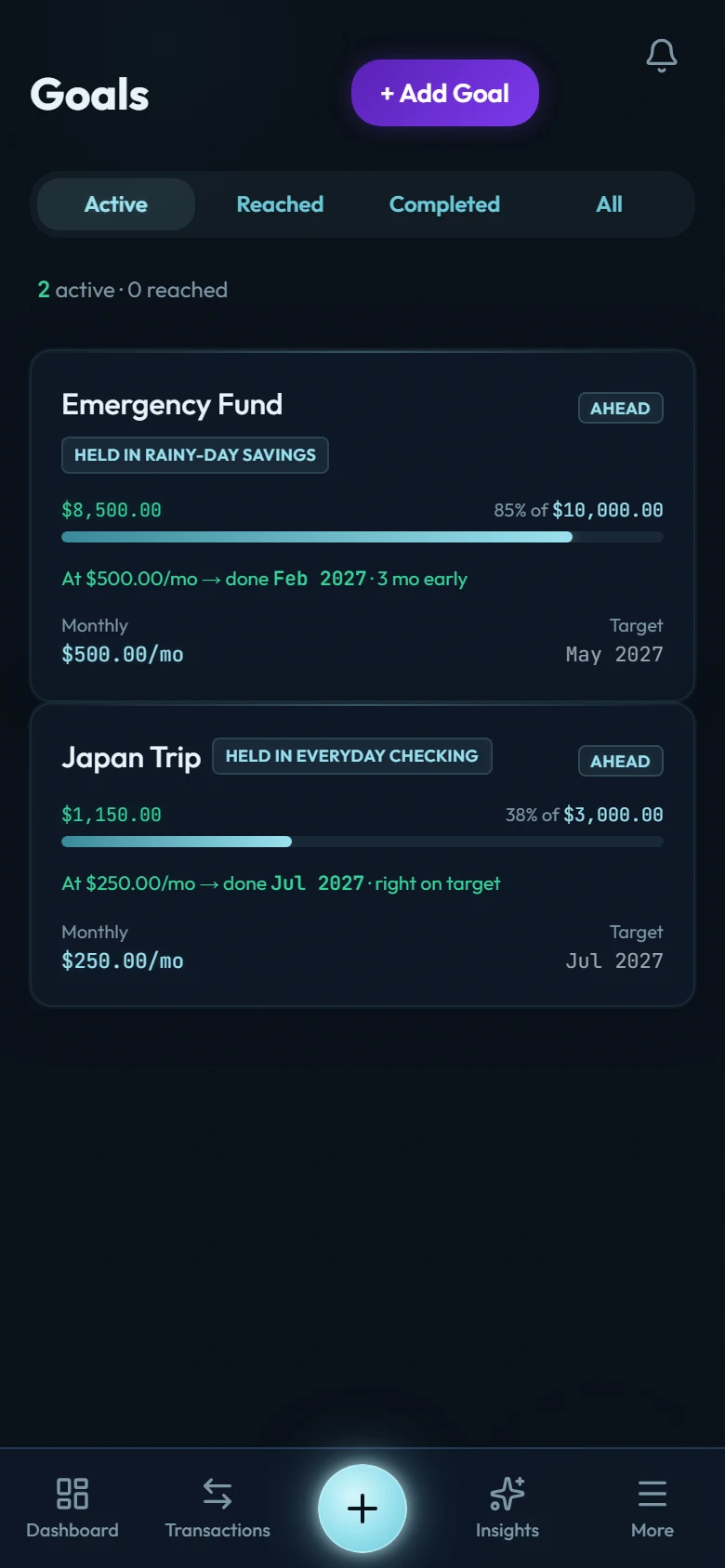
Wealth Mutant is the personal finance app we built for exactly this. Every sinking fund can be a goal with a target, a due date and a monthly amount, and its card says how many months early or late you will finish at that pace. A goal is an envelope inside a real account (part of its balance, set aside for one purpose), so several funds can share one savings account and no bar runs ahead of the money that is really there. You note each purchase yourself in a few seconds, a small daily habit that makes you notice which costs come back every year, and no bank login is ever shared. You pay for it once.
Keep every fund in one place
Goals, budgets, cards and loans in one personal finance app, with each fund earmarked inside your real accounts.
Buy — $99 onceHow do you start a sinking fund?
Start with 1 or 2 funds, for the bills that hurt most. When the first has paid its bill on schedule, add the next.
Look back over 12 months
List everything that was not monthly: renewals, gifts, repairs, fees, trips. If you write your spending down as you go, this is a short job. From memory alone you will miss some.
Write down the cost and the due date
Use last year's bill, plus a little if prices usually rise. For lumpy costs such as repairs, use last year's total.
Divide the cost by the months left
$720 due in 12 months is $60 a month. The same bill due in 4 months is $180. If that is more than you can spare, put in what you can: a fund that is only half full still makes the bill smaller when it lands.
Move the money on payday
Set up a transfer for the day your pay arrives, so the set-aside happens before the spending does. If your income varies, move a fixed share of each payment instead; the freelancers page covers irregular income.
Pay the bill from the fund, then restart it
When the bill arrives, pay it from the fund. If the cost comes back next year, the fund starts again from zero the same day.
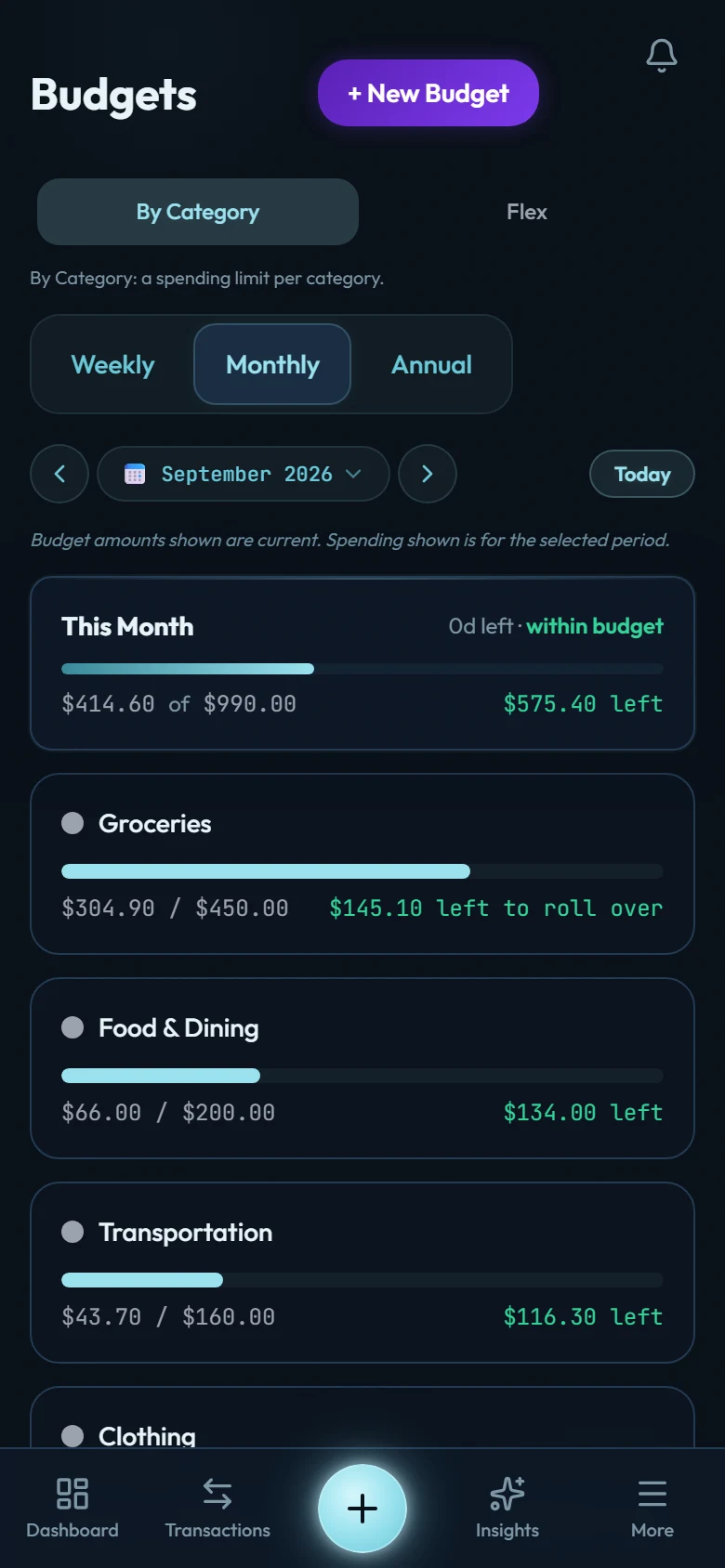
Some irregular costs are too minor for a fund each: a repair here, an annual fee there, the odd gift. Flex budgeting sorts spending into 3 buckets, and costs like these share one Non-Monthly bucket. In Wealth Mutant's Flex mode, give that bucket a monthly amount and switch rollover on (unspent budget carries into next month), and what you do not spend stays in it until a bill arrives. The rollover guide explains the carry.
What changes once your sinking funds are running?
The renewal month stops being a bad month. The bill arrives, the fund pays it, and your balance drops by an amount that was already spoken for. You stop asking whether you can afford the same costs every year, and ask one thing instead: do the monthly amounts still fit?
Two things can go wrong. One is the raid: the gift fund pays for a night out, and 3 months later the festival lands on an empty fund.
A raid often means the everyday budget was a guess that ran out early, so fix that first. Why budgets fail by the 15th shows how to set limits from real numbers.
The other is the stale plan: premiums rise and a child changes school. Once a year, look back over the last 12 months and update every amount.
Common questions
How many sinking funds should I have?
As many as you have costs you can see coming, but begin with the 1 or 2 bills that hurt most, and add another each time a fund pays its bill. There is no right number, only the bills on your calendar and the monthly amount you can spare.
Is a sinking fund the same as a savings account?
No. A savings account is where the money sits, and a sinking fund is what part of that money is for. One account can hold several funds, as long as you can say which part belongs to which bill.
Can I use a sinking fund in an emergency?
You can, but treat it as a loan from the fund and pay it back on a schedule. If emergencies keep dipping into your sinking funds, build the emergency fund first, because covering emergencies is its job.
What if the bill is bigger than I planned for?
The fund pays the part you saved for, and the rest comes out of that month's spending money. For the next round, use the new price as your estimate and set the monthly amount from that.
Your next step
Pick the one bill that hurt most last year. Write down its cost and its due date, divide, and move the first amount on your next payday. In Wealth Mutant, add it as a goal with that monthly amount, and the card shows the month it will be fully funded; the tour walks through the screens around it.
Once the known bills each have a fund, your savings rate (the part of your income you keep) shows how much is left once they are paid. If you like money in separate piles, envelope budgeting runs on the same idea for everyday spending.