
The 50/30/20 rule is where most people start: 50% of your take-home pay for needs, 30% for wants, 20% saved. Take-home pay is what actually reaches your account, after tax and deductions.
It is the most recommended rule in personal finance, and there is a good reason for that. There is also a good reason experienced budgeters stop using it.
This article covers both: what the rule teaches you in the first month, the three places it gets your life wrong, and how to replace its percentages with your own.
Why it works as a first map
Before the rule, most people's budget is one blur: money arrives, money leaves. The rule makes you do one thing, once: sort your spending into needs, wants, and future. That single sort turns the blur into 3 piles you can actually see.
That sort alone is worth an afternoon. Some people find their needs alone take 70% of what they earn, which is a problem no amount of cutting small treats will fix. Others find that wants have eaten the savings entirely, which usually starts correcting itself the moment they can see it. The rule works because any simple frame beats no frame at all. It is a first map for someone who has never seen their own spending drawn out.
The 20% does something else that matters: it makes saving a fixed part of the month, not whatever happens to be left at the end. That one habit, kept for 10 years, will beat most clever advice.
Where it lies
The trouble starts when a rule of thumb gets treated as a law. Three places it gets your life wrong:
Lie one: the percentages fit your life. The numbers were worked out for a middle-income life with moderate rent. They were popularised by Elizabeth Warren and her daughter Amelia Warren Tyagi in their 2005 book All Your Worth, which calls the three piles must-haves, wants and savings. In an expensive city, needs alone can take 65%. The rule then tells you that you are failing, when what is actually failing is the rule's guess about your rent. The reverse happens too. Someone who earns a lot and saves 20% gets a pass from the rule while saving far less than they easily could. (We wrote about that trap separately.)
Lie two: needs and wants split neatly by category. Groceries are a need; the expensive version of the same groceries is a want. A car may be a need; that particular car isn't. The clean 3-way sort is what makes the rule easy to teach. It also blurs exactly where your real decisions happen, which is inside a category, not between categories.
Lie three: 20% is a destination. When you are starting out, 20% is a stretch. Once you are building wealth, it is the minimum, not the target. Treating it as "done" is how people stay in the same place for 20 years: comfortable, following the rule, and saving far less than they could. People who reach financial independence early — the point where working becomes optional — save far more than 20%.
Rules of thumb are for people who don't yet have data. Once you have data, your thumb can retire.

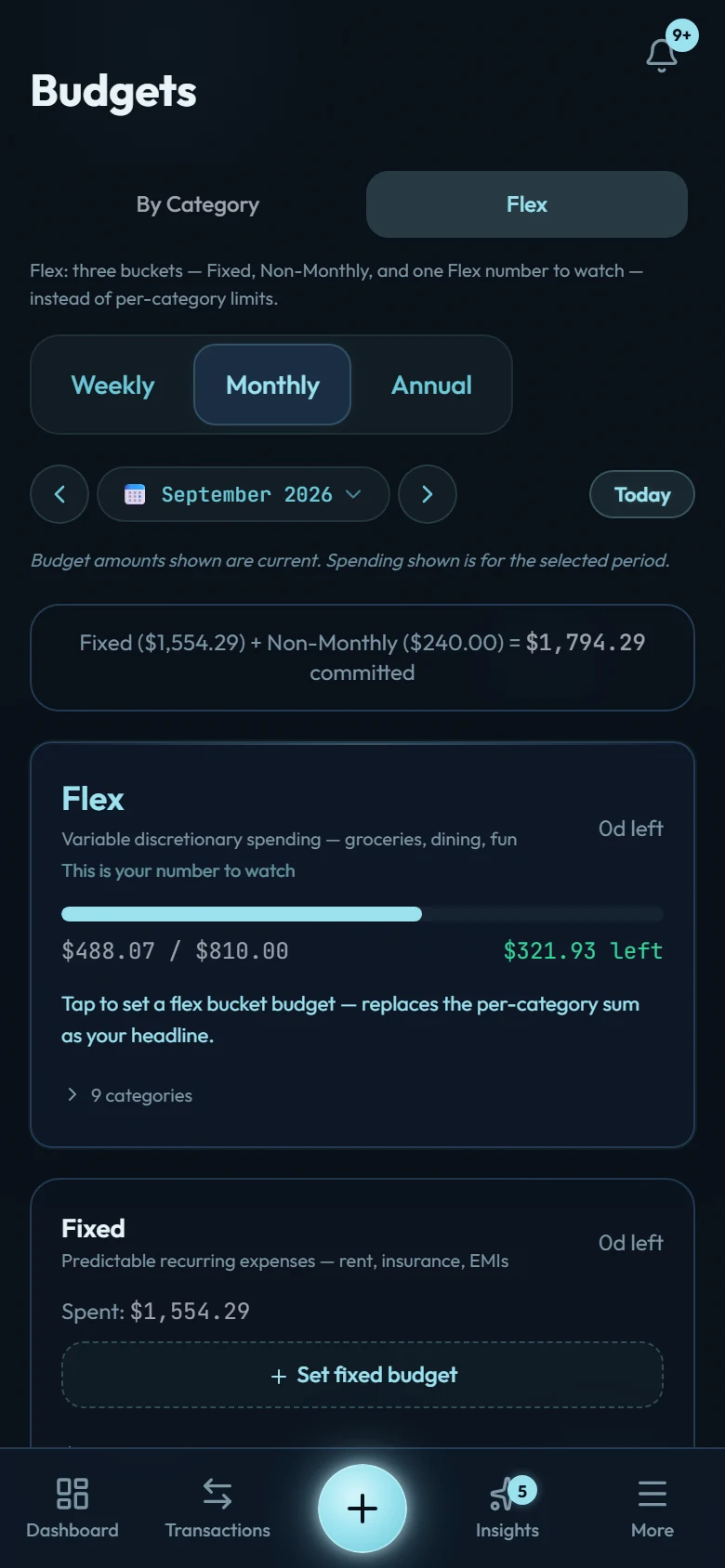
In Wealth Mutant, a personal finance app, the 3 piles keep adding themselves up. Mark each category as Fixed, Flex or Non-Monthly once, and the totals stay current on their own as you record what you spend, a few seconds each time. Your bank login stays with you, and the app is paid for once.
Ready to take control?
See your budgets, cards, loans and net worth in one place. One payment, yours for life.
Buy — $99 onceIf your needs are over 50%: 60/20/20, 70/20/10 and your own split
If rent and bills already take more than half of your take-home pay, two adjusted splits come up most often. 60/20/20 keeps the 20% for saving and moves 10 points from wants to needs. It suits a life where the needs are high but the saving habit is worth protecting, such as the first years in an expensive city.
70/20/10 is often written as 70% for living, 20% for saving and 10% for debt or giving. It fits a tight stretch, when a larger share of the money has to cover the basics for a while.
Both beat being told you are failing by a rule written for someone else's rent. Your own split beats both: record a few months, see whether your needs are really 62% or 71%, and set your savings number from what is actually left. Then the percentages describe your life instead of an average one.
Growing out of the rule
Used well, the rule is a starting frame you take down once you have your own numbers:
Month 1: sort honestly
Track spending and label each entry need/want/future. Do not try to improve anything yet. The sorting is the lesson. Most people have never once seen their 3 piles.
Month 2: replace the rule's numbers with yours
Your actual split might be 62/23/15. Fine — now it's real. The question changes from "am I following the rule?" to "which of my own numbers do I want to move, and by how much?"
Month 3 onward: watch one number
Your savings rate — the share of your income you keep — is the pile that builds your future. Track that one number month to month, and let needs and wants move around it while you nudge it up.
What to keep, what to drop
50/30/20 is a very good first month and a poor 5th year. Keep three things from it: the sort, the habit of saving first, and the comfort of a simple frame. Then let your own recorded numbers replace its percentages. Your life was never the average life the rule was built for.
Getting there takes one thing: a few weeks of writing down what you spend. After that, Wealth Mutant keeps the 3 piles adding themselves up from your entries, so the split on your screen is always this month's, not last January's guess.