
A financial goal is a specific amount of money for a specific purpose by a specific date. The financial goals that work are written down, measurable and put in an order that makes sense.
"Save more" and "get out of debt" are a fine place to start. This guide turns them into goals, with examples by timeframe, the order to tackle them in and the monthly amount that keeps each one moving.
What are financial goals?
Financial goals are targets for your money that you can check: how much, what for and by when. "Save $2,500 for a starter buffer by 30 April" is one. "Save more" is not, because on 30 April you could not say whether you had done it.

The FDIC's Money Smart lesson for children lists the same parts for a savings goal and adds a 4th: how you plan to save. For most goals that means an amount each month. Say today is 30 November: 30 April is 5 months away, so $2,500 comes to $500 a month.
What are examples of financial goals?
There is no single official line between short, medium and long term. The CFPB's Your Money, Your Goals toolkit calls a goal short term if it takes under 6 months, while a CFPB teacher's guide counts goals of up to 5 years as short-term. This guide uses under 1 year, 1 to 5 years and over 5.
The amounts are examples for someone who spends $2,500 a month ($30,000 a year), so swap in your own. The division works the same in any currency.
Short-term financial goals: under 1 year
| Example goal | Example amount | Monthly amount |
|---|---|---|
| Starter buffer | $2,500, 1 month of spending | $500 for 5 months |
| Pay off a credit card (avalanche or snowball) | $3,000 | $300 for 10 months, plus interest |
| A planned bill or trip (a sinking fund) | $1,200 | $150 for 8 months |
Medium-term goals: 1 to 5 years
| Example goal | Example amount | Monthly amount |
|---|---|---|
| Full emergency fund | $15,000, 6 months of spending | $500 for 30 months |
| A car | $6,000 | $250 for 2 years |
| A home deposit (down payment in the US) | $30,000 | $500 for 5 years |
The full fund includes the starter buffer: at $500 a month, 5 months finish the buffer and 25 more finish the fund. The usual range is 3 to 6 months of expenses: FINRA says planners often suggest it, and so does Canada's Financial Consumer Agency. How much emergency fund you need helps you pick your point in it.
Long-term financial goals: more than 5 years
| Example goal | Example amount | Monthly amount |
|---|---|---|
| Retirement or financial independence | $750,000, 25 times a year of spending | Depends on growth |
| A child's education | $24,000 | $200 for 10 years |
Financial independence (FI) means your savings and investments can pay your living costs, so working is optional. In Wealth Mutant, Level 9 counts a net worth (all you own minus all you owe) equal to 25 years of your average spending as one way to reach it, a rough guide and not a promise. The accounts go by different names: ISAs and workplace pensions in the UK, 401(k)s and IRAs in the US, RRSPs and TFSAs in Canada, and EPF or NPS in India. If a pension will cover part of your spending, multiply only the rest by 25.
Put a number on your first goal
Add a goal to Wealth Mutant, choose a monthly amount you can spare, and see the month you would finish.
No card needed.
In what order should you work on your financial goals?
The monthly amounts add up. The 3 short-term rows come to $950 a month, so if $600 is what you have left, something goes first.
One sensible order is the Mutation Path in Wealth Mutant: 9 levels, read from your own numbers, with every rule in the Mutation Path guide. As a goals list it runs like this, with Levels 2, 3 and 4 worked on side by side:
- Level 1, Know Your Numbers: 5 saved transactions, typed or imported, with no deadline.
- Level 2, Starter Shield: a buffer the size of your average monthly spending, held in the accounts that count as your emergency fund.
- Level 3, Free Money First: a retirement or investment account that you pay into or that already holds money. Collect any employer match first.
- Level 4, Debt Purge: nothing owing but a home loan and any loan you told the app you cannot clear early, no overdraft drawn, and every card clear of interest on its last 3 statements.
- Level 5, Full Fortress: the same accounts hold 6 times your average monthly spending. It waits until Levels 2, 3 and 4 are all holding.
- Level 6, Accelerate, and Level 7, Compound: in 12 months your net worth grows by 15% of your average yearly income or more (25% for Level 7), or it reaches 10 times your average yearly spending (15 times for Level 7).
- Level 8, Fund the Future: a goal at least 10 years away, marked long-term, with the account behind it holding 3 months of your average spending. It opens beside Level 7.
- Level 9, Financial Independence: passive income (rent, dividends and other money you do not work for) pays for your spending, averaged over 12 months, while net worth holds 10 years of it; or net worth alone reaches 25 times your average yearly spending.
A buffer keeps a surprise off your card, a cleared card frees its interest for the next goal, and a full fund means a lost job does not drain what you are building. Levels of wealth has a worked example for all 9.
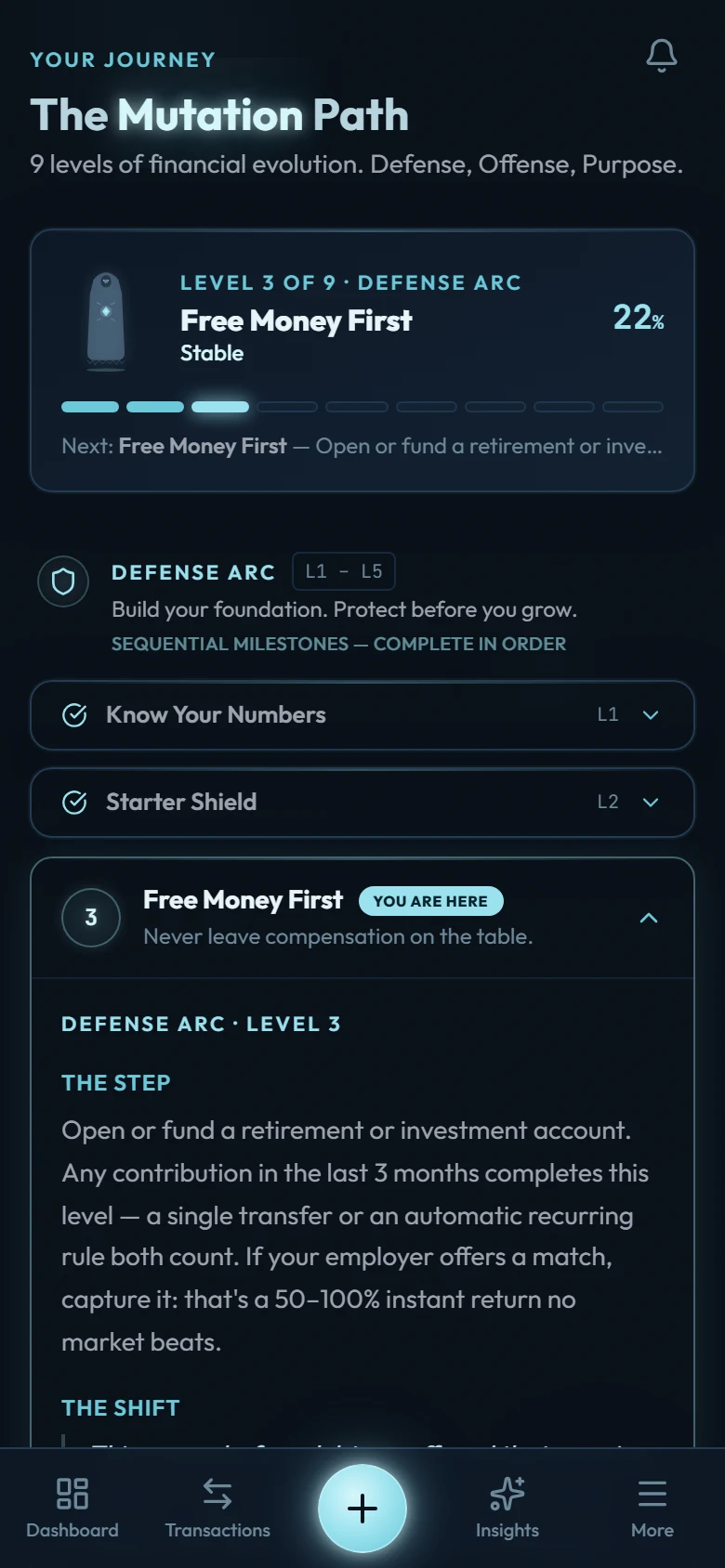
Wealth Mutant is the personal finance app we built for exactly this. A goal takes a target, a date and a monthly amount and is held in a real account, and the Mutation Path shows which level you are on, read from your own numbers. You note each purchase yourself in a few seconds, a small daily habit that makes you notice, and no bank login is ever shared. You pay for it once.
See what to work on next
Goals, the accounts behind them and the Mutation Path sit side by side in one personal finance app, so the next step is easy to find.
Buy — $99 onceHow do you track financial goals each month?
The monthly amount for any goal is the amount still to save, divided by the months left: (target − saved so far) ÷ months. The tables above started each goal from zero. If you already hold $1,200 of the $6,000 car fund and have 24 months to go, that is ($6,000 − $1,200) ÷ 24 = $200 a month. The free savings goal calculator does the division for you: type in what you have saved, the target and the date, and it gives the monthly amount.
Then add up your goals' monthly amounts and compare the total with what is left after bills and everyday spending. That left-over figure, divided by your income, is your savings rate: how much of each pay you hold on to. If the total is too big, run fewer goals at once or move a date later. At $150 a month instead of $200, the car fund takes 32 months, 8 more than planned.
Back each goal with a real account
In Wealth Mutant a goal is held in an account that exists. For a manual goal you tap Allocate to earmark the monthly amount: a label inside the account, with no money moved.
Read the finish month
Once a goal has a monthly amount, its card tells you the month you would finish. Give it a target date as well and the card says whether that is early or late, and by how many months.
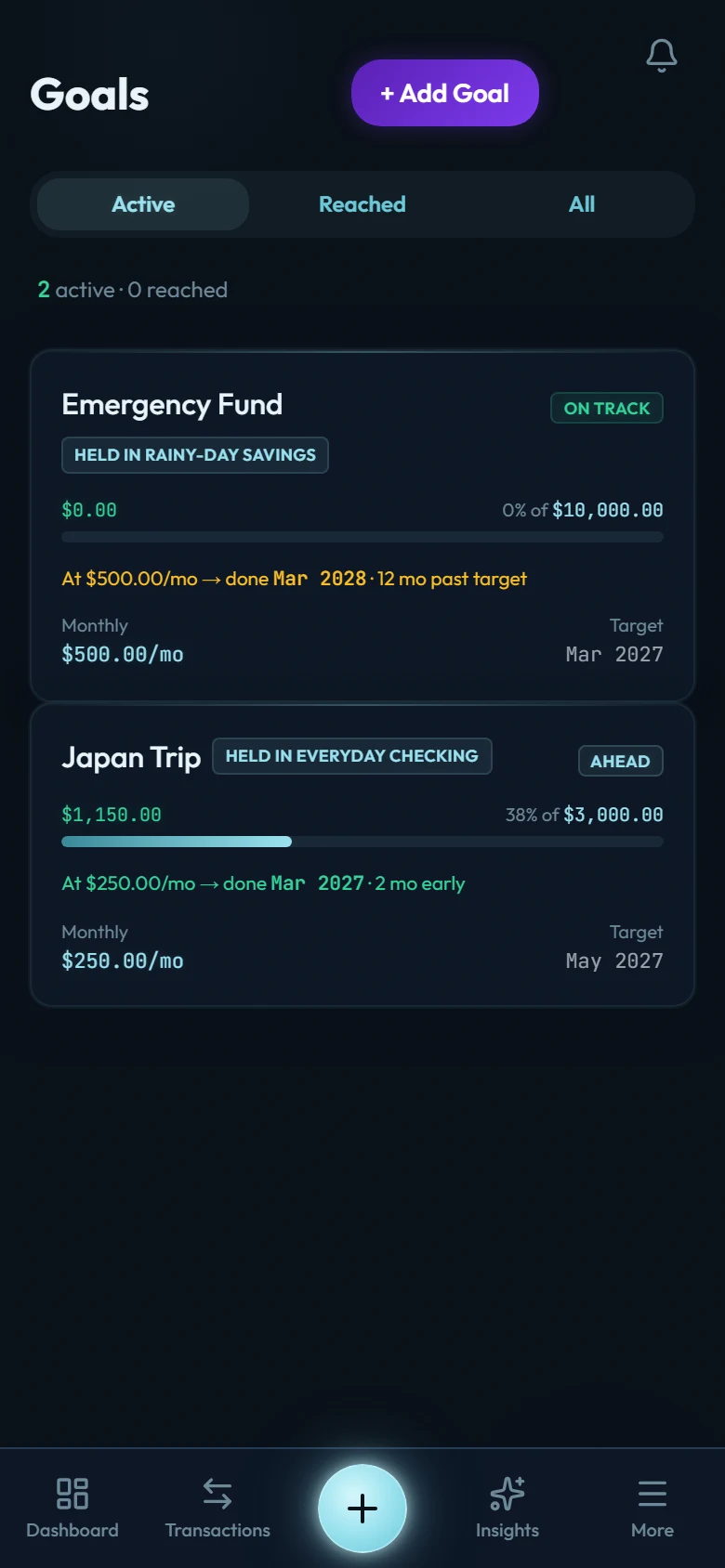
For goals decades away, plain division ignores investment growth, so it gives a higher monthly amount than you need if your savings grow. Future Self runs your current pace forward 10, 20 and 30 years. The free Coast FIRE calculator shows when your retirement savings could reach your target on growth alone (see what Coast FIRE means).
What changes once your financial goals have numbers?
A goal with an amount and a date stops being a worry you carry and becomes a line in your month. On any payday you can tell whether you are ahead or behind, and the fix for behind is a number: a later date, a smaller target or a bigger monthly amount.
Common questions
What are the 3 types of financial goals?
Short-term, medium-term and long-term, sorted by how long they take. There is no single official line between them; this guide uses under 1 year, 1 to 5 years and more than 5 years. In Wealth Mutant you can mark a goal long-term once its date is at least 10 years away, and Level 8 reads only those.
What are SMART financial goals?
SMART began as a checklist for management objectives in a 1981 article by George T. Doran, where the letters stood for specific, measurable, assignable, realistic and time-related. Money guides now use specific, measurable, achievable, relevant and time-bound, as the CFPB and the Government of Canada do. Doran added that not every objective will have all 5. For money, the amount, purpose and date are the core: "$2,500 for a starter buffer by 30 April" has all 3.
How do I set financial goals if I have no money left each month?
Look first. Record what you spend for a few weeks (Level 1 in Wealth Mutant is just 5 saved transactions) and see where it goes. Then pick a goal that is hard to miss: the CFPB's booklet "Building your savings? Start with small goals" uses $400 in 20 weeks, or $20 a week.
Your next step
Pick one goal from the tables and write it as how much, what for and by when. Then create it in Wealth Mutant with a monthly amount, and its card will show the month you finish. The tour shows goals and the Mutation Path before you start.
Don't know yet what a usual month costs you? Start with the looking habit.