
To convert hourly to salary, multiply your hourly rate by 2,080. That is 40 hours a week for 52 weeks, so $25 an hour comes to $52,000 a year.
To go the other way, divide a yearly salary by 2,080, so $60,000 a year works out to $28.85 an hour.
Both answers are gross, meaning before tax and deductions, and both assume you are paid for all 52 weeks. Below are tables for the usual rates, what unpaid time off and overtime change, and a second number worth knowing: what an hour of your life earns. The examples use dollars; the sum is the same in any currency. The free hourly to salary calculator runs it on your own rate, hours and weeks.
How do you convert hourly to salary?
Multiply your hourly rate by the hours you work in a week, then by the weeks you are paid. A full-time year is rate × 40 × 52, or rate × 2,080.
At $25 an hour that gives $52,000 a year, $4,333 a month ($52,000 ÷ 12) and $1,000 a week ($25 × 40). Part-time uses your own hours: $18 an hour for 25 hours a week is $18 × 25 × 52 = $23,400 a year.
Full-time is a workplace custom, not a legal number. The US Department of Labor says the federal wage law does not define full-time employment or part-time employment, and GOV.UK says a UK full-time worker will usually work 35 hours or more a week. On a 37.5-hour contract the multiplier is 37.5 × 52 = 1,950, so £20 an hour is £39,000 a year.
Figures are rounded to the dollar, and hourly rates to the cent.
| Hourly rate | Yearly (× 2,080) | Monthly (yearly divided by 12) | Weekly (× 40) |
|---|---|---|---|
| $10 | $20,800 | $1,733 | $400 |
| $12 | $24,960 | $2,080 | $480 |
| $14 | $29,120 | $2,427 | $560 |
| $15 | $31,200 | $2,600 | $600 |
| $16 | $33,280 | $2,773 | $640 |
| $17 | $35,360 | $2,947 | $680 |
| $18 | $37,440 | $3,120 | $720 |
| $19 | $39,520 | $3,293 | $760 |
| $20 | $41,600 | $3,467 | $800 |
| $21 | $43,680 | $3,640 | $840 |
| $22 | $45,760 | $3,813 | $880 |
| $23 | $47,840 | $3,987 | $920 |
| $24 | $49,920 | $4,160 | $960 |
| $25 | $52,000 | $4,333 | $1,000 |
| $26 | $54,080 | $4,507 | $1,040 |
| $28 | $58,240 | $4,853 | $1,120 |
| $30 | $62,400 | $5,200 | $1,200 |
| $35 | $72,800 | $6,067 | $1,400 |
| $40 | $83,200 | $6,933 | $1,600 |
| $45 | $93,600 | $7,800 | $1,800 |
| $50 | $104,000 | $8,667 | $2,000 |
| $60 | $124,800 | $10,400 | $2,400 |
| $70 | $145,600 | $12,133 | $2,800 |
| $75 | $156,000 | $13,000 | $3,000 |
How do you convert salary to hourly?
Divide the yearly salary by 2,080: $60,000 ÷ 2,080 is $28.85 an hour, and $50,000 ÷ 2,080 is $24.04. Paid by the month? Multiply by 12 first.
If another converter's cents differ, check the number it divides by. For US federal government employees, the pay law divides the annual rate by 2,087 instead of 2,080, which turns $28.85 into $28.75 on $60,000.
| Yearly salary | Hourly (divided by 2,080) | Monthly (divided by 12) |
|---|---|---|
| $25,000 | $12.02 | $2,083 |
| $30,000 | $14.42 | $2,500 |
| $35,000 | $16.83 | $2,917 |
| $40,000 | $19.23 | $3,333 |
| $45,000 | $21.63 | $3,750 |
| $50,000 | $24.04 | $4,167 |
| $55,000 | $26.44 | $4,583 |
| $60,000 | $28.85 | $5,000 |
| $65,000 | $31.25 | $5,417 |
| $70,000 | $33.65 | $5,833 |
| $75,000 | $36.06 | $6,250 |
| $80,000 | $38.46 | $6,667 |
| $90,000 | $43.27 | $7,500 |
| $100,000 | $48.08 | $8,333 |
| $120,000 | $57.69 | $10,000 |
| $150,000 | $72.12 | $12,500 |
| $175,000 | $84.13 | $14,583 |
| $200,000 | $96.15 | $16,667 |
Find out what an hour of your life earns
Wealth Mutant turns what you record into your own earning and spending rate per hour, so a purchase you are planning can be priced in hours of your life before you buy it.
No card needed.
Is the yearly figure before or after tax?
Before. Take-home is what reaches your account after tax and deductions, and the gap depends on your country, where you live in it and what comes out for pensions and insurance. No single percentage fits everyone, so this page gives no tax tables. Your payslip shows your real take-home, the number you can actually spend.
What is an hour of your life worth in money?
An hourly rate prices the hours you work. Your pay gets spent across every hour of the year, nights and weekends included. A 365-day year has 8,760 hours (365 × 24), and a full-time job pays for 2,080 of them, about 24%.

Share a year's take-home across every hour and the figure shrinks. Say you earn $25 an hour and $40,000 of the $52,000 reaches your account (yours will differ). That gives $40,000 ÷ 8,760 = $4.57 for each hour of your life, asleep or awake. Call it your money per hour.
That number lets you read a price as time. A $1,200 laptop is 263 hours of your life, about 11 days. A $14 lunch on each of the year's 260 weekdays is $3,640 a year, or 796 hours of your life, about 33 days.
The free Hours of Your Life calculator does that sum for any price. Enter the price, how often it repeats and your take-home pay; a repeating price also shows its total over 1, 5, 10 and 20 years. It prices things in time and does not say whether they are worth it.
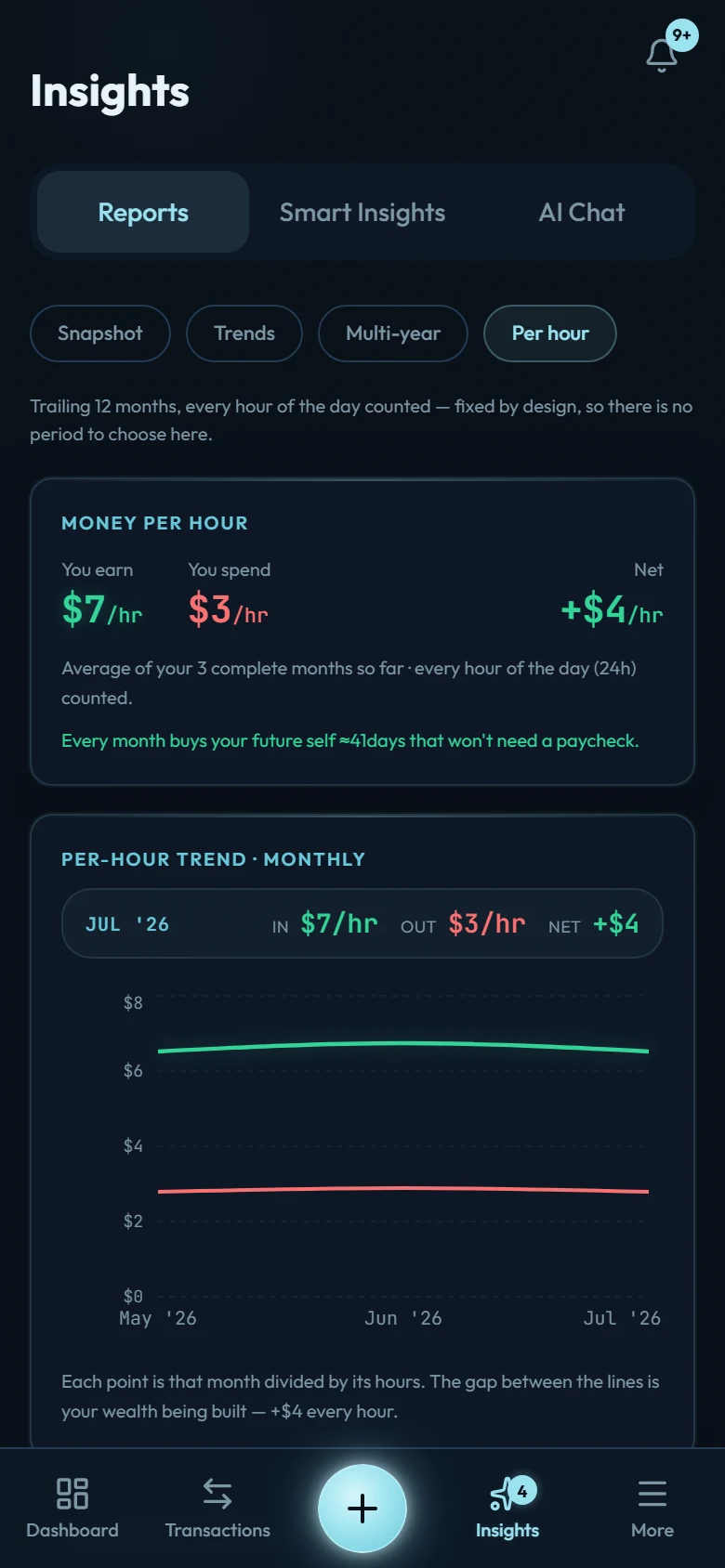
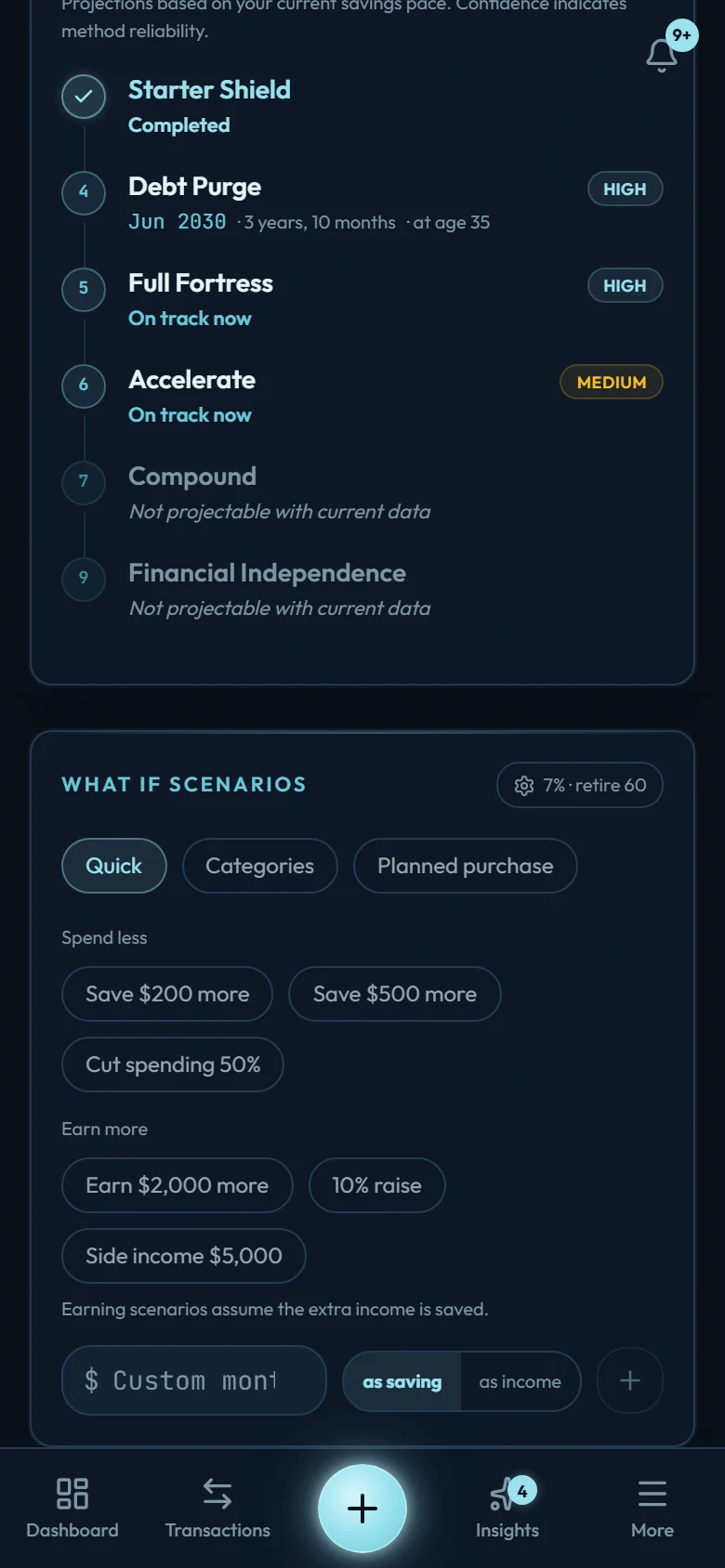
Wealth Mutant is the personal finance app we built for exactly this. Once you have 3 finished months of entries, it works out your own money per hour from the income you record, counting every hour of the day, and shows what each spending category costs in hours of your life. When you plan a purchase in What If, it is priced in those hours before you commit. You note each purchase yourself in a few seconds, a small daily habit that makes you notice, and no bank login is ever shared. You pay for it once.
See your spending in hours of your life
Your own money per hour, each spending category in hours, and What If to test a purchase before you make it. One payment, and the app is yours to keep.
Buy — $99 onceWhat changes an hourly to salary conversion?
The sum above assumes 40 hours a week for 52 paid weeks. Two things move it.
Do you get paid for holidays and time off?
The 2,080 figure counts 52 paid weeks. A salary usually pays you through holidays and leave; an hourly job may not. In the US, the Department of Labor says the federal wage law does not require payment for time not worked, such as vacations, sick leave or federal or other holidays. Count only the weeks you are paid: rate × 40 × paid weeks. Two unpaid weeks mean 50 paid weeks, or 2,000 hours.
| Hourly rate | 52 paid weeks (2,080 hours) | 50 paid weeks (2,000 hours) | 48 paid weeks (1,920 hours) |
|---|---|---|---|
| $15 | $31,200 | $30,000 | $28,800 |
| $20 | $41,600 | $40,000 | $38,400 |
| $25 | $52,000 | $50,000 | $48,000 |
| $30 | $62,400 | $60,000 | $57,600 |
| $40 | $83,200 | $80,000 | $76,800 |
In the UK, most workers on a 5-day week must receive at least 28 days' paid annual leave, which GOV.UK calls the equivalent of 5.6 weeks, and an employer can count bank holidays inside it. So those weeks off are paid, and the 52-week sum fits.
Comparing a salary with an hourly offer that pays nothing for leave? Divide the salary by the hours you will really work. With 5 weeks off in all that is 1,880 hours, and $60,000 ÷ 1,880 is $31.91 an hour, not $28.85.
How does overtime change it?
Overtime comes on top of the 2,080 sum. In the US the Fair Labor Standards Act (FLSA), the federal wage law, says covered employees must get overtime pay for hours over 40 in a workweek at not less than 1.5 times the regular rate, unless they are exempt (the rule does not apply to them). Each workweek stands alone: averaging hours over 2 or more weeks is not permitted. At $25 an hour, a 45-hour week pays 40 × $25 = $1,000 plus 5 × $37.50 = $187.50, so $1,187.50. A year of weeks like that is $1,187.50 × 52 = $61,750, against $52,000 without the extra hours.
A salary does not always mean no overtime: the department says job titles do not determine exempt status, and duties and pay level both have to qualify. If you are exempt, your employer does not have to pay more for long weeks, so your real hourly rate falls. On $60,000 with 50-hour weeks, that is $60,000 ÷ 2,600 = $23.08 an hour, not $28.85.
Canada has no single rule: the Government of Canada says the laws on hours of work and overtime vary by province or territory. Federally regulated workplaces use 40 standard hours a week, with overtime at least 1.5 times the regular hourly wage. In Ontario, overtime for most employees begins after 44 hours in a work week, at 1.5 times the regular rate.
UK law sets no general overtime rate: GOV.UK says employers do not have to pay workers for overtime, as long as your average pay for all the hours you work does not fall below the National Minimum Wage, and your contract usually sets any rate. Elsewhere, check your country's rules and put your contract's hours in place of the 40.
How do your hourly rate and money per hour work together?
A job offer and a price tag now speak the same language: the tables turn $25 an hour into $52,000 a year, and your money per hour turns $1,200 into about 11 days of your life. A raise converts the same way: $2 more an hour is $4,160 more a year before tax ($2 × 2,080). Whether you ever feel it depends on your savings rate, the share of your income you keep.
Common questions
How many working hours are in a year?
A 40-hour week for 52 paid weeks is 2,080 hours, or 2,000 with 2 unpaid weeks. On other hours, multiply your contract's weekly hours by the weeks you are paid.
How do I turn monthly or biweekly pay into an hourly rate?
Work out the yearly pay first, then divide by 2,080: monthly pay × 12, or pay every 2 weeks × 26. For example, $4,000 a month is $48,000 a year, or $23.08 an hour. At $2,000 every 2 weeks, that is $52,000 a year, or $25.00 an hour.
Is an hourly job or a salary better?
Neither wins on its own. In the US, an hourly employee covered by the federal wage law is usually owed overtime beyond 40 hours a week, while an exempt salaried employee is paid the same however long the week runs. Compare what each pays per hour you will really work.
Try it today: put your payslip's take-home and one price you are weighing into the free calculator and read the answer in days. In the biggest money mistakes people confess, the payment priced in hours is one of the numbers that came too late. For a rate built from your own entries, Money Per Hour explains the 12-month window, and the tour shows that screen.