Free calculator
Hourly to Salary Calculator: Yearly, Monthly
Type what you are paid by the hour, day, week, 2 weeks, month or year, and see it every other way, before tax. It starts at 40 hours a week for 52 paid weeks, and you can change both.
Nothing you type is saved or sent anywhere, and there is nothing to sign up for. The only copy is one you print or download yourself.
Your answer, example
$52,000a year
$25 an hour is $52,000 a year before tax, at 40 hours a week for 52 paid weeks (2,080 hours).
The same pay, every way
Per hour
the hourly rate
$25.00
Per day
a day of 8 hours
$200.00
Per week
a week you are paid
$1,000.00
Every 2 weeks
2 weeks you are paid
$2,000.00
Per month
the year ÷ 12
$4,333.33
Per year
before tax
$52,000.00
Hours worked in the year
40 hours a week × 52 paid weeks
2,080
From your numbers: $25 an hour, 40 hours a week, 52 paid weeks
Once you have 3 finished months, the app works out your real hourly rate from the income you record.
See it in the appYour hour, priced
A price turned into hours of work at this pay. It divides by $25.00 an hour, the rate before tax. Hours of your life counts every hour of the day, so its rate per hour is lower: the link below does that sum.
What this pay can save
Saving a share of your pay before tax a year, and how long it takes to reach a target.
| Share saved | Month | Months |
|---|---|---|
| 10% | $433 | 24 |
| 15% | $650 | 16 |
| 20% | $867 | 12 |
Made in your browser when you click. Nothing is sent anywhere.
Hours a week
| Hours a week | Hours | Month | Year |
|---|---|---|---|
| 20 | 1,040 | $2,167 | $26,000 |
| 25 | 1,300 | $2,708 | $32,500 |
| 30 | 1,560 | $3,250 | $39,000 |
| 35 | 1,820 | $3,792 | $45,500 |
| 37.5 | 1,950 | $4,063 | $48,750 |
| 40 | 2,080 | $4,333 | $52,000 |
| 45 | 2,340 | $4,875 | $58,500 |
| 50 | 2,600 | $5,417 | $65,000 |
Made in your browser when you click. Nothing is sent anywhere.
Weeks with no pay
| Unpaid weeks | Hours | Month | Year |
|---|---|---|---|
| 0 | 2,080 | $4,333 | $52,000 |
| 2 | 2,000 | $4,167 | $50,000 |
| 4 | 1,920 | $4,000 | $48,000 |
| 6 | 1,840 | $3,833 | $46,000 |
Made in your browser when you click. Nothing is sent anywhere.
What this assumes
- All figures are before tax and deductions, unless you type the share you keep.
- It starts at 40 hours a week for 52 paid weeks, 2,080 hours. Both are boxes you can change.
- A month is a twelfth of the year, so it averages the months together.
- Pay typed per hour, day, week or 2 weeks is earned only in the weeks you are paid. Pay typed per month or year is taken as the year’s pay as it stands.
- Overtime is the hours above your weekly hours, paid at the multiple you type in every paid week. This page holds no tax tables and no overtime rules.
What this is not for
It does not work out tax, benefits, bonuses or pay that changes from week to week. It starts from one rate and one set of hours. For take-home pay, type the share your payslip shows you keep.
This page counts the hours you are paid for. At 25 an hour before tax, a laptop of 1,200 is 48 hours of work here, or 64 if you type the 75% you keep. Hours of your life counts every hour, sleep and weekends included, so from a take-home of 39,000 a year the same laptop is about 270 hours of your life there. Neither is wrong.
How the sum works
Yearly pay is the hourly rate × the hours you work in a week × the weeks you are paid. At 40 hours for 52 weeks that is the rate × 2,080.
To go the other way, divide the yearly pay by the hours in the year. Pay by the month is multiplied by 12 first.
This is also the salary to hourly sum: type your salary, pick Year or Month, and the big answer is the hourly rate.
A month is the year ÷ 12. A week is the rate × the hours in a week, and a day is the rate × the hours in a day. Each figure is worked from the exact rate and rounded to 2 decimal places once, so 60,000 ÷ 2,080 is 28.846 and prints 28.85, while a week is 60,000 ÷ 52 = 1,153.85.
Weeks with no pay come off the 52. Overtime adds the extra hours × the rate × the multiple, in each paid week. What you keep is one percentage you type, applied to every figure.
Time and a half is a multiple of 1.5, which is where the overtime box starts. Double time is 2.
An example
$25 an hour for 40 hours a week is $25 × 40 = $1,000 a week. Over 52 paid weeks (2,080 hours) that is $52,000 a year, and $4,333 a month. Turned around, $52,000 a year ÷ 2,080 hours is $25.00 an hour.
The longer walk through, with tables from $10 to $75 an hour, is the article Hourly to Salary: $25 an Hour Is $52,000 a Year.
Pay at common hourly rates, in US dollars
One page for each of these rates, with its own tables and questions.
- $20 an hour: $41,600 a year before tax
- $22 an hour: $45,760 a year before tax
- $23 an hour: $47,840 a year before tax
- $24 an hour: $49,920 a year before tax
- $25 an hour: $52,000 a year before tax
- $28 an hour: $58,240 a year before tax
- $30 an hour: $62,400 a year before tax
- $35 an hour: $72,800 a year before tax
- $40 an hour: $83,200 a year before tax
- $50 an hour: $104,000 a year before tax
Questions people ask
The examples are plain numbers. Read them in your own currency: the sum is the same.
How do I turn an hourly rate into a yearly salary?
Multiply the rate by the hours you work in a week, then by the weeks you are paid. At 40 hours for 52 weeks that is the rate × 2,080, so 25 an hour is 52,000 a year before tax.
How do I turn a yearly salary into an hourly rate?
Divide the year by the hours in it. At 40 hours for 52 weeks, 60,000 ÷ 2,080 is 28.85 an hour. If you are paid by the month, multiply by 12 first.
Is the answer before or after tax?
Before. What reaches your account depends on tax and deductions where you live, so this page holds no tax table. Type the share of pay you keep, from your payslip, and every figure shows it too.
What if I do not get paid for some weeks off?
Put those weeks in the box for weeks with no pay. At 25 an hour, 2 unpaid weeks leave 50 paid weeks and 50,000 a year instead of 52,000. A salary stays what it is, and the weeks off only change the hours it covers.
How does overtime change the year?
It adds the extra hours × your rate × the multiple, in each week you work them. At 25 an hour, 5 extra hours at 1.5 times add 187.50 a week, so 52,000 becomes 61,750. Your contract or local rules set the real multiple.
What the app does with your own numbers
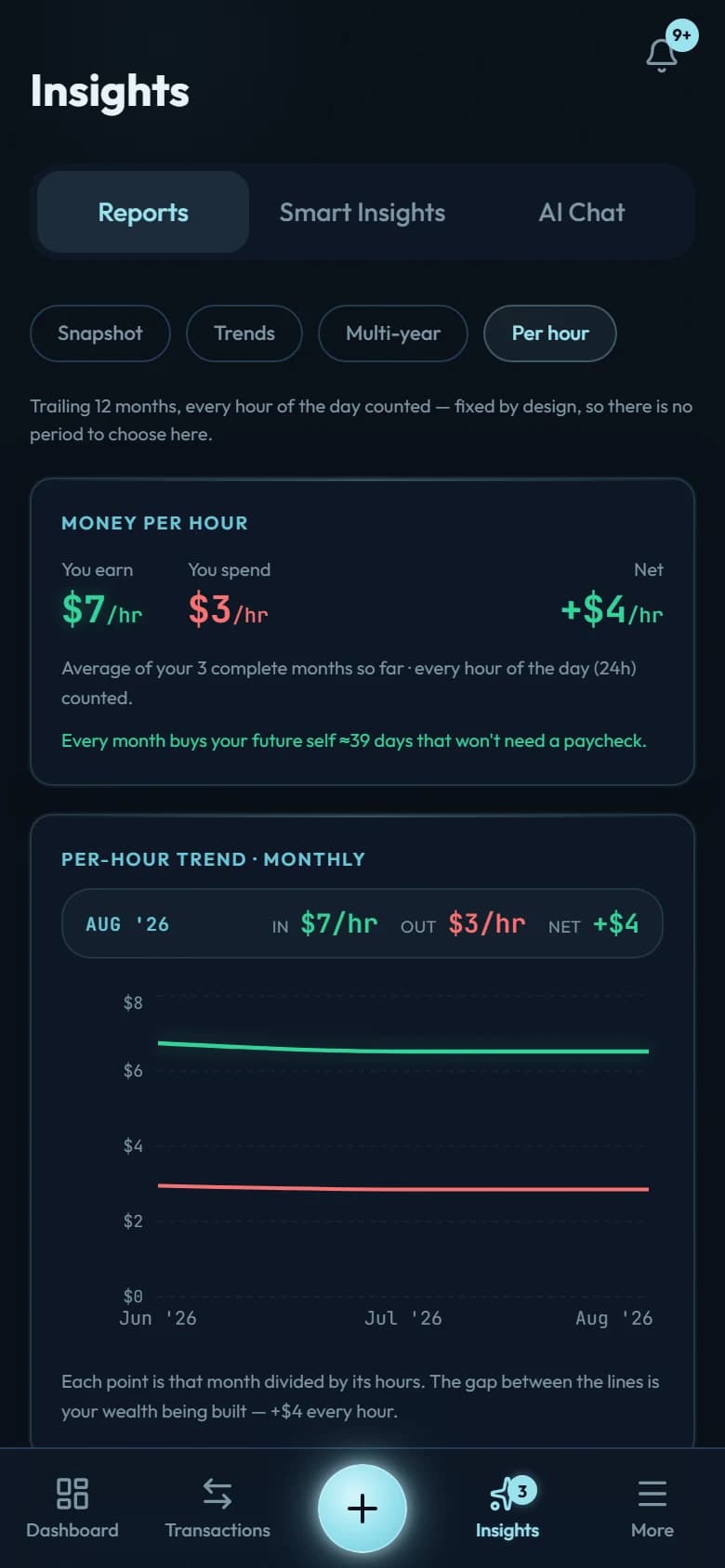
Wealth Mutant is a personal finance app. You note each payment you receive and each thing you spend, a few seconds each, and once 3 months have finished it turns up to your last 12 into what you earn and spend for every hour of your life. In What If you can try a 10% raise and see your earn rate rise by the hour. No bank login is ever shared, and the daily noting is what makes you notice where your pay goes. You pay for it once.
The help page on Money Per Hour covers how the 12-month window works and when the numbers first appear.
More free tools
- How many hours of my life does this cost?Hours of your life calculator
- How big should my emergency fund be?Emergency fund calculator
- When will I reach my savings goal?Savings goal calculator
- If I lost my job, how long would my savings last?Runway calculator
- How long will it take to double my money?Rule of 72 calculator
- When will I be debt free?Debt payoff calculator
- How much interest is my credit card costing me?Credit card interest calculator
- When is my credit card bill due?Credit card billing cycle calculator
- What does paying extra on my mortgage do?Extra mortgage payment calculator
- What is my net worth?Net worth calculator
- How much do I need to stop working, and when will I get there?FIRE calculator
- Can I stop saving for retirement yet?Coast FIRE calculator
Checked on 13 Nov 2026 against a separate re-calculation of every figure in the examples.
Next, run these sums on your own money
7 days free · no card needed