Free calculator
Rule of 72 Calculator: Doubling Time
The rule of 72 says money doubles in about 72 ÷ the yearly rate, in years. Type a rate to see that beside the exact answer, or type the years you have to see the rate you need.
Nothing you type is saved or sent anywhere, and there is nothing to sign up for. The only copy is one you print or download yourself.
Your answer, example
10.3years to double, by the rule of 72
At 7% a year, money doubles in about 10 years by the rule of 72.
Counted exactly
ln 2 ÷ ln(1 + 7%), interest added once a year. The ln key is on a scientific calculator.
10.2 years
The rule says 0.4% longer than the exact answer, under a month apart.
With an amount
By the rule, $10,000 at 7% a year becomes about $20,000 in about 10 years.
Worked out exactly, $10,000 at 7% for 10.29 years is $20,061.
From your numbers: a yearly rate of 7%, with $10,000 to try
Whole rates from 2% to 12%
| Yearly rate | 72 ÷ rate | Exact | Rule is off by |
|---|---|---|---|
| 2% | 36.0 | 35.0 | +2.8% |
| 3% | 24.0 | 23.4 | +2.3% |
| 4% | 18.0 | 17.7 | +1.9% |
| 5% | 14.4 | 14.2 | +1.4% |
| 6% | 12.0 | 11.9 | +0.9% |
| 7% | 10.3 | 10.2 | +0.4% |
| 8% | 9.0 | 9.0 | −0.1% |
| 9% | 8.0 | 8.0 | −0.5% |
| 10% | 7.2 | 7.3 | −1.0% |
| 11% | 6.5 | 6.6 | −1.5% |
| 12% | 6.0 | 6.1 | −1.9% |
Made in your browser when you click. Nothing is sent anywhere.
A plus sign means the rule says longer than the exact answer.
The same sum, turned around
Anything that grows by a percentage each year doubles on the same clock. Prices do, and so does a debt nobody pays.
Once you have 3 complete months, the app shows where your own saving pace leads in 10, 20 and 30 years.
See it in the appWhat this assumes
- The rate is the same every year, and the interest is added once a year.
- Nothing is added to the money and nothing is taken out.
- The rule is a shortcut. It is closest from about 4% to 12%, and says longer than the exact answer under about 7.8% and shorter over it.
- Tax, fees and rising prices are not counted. A rate here is a number you try, not a forecast: nobody can promise a return.
- For prices, the page counts a rise added once a year. For a card, it counts nothing paid. It reads a UK or EU rate as a full year's growth, and adds interest on any other APR at APR ÷ 12 each month.
What this is not for
This turns a growth rate into a doubling time. It does not say what rate you will get, and it cannot see money you add each month.
How the sum works
The rule of 72 is a quick way to see how long it takes to double your money. It says money doubles in about 72 ÷ the yearly rate, in years, with the rate as a plain number (7 for 7%). At 6% that is 72 ÷ 6 = 12 years. Turned around, doubling in 10 years needs about 72 ÷ 10 = 7.2% a year.
The exact answer uses a logarithm, because compound interest, interest that earns interest, grows by a power and not in a straight line. Years = ln 2 ÷ ln(1 + rate), with the rate as a decimal, so 7% is 0.07. Turned around, the rate in percent is (2 to the power of 1 ÷ years, minus 1) × 100. Both count interest added once a year.
Why 72? Interest added every instant would double money in 69.3 ÷ the rate years, because 100 × ln 2 is 69.3. Adding it once a year is slightly slower, so the number that would make the rule exact creeps up with the rate: about 70 at 2%, 72 at 8% and 73 at 12%. 72 sits in the middle of the rates people use, and it divides by 2, 3, 4, 6, 8, 9 and 12, which keeps the sum easy to do in your head.
Where it is close: from about 4% to 12% the rule is within 2% of the exact answer, at most about 4 months on one doubling. Under about 7.8% it says longer than the exact answer, and over it a little shorter. At 1% it says 72 years where the exact answer is 69.7.
It assumes one fixed yearly rate, with nothing added and nothing taken out. The error repeats with each doubling, so over many doublings it adds up.
An example
$10,000 grows 7% a year. 72 ÷ 7 = 10.3 years, so it doubles to about $20,000 in about 10 years. Counted exactly it takes 10.2 years, so the rule is 0.4% longer. Turned around, doubling in 10 years needs about 72 ÷ 10 = 7.2% a year, and exactly 7.18%.
Questions people ask
How do you use the rule of 72?
Divide 72 by the yearly rate. At 9% that is 72 ÷ 9 = 8 years for money to double. The amount does not matter, so 1,000 and 1,000,000 double in the same time.
How long does it take to double a sum of money?
It depends on the yearly rate, not on the sum. At 4% it takes about 18 years, at 7% about 10 and at 9% about 8. To double in 10 years you need about 7.2% a year.
Is the rule of 72 accurate?
From about 4% to 12% it stays within 2% of the exact answer, running a little long under about 7.8% and a little short above it. It is furthest out at the ends: at 1% the exact answer is 69.7 years, not 72.
Does the rule of 72 work for inflation and debt?
Yes, for anything growing by a percentage a year: at 3% inflation, prices double in about 24 years. Left unpaid at 22%, a card balance doubles in about 3.3 years by the rule. Counted exactly: 3.5 years for a UK or EU APR, which already counts interest on interest, and usually 3.2 elsewhere (a US, Canadian or Indian APR).
Does it work if I keep adding money?
No. The rule is for one sum with nothing added or taken out. Money added each month makes the pile grow faster than the rule says, and money taken out makes it slower.
Keep reading
What the app does with your own numbers
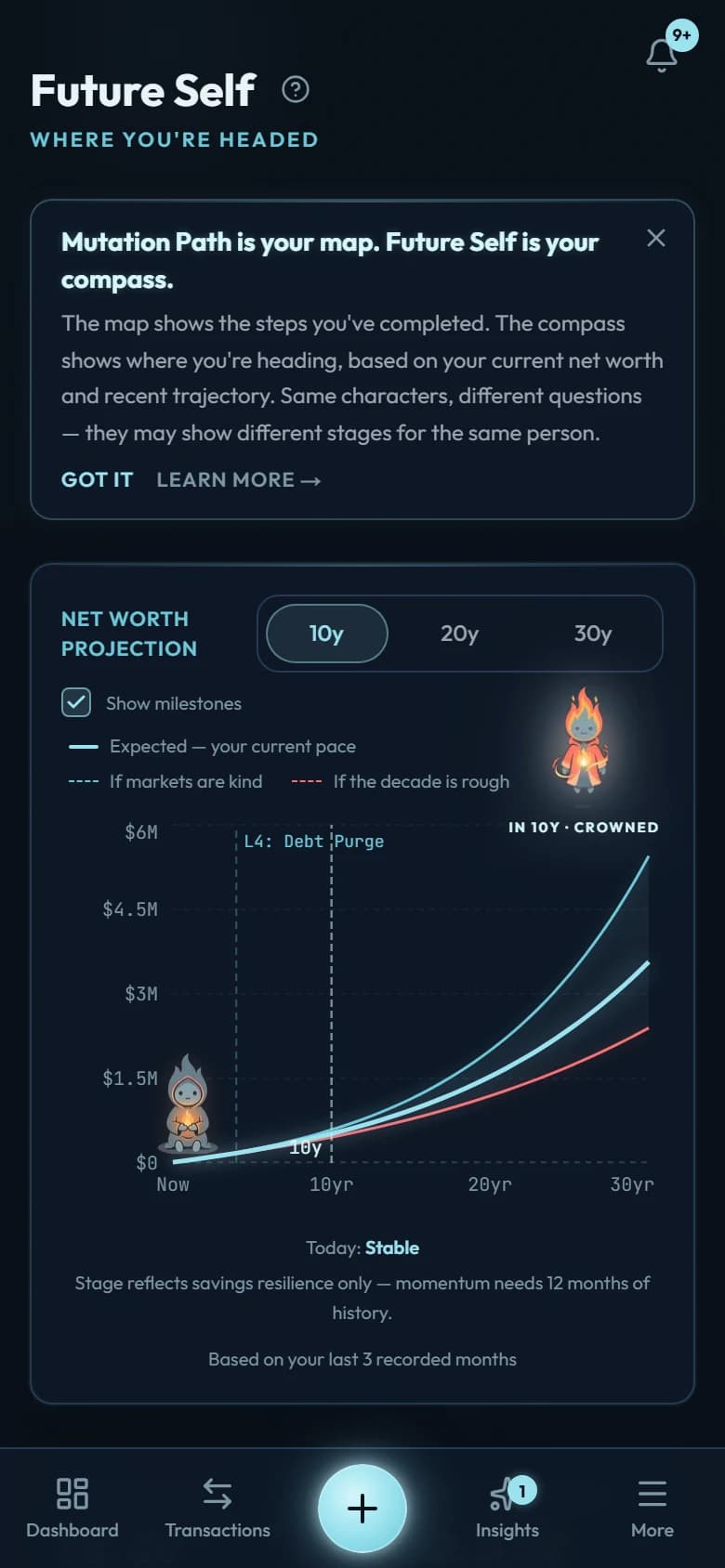
Wealth Mutant is the personal finance app we built for exactly this. Its Future Self view takes your saving pace from your own entries once you have 3 complete months, and carries it 10, 20 and 30 years ahead, with a kinder and a rougher line either side. You note each purchase yourself in a few seconds, a small daily habit that makes you notice, and no bank login is ever shared. You pay for it once.
The help page on Reading Your Projections covers the 10, 20 and 30 year views and when they first appear.
More free tools
- How much is my hourly pay a year?Hourly to salary calculator
- How many hours of my life does this cost?Hours of your life calculator
- How big should my emergency fund be?Emergency fund calculator
- When will I reach my savings goal?Savings goal calculator
- If I lost my job, how long would my savings last?Runway calculator
- When will I be debt free?Debt payoff calculator
- How much interest is my credit card costing me?Credit card interest calculator
- When is my credit card bill due?Credit card billing cycle calculator
- What does paying extra on my mortgage do?Extra mortgage payment calculator
- What is my net worth?Net worth calculator
- How much do I need to stop working, and when will I get there?FIRE calculator
- Can I stop saving for retirement yet?Coast FIRE calculator
Checked on 28 Oct 2026 against a separate re-calculation of every figure in the table and the example.
Next, run these sums on your own money
7 days free · no card needed