
The rule of 72 gives the years it takes money to double: divide 72 by the yearly rate. At 6% that is 72 ÷ 6 = 12 years, at 9% it is 8 years, and at 2% it is 36.
It is a shortcut for compound interest, which is interest that earns interest of its own, and it takes one division you can do in your head. It works on anything that grows by a percentage each year, so it also tells you how fast prices double and how fast an unpaid card balance does.
How does the rule of 72 work?
The rule of 72 formula is one division. Take the yearly rate as a plain number (8 for 8%) and divide 72 by it. The answer is the years until the money has doubled, if you leave it alone. The amount does not matter, so 1,000 and 1,000,000 double in the same time.
Say you hold 1,000 and it grows 8% a year. Divide 72 by 8 and you get 9, so you have about 2,000 after 9 years, 4,000 after 18 and 8,000 after 27. The sums work in any currency, so read the 1,000 as dollars, pounds or rupees. The Federal Reserve Bank of St. Louis teaches it the same way: "Simply divide 72 by the interest rate to determine the outcome."
The exact answer uses a natural logarithm (the LN button on a calculator): years = ln 2 ÷ ln(1 + rate), with the rate as a decimal. That turns any spreadsheet into a rule of 72 calculator: with the rate in cell A1 written as 8%, type =LN(2)/LN(1+A1). The free Rule of 72 calculator shows both answers for any rate you type. Here are the 2 answers side by side, in years:
| Yearly rate | 72 divided by rate | Exact | Rule is off by |
|---|---|---|---|
| 1% | 72.0 | 69.7 | +3.4% |
| 2% | 36.0 | 35.0 | +2.8% |
| 3% | 24.0 | 23.4 | +2.3% |
| 4% | 18.0 | 17.7 | +1.9% |
| 5% | 14.4 | 14.2 | +1.4% |
| 6% | 12.0 | 11.9 | +0.9% |
| 7% | 10.3 | 10.2 | +0.4% |
| 8% | 9.0 | 9.0 | −0.1% |
| 9% | 8.0 | 8.0 | −0.5% |
| 10% | 7.2 | 7.3 | −1.0% |
| 11% | 6.5 | 6.6 | −1.5% |
| 12% | 6.0 | 6.1 | −1.9% |
A plus sign means the rule says longer than the exact answer.
How accurate is the rule of 72, and when do 69 or 70 fit better?
Closer than you might expect. From 4% to 12% it is within 2% of the exact answer, which is at most about 4 months on one doubling, and at 8% the 2 answers match to the first decimal. Below 8% the rule runs long (at 1% it says 72 years against an exact 69.7). Above 8% it runs short.
The number 72 is a compromise. When interest is added continuously, every instant, the exact answer is 69.3 ÷ the rate, because 0.693 is ln 2. Adding it once a year is slightly slower, so the number that would make the rule exact creeps up as the rate rises: about 70 at 2%, 72 at 8% and 73 at 12%. That puts 72 in the middle of the rates people use, and it divides evenly by 2, 3, 4, 6, 8, 9 and 12, which keeps it easy to do in your head.
Switch to 70 for rates of 4% or less, and when interest is added monthly. When it is added daily, as on some cards, 69.3 is almost exact, because daily is so close to continuous. Take a card rate of 22.36% a year, added monthly: the exact answer is 3.13 years, 70 ÷ 22.36 gives 3.13, and 72 gives 3.22.
Stretch the rule over many doublings and the error multiplies. The St. Louis Fed's own example is 5,000 at 12% for 36 years: the rule says 6 doublings, so 320,000, where the exact figure is about 295,680, roughly 8% lower. The same page states the limit plainly: "The Rule of 72 is intended as an approximation."
How do you use the rule of 72 backwards?
Divide 72 by the years you have, and you get the yearly rate you need. To double in 10 years you need about 72 ÷ 10 = 7.2% a year (the exact rate is 7.18%). To double in 6 years you need about 12% (exact: 12.25%).
The second answer is a warning: a deadline that needs a double-digit rate every year is one nobody can promise, so the safer fixes are more time or a bigger monthly saving.
See where your own pace leads
Future Self in Wealth Mutant carries your real saving pace years ahead, so you work from your numbers and not a textbook example.
No card needed.
What does the rule of 72 say about inflation?
Inflation is the yearly rise in prices. When prices double, the same money buys half as much, so 72 ÷ the inflation rate gives the years until your money buys half of what it does now.
Central banks publish targets. The Federal Reserve aims for 2% a year over the longer run, the Bank of England has a 2% target set by the Government, and the Bank of Canada aims for the 2% midpoint of a 1% to 3% range. In India the Government sets the Reserve Bank's target at 4%, with a band from 2% to 6%. These are targets, not forecasts: UK inflation was 3.5% in the 12 months to September 2026, according to the Office for National Statistics.
At 2%, prices double in about 36 years (35 counted exactly). At 3.5% it takes about 21 years (20 counted exactly), and at India's 4% about 18.
What counts is the rate after inflation. Money growing 7% a year while prices rise 3% doubles what it can buy in about 72 ÷ 4 = 18 years, not the 10 that 7% alone suggests.
How fast does a credit card balance double?
Much faster than savings. The Federal Reserve's figure for August 2026 (preliminary) puts the average yearly rate (the APR) on card accounts at US banks that were charged interest at 22.36%. Leave a $1,000 balance with no payments, no new purchases and no fees, and the rule gives 72 ÷ 22.36 = 3.2 years to $2,000. Counted exactly, with interest added monthly, it is 3.1 years.
Cards compound too. The US Consumer Financial Protection Bureau says some issuers add each day's interest to the balance, "which means that interest is compounding on a daily basis." A real balance moves differently, because you pay something each month and may keep spending, but the doubling time shows what carrying one costs. If you pay only the minimum each month, the guide to the minimum payment shows what that adds up to.
The rule works the same in the UK, Canada and India. The exact figure differs in the UK, because a UK APR already includes the compounding: at 24%, it is 3.2 years against the rule's 3.0. Some Indian cards quote the rate per month: SBI Card's terms list up to 3.75% a month, which it gives as 45% a year (3.75 × 12), and 72 ÷ 45 = 1.6 years. What is APR on a credit card covers how the UK and India show the rate, and how to calculate credit card interest counts one month's interest day by day.
Paying a balance down at 22.36% is like earning 22.36% on that money, which is why a card's doubling time matters more than a savings account's.

None of those 3 rates is yours to set. What you steer is how much you keep and how soon, and the rule cannot see that.
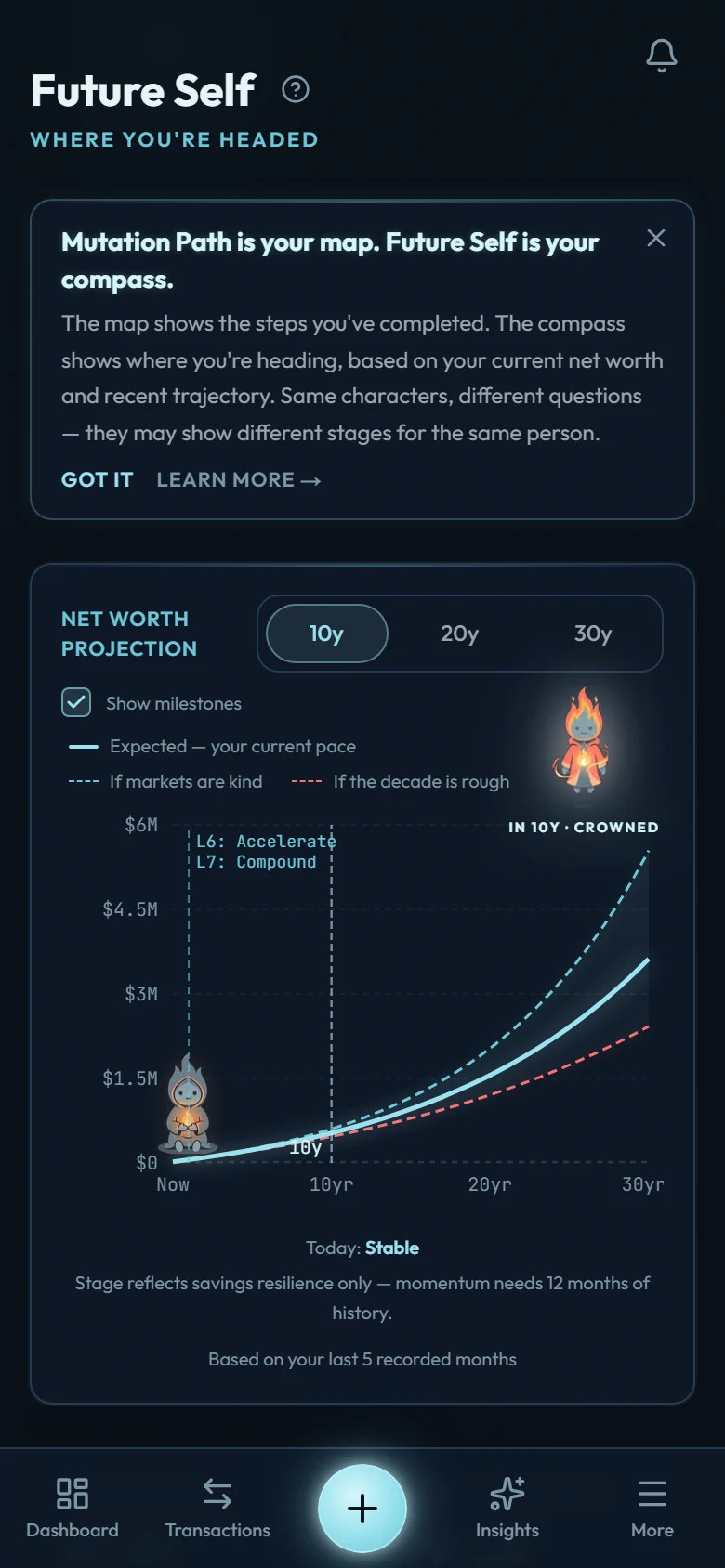
Wealth Mutant is the personal finance app we built for exactly this. Its Future Self view takes the saving pace from your own entries and shows where it leads in 10, 20 and 30 years, at a return you choose, with a lower and a higher line around it. You note each purchase yourself in a few seconds, a small daily habit that makes you notice where the money goes, and no bank login is ever shared. You pay for it once.
Put your own numbers on the curve
Future Self, your accounts and your spending in one personal finance app. One payment, and it is yours.
Buy — $99 onceHow to use the rule of 72 on your own money
Find the rate
For savings, the yearly rate your account states. For a loan or card, its yearly interest rate (on a US card, the APR). For prices, the inflation rate. For investments, a rate you assume, since nobody can promise one.
Divide 72 by it
Use 70 for rates of 4% or less and for interest added monthly, and 69.3 for interest added daily. The answer is the years to double.
Count the doublings you have time for
Divide your years by the answer. At 6%, 36 years is 3 doublings, so 1,000 becomes about 8,000.
Put in your own pace
The rule needs one lump sum, and your saving is a stream. The part you steer most directly is your savings rate, the share of what you earn that you keep. Future Self carries your pace forward once you have 3 complete months of entries.
Check your finish line
The free Coast FIRE calculator finds your Coast FIRE number and the month you could stop adding to retirement savings. Coast FIRE explains the idea.
Why does time do more of the work than the amount?
Once you think in doublings, starting early becomes a sum you can check. At 8% money doubles every 9 years, so 1,000 becomes 2,000, 4,000, 8,000 and then 16,000 after 36 years. The last 9 years add 8,000, more than the first 27 combined (7,000). Waiting one doubling halves what you finish with, whatever you start with.
Regular saving follows the same pattern. Take 7% a year, with interest added monthly. Saving 200 a month from age 25 to 65 comes to about 525,000, of which 96,000 is what you paid in. The same 200 from 35 comes to about 244,000. A 10-year wait, roughly one doubling at 7%, costs about 54% of the result, and even 400 a month from 35 reaches only about 488,000.

The race depends on the rate you assume: at 6% the doubled deposits finish about 1% ahead, and at 5% about 9% ahead. The cost of waiting holds at every rate from 4% to 8%: 10 years costs 41% of the result at 4% and 57% at 8%.
You can always add more money later. Nobody, at any income, can add more earlier.
What changes is the question. "How much do I need to start with?" becomes "how many doublings can I fit in?" At 7%, 50 a month from 25 to 65 (24,000 paid in) ends near 131,000, while 400 a month for only the last 10 years (48,000 paid in) ends near 69,000.
Common questions
How long does it take to double $10,000?
Divide 72 by the yearly rate. At 4% it takes about 18 years, at 7% about 10 and at 9% about 8, whatever the starting amount.
How do I calculate the rule of 72 in Excel or Google Sheets?
Put the rate in A1 as a percentage, such as 8%. The rule is =72/(A1*100), which gives 9. The exact answer is =LN(2)/LN(1+A1), which gives 9.006.
How long does it take to double money in the stock market?
Nobody can say, because returns are not a fixed rate. At the roughly 10% a year that US large-company stocks (the S&P 500 with dividends) grew from 1928 to 2025, before inflation, tax and fees, the rule gives about 7 years. But 26 of those 98 years were losses, the worst at −43.8% (Aswath Damodaran, NYU Stern). That is history, not a forecast.
Does the rule of 72 work if I keep adding money?
No. It is for one sum with nothing added or taken out. Deposits make the pile grow faster than the rule says, and withdrawals slower, so use a calculator that takes deposits, or Future Self, which uses your own saving pace.
Start with one number: the yearly rate on your savings, your loan or your card, and divide 72 by it. Then see your own pace in Future Self, and the tour shows what else the app does.