
How to become a millionaire has a plain answer for most people: save a set amount every month, invest it, and give it decades. Clear any high-interest debt early. You do not need one big win.
Start from nothing, save $1,000 a month at 6% a year, and you pass $1,000,000 in 30 years. Save $500 a month and it takes about 40.
Nobody can promise 6%, so the table below tries 3 returns and 5 monthly amounts, and every assumption is written next to it. If you searched for how to get rich, the same table applies: the route you can check is the slow one.
How to become a millionaire: how many years does it take?
This table gives the years to reach $1,000,000 from a balance of $0, for 5 monthly amounts at 3 yearly returns. Read across a row to see what the return changes, and down a column to see what saving more changes.
| Saved each month | At 4% a year | At 6% a year | At 8% a year |
|---|---|---|---|
| $200 | 71.9 | 54.5 | 44.4 |
| $500 | 51.1 | 40.1 | 33.4 |
| $1,000 | 36.8 | 30.0 | 25.6 |
| $1,500 | 29.3 | 24.5 | 21.3 |
| $2,000 | 24.6 | 21.0 | 18.4 |
Years are rounded to 0.1. You save the same amount at the end of every month, the yearly return is added monthly (1/12 of it each month), and tax, fees and inflation are left out. These are assumptions: real returns change from year to year.
Two things stand out. Saving 4 times as much cuts the time by only about half: at 6%, $500 a month takes 40.1 years and $2,000 takes 21.0.
And most of the million is growth. At $1,000 a month and 6% you pay in $360,000 over the 30 years, and about $645,000 more is growth. That is compounding: past growth earns growth too.
Take the growth away and $2,000 a month needs 41.7 years to reach $1,000,000, about twice the 21 it takes at 6%.
The first years look slow. At $1,000 a month and 6% you hold about $164,000 after 10 years, $462,000 after 20 and $1,005,000 after 30, so the last 10 years add more than the first 20 put together.

Want a millionaire calculator for your own numbers? One spreadsheet formula does it. Put the yearly return in A1 (as 6%), what you save each month in A2 and your target in A3 (1000000, or your own finish line), then type this in another cell for the years:
=ROUNDUP(NPER(A1/12,-A2,0,A3),0)/12
NPER gives the number of monthly payments, ROUNDUP counts the whole month in which you cross the line, and dividing by 12 turns months into years. With 6%, 500 and 1000000 it gives 40.08 years (481 months), the 40.1 in the table. Excel and Google Sheets both have NPER, and your saving goes in as a negative number because to the spreadsheet it is money leaving you.
The free savings goal calculator gives the month for your own numbers, with every milestone on the way to $1,000,000. It reads 6% as exactly 6% over a year, while this table, like Future Self in Wealth Mutant, adds 1/12 of 6% each month, so the calculator's dates come a few months later, up to about a year for the smallest amounts.
What return should you assume?
Nobody knows, which is why the table has 3 columns. History gives a range. In Aswath Damodaran's table of US returns at NYU Stern, the S&P 500 with dividends (an index of 500 large US companies) returned about 10% a year from 1928 to 2025, and 10-year US government bonds about 4.5%. That is before inflation, tax and fees, and it is history, not a forecast.
The ride was rough. Stocks fell in 26 of those 98 years, by 43.84% in the worst one (1931). Our own calculation from his yearly figures shows the worst 20-year stretch, 1929 to 1948, averaged only 2.4% a year.
It is also one country's market over one stretch of history. The 4%, 6% and 8% columns run from near the bond record to below the stock record, and none of them is a floor: even 4% a year is more than stocks returned in their worst 20 years.
See what your own saving adds up to
Wealth Mutant's Future Self draws your net worth decades ahead from the saving you actually do.
No card needed.
What will $1,000,000 buy in 30 years?
Less than it buys now. Prices rise most years (inflation), so each dollar buys a little less every year.
Central banks aim to hold inflation at a set rate: 2% a year at the Federal Reserve and the Bank of England, 2% at the Bank of Canada (the middle of a 1% to 3% range), and 4% at the Reserve Bank of India, within a 2% to 6% band. Prices can run ahead of the target for a while: the Office for National Statistics measured UK prices 3.5% higher in September 2026 than a year earlier.
At 2% a year, prices rise by a factor of 1.81 over 30 years (1.02 multiplied by itself 30 times). So $1,000,000 in 30 years buys what about $552,000 buys today, and you would need about $1,811,000 then to match $1,000,000 now. At India's 4% target the factor is 3.24, and $1,000,000 buys what about $308,000 does today.
To plan in today's money, subtract inflation from the return and read that column. With 6% growth and 2% inflation, read the 4% column. It assumes your monthly saving rises with prices each year.
Do millionaires have anything in common?
One large survey of millionaires' habits comes from Ramsey Solutions, a US company that sells financial advice. Its National Study of Millionaires asked more than 10,000 US millionaires about their money from November 2017 to January 2018. By its count:
- 75% said regular, consistent investing over a long period was the reason for their success.
- 79% had received no inheritance at all, and only 3% inherited $1 million or more.
- Only 31% averaged $100,000 a year over their career, and 1 in 3 never earned $100,000 in any single working year.
That fits the table, but it does not prove a cause. The answers are self-reported, part of the sample came from the company's own research panel, and the survey asked only people who got there, so it cannot say how many others did the same and fell short. How the spending side looks day to day is the subject of stealth wealth.
For scale, the Federal Reserve's 2025 Survey of Consumer Finances found that the middle US family had a net worth (what you own minus what you owe) of $215,900. A net worth of $1,000,000 was more than 3 in 4 US families had, though still short of the top 10%, which began at $2,539,200. Average net worth by age goes through the numbers by age group.
A table cannot see your own pace, and 30 years is a long time to keep one going without seeing where it leads.
Wealth Mutant is the personal finance app we built for exactly this. Its Future Self view projects your net worth 10, 20 and 30 years out from your own recent months, at a return you set, and its What If panel redraws the line when you try saving more each month. You note each purchase yourself in a few seconds, a small daily habit that makes you notice where the money goes, and no bank login is ever shared. You pay for it once.
Watch the line move when your saving does
Your net worth, your spending and a timeline built from your own pace, in one personal finance app.
Buy — $99 once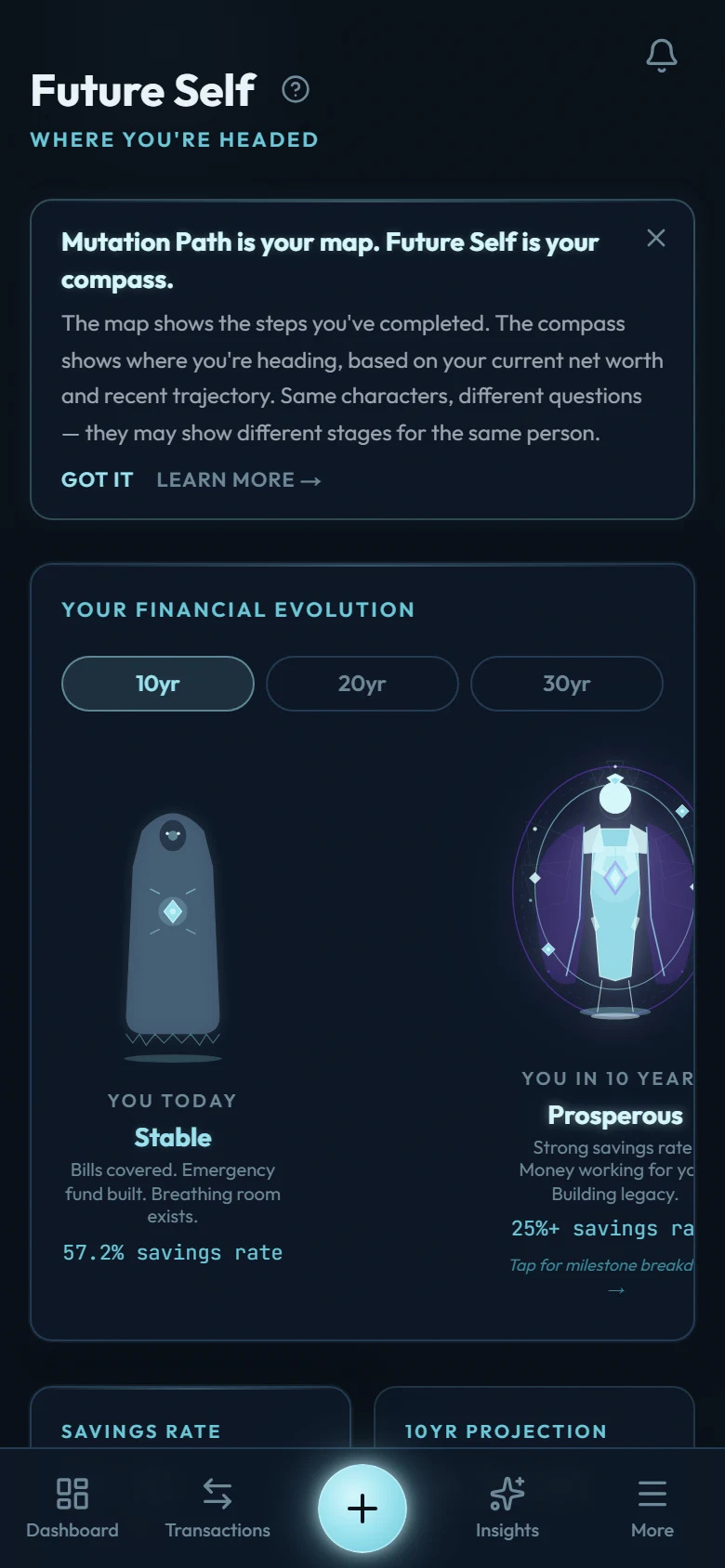
What helps you become a millionaire, in order?
These 5 habits do most of the work. Deal with them in this order.
Save a share you can keep up, and start now
The monthly amount and the years do most of the work, and the years are the part you cannot buy back: save for 20 years instead of 30 and the same $1,000 a month ends at about $462,000 instead of about $1,005,000.
Save a fixed share of your pay (that share is your savings rate), and when you get a raise, raise the saving before the spending. Lifestyle creep is how raises disappear.
Take the employer match, where there is one
A match means your employer adds money when you save. The IRS says employers can contribute to a 401(k), and GOV.UK says that in most cases your employer also adds money to your workplace pension. If your employer adds $250 to your $500, you are saving $750 a month, and the 6% wait falls from 40.1 years to 34.1.
In Fidelity's Q2 2026 data, more than 8 in 10 of its 401(k) participants (81.2%) saved enough to get their employer's full match.
Clear high-interest debt before you invest more
A card balance is a return in reverse. The Federal Reserve's figure for August 2026 (preliminary) puts the average card rate at US banks at 22.36% on the accounts that were charged interest. Paying off a balance at that rate saves you 22.36% a year on that money, more than any column in the table assumes. Avalanche vs snowball covers the order to pay in.
Keep fees low
A fund's fee comes out of your return every year. A 1% fee turns 6% into about 5%, and at $1,000 a month that moves the million from 30.0 years to 32.9. Check what your funds charge, and what any adviser or platform adds.
Do not cash out
The money only works if it stays. A 40% fall needs a 67% rise to get back, and the stock record above had 26 down years in 98. Selling after a fall locks the loss in. Taking money out for a purchase also removes the years it would have grown, and some retirement accounts have their own rules for early withdrawals, so check yours first.
Can you become a millionaire in pounds, rupees or Canadian dollars?
Yes. The sums scale with the amount, so £500 a month at 6% reaches £1,000,000 in the same 40.1 years as $500 reaches $1,000,000, and Rs 5,000 a month reaches Rs 1 crore (Rs 10,000,000) in the same 40.1. What changes by country is the return you can earn and the inflation you face: India's target is 4%, for example, against 2% in the US, the UK and Canada.
Where the money sits changes too: the 401(k) and IRA in the US, the workplace pension and ISA in the UK, the RRSP and TFSA in Canada, and the NPS and PPF in India. Each has its own limits and tax rules, which change, so read your own country's official page first. This article gives no tax advice.
How do you know you are on track?
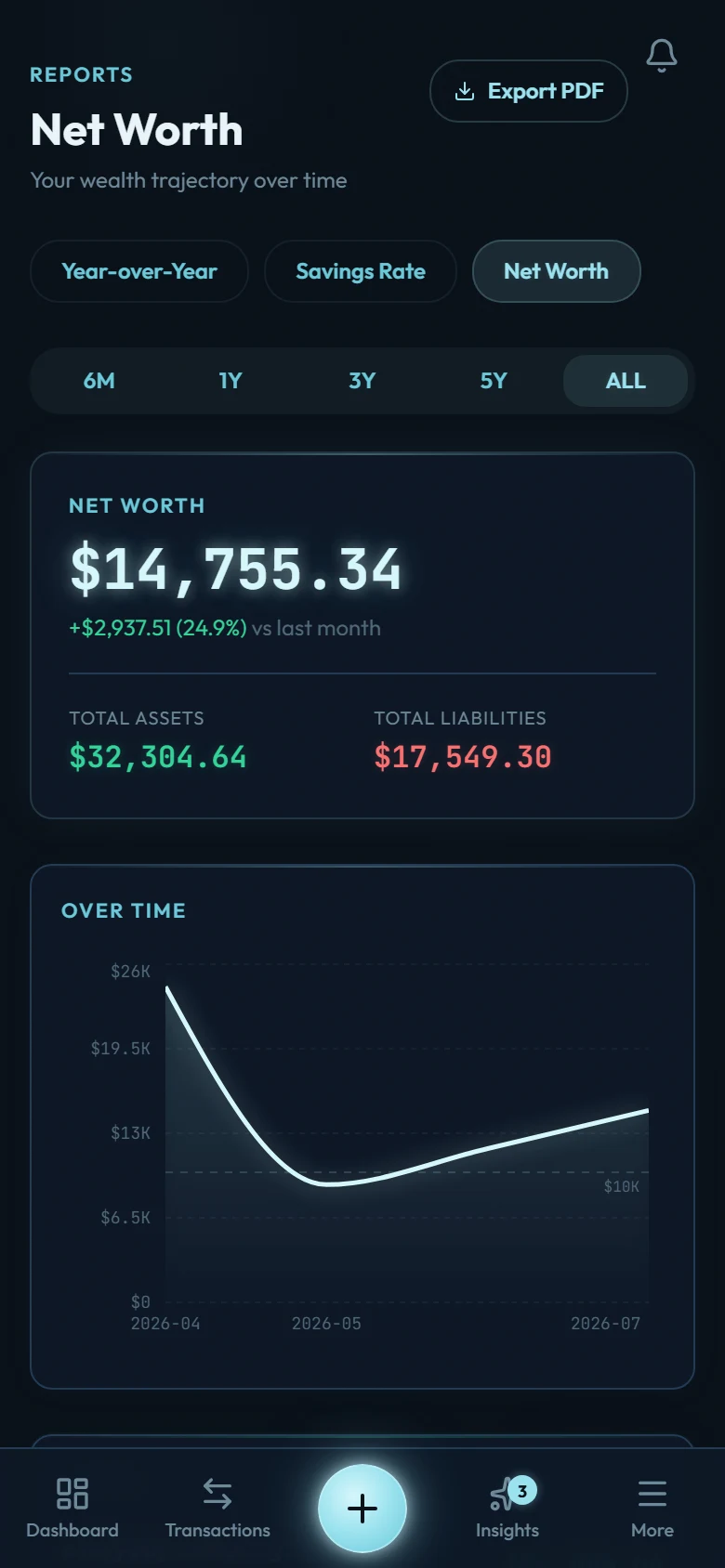
Check your net worth once a month. Debts count against it, so if you start in debt the first job is to reach zero. Then compare what you have set aside with where your plan would put you by now: at $1,000 a month and 6%, about $70,000 after 5 years and $164,000 after 10. A few months ahead or behind mean little. Look at the direction over a year or more.
Common questions
How long does it take to become a millionaire from nothing?
It depends on the monthly amount and the return. From $0 at 6% a year, $500 a month takes 40.1 years, $1,000 takes 30.0 and $2,000 takes 21.0. Starting with $50,000 already saved cuts the $500 wait to 33.3 years. Nobody can promise the return.
Can you become a millionaire on a $50,000 salary?
On paper, yes, with a steady share saved for decades. At 6% a year, saving 10% of $50,000 ($417 a month) takes 42.9 years, 15% ($625) takes 36.8 and 20% ($833) takes 32.6. A raise that lifts your saving shortens it, and so does an employer match.
How much a month do I need to save to become a millionaire in 20 years?
From $0, about $2,165 a month at 6%, $2,727 at 4% or $1,698 at 8%. For 30 years it is $996 at 6% ($1,441 at 4%, $671 at 8%). For 10 years it is $5,467 to $6,792 a month at those returns, so a million in 10 years mostly needs a big income or a head start.
What is the fastest way to get rich?
There is no reliable shortcut. A windfall can shorten the wait, but nobody can plan on one. A higher income helps when the extra goes to saving. Beyond that, you control how much you save, how long you stay invested and what you pay in interest and fees.
Your first step is one number: what you can save each month, and its row in the table. Then set it against your own finish line, which depends on what you spend: Coast FIRE explains the finish lines, and the free Coast FIRE calculator works yours out from your age, what you have invested and what you plan to spend. After 3 complete months of entries, Future Self draws where your own pace is heading, and the tour covers debts, budgets and the 9 levels. Levels of wealth covers the stages on the way, and the rule of 72 the doubling behind the curve.