
There is no official scale for the levels of wealth. Here is one clear way to see them: 9 levels, from knowing your numbers to not needing to work, each with a plain test you can check against your own money.
Most lists sort people by net worth (what you own minus what you owe) or by lifestyle, and they disagree. These 9 sort by what to do next, so you can find where you are and see what the next level asks of you.
If you are not sure where you stand, that is normal. Level 1 takes only 5 saved transactions.
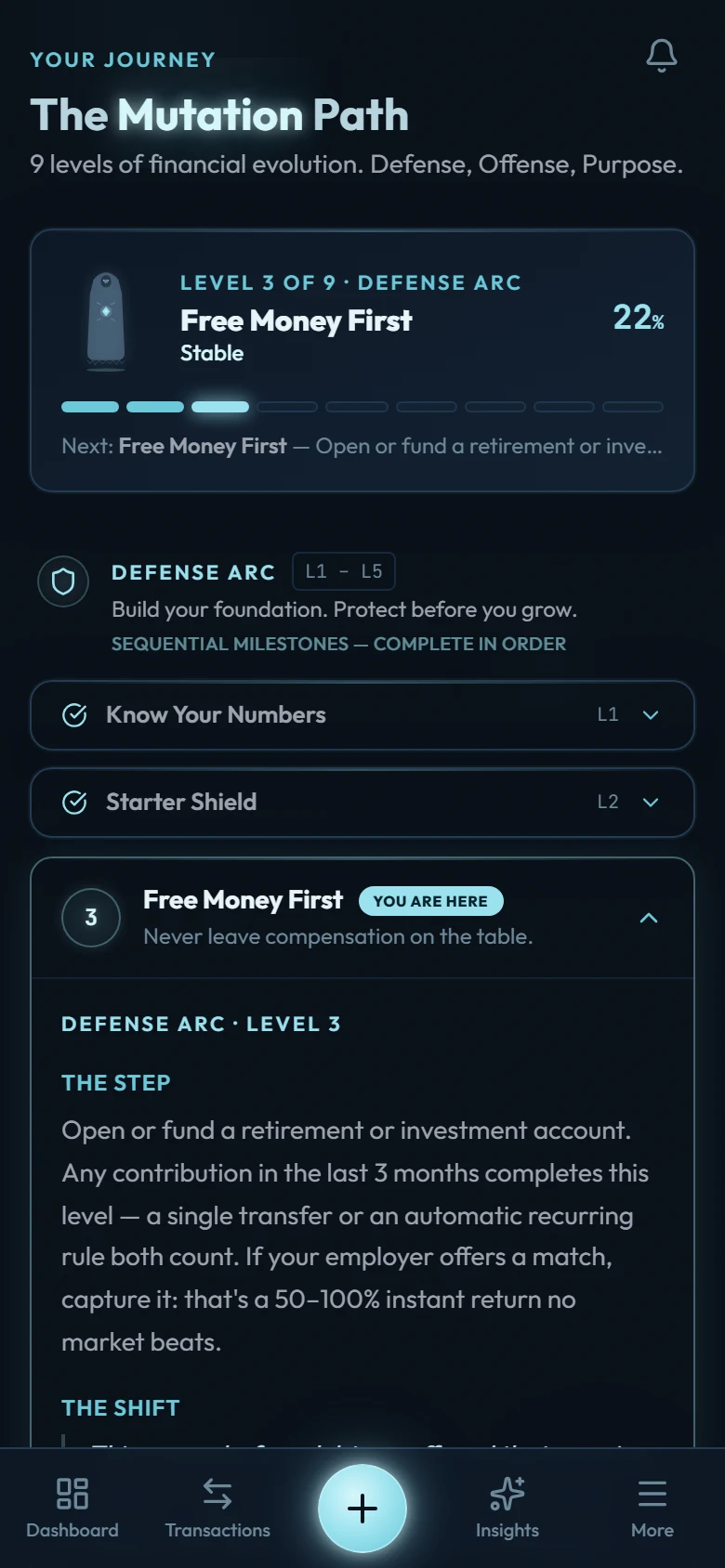
What are the levels of wealth?
Levels of wealth, or stages of wealth, are named steps people use to say how far along they are with money. Two well-known scales:
- Nick Maggiulli's Wealth Ladder has 6 levels by net worth, each 10 times the one before, from under $10,000 to $100 million or more.
- Kevin Kelly's 9 classes describe how wealth feels, from no longer watching grocery prices to feeling that everything is free.
Neither is official. The closest thing to an official view comes from the Consumer Financial Protection Bureau (CFPB), a US government agency. Its 2015 report on financial well-being found that well-being runs along a sliding scale "not strictly aligned with income level".
Most tests in the 9 levels here are sized by your own average spending or income, so the same test fits any income. They are the Mutation Path inside Wealth Mutant, our personal finance app, and they work in a notebook too.
They sit in 3 arcs: Defense (Levels 1 to 5) builds protection, Offense (6 and 7) grows your net worth, and Purpose (8 and 9) gives the money a job. They are not a strict ladder, as the picture shows.

What does each level ask of you?
Where a level uses an average, that is your monthly spending or income averaged over your last 12 months of entries, so the targets move with your life. Here are all 9 for Alex, who earns $4,000 and spends $3,000 a month on average: $48,000 of income and $36,000 of spending a year. The sums work in any currency.
| # | Level and test | For Alex |
|---|---|---|
| 1 | Know Your Numbers: save 5 transactions, typed in or imported. No deadline | 5 transactions |
| 2 | Starter Shield: 1 month of your average monthly spending, in the accounts you count as your emergency fund | $3,000 |
| 3 | Free Money First: money going into, or already sitting in, a retirement or investment account | Any balance counts |
| 4 | Debt Purge: nothing owing, apart from a home loan or a loan you cannot clear early. No card that carried interest on any of its last 3 statements, no drawn overdraft | Nothing owing |
| 5 | Full Fortress: 6 months of your average monthly spending, in the same accounts | $18,000 |
| 6 | Accelerate: way one is net worth that grew by at least 15% of a year of your average income over the last 12 months. Way two is net worth of at least 10 times your average yearly spending | $7,200 of growth, or $360,000 |
| 7 | Compound: the same 2 ways with higher bars, at least 25% of a year of your average income or at least 15 times your average yearly spending | $12,000 of growth, or $540,000 |
| 8 | Fund the Future: a long-term goal dated 10 or more years away, with 3 months of your average spending in its linked account | $9,000 |
| 9 | Financial Independence: way one is passive income that covers your spending, with net worth of at least 10 years of your average spending. Way two is net worth of at least 25 times your average yearly spending | $3,000 a month of passive income plus $360,000, or $900,000 |
Most targets are multiples of your own spending, so when your spending falls, they fall with it. At $2,500 a month, Alex's Level 5 drops from $18,000 to $15,000 and the second way of Level 9 from $900,000 to $750,000.
See which level you are on
Add your accounts, loans and goals to Wealth Mutant and the Mutation Path shows which levels hold, and what the next one needs from you.
No card needed.
Levels 1 to 5: how do you get protected first?
Defense comes first because everything after it leans on it. Levels 2, 3 and 4 are open from day one, so you can build a buffer while you clear a card, and Level 5 waits for all 3. The Defense guide has every rule.
Level 1: Know Your Numbers
Save 5 transactions, typed in or imported from another app. Both count, with no deadline or streak, and with normal use it is done within the first few days. Every later target is sized from your own entries, which is why looking is the first money habit.
Level 2: Starter Shield
The buffer is 1 month of your average monthly spending, set aside for surprises. From the start, your cash, checking, wallet and savings accounts all count, and you can add or remove any account that is not a retirement account or a debt. When your first complete month of spending is recorded, the level gives a first reading, marked provisional. The target settles at 3 complete months.
Level 3: Free Money First
Any one of 3 things passes: a transfer or income into a retirement or investment account in the last 3 months, a recurring contribution rule at least 14 days old, or an account that already holds a positive balance. There is no minimum.
Account names vary by country, such as a 401(k) or IRA in the US, a workplace pension in the UK, an RRSP in Canada or EPF in India, and the level treats them alike. If your employer matches what you put in, take that first. The level never tests for a match.
Level 4: Debt Purge
Three things count against this level, and a home loan is not one of them:
- any other loan still owing money, such as personal, auto, education or payday;
- a card that carried interest on any of its last 3 closed statements;
- a drawn overdraft or line of credit.
A card clears only after 3 clean statements in a row, so paying it to zero today does not lift it early. A loan you mark as one you cannot clear early is exempt too. The type of debt decides, and the interest rate is never read.
Interest is money taken from your future. The Federal Reserve's report on its 2025 Survey of Consumer Finances puts the average credit card interest rate at 21.4%, so a $3,100 balance, the median among US families that carry card debt, costs more than $660 a year if it stays put. What the minimum payment really costs and avalanche vs snowball help you clear it.
Level 5: Full Fortress
The target is 6 months of your average monthly spending, in the same accounts. It is the last level of Defense, so it opens only when Levels 2, 3 and 4 all hold, and the target moves when your spending does. How much emergency fund you need covers where to keep it.
Levels 6 to 8: how do you grow, and what is it for?
Level 6 opens once Level 5 holds, and the work turns from protecting your money to growing it. Levels 7 and 8 then both open from Level 6. The guide to Levels 6 to 9 has every rule.
Levels 6 and 7: Accelerate and Compound
Each has 2 ways to pass, and the app judges whichever is further along. Way one is how much your net worth grew over the last 12 months, measured against a year of your average income. Saved money, investment growth you record and debt you pay down all count. Way two is the net worth you already have. Level 7 sets a higher bar on both, as the table shows.
Way one needs a full year of entries, and way two can be read after 3 completed months. If your net worth grows only by what you save, way one is just your savings rate, the share of your income that stays with you. Future Self shows what your pace buys at 10, 20 and 30 years, and the Coast FIRE calculator finds when you could stop adding to your retirement savings.
Level 8: Fund the Future
This level asks you to save for something 10 or more years away, for you, your family or your children: a child's education fund, a future home, a health fund for your parents. You mark the goal as long-term, which the app allows once its target date is that far out, and link it to an account.
The level passes when that account holds 3 months of your average spending. The money has to be there: a number typed into the goal never counts. Goals and funding shows how.
Financial freedom or financial independence: what is the goal?
People use the two phrases for the same finish line, and they are not quite the same thing.
Financial independence (FI) is the part you can count: your money pays for your life, so working becomes a choice. It is Level 9 here, with 2 ways. Way one needs both parts to hold. Passive income (money that arrives without your working, such as dividends, rent or royalties, from categories you mark as passive) covers your spending on a 12-month average, and your net worth is at least 10 years of your average spending.
Way two is a net worth of at least 25 times your average yearly spending, $900,000 for Alex. That is the 4% rule turned around: 4% of $900,000 is $36,000, Alex's yearly spending. Treat 25 times as a rough guide for planning.
Financial freedom is the wider, everyday phrase: it includes FI and starts earlier. The CFPB lists "the financial freedom to make the choices that allow you to enjoy life" as one of the 4 parts of financial well-being. There is no official list of levels of financial freedom either.
Some people at Level 9 keep working because they like it; what changes is that the choice is theirs. Lean, Coast, Barista and Fat FIRE (financial independence, retire early) name other finish lines, nearer or further than this one, and What Is Coast FIRE? compares them.
Knowing your own level takes numbers from several places at once: accounts, debts, goals and a year of what you earn and spend. Wealth Mutant is the personal finance app we built around exactly these 9 levels. Its Mutation Path reads each level from your own accounts, loans, goals and entries, shows which ones hold today and names the next step. You note each purchase yourself in a few seconds, a small daily habit that makes you notice where the money goes, and no bank login is ever shared. You pay for it once.
Your level, checked every day
Wealth Mutant is a personal finance app with the Mutation Path built in: it shows your level, what the next one needs and where your pace leads.
Buy — $99 onceHow does Wealth Mutant read your level?
The Mutation Path judges each level from your accounts, transactions, loans and goals as they already are, and checks again every day. A few things it cannot see are yours to set: which accounts count toward your emergency fund, which loans you cannot clear early, which income is passive and which goals are long-term. Until you have added a loan, a card or an overdraft, the Debt Purge sheet asks whether you have any, and I have no loans or cards answers it in one tap.
The date you first reach a level becomes permanent within a month. Beside it, every level from 2 up carries a live reading of whether it still holds today. A hard year can put a level on hold, and nothing you built is lost.
The Path is the map of where you have been, and Future Self is the compass for where your pace leads. On the dashboard, the Mutation Path card shows your level and its arc, with a bar toward the next step where the level has an amount to reach, or a line naming what is in its way.
Where do most people get stuck on the levels of wealth?
No survey measures people against these 9 levels, so nobody can say where most people sit. Public surveys do cover the first steps, with different yardsticks, so read each row within its own country.
| Level | What the surveys show |
|---|---|
| 2 | US, 2025: asked about a $400 emergency, 63% of adults said cash or its equivalent would cover it, and 55% said they had 3 months of expenses set aside (Federal Reserve, Economic Well-Being of U.S. Households in 2025, 13 May 2026). UK, 2024: 9% could cover living costs for a week at most if their main income stopped (FCA Financial Lives 2024) |
| 3 | US, 2025: 54.9% of families held a retirement account (Federal Reserve, Survey of Consumer Finances, October 2026). UK, 2024: 19% of non-retirees had no private pension (FCA Financial Lives 2024) |
| 4 | US, 2025: 44.7% of families carried a credit card balance after their last payment (Federal Reserve, Survey of Consumer Finances) |
Plenty of adults are working on these levels, so if you are too, you are in large company.
After Level 5 the sticking point changes. Levels 6 and 7 grow with what you keep, so a raise that all gets spent puts them further off: the bars rise with your income and your spending, and your net worth does not. Lifestyle creep is how that happens, and average net worth by age shows where typical families sit.
How do you find your level of wealth today?
You can do this in the app or in a notebook, and the steps are the same.
List what you own and what you owe
Every account with today's balance, and every loan, card and overdraft with what is owed. The difference is your net worth, and the net worth calculator adds it up for you. In Wealth Mutant, the Path starts from the accounts you add, with their balances.
Work out your average month
Your spending and income, averaged over the last 12 months of entries. After 3 complete months, the app settles the average for you.
Check Levels 2, 3 and 4 side by side
Which accounts would you reach for in an emergency? Do you hold, or add to, a retirement or investment account? Is anything owing? Any of the 3 that does not hold yet is a level to work on now, and Level 5 follows when all 3 do.
Read upward one level at a time
Way one of Levels 6 and 7 needs a year of entries, so use way two to see where you stand today. Level 8 asks for a long-term goal with money behind it, and Level 9 for the 2 ways above.
What changes as you climb the levels of wealth?
Level 1 can be done this week, and each level you reach makes the next easier, because the same habit carries across: you look at your numbers.
What changes is what a surprise means. With a month of spending set aside, a car repair is an errand. With 6 months, a lost job is a plan. At Level 9, working is a choice. A life where work is optional makes a better goal than retirement, because it grows as you go: every month of saving buys a bit more freedom, long before the finish.

Common questions
How many levels of wealth are there?
It depends whose scale you use, because none is official: 6 levels in Nick Maggiulli's Wealth Ladder, 9 classes from Kevin Kelly, and 9 in the Mutation Path in Wealth Mutant.
How much money do you need for financial independence?
In the Mutation Path, either passive income that covers your spending on a 12-month average plus a net worth of 10 years of spending, or a net worth of 25 times your average yearly spending, which is $900,000 at $36,000 of spending a year. Treat 25 times as a rough guide for planning.
Do you have to climb the levels in order?
Not strictly. Level 1 is open from day one and nothing waits on it. Levels 2, 3 and 4 open together beside it, and Level 5 waits for all 3. Level 6 follows Level 5, Levels 7 and 8 both open after Level 6, and Level 9 opens after Level 7.
Your next step
You are somewhere on these levels right now. To see where, save your first 5 transactions in Wealth Mutant: that completes Level 1, and the Path shows where you stand on the levels beside it. Adding a transaction takes seconds, and the tour shows the whole path first.