
Generational wealth is money and assets that outlive you and give the next generation a head start. Ordinary families build it over decades, rather than from one windfall. The pieces are usually a home, retirement savings or a family business, plus the money habits children pick up by watching.
You do not need an inheritance to start, or a high income. Time does much of the work: the longer money is left to grow, the larger the share of it that is growth rather than what you put in.
By the end you will know what generational wealth is made of, the order to build it in, and which official pages to check so it lasts.
What is generational wealth made of?
Two things travel together. The first is assets that keep their value or grow: a home, retirement savings, shares or funds, a family business, land. The second is what the next generation learns about money from the people who have it.
Examples include a home with the loan paid off, a retirement fund that was not fully spent, shares held for decades, a shop or farm the family still runs, and a life insurance payout.
For most families the first part comes down to a home and a retirement account. The Federal Reserve's 2025 Survey of Consumer Finances interviewed 4,367 US families about what they own and owe. Here are the 4 assets it found most often after bank accounts and vehicles, in 2025 dollars:
| What US families own, 2025 | Share of families | Median value among those who own it |
|---|---|---|
| Their home (primary residence) | 65.6% | $375,000 |
| Retirement accounts | 54.9% | $106,000 |
| Stocks held directly | 19.0% | $30,000 |
| A stake in a private business | 15.4% | $75,400 |
Half of the families that own each asset hold more than its median, and half hold less. Owning a home goes with a very wide difference in net worth (what you own minus what you owe): homeowners had a median of $458,900, while renters and other non-homeowners had $10,600.
Great Britain looks similar. The Office for National Statistics (ONS) found that property, after mortgage debt, made up 40% of household wealth and private pensions 35% in the period April 2020 to March 2022. The ONS has suspended the accreditation of that survey round while it works on quality, so read the shares as a guide.
The second part is easy to miss, because it appears on no statement. The US Consumer Financial Protection Bureau (CFPB) calls it financial socialization: "Financial socialization occurs as children and youth observe the financial behaviors of others." It adds that parents and caregivers are "the primary influencers" in elementary and middle school, with peers and media becoming "more influential" in the teen years.
How much wealth will pass between generations?
You may have heard of the "Great Wealth Transfer", the money passing from older generations to younger ones. Cerulli Associates, a research firm for the asset and wealth management industries, projects that wealth transferred through 2048 will total $124 trillion, most of it to heirs (the people who inherit) and some to charity. The figure comes from its 2024 report on US high-net-worth markets.
The headline hides who it comes from. Cerulli expects about half of it, $62 trillion, to come from households that are already high-net-worth or ultra-high-net-worth, its terms for very wealthy households. It says they make up only 2% of all households.
A family cannot plan around a figure like that. In the Fed's 2025 survey, the median US family's net worth was $215,900. What a family can plan around is what it builds. Average net worth by age breaks the Fed's figures down by age, so you can see where your own number sits.
See what your family is building
Your accounts, loans, goals and net worth sit together in Wealth Mutant, and Future Self shows where your saving today leads, decades out.
No card needed.
How do ordinary families build generational wealth?
Take these steps roughly in this order, since each one makes the ones after it safer.
Clear high-interest debt
In the Fed's report on its 2025 survey, the average US credit card interest rate was 21.4% in early 2025, up from 14.6% in early 2022. Money sent to a card at a rate like that saves you the interest every year, a saving you can count on, unlike investment growth. Avalanche vs snowball compares 2 ways to clear several balances.
Keep a buffer for surprises
Money set aside for a lost job or a repair bill means you do not have to sell what you are building to pay for it. For its size and where to keep it, see how much emergency fund you need.
Save and invest for the long run
Put away a fixed share of every pay. If your employer matches what you pay in, take the full match even while you clear debt, because a match you do not claim is lost. Use the retirement and long-term savings accounts your country offers, such as a 401(k) or an IRA in the US, workplace pensions and ISAs in the UK, the RRSP and the TFSA in Canada, and the EPF in India. Then leave the money alone, because growth needs time more than size. The rule of 72 shows how fast money doubles.
Cover the people who depend on you
The National Association of Insurance Commissioners (NAIC), the US body of state insurance regulators, describes life insurance as providing "financial support for loved ones if the policyholder passes away". Which cover fits you is a question for a licensed adviser where you live.
Make a will, and keep it up to date
GOV.UK's guide to making a will puts it plainly: "If you die without a will, the law decides who gets what." Rules differ by place, and GOV.UK notes that Scotland and Northern Ireland have their own.
Talk about money with your children
Children copy what they see, so let them watch you make money decisions, and say why. The CFPB's Money as You Grow offers conversation starters by age, and says it is neither too early nor too late to talk about a money topic.
Saving and investing is the slow step, so look at it across generations. Take one family and give each generation the same plain habit: 100 a month for 30 years (any currency gives the same result). Assume the money grows 4% a year after inflation, added monthly, that nobody ever spends any of it, and that each generation hands the whole fund on.

By generation 3 the fund is about 1,061,400, and only 108,000 of that was ever saved. About 90% of it is growth, and about 76% of the growth arrives in the last 30 years. Compounding, where each year's growth stays in the fund and grows in turn, is why a generation's early work looks modest. Real returns vary and real families spend, so treat this as a picture of how compounding works.
A plan like this has one weakness: from year to year it hardly moves, so it is easy to lose sight of. Wealth Mutant is the personal finance app we built for exactly this. It charts your net worth for every month you record, and Future Self projects your actual saving 10, 20 and 30 years ahead. You note each purchase yourself in a few seconds, a small daily habit that makes you notice where the money goes, and no bank login is ever shared. You pay for it once.
See a plan that runs for decades
Track your net worth, loans and goals year after year in a personal finance app, with Future Self looking decades ahead.
Buy — $99 onceWhat can stop generational wealth from lasting?
Spending is the obvious one. In the same illustration, suppose each generation spends half of the fund before handing the rest on. Generation 3 then ends with about 374,900 instead of 1,061,400, because the growth the spent half would have earned goes with it. Stealth wealth describes a fixed order for spending, with safety first.
Silence is another. In Cerulli's 2024 survey of firms serving wealthy clients, 89% called family meetings and regular communication among family members "a key best practice". The last step above is where that starts.
Tax is the third, and the rules differ by country. These official pages are the place to start; this is general information, not tax or legal advice.
| Where | What the official page says |
|---|---|
| United States | The IRS calls the estate tax "a tax on your right to transfer property at your death", says most relatively simple estates do not need to file an estate tax return, and gives $15,000,000 as the filing threshold for a death in 2026 (the page explains what counts toward it). |
| United Kingdom | GOV.UK says Inheritance Tax is charged on the estate (the property, money and possessions) of someone who has died. There is normally none to pay below a threshold, or if everything above it goes to a spouse, civil partner or charity. |
| Canada | The Canada Revenue Agency lists the returns to file when someone dies, covering income, capital gains and plans such as RRSPs and TFSAs. |
| India and elsewhere | Start with your own tax authority's pages, and ask a local lawyer. |
How do you track what you are building?
Three numbers show whether the plan is on course: your net worth, how much of each year's income you keep, and where your current pace leads. Tracking your net worth explains the first, and the second is your savings rate.
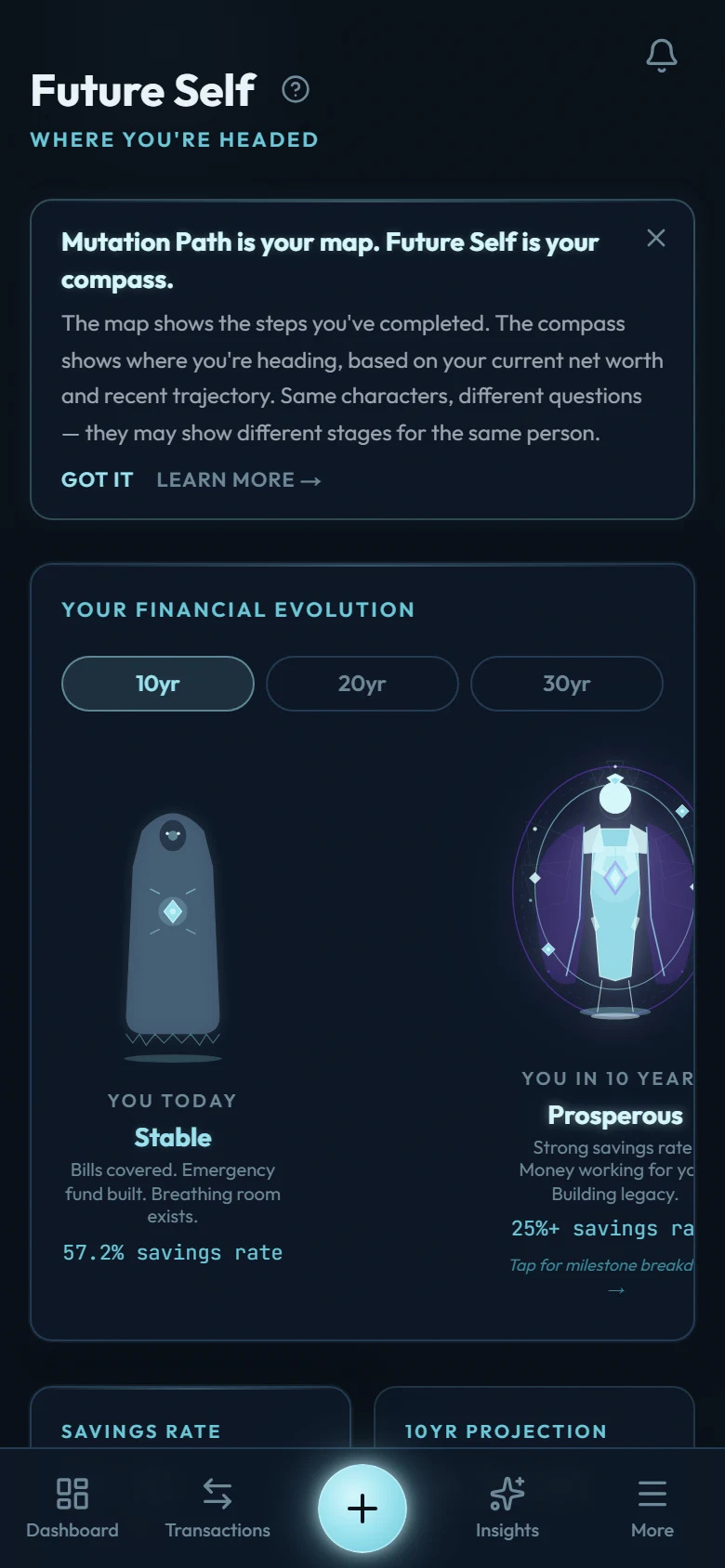
In Wealth Mutant, Future Self draws the third from your real recent months, 10, 20 or 30 years ahead, with a dashed line for if markets are kind and one for if the decade is rough. It starts once you have recorded 3 complete months.
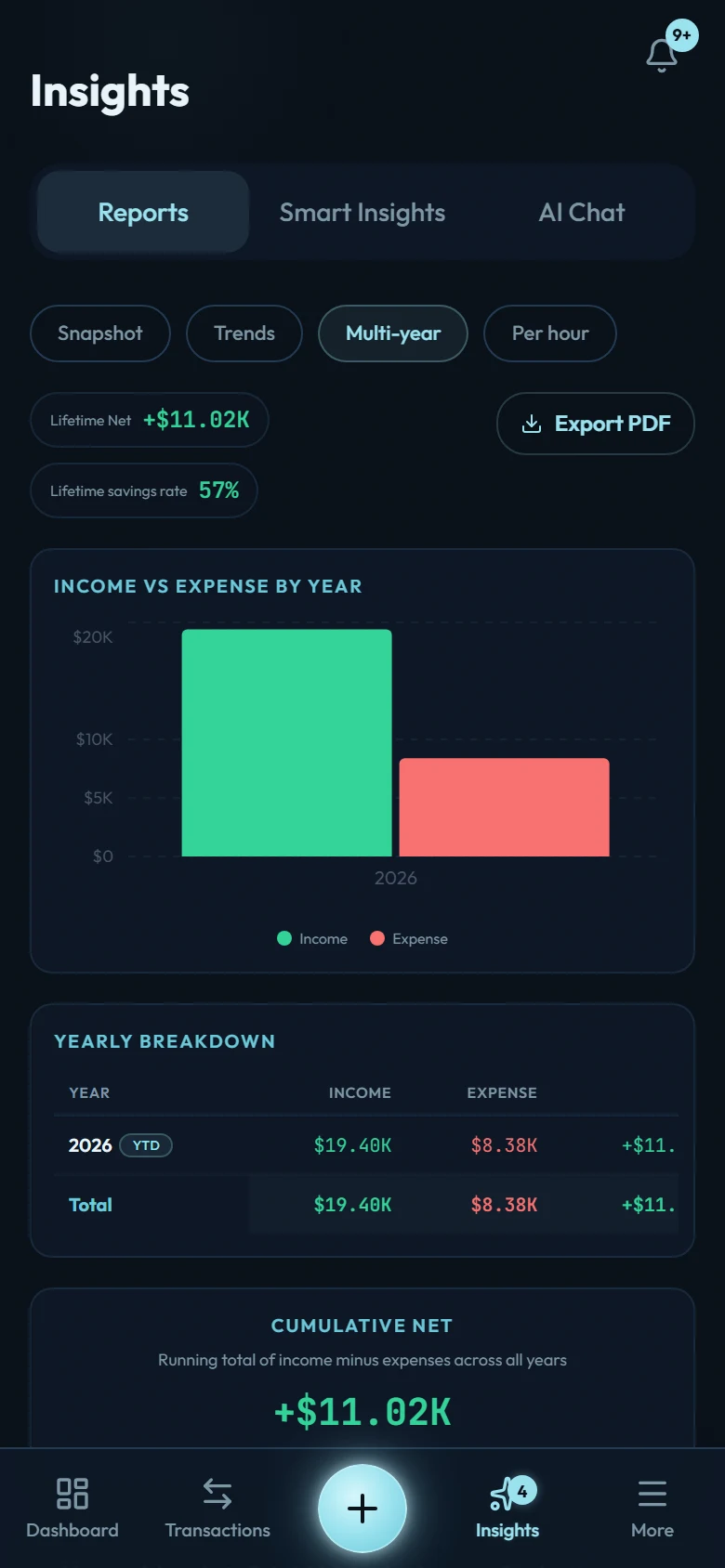
Reports keeps the yearly record. Its Multi-year view puts each year's income beside that year's spending, and the difference, what you kept, is the part that feeds everything above.
For money you are setting aside for your children, such as an education fund, a goal in Wealth Mutant is backed by a real account, so its progress cannot run ahead of the money. Date it 10 or more years out and you can mark it as long-term. When its account holds 3 times your average monthly spending, the long-term goal counts toward Level 8 of the Mutation Path, Fund the Future.
A projection only carries your current pace forward, and as the help article says, no forecast survives a career change, a market crash or a windfall. It still shows whether your pace points where you want it to.
Common questions
How much money counts as generational wealth?
No fixed amount defines it. Wealth is generational when it outlasts the person who built it and gives the next generation a head start, which a home with the loan paid off can do. In the Federal Reserve's 2025 survey, half of US families had a net worth below $215,900 and half above it.
Can you build generational wealth on an ordinary income?
Yes, over decades. In the illustration above, 100 a month for 30 years grows to about 69,400 at an assumed 4% a year after inflation, and the same fund left alone for 30 more years grows to about 230,000. Real returns vary from year to year, so read both figures as an example.
Is generational wealth the same as an inheritance?
No. An inheritance is what someone leaves when they die. Generational wealth can also pass on while the giver is alive, such as help with a home deposit, and it includes the money habits and knowledge that come with the assets. GOV.UK notes that some gifts made in life may be taxed after a death, so check the rules where you live.
Do heirs pay tax on what they inherit?
It depends on where you live. GOV.UK says that in the UK the estate pays any Inheritance Tax and people who inherit do not normally pay tax on what they receive, though related taxes can apply. The IRS describes the US federal estate tax as a tax on the right to transfer property at death. Check your own rules.
Your next step
Write down your family's net worth today, with the date beside it. The free net worth calculator works it out from what you own and what you owe. To keep that number current in Wealth Mutant, set up each account with what it holds today, loans too, and your net worth becomes the main number on your dashboard. The tour walks through the other screens.
Then pick the first step in the list above that you have not done, and put a date on it. For the milestones beyond, levels of wealth lays out 9 levels, and how to become a millionaire is the next read if that is your target.