
How much emergency fund do you need? A common guide is 3 to 6 months of living expenses, with 1 month as the first stop. Go higher if your income swings, if one income supports the household, if other people depend on you, or if your job feels shaky or would be hard to replace.
An emergency fund is money set aside for costs you did not plan for: a car repair, a medical bill, a gap between jobs. If you have none yet, that is a normal place to start.
How much emergency fund do the guides recommend?
The guides give a range. The US Financial Industry Regulatory Authority (FINRA) says financial planners often recommend 3 to 6 months of living expenses. Canada's Financial Consumer Agency says to try for 3 to 6 months of regular expenses, and adds that 3 to 6 months of income works too.
The US Federal Deposit Insurance Corporation (FDIC), the deposit insurer, says financial experts generally recommend at least 6 months of living expenses. So all 3 name 6 months, and 2 put the low end at 3.
Where you land in that range depends on how steady your income is. A steady job with a second income at home sits nearer 3. One income, or a job you could not replace quickly, sits nearer 6.
The guides say "living expenses" or "regular expenses". The smallest sensible reading is essentials: the costs you would still pay in a month with no job, such as rent or mortgage, food, utilities, transport, insurance and the minimum payment on each debt (the least the lender accepts that month). Count everything you spend and the target grows, because it includes what you could pause.
How do you work out your emergency fund target?
Your target is 1 normal month of essentials times the number of months you are aiming for. If you are not sure what a normal month costs, add up the essentials on your last 3 months of statements and divide by 3.
Take a renter with a steady job who pays $1,100 rent, $450 for groceries, $220 for utilities and phone, $260 for transport, $160 for insurance and $110 in minimum debt payments. That is $2,300 of essentials a month, so 1 month is $2,300, 3 months is $6,900 and 6 months is $13,800.

The sum works in any currency. The free emergency fund calculator does it on your own numbers and gives the month you reach each stage. The free runway calculator answers the other question, how long your savings would last: it takes your savings and monthly spending and shows the months, the date the money would run out, and what 6 months of your spending comes to.
What is a starter emergency fund?
A starter emergency fund is the first stage: 1 month of essentials, saved before you aim for 3 or 6. It is also the quickest stage to reach.
Say you save 20% of your take-home pay and spend the other 80%. Then every month of that spending takes 4 months to save, so 3 months take a year and 6 months take 2 years (less if you count only essentials).
Why start with 1 month? In the Federal Reserve's latest survey of US households (Economic Well-Being of U.S. Households in 2025, published May 2026), 63% of adults said they would cover a hypothetical $400 emergency expense using only cash, savings or a credit card paid off at the next statement. The other 37% said they would borrow or sell something, or could not pay it at all. In the example above, 1 month of essentials would pay a $400 bill 5 times over.
Canada's Financial Consumer Agency notes that the full amount can take months or years to reach. Its advice is to begin with what you can put aside each week: "It's better to start with a small amount so that you don't get discouraged."
See how far your savings reach
Mark the accounts that hold your emergency fund, and Wealth Mutant compares them with your own average month of spending.
No card needed.
How much emergency fund do you need if your income is less certain?
Move toward 6 months, or past it, when losing income would hit harder or take longer to fix. FINRA says people with variable income or specialized careers might need a larger reserve than those with stable jobs. The same reasoning fits other situations:
| Your situation | Why you may need more |
|---|---|
| Freelance, commission or gig income | Some months bring in less than your essentials cost |
| One income supports the household | Nothing else comes in if that income stops |
| Other people depend on you | Their costs carry on, and they are harder to cut |
| A shaky job, a specialized role or few similar jobs near you | You may need the fund sooner, and a replacement may take longer to find |
None of the 3 guides gives a number above 6 months, so past that the number is yours: pick one you can give a reason for, such as 9 months because your income dips every winter. If your pay swings from month to month, the freelancers page shows one way to steady it: a holding account and a salary you pay yourself.
Where should you keep your emergency fund?
Keep it in an insured, instant-access savings account that is separate from the one you spend from. The account has to pass 3 tests:
- It is safe: the bank's deposits are insured, so if the bank fails, you get your money back up to a set limit.
- It is accessible: you can withdraw at any time without penalty.
- It is out of easy reach: an account of its own, not your everyday one.
The US Consumer Financial Protection Bureau (CFPB) lists the same 3: the fund should be "safe, accessible, and in a place where you're not tempted to spend it on non-emergencies".
The deposit insurance limit differs by country, and each is in that country's own currency:
| Country and scheme | Limit | How it is counted |
|---|---|---|
| US: Federal Deposit Insurance Corporation (FDIC) | $250,000 | Per depositor, per insured bank, per account ownership category |
| UK: Financial Services Compensation Scheme (FSCS) | £120,000 | Per eligible person, per bank, building society or credit union |
| Canada: Canada Deposit Insurance Corporation (CDIC) | $100,000 | Per category of deposit, per member institution, interest included |
| India: Deposit Insurance and Credit Guarantee Corporation (DICGC) | Rs 5,00,000 (5 lakh rupees) | Per depositor, per bank, interest included |
Insurance covers deposits such as savings accounts, not investments: the FDIC and CDIC both list stocks, bonds, mutual funds and crypto as not covered. Each limit applies per bank, so a larger fund can be split between banks that are each members (in the UK, banks that share a licence count as one). Check that your bank is a member before you open the account; for a credit union, ask which scheme covers it.
Places that fail a test: shares and funds can fall in the same downturn that costs you your job, term deposits such as CDs can charge a penalty for early withdrawal (the FDIC notes this), and cash at home "can be stolen, lost, or destroyed", in the CFPB's words.
In Wealth Mutant, cash, checking, wallet and savings accounts count toward your emergency fund from the start. To change which ones count, use the "Counts toward my emergency fund" switch on an account's Edit screen.
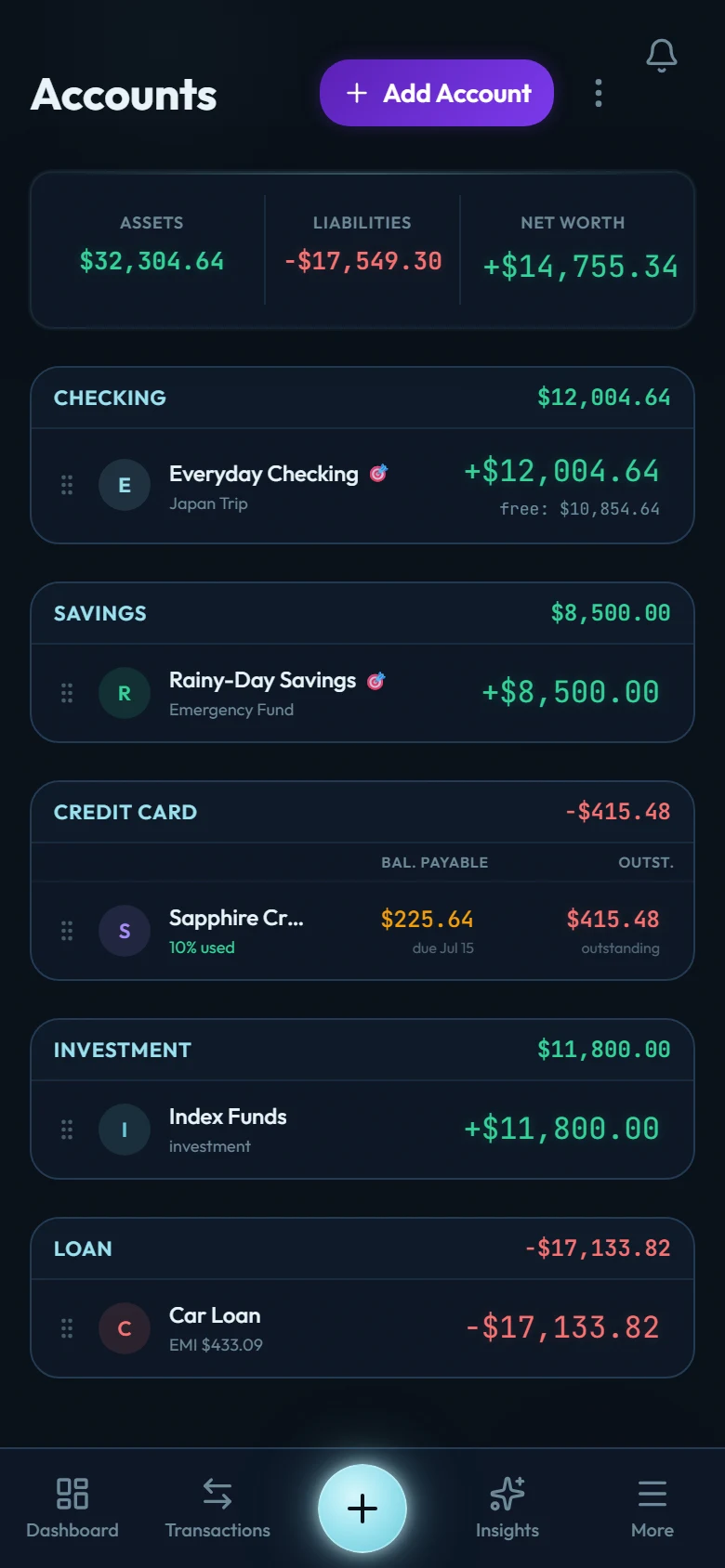
Wealth Mutant is the personal finance app we built for exactly this. On its 9-level Mutation Path, Level 2 (Starter Shield) is reached when the accounts you count as your emergency fund hold 1 month of your average spending, and Level 5 (Full Fortress) asks for 6 months. You note each purchase yourself in a few seconds, a small daily habit that makes you notice where the money goes, and no bank login is ever shared. You pay for it once.
Watch your emergency fund fill
A goal backed by a real savings account, so the bar only fills with money that is there.
Buy — $99 onceWhen should you use your emergency fund?
When the cost is unplanned, necessary and cannot wait. Canada's Financial Consumer Agency calls an emergency "a major and sudden need that's not part of your current budget and that's unplanned". Costs you can see coming, such as school supplies or winter tires, belong in your budget or in a sinking fund: savings you add to each month for one bill you expect.
When it is a real emergency, use it. The CFPB says not to be afraid to, and notes that putting the bill on a card or a loan instead can make it grow through interest and fees.
How do you build your emergency fund, and refill it?
Open a separate account and move money on payday
Name the account for its job, and have a fixed sum move into it automatically each payday. The CFPB says automatic recurring transfers are often one of the easiest ways to save consistently.
Send windfalls and freed-up payments there first
A tax refund, a bonus or a gift can fill much of the starter fund at once, and the CFPB suggests saving all or part of a refund. When a loan is paid off, Canada's Financial Consumer Agency suggests putting the old monthly payment into savings.
Track it as a goal
In Wealth Mutant, back a goal with the savings account and give it a target and a monthly amount: the goal's card then works out the month you will get there at that pace. If the account holds only the fund, mirror mode makes the whole balance the goal's progress.
Refill it as soon as you can
After you use it, FINRA says to replenish the money as soon as you can. Put a number on it: if a $1,500 repair came out and you can add $300 a month, you are whole again in 5 months.
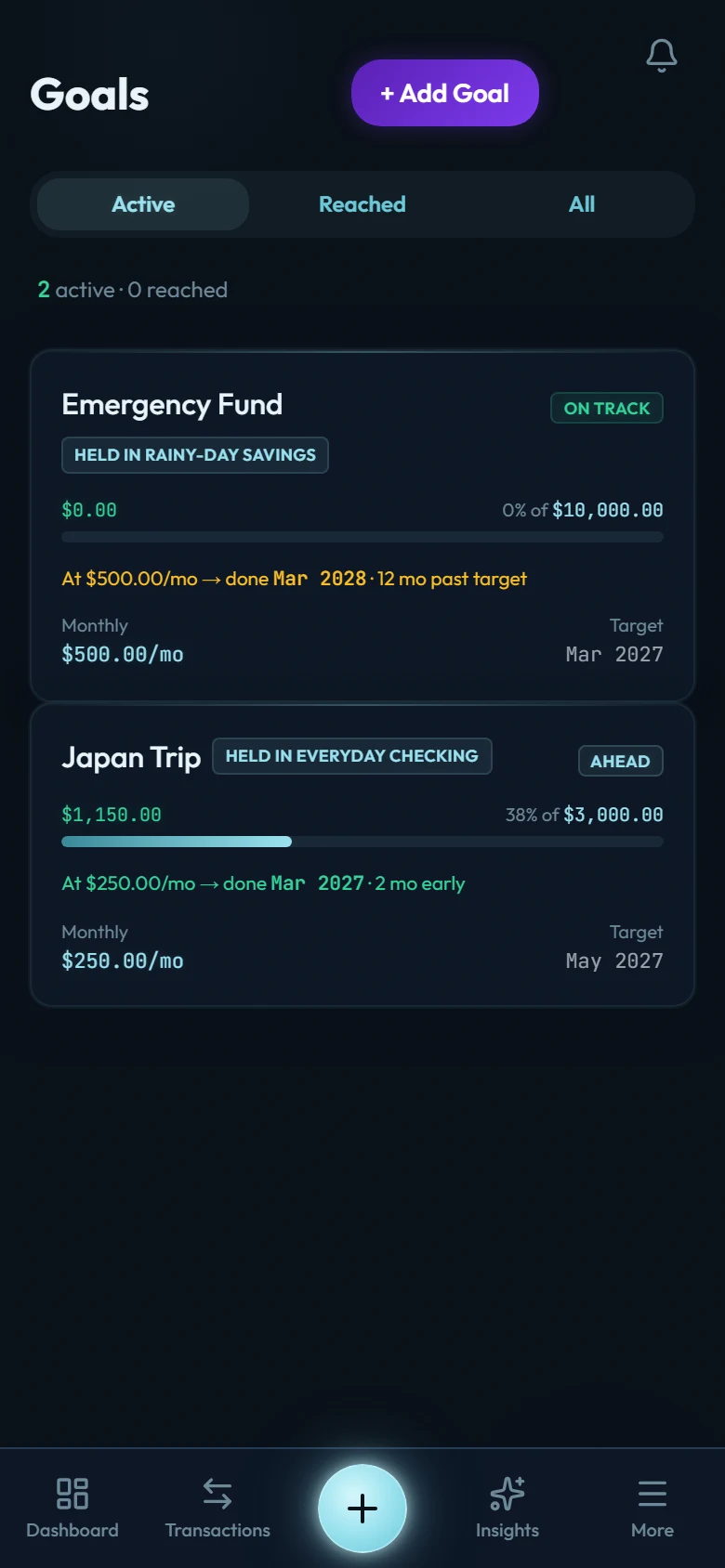
One difference from your essentials sum: Level 2 and Level 5 use your average monthly spending, worked out from what you record, so their targets can come out higher. If you need more than 6 months, treat Level 5 as your floor.
What changes once your emergency fund is full?
Your bills stay the same, but a surprise lands differently. The repair comes out of the fund rather than going on a card, and a bad month stays a bad month instead of turning into debt. FINRA adds that a fund might let you take appropriate investment risks without fearing that a market downturn might force you to sell at a loss.

Common questions
Is $1,000 enough for an emergency fund?
It depends on what a month of essentials costs you. If that is $2,300, $1,000 covers about 2 weeks and $10,000 covers about 4 months. A flat $1,000 can be a fine first stop, but the target that fits your life is 1 month of your own essentials, then 3 to 6.
Should I pay off debt or build an emergency fund first?
Do both, in order. FINRA says that with high-interest debt you have to decide how to balance paying it off against building your fund. A sensible order is a starter fund first, so a surprise does not land on your card, then the debt that charges the most interest, then the rest of the fund.
Can I use a credit card as my emergency fund?
A card you pay off in full at the next statement works like cash, and the Federal Reserve's survey counts it that way. That holds only while the money to pay the statement is already there. A card you carry a balance on does not work like cash. The CFPB warns that if you use a card or loan for an emergency, the expense may grow significantly larger than your original bill because of interest and fees.
Can I keep my emergency fund in a CD, a fixed-term deposit or investments?
Only if you can reach the money quickly and keep all of it. The FDIC notes that CDs generally have a penalty for early withdrawal, and FINRA says to check how accessible the money will be and what fees or penalties apply. Stocks, bonds and mutual funds are not insured deposits.
Your next step
Add up one normal month of essentials tonight, then open a savings account to hold that first month. In Wealth Mutant, add the account with what it holds: Level 2 gives a provisional reading after your first complete month with spending in it, and settles once 3 complete months are on record. The tour shows where it sits on the path.
Once the starter fund is moving, your savings rate (what you keep out of every 100 you earn) shows how fast the rest will fill, and a savings challenge can keep the habit going. If a card balance is costing you interest, avalanche vs snowball shows how to pick the order to clear it.