
A savings challenge is a set rule for putting money aside, usually a schedule of amounts, so you know the total before you start. One of the best known is the 52-week savings challenge. Save $1 in week 1, $2 in week 2, and so on up to $52 in week 52, and you have $1,378.
Below are 5 more, from 1p a day to a no-spend month. Each comes with its total, or how to work out yours, and the point where it gets hard. Amounts are in dollars unless a country is named, and the sums come out the same in any currency.
How does the 52-week savings challenge work?
Each week you save as many dollars as the week number: $1 in week 1, $10 in week 10, $52 in week 52. Credit unions and banks publish it, and the week-by-week table from First Florida Credit Union, a US one, ends at the same $1,378. It suits anyone with steady money left over each week, and anyone who wants an easy first month.
The sum is easy to check. Pair week 1 with week 52, week 2 with week 51, and so on down the list. That makes 26 pairs worth $53 each, and 26 × $53 = $1,378.
The printable tracker below has a box for every week, in 4 groups of 13. Tick a box once that week's money has moved, and read the total saved so far at the end of each group.

To print it, open the tracker on its own page and print that page from your browser. It prints on the same dark background you see here, so a highlighter or a light-coloured pen shows up best.
Is the 52-week savings challenge too hard at the end?
It can be, because the money arrives late. After 26 weeks, half the year has gone and you hold $351, just over a quarter of the total. The last 13 weeks ask for $598 (43%), and weeks 50, 51 and 52 ask $50, $51 and $52 in a row.
Start on 1 January and those 3 weeks run from about 10 December to the year's end. Shawbrook, a UK bank, warns in its guide that "December will be expensive", and First Florida suggests flipping the schedule for anyone who struggles then.
Check last December in your own statements. If it was a costly month, count down instead: $52 in week 1 and $1 in week 52. The total is still $1,378, you hold $1,027 after 26 weeks, and the last 4 weeks ask $10 in all.
| After week | Counting up | Counting down |
|---|---|---|
| 13 | $91 | $598 |
| 26 | $351 | $1,027 |
| 39 | $780 | $1,287 |
| 52 | $1,378 | $1,378 |
Change the weekly step and every figure scales with it: a step of $2 makes $2,756, and in rupees a step of Rs 50 makes Rs 68,900, with Rs 2,600 due in week 52. Or drop the ladder: $26.50 a week for 52 weeks also makes $1,378, and stays ahead of the counting-up order until the last week, when the two meet. The ladder's real job is a gentle start.
Give your challenge a goal to fill
Set the goal's target to the challenge's total, have it mirror the account that holds the money, and the card shows what you have really saved.
No card needed.
What other money saving challenges can you try?
| Challenge | What you save | Total |
|---|---|---|
| 1p a day | 1p on day 1, 2p on day 2, up to £3.65 on day 365 | £667.95 |
| 12-month ladder | £10 in month 1, £20 in month 2, up to £120 in month 12 | £780 |
| 100 envelopes | $1 in envelope 1, $2 in envelope 2, up to $100 in envelope 100 | $5,050 |
| No-spend month | Only necessities for 30 days | What you would have spent |
What is the 1p a day savings challenge?
Save 1p on day 1, 2p on day 2, and so on to £3.65 on day 365. The sum is 365 × 366 ÷ 2 = 66,795p, or £667.95, and in cents the digits are the same: $667.95. You hold £4.65 by day 30 and £168.36 at the halfway mark, day 183.
It suits someone who has never saved on a schedule, because the first deposits are only pennies. The last 65 days bring £216.45, about a third of the total, so that is where it can slip. NatWest and Shawbrook, both UK banks, publish it too.
What is the 12-month savings challenge?
If you are paid monthly, a weekly ladder fits badly. NatWest and Shawbrook both list a monthly one: save 10 times the month number, £10 in January, £20 in February, £120 in December, for £780 (10 × 78, since 1 + 2 + … + 12 = 78). It gets heavier toward the end like the others, so start at £120 and count down if December is a costly month.
What is the 100 envelope challenge?
Number 100 envelopes from 1 to 100 and put that many dollars in each, in any order: $5,050 in all (100 × 101 ÷ 2). Choosing the order is its strength, because a good month can take a big envelope and a lean month a low one. It is also the largest challenge here: $5,050 is about $97 a week for a year.
Can a savings challenge be a habit instead of a sum?
Some challenges have no sum at all. In one, every $5 bill (or £5 note) that reaches your wallet goes into a jar and stays there. It suits anyone who still handles cash, the total is whatever comes your way, and the hard part is leaving the jar shut.
The card version saves your spare change instead, and a bank can run it for you: once switched on, NatWest's Round Ups send "the spare change from your debit card spend to your savings account".
How do you track a savings challenge?
A paper tracker has one weakness: you can tick a box without moving the money. Tracking the account fixes that, because the bank balance only rises when the money has really arrived.
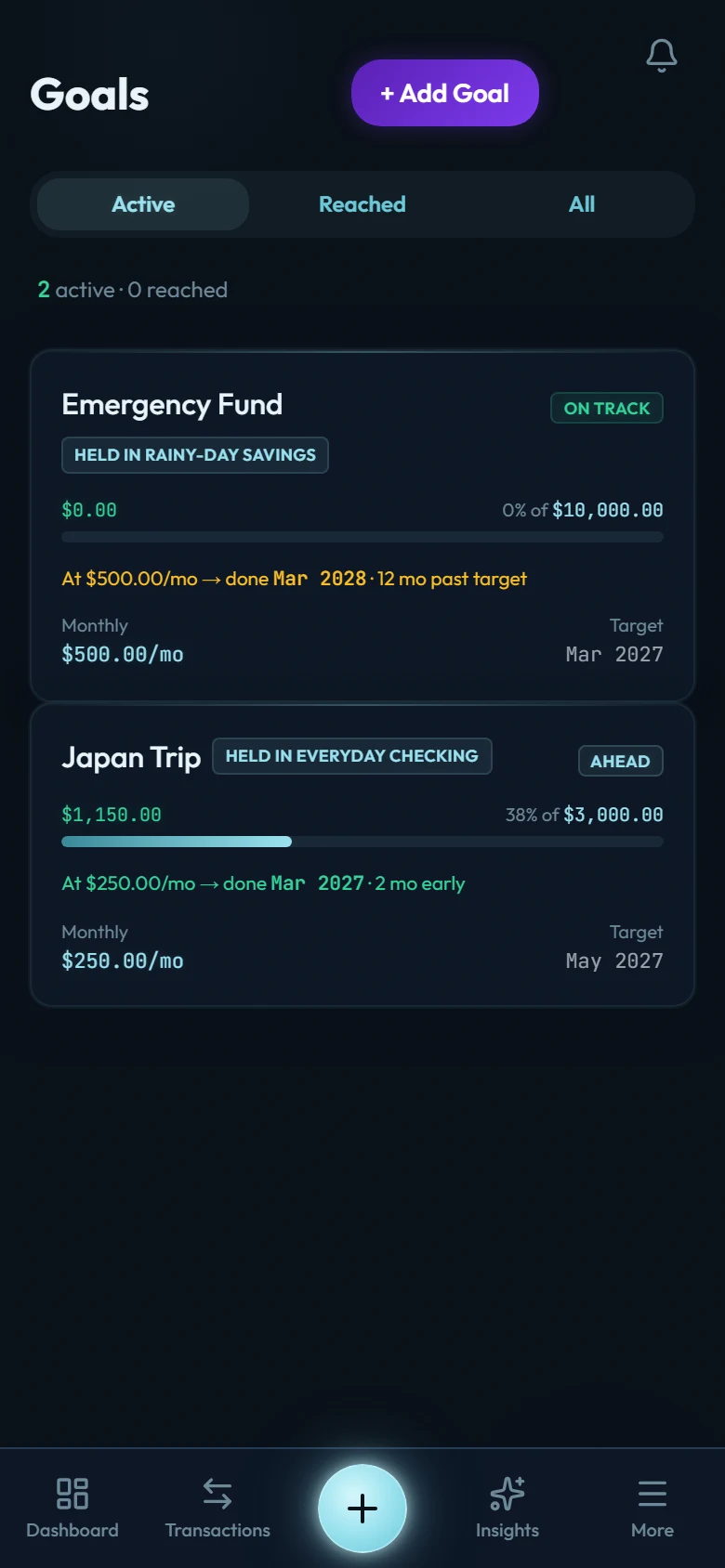
Wealth Mutant is the personal finance app we built for exactly this. Each challenge becomes a goal: you set its target to the total, back it with the account that holds the money, and the bar can't run ahead of what you actually have. You note each purchase yourself in a few seconds, a small daily habit that makes you notice where the money goes, and no bank login is ever shared. You pay for it once.
Keep the challenge next to the rest of your money
A goal for the total, a transfer for each deposit and a month calendar that shows the days you spent nothing, in one personal finance app.
Buy — $99 onceHow does a no-spend challenge work?
A no-spend challenge is a set stretch, such as 30 days, when you buy only what you need. Before day 1, write down what you will still buy: rent or mortgage, utilities, groceries, transport to work, insurance, minimum debt payments, medicine.
Everything else waits, from eating out and streaming to clothes and online orders. Shawbrook describes it the same way, with "bills, groceries and toiletries" as its examples of necessities.
Like the $5 jar, it has no fixed total. Yours is whatever you would have spent, and last month's statement tells you.
Say it shows $120 eating out, $45 coffee and snacks, $75 clothes, $20 apps and games and $60 online impulse buys. That is $320 a month you can keep.
Not spending is not saving yet. The $320 sits in your everyday account until something else spends it. Each week, move a quarter of it ($320 ÷ 4 = $80) into a separate savings account, so the month ends with a real balance.
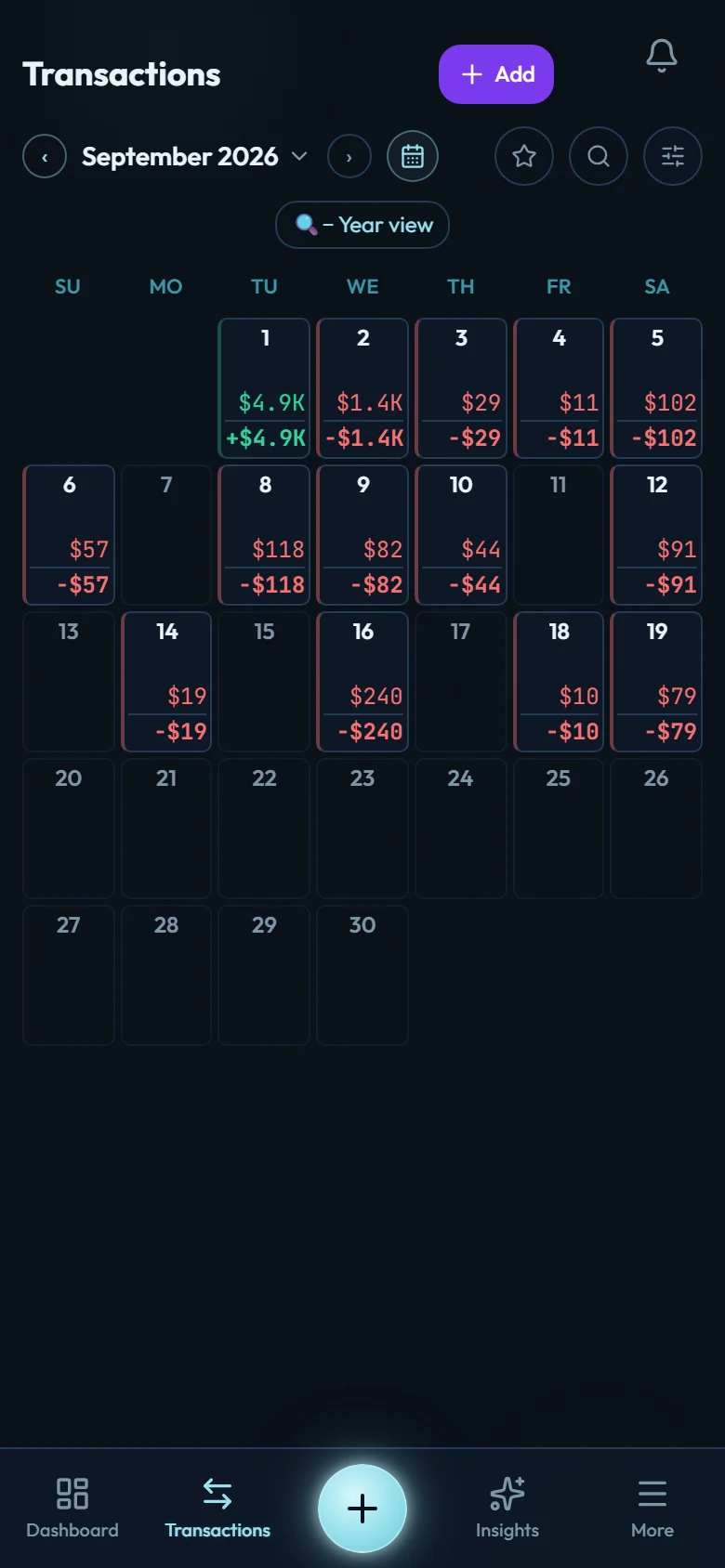
This is the challenge that leans most on noting every purchase. In Wealth Mutant's month calendar, money out shows in red on the day it left, and a day with nothing recorded stays blank. Once everything is noted, each day so far without a red figure is a no-spend day, even a payday or the day you move money to savings.
This challenge suits a reset after a heavy month, and it gives little if your necessities already take nearly all your pay. The risk is the rebound: a month of saying no can end in a spree on day 31, so before you start, pick 1 or 2 of the cuts to keep after day 30. For the urge itself, the two-second pause helps.
How do you keep a savings challenge going?
Pick one and write its total at the top
One at a time. Starting a second when the first gets heavy leaves you with 2 half-filled trackers, so shrink the step instead.
Give the money its own account
A separate savings account makes it less tempting to dip in, and its balance shows your progress at a glance. In Wealth Mutant, set the challenge's goal to mirror that account, and the goal's bar is the account's balance.
Fix one deposit day
Pick one day, such as the day after you are paid, and keep to it.
Record each deposit as a transfer
In Wealth Mutant, a transfer from your everyday account to the savings account is neither income nor spending, so it stays out of your spending totals and budgets. For a ladder, build a transfer bookmark in Settings → Bookmarks with the amount left blank. Each week, tap the star in the transaction form, tap the bookmark, type the week's amount and save.
Decide now what a missed week costs
Add it to the next deposit, or let it go and finish with a lower total. One missed week costs one week's amount, and the challenge goes on.
What changes once the challenge ends?
You have a lump of savings and a habit of moving money on a schedule. Give the money a job before the last week: an emergency fund, or sinking funds for bills you can see coming.
Then turn the habit into a percentage. On $40,000 a year in pay, $1,378 is 3.4%, and your savings rate, the slice of your pay you hold on to, is how you keep going once the challenge is over.
Common questions
What is the easiest savings challenge to start?
The one whose first deposits you will not feel: the 52-week challenge starts at $1, and 1p a day starts at 1p. Both get heavier toward the end, so read the last deposit before you begin, $52 or £3.65. If that is too much, shrink the step; if only December worries you, count down.
What if I am paid every 2 weeks or once a month?
Paid every 2 weeks, combine 2 weeks into each deposit: $3, $7, $11 and so on up to $103. That is 26 deposits and the same $1,378. Paid monthly, use the 12-month ladder: 10 times the month number, £780 in all.
Can I start a savings challenge in the middle of the year?
Yes. Count the weeks from your own start date. Only the timing changes, so check what the last 3 weeks of your challenge fall on before you pick the order.
Where should I keep the money from a savings challenge?
In a savings account apart from the one you spend from, which makes it less tempting to dip in. Check that it is covered by deposit insurance: the FDIC for US banks (the NCUA for federally insured credit unions), the FSCS in the UK, CDIC in Canada or the DICGC in India. Each country sets its own limit, so look up yours.
Your next step
Pick one challenge, read its last deposit, and choose the order before you make the first. In Wealth Mutant, add a goal with the challenge's total as its target, and the tour shows where goals sit beside budgets, cards and loans. For the daily noting, the 30-second habit shows how little time it takes, and envelope budgeting takes the envelope idea into everyday spending.