
To save $10k in a year, put aside $833.33 a month. That is $192.31 a week or $27.40 a day. The sums are the same in any currency.
Whether it is realistic depends on one thing: what share of your take-home pay (what reaches your account after tax) $833 is. On $4,000 a month it is about 21%. On $8,000 it is about 10%. If it is more than you can keep, the plan still works. It ends later, and below you can see which month.
How much do you need to save each month to save $10k in a year?
Divide $10,000 by the number of times you will save. The Rs column is the same split for a goal of 10 lakh rupees (1,000,000), for readers who save in rupees.
| You save every | $10,000 goal | Rs 10 lakh goal | Times in a year |
|---|---|---|---|
| Month | $833.33 | Rs 83,333.33 | 12 |
| 2 weeks | $384.62 | Rs 38,461.54 | 26 |
| Week | $192.31 | Rs 19,230.77 | 52 |
| Day | $27.40 | Rs 2,739.73 | 365 |
Round up, never down. $833 a month for 12 months is $9,996, which is $4 short, and $834 comes to $10,008. You can also keep $833.33 and let the last transfer make up the cents. If you are paid on the 1st and the 15th, that is 24 payments of $416.67.
Is it realistic to save $10k in a year on your income?
It is realistic when $833 is a share of your pay you can keep. If you are paid by the hour, the free hourly to salary calculator turns your rate into pay per month, with a box for the share you keep after tax. The table shows that share for a range of monthly take-home pay in dollars, then how many months $10,000 takes at 4 different savings rates. Your savings rate is the share of your pay you keep, and months are rounded up.
| Take-home a month | $833 as a share of pay | Months at 5% saved | At 10% | At 15% | At 20% |
|---|---|---|---|---|---|
| $2,000 | 41.7% | 100 | 50 | 34 | 25 |
| $3,000 | 27.8% | 67 | 34 | 23 | 17 |
| $4,000 | 20.8% | 50 | 25 | 17 | 13 |
| $5,000 | 16.7% | 40 | 20 | 14 | 10 |
| $6,000 | 13.9% | 34 | 17 | 12 | 9 |
| $8,000 | 10.4% | 25 | 13 | 9 | 7 |
Read your row. On $5,000 a month, saving 15% takes 14 months, so a year needs about 17%. Saving 20% of $8,000 is $1,600 a month, which clears $10,000 in 7 months. On $2,000 a month the same $10,000 at 10% takes more than 4 years. A section below shows what to do then: move the date.
Official figures show where households stand. Each is a national total from that country's own statistics office, for the period shown. The household saving rate is the share of after-tax income that households did not spend:
| Country | Household saving rate | Period | Source |
|---|---|---|---|
| US | 3.8% | September 2026 | Bureau of Economic Analysis |
| UK | 8.8% | April to June 2026 | Office for National Statistics |
| Australia | 6.5% | June quarter 2026 | Australian Bureau of Statistics |
| Canada | 3.7% | April to June 2026 | Statistics Canada |
They are national totals, each by its own office's definition, so read them as a rough guide to where households stand. Statistics Canada notes that its rate is "aggregated across all income brackets; in general, saving rates are greater in higher income brackets", so a total mixes households that save a lot with households that save nothing. Against rates like these, the 17% to 21% of pay that $833 asks of someone taking home $4,000 or $5,000 a month is a lot.
One more figure, for the US. The Census Bureau puts median household income after tax at $76,060 for 2025, which is $6,338 a month. $10,000 is 13.1% of that year's income. A household is not one person, but 13.1% is more than 3 times the 3.8% above. If a year feels like a stretch, wanting more time is a normal answer.
How do you save $10k in 6 months, or $5,000 or $20,000 in a year?
Divide the goal by the months. Every version of the question is the same sum with different inputs.
| Goal | In 3 months | In 6 months | In 12 months | In 18 months | In 24 months |
|---|---|---|---|---|---|
| $5,000 | $1,666.67 | $833.33 | $416.67 | $277.78 | $208.33 |
| $10,000 | $3,333.33 | $1,666.67 | $833.33 | $555.56 | $416.67 |
| $20,000 | $6,666.67 | $3,333.33 | $1,666.67 | $1,111.11 | $833.33 |
Look at the 3 cells that read $833.33: $5,000 in 6 months, $10,000 in 12 and $20,000 in 24 all ask for the same monthly amount. If you can manage $833 a month, you can pick the goal to match.
To save $10k in 6 months you need $1,666.67 a month, double the 12-month sum. In 3 months it is $3,333.33. Those paces work when you already have part of the money, when a bonus or a sale of something big lands in the window, or when your take-home is high enough that the share is modest (on $8,000 a month, $1,667 is 21%). Otherwise, spread the same $10,000 over a longer time.

What if you cannot save $10k in a year?
Move the date, keep the plan. $10,000 over 18 months is $555.56 a month, and over 24 months $416.67. Someone who can set aside $500 a month finishes in 20 months, a plan that ends on a date you can name. Saving $500 for 12 months and stopping would leave you at $6,000, with nothing in place to carry on.
The finishing month is one division. Take the goal, subtract what you already have, divide by the monthly amount and round up. With $2,000 already saved and $500 a month, that is ($10,000 − $2,000) ÷ $500 = 16 months. In rupees it works the same way: 10 lakh at Rs 40,000 a month is 25 months. If you start in January and your first deposit is that month, here is where each monthly amount lands:
| Saved a month | Months | Finishing month |
|---|---|---|
| $1,666.67 | 6 | June |
| $1,250 | 8 | August |
| $1,000 | 10 | October |
| $834 | 12 | December |
| $700 | 15 | March, the next year |
| $600 | 17 | May, the next year |
| $500 | 20 | August, the next year |
In Wealth Mutant, a personal finance app, each goal has a target and a monthly amount, and its card shows when you will finish at that pace, in a line like "At $500.00/mo → done Feb 2027". The free savings goal calculator gives you the same month for any goal, before you open the app.
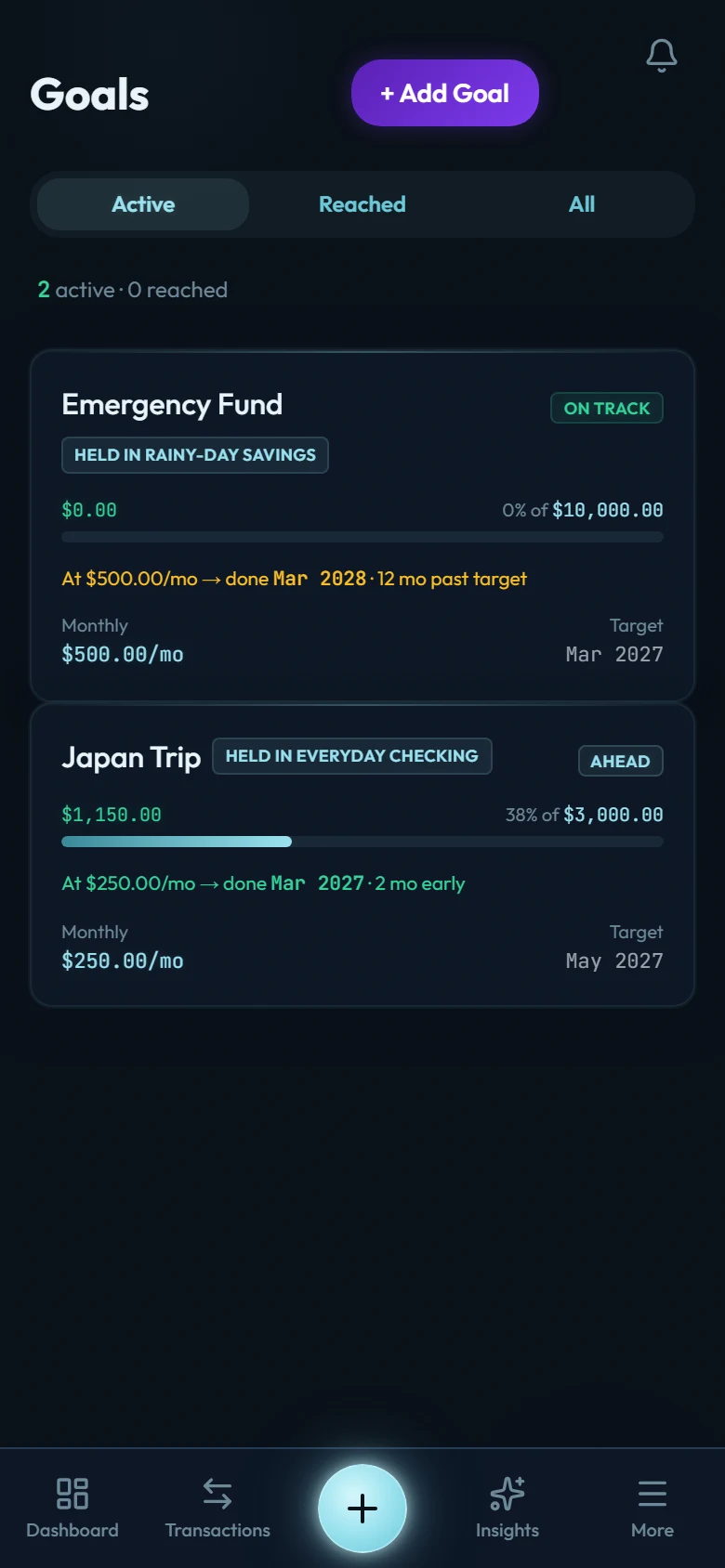
See the month you finish
Give your $10,000 a goal and a monthly amount, and the goal's card shows the month you will be done at that pace.
No card needed.
How do you save $10k in a year with irregular income?
Save a share of each payment. A fixed $833 is easy in a month that brings $5,200 and impossible in a month that brings $1,700, where it is 49% of what you took home.
Say a freelancer took home between $1,700 and $5,200 a month, $40,000 over the year. A goal of $10,000 is 25% of that, so 25% of every payment is moved the day it lands. The thin month sends $425 and the best one $1,300, and the year ends on $10,000 if the pay repeats the same pattern.
Add up your last 12 months of take-home pay
Use what reached your account, after tax. If you have less than a year of history, use the months you have and expect to adjust.
Divide your goal by that total
$10,000 ÷ $40,000 is 25%. That share is your rule for every payment, large or thin.
Move the share the day each payment lands
Send it to a separate savings account before it mixes with spending money. In a good month, add extra on top.
Check every 3 months and redo the sum
Last year's total is an estimate, so if income comes in lower, the share needs to rise or the date moves.
Canada's Office of the Superintendent of Bankruptcy says it directly: "If your employment income is irregular or variable, you are encouraged to save during months when you have higher income to cover months of lower income." The freelancers page covers how to pay yourself the same amount every month out of an account where all your payments land.
Where should you keep $10,000 while you save it?
Keep it in a savings account of its own, separate from the one you spend from. Canada's Financial Consumer Agency, in its guide to emergency funds, suggests looking for an account that "is separate from the account you use for day-to-day transactions", "allows you to make withdrawals without penalty" and "generates interest on the money you save".
The emergency fund guide covers what else to check, including the limits that protect deposits in the US, UK, Canada and India. Look them up for your bank before you move a large sum.
Interest helps a little, and you should not plan around it. Assume the balance grows 4% over a year. That is a guess, because rates move. With deposits of $833.33 at the end of each month and interest added monthly, the interest would come to about $182 over the year, and about $818 a month would reach $10,000. At 3% the interest is about $137, at 5% about $227. None of these changes the plan, so pick the account for safety and access, then set the monthly transfer.
How do you keep the transfers going?
Make the transfer happen without you. The CFPB says: "If you're tempted to spend your paycheck when you get it, this is an easy way to put money aside without having to think twice." It describes recurring transfers from checking to savings. Canada's Financial Consumer Agency says you can schedule yours for the days you get paid.
Add what is not already spoken for. The CFPB says saving all or a portion of a tax refund "could help you quickly set up your emergency fund". A bonus, a gift or a loan you have finished paying all shorten the date. Work them into your sum: $1,500 saved at once takes $1,500 ÷ $833.33 = 1.8 months off the schedule.
A year is long, and partway through it helps to see whether you are still on course for the month you picked.
Wealth Mutant is the personal finance app we built for exactly this. Your $10,000 becomes a goal with a monthly amount, and its card names the month you will finish at that pace, so the finish is a month you can see, not only a total. You note each purchase yourself in a few seconds, a small daily habit that makes you notice where the money goes, and no bank login is ever shared. You pay for it once.
Keep the $10,000 next to the rest of your money
A goal with a done month and all your accounts, in one personal finance app.
Buy — $99 onceWhat do you do with the first $10,000?
Decide what the money is for before you start. For many people the first job is an emergency fund. In the emergency fund guide's example of $2,300 of essential costs a month, $10,000 covers about 4 months, and the free runway calculator does the same sum on your own numbers. Level 2 of the app's 9-level Mutation Path is done when the accounts you count as your emergency fund hold 1 month of your average spending, and Level 5 asks for 6 months of your average spending.
If the money has a nearer job, such as a deposit or a trip, name it and keep it in its own goal. When $10,000 is the first step toward something bigger, why the first $100k is the hardest shows how long each next $100k takes. To keep the habit going between big goals, a savings challenge gives you a schedule, and the rule of 72 shows how long money takes to double once it is invested.
Common questions
How much a week do I need to save $10,000 in a year?
$10,000 over 52 weeks is $192.31 a week. Over 26 two-week periods it is $384.62, and over 365 days it is $27.40 a day. Round up each time, because $192 a week for 52 weeks is $9,984.
How much do I need to earn to save $10,000 in a year?
It depends on the share of your take-home pay you can keep. At a 20% savings rate, $10,000 in a year takes about $4,170 a month of take-home pay. $10,000 is 20.8% of $4,000 a month, 16.7% of $5,000 and 10.4% of $8,000. If you keep 15% of $5,000, the goal takes 14 months.
Can I save $10,000 in 3 months?
It takes $3,333.33 a month. That is realistic only if you already hold part of the money, expect a large one-off sum, or can spare a third of your take-home pay. On $10,000 a month, $3,333.33 is 33%.
What if I can only save $500 a month?
$10,000 takes 20 months at $500 a month. Start the transfer, keep a goal with that monthly amount, and raise it when you can. Each extra $100 a month brings the date forward.
Your next step
Find your take-home pay in the table above, or divide $833.33 by it and read the result as a percentage ($833.33 ÷ $4,000 = 0.208, so 21%). Then pick the monthly amount you can keep, open a savings account of its own and set the transfer for payday.
In Wealth Mutant, add the account and give the money a goal with your monthly amount, and the finishing month appears on its card. The tour shows where goals sit next to your net worth (what you own minus what you owe) and the 9-level Mutation Path.