
The first $100k is the hardest because it is the slowest. Early on, your savings have little to grow from, so most of it has to come from your own deposits. At $1,000 a month it takes 6 years 8 months if the money grows 7% a year, and 8 years 4 months if it does not grow at all.
If the money grows, the next $100k takes less time at the same deposit, and the one after that takes less again.
The growth rates here (0%, 4% and 7% a year) are examples that show how the sum moves. Returns are not guaranteed, and in some years they are negative. Nothing on this page says what to put your money in.
Where does "the first $100k is the hardest" come from?
The line is credited to the late Charlie Munger, Warren Buffett's partner at Berkshire Hathaway. In Janet Lowe's 2000 biography Damn Right!, as quoted by others, Munger is reported to have called the first $100,000, earned from nothing, the hardest part of building wealth. A blunter version of the line is widely repeated. We could not confirm its exact words or where he said them, so we do not quote it.
Whatever he said exactly, the sums below show why the first stretch drags. It is the only one where growth has almost nothing to work on.
Is the first $100k harder, or just slower?
Slower, and the reason is growth. Take a $1,000 deposit every month and a 7% yearly return. Here is how long each $100k step takes, with 0% and 4% beside it:
| $100k step | 0% a year | 4% a year | 7% a year |
|---|---|---|---|
| 1st | 8 yr 4 mo | 7 yr 3 mo | 6 yr 8 mo |
| 2nd | 8 yr 4 mo | 5 yr 8 mo | 4 yr 7 mo |
| 3rd | 8 yr 4 mo | 4 yr 7 mo | 3 yr 5 mo |
| 4th | 8 yr 4 mo | 3 yr 11 mo | 2 yr 10 mo |
| 5th | 8 yr 4 mo | 3 yr 4 mo | 2 yr 5 mo |
Each step is the time from the end of the one before. At 7%, you reach $500,000 after 19 years 11 months in all.

The 0% column shows what happens without compounding. Compounding means growth earns growth of its own. With none, every $100k takes the same 8 years 4 months, and the 1st is no harder than the 5th.
With growth, the balance does more of the work each step. In the 1st step, growth adds 21% of the $100k and your deposits add the other 79%. By the 3rd step growth adds 58%, more than your own deposits do. A balance of $100,000 at 7% would double in about 10 years with no deposits at all (the rule of 72 gives 72 ÷ 7 = 10.3).
There is a second reason it feels hard. The 1st step is where the habit is new and there is no cushion yet, so a car repair or a slow month lands on a balance that cannot absorb it.
How long does it take to save $100k?
Divide the target by the monthly amount, then see what growth changes. The sums work in any currency, and the rupee version is further down. With no growth it is one division: 100,000 ÷ 1,000 = 100 months, which is 8 years 4 months.
With growth, you need a monthly rate. 7% a year means the balance is 7% bigger after a year; spread over 12 months that is about 0.565% a month. In a spreadsheet, =NPER(1.07^(1/12)-1, -1000, 0, 100000) gives 79.5 months, and you round up to 80 because the 79th deposit leaves you a little short.
The sums assume each deposit lands at the end of the month. Here is the answer for 6 monthly amounts:
| Monthly deposit | 0% a year | 4% a year | 7% a year |
|---|---|---|---|
| 250 | 33 yr 4 mo | 21 yr 5 mo | 17 yr 6 mo |
| 500 | 16 yr 8 mo | 12 yr 11 mo | 11 yr 3 mo |
| 1,000 | 8 yr 4 mo | 7 yr 3 mo | 6 yr 8 mo |
| 1,500 | 5 yr 7 mo | 5 yr 1 mo | 4 yr 9 mo |
| 2,000 | 4 yr 2 mo | 3 yr 11 mo | 3 yr 9 mo |
| 3,000 | 2 yr 10 mo | 2 yr 8 mo | 2 yr 7 mo |
Read across to see what growth does, and down to see what a bigger deposit does. Going from 1,000 to 1,500 a month saves 23 months at 7%. That is about as much as the whole 7% return saves at 1,000 a month (100 months becomes 80, so 20 months). The deposit is the part you steer.
To get a calendar month instead of a number of years, the free savings goal calculator shows the month you reach a goal at your monthly amount, and the date of each milestone from 1,000 to 1,000,000.
See the month your first $100k lands
Give the goal a target and a monthly amount in Wealth Mutant, a personal finance app, and its card works out the month you will get there.
No card needed.
How can you save $100k in 2, 3 or 5 years?
Work backwards from the date. At 0% it is 100,000 ÷ the number of months. With growth, a spreadsheet does it: =-PMT(1.07^(1/12)-1, 60, 0, 100000) gives 1,404.58 for 5 years at 7%. The table gives the monthly amount, rounded up to the next whole number so that it reaches the target:
| To reach 100,000 in | 0% a year | 4% a year | 7% a year |
|---|---|---|---|
| 2 years | 4,167 | 4,012 | 3,903 |
| 3 years | 2,778 | 2,622 | 2,513 |
| 5 years | 1,667 | 1,512 | 1,405 |
| 10 years | 834 | 682 | 585 |
The longer the plan, the more growth trims. At 2 years, 7% lowers the monthly amount by about 6%. At 10 years it lowers it by about 30%.
Put the number next to your take-home pay, the pay that reaches your account after tax. Say you take home 5,000 a month. The 3-year row asks for more than half of it (2,778 at 0%) and the 5-year row for a third (1,667). For a first target of $10k, see how to save $10k in a year.
How long does it take if you take home 3,000 a month?
It depends on the share of your pay you keep, which is your savings rate. Say you take home 3,000 a month and aim for 100,000 (any currency, same unit):
| Share saved | Monthly | Time at 0% a year | Time at 7% a year |
|---|---|---|---|
| 5% | 150 | 55 yr 7 mo | 23 yr 2 mo |
| 10% | 300 | 27 yr 10 mo | 15 yr 8 mo |
| 20% | 600 | 13 yr 11 mo | 9 yr 10 mo |
| 30% | 900 | 9 yr 4 mo | 7 yr 3 mo |
For context, the US Bureau of Economic Analysis put the personal saving rate (saving as a share of what households have left after tax) at 3.8% in September 2026. The UK's Office for National Statistics put the household saving ratio at 8.8% in April to June 2026. Both are whole-economy figures, each measured its own way, and not what a typical person saves. For scale, 3.8% and 8.8% fall near the 5% and 10% rows.
The table shows why your savings rate moves the date more than any other number here: at 3,000 a month, going from 5% to 20% takes 41 years 8 months off the 0% time.
Is $100k savings or net worth?
They are different numbers. Savings is the money you hold in accounts and investments. Net worth is everything you own minus everything you owe, so debts and the value of a home count too. Take Asha:
| What Asha has | Amount |
|---|---|
| Savings account | 40,000 |
| Investments | 35,000 |
| Savings and investments | 75,000 |
| Car loan | −22,000 |
| Student loan | −18,000 |
| Net worth | 35,000 |
If Asha also owns a flat worth 80,000 more than what she owes on it, her net worth is 115,000. She is past 100,000 in net worth and 25,000 short in savings.
Both are fair goals, as long as you say which one you mean. A savings goal is the one the tables above answer. Net worth is the whole picture: why it is the one number to track. For where others stand, see average savings by age and average net worth by age.
What about rupees: 10 lakh and 1 crore?
A lakh is 100,000, and a crore is 10,000,000, or 100 lakh. Two common first targets are Rs 10,00,000 (10 lakh) and Rs 1,00,00,000 (1 crore).
The time depends only on the share of the target you save each month, so one table serves every currency. Saving 1% of the target a month is 1,000 toward 100,000, Rs 10,000 toward 10 lakh and Rs 1,00,000 toward 1 crore:
| Share of target a month | For Rs 10,00,000 | For Rs 1,00,00,000 | Time at 0% a year | Time at 7% a year |
|---|---|---|---|---|
| 0.5% | Rs 5,000 | Rs 50,000 | 16 yr 8 mo | 11 yr 3 mo |
| 1% | Rs 10,000 | Rs 1,00,000 | 8 yr 4 mo | 6 yr 8 mo |
| 2% | Rs 20,000 | Rs 2,00,000 | 4 yr 2 mo | 3 yr 9 mo |
| 3% | Rs 30,000 | Rs 3,00,000 | 2 yr 10 mo | 2 yr 7 mo |
The 7% column is an example rate. Pick the column closest to the growth you have seen, or the 0% column for the slowest case.
How do you speed up the first $100k?
A bigger deposit moves the date most: at 7%, 2,000 a month takes 3 years 9 months where 1,000 takes 6 years 8 months. Starting a month earlier brings every date forward by a month, and the money grows only if it stays in.
A starter emergency fund (1 month of essentials) keeps a surprise from undoing months of deposits, and a savings challenge gives you a schedule for the deposit.
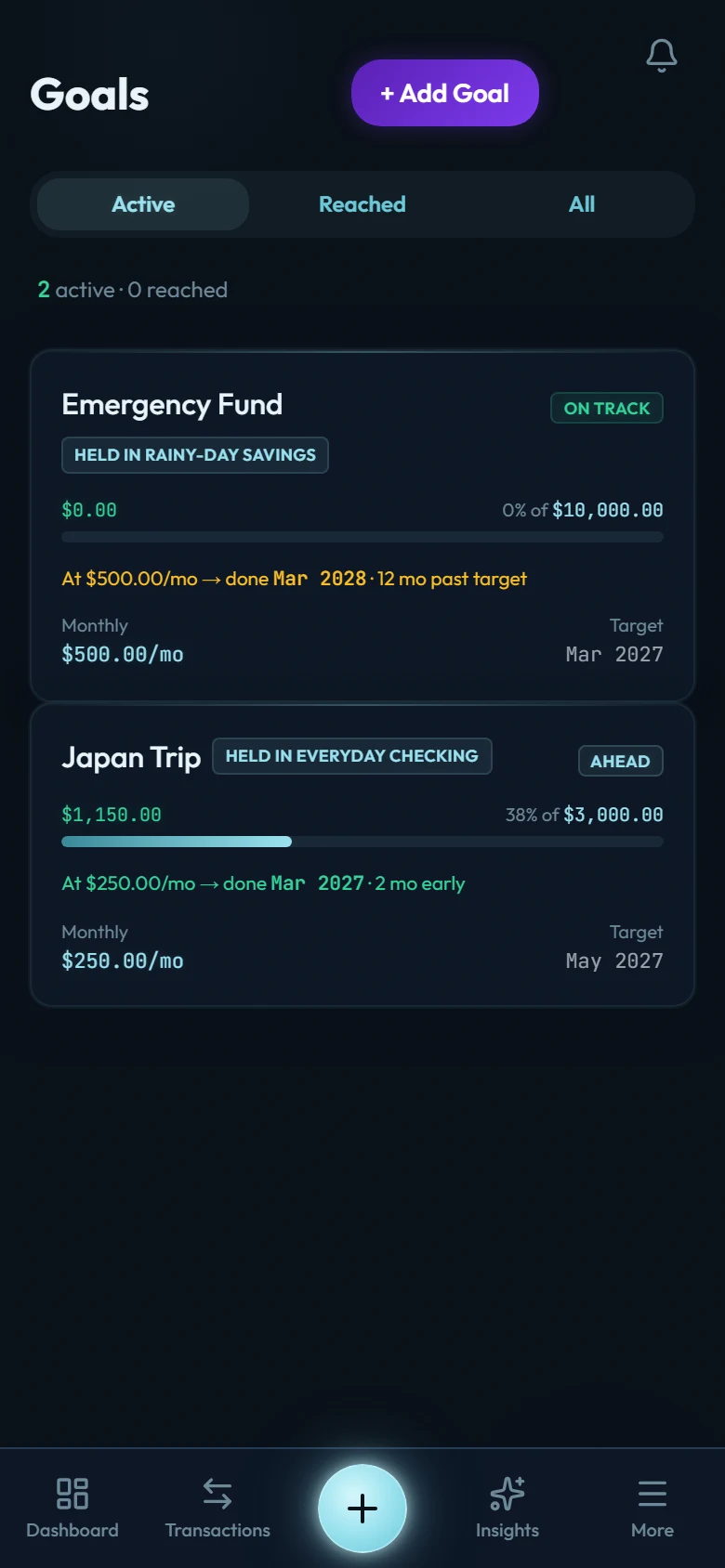
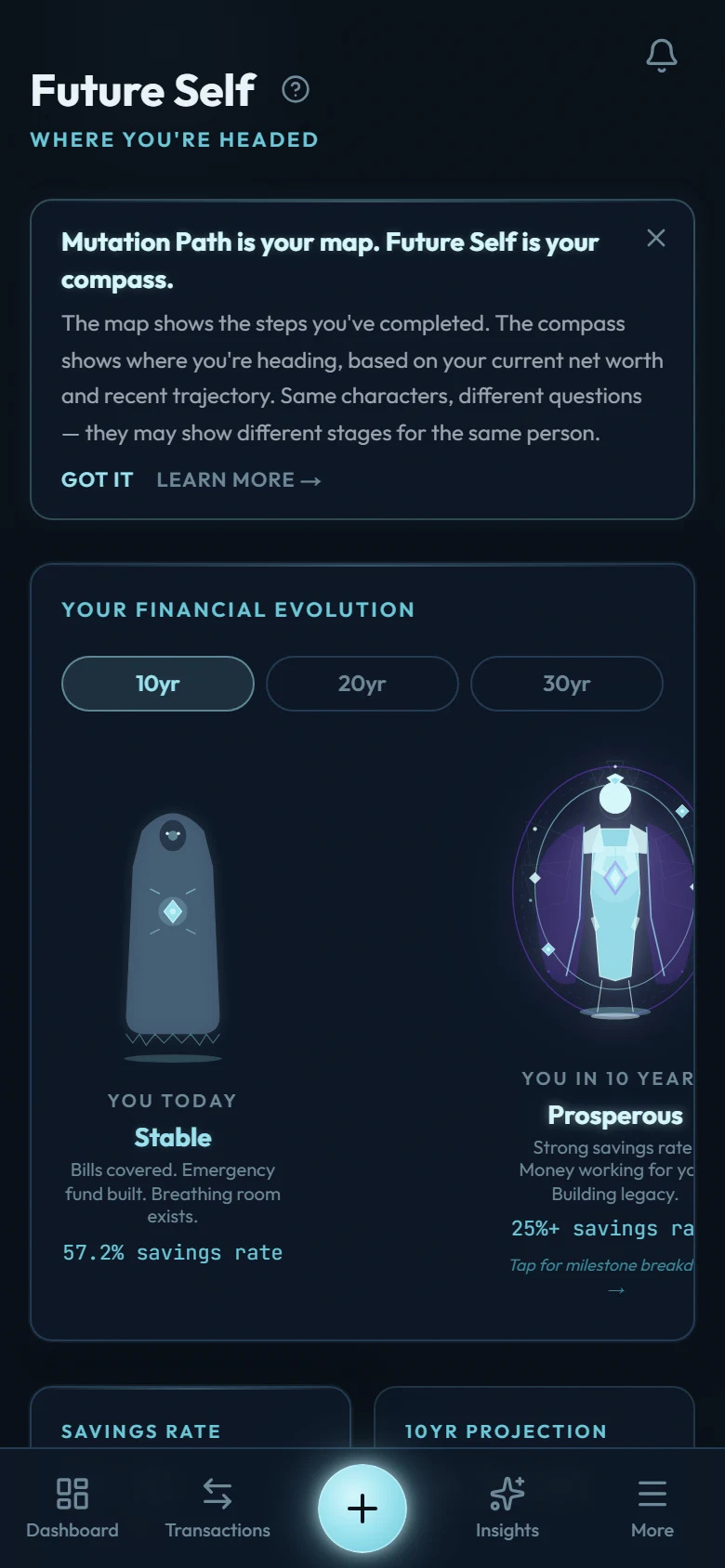
Wealth Mutant is the personal finance app we built for exactly this. A goal's card gives the month you reach it at your monthly amount. Future Self, the app's projection of where your own saving pace leads, carries it forward 10, 20 and 30 years and shows a line for good years and a line for rough ones. You note each purchase yourself in a few seconds, a small daily habit that makes you notice where the money goes, and no bank login is ever shared. You pay for it once.
Watch the date move as you save
Goals, net worth and Future Self in one personal finance app, so you can see how far the next $100k is.
Buy — $99 onceWhat changes after the first $100k?
At $1,000 a month, you reach $1,000,000 after 28 years 1 month in all at 7%, 37 years 1 month at 4% and 83 years 4 months at 0%.
Your deposit is the same $1,000 it was in month 1. By the 5th step growth supplies 72% of each $100k. It also means a rough run of years moves your date more in the later steps than in the 1st.
Common questions
How long does it take to save $100k at $500 a month?
100,000 ÷ 500 = 200 months, which is 16 years 8 months with no growth. If the money grows 4% a year it takes 12 years 11 months, and at 7% it takes 11 years 3 months. Doubling the deposit to $1,000 a month brings the 0% answer to 8 years 4 months.
Should I have $100k by 30?
Not necessarily. Fidelity's guideline is to save at least 1x your salary by 30, so on a salary of 100,000 that is 100,000, and on 50,000 it is 50,000. Among its assumptions: you save 15% of your income from age 25 (employer match included) and retire at 67. It is a guide for retirement saving. Fidelity's page is dated 25 September 2026.
What if my money earns less than 4% or more than 7%?
Pick the nearest column, or run your own rate in a spreadsheet. =NPER(1.05^(1/12)-1, -500, 0, 100000) is 5% a year and 500 a month, and gives 146.6 months, which rounds up to 147 (12 years 3 months). Change the 1.05 and the 500 to yours. The 0% column is the slowest case, and a higher rate shortens every row.
Will $100k be worth the same when I get there?
No. Prices rise most years, so $100,000 reached in 8 years buys less than $100,000 does today. The tables use plain money amounts. The rule of 72 article shows how fast prices double at different inflation rates.
Your next step
Find your monthly amount in the monthly deposit table, and write down how long it gives. If that is longer than you hoped, the 2, 3 and 5 year table shows what each shorter plan asks for.
In Wealth Mutant, add a goal named for your first $100k, set the target and what you add each month, and its card names the month you will finish. After 3 complete months of tracking, Future Self starts to show where your own pace leads. The tour shows where both sit, and the savings goal calculator works out your date before you open the app.