Free calculator
Savings Goal Calculator: When You Reach It
Type what you have saved, what you add each month and your goal. You get the calendar month you reach it, or, under Find the amount, how much to save each month to reach it by a date. Under that is the month of each milestone on the way to your goal, in your currency.
Nothing you type is saved or sent anywhere, and there is nothing to sign up for. The only copy is one you print or download yourself.
Your answer, example
2 years 6 months
You reach $10,000 in 2 years 6 months.
After 2 years 6 months the pot holds $10,000.
What you started with
$1,000
What you add
$9,000
What growth adds
$0
In the pot
$10,000
What if you add more
Add $50 more a month
4 months sooner
2 years 2 months
Add $100 more a month
7 months sooner
1 year 11 months
Add $200 more a month
1 year sooner
1 year 6 months
From your numbers: saved so far $1,000, adding $300 a month, a goal of $10,000, growth of 0% a year.
The month of each milestone
From the same numbers: the month each amount is crossed, and how long it took after the one before.
$1,000Already there
$10,000, your goal2 years 6 months
2 years 6 months from now
$10,000 in the pot: $10,000 you put in, $0 growth
$50,00013 years 8 months
11 years 2 months after $10,000, your goal
$50,200 in the pot: $50,200 you put in, $0 growth
Larger milestones appear here when your goal is larger.
Your balance, with each milestone marked
- Your balance
| Months from now | Your balance |
|---|---|
| 0 | $1,000 |
| 5 m | $2,500 |
| 9 m | $3,700 |
| 14 m | $5,200 |
| 18 m | $6,400 |
| 23 m | $7,900 |
| 27 m | $9,100 |
| 30 m | $10,000 |
| 32 m | $10,600 |
| 3 y | $11,800 |
| 41 m | $13,300 |
| 46 m | $14,800 |
| 50 m | $16,000 |
| 55 m | $17,500 |
| 59 m | $18,700 |
| 64 m | $20,200 |
| 68 m | $21,400 |
| 73 m | $22,900 |
| 77 m | $24,100 |
| 82 m | $25,600 |
| 87 m | $27,100 |
| 91 m | $28,300 |
| 8 y | $29,800 |
| 100 m | $31,000 |
| 105 m | $32,500 |
| 109 m | $33,700 |
| 114 m | $35,200 |
| 118 m | $36,400 |
| 123 m | $37,900 |
| 128 m | $39,400 |
| 11 y | $40,600 |
| 137 m | $42,100 |
| 141 m | $43,300 |
| 146 m | $44,800 |
| 150 m | $46,000 |
| 155 m | $47,500 |
| 159 m | $48,700 |
| 164 m | $50,200 |
- Goal $10K: 30 m, $10,000
- $50K: 164 m, $50,000
The same list as a table
| Milestone | Reached | After the one before | In the pot | You put in | What growth adds |
|---|---|---|---|---|---|
| $1,000 | Already there | 0 months | – | – | – |
| $10,000, your goal | 2 years 6 months | 2 years 6 months | $10,000 | $10,000 | $0 |
| $50,000 | 13 years 8 months | 11 years 2 months | $50,200 | $50,200 | $0 |
Made in your browser when you click. Nothing is sent anywhere.
At your monthly amount, a goal's card in the app shows the month you will reach it.
See it in the appNext questionMoney that grows doubles on a clock. See how long it takes at a yearly rate.
What this assumes
- Month 1 is next month. Each month the balance grows first, then your amount goes in at the end of it, and a date is the calendar month that happens in.
- Growth is one yearly rate, turned into a monthly rate so that 7% a year means 7% a year. It starts at 0, which is cash that earns nothing.
- The amount you add is the same every month, unless you type a yearly rise, which lifts it once a year from month 13.
- Tax, fees and rising prices are not counted. A growth rate here is a number you try, not a forecast: nobody can promise a return.
- The search stops at 80 years. A milestone further out shows as "beyond 80 years at this pace".
What this is not for
This follows one pot at one fixed yearly rate. It does not know what you will earn, what a bank will pay, or what the goal will cost when you get there.
The road, milestone by milestone
These sections read the same sum as the tool. Their figures come from one example, so you can redo them: nothing saved, $1,000 added at the end of each month, and growth of 7% a year. Type your own numbers above to see your own road.
The first $1,000, and a month of spending
A first $1,000 is a round number. What it protects depends on what you spend, so a milestone worth marking beside it is 1 month of your own spending, whatever that comes to.
Type a month of your spending under "Add detail" and the timeline marks 1 month and 6 months of it. In Wealth Mutant, Level 2, Starter Shield, is done when 1 month of your average spending sits in the accounts you count as your emergency fund, and Level 5, Full Fortress, asks for 6 months in the same accounts. This pot is not those accounts: here it stands in for them.
Go deeper
- Emergency fund calculator: How much to hold, and the month you reach each stage.
- How much emergency fund do you need?: How many months of spending to hold, and where to keep it.
- Savings challenges, with every total worked out: Ways to put the first 1,000 together, with the sums.
The first $10,000
In the example you pass $10,000 after 10 months, with $10,258 in the pot: $10,000 you put in and $258 of growth. At this size the date is set almost entirely by the monthly amount.
That is why the tool tries a little more each month: while growth adds little, the amount you add is the one lever that moves the date. What share of your income that amount is has a name, your savings rate.
Go deeper
- How to save $10k in a year: The sum by month, week and day, and whether it fits your pay.
- Savings rate: the only percentage that matters: What share of your income goes in each month, and how to raise it.
$100,000, and why the next one is quicker
With growth, the second $100,000 comes sooner than the first, and the third sooner again. The reason is a sum you can check. At 7% a year, a balance of $100,000 grows by about $565 in a month by itself, before your $1,000 goes in. Your deposit stays the same size while growth takes a bigger piece each month.
In the example, the first $100,000 takes 6 years 8 months from today. Then: $100,000 to $200,000: 4 years 7 months; $200,000 to $300,000: 3 years 5 months; $300,000 to $400,000: 2 years 10 months; $400,000 to $500,000: 2 years 5 months; $500,000 to $600,000: 2 years; $600,000 to $700,000: 1 year 9 months; $700,000 to $800,000: 1 year 8 months; $800,000 to $900,000: 1 year 5 months; $900,000 to $1,000,000: 1 year 4 months.
With no growth, every $100,000 takes 8 years 4 months, because only your deposits are doing the work. At 7% a year money doubles in about 10 years by the rule of 72, so a pot of $500,000 grows by about another $500,000 in that time with nothing added.
Go deeper
- Why the first $100k is the hardest: How long each step takes at your monthly amount, with the sums shown.
- Rule of 72 calculator: How many years money takes to double at a yearly rate.
- Rule of 72: how long to double your money: The rule, a table from 1% to 12%, and where it is exact.
$1,000,000
In the example you pass $1,000,000 after 28 years 1 month, with $1,005,710 in the pot: $337,000 you put in and $668,710 of growth. So 66% of the pot is growth, not money you added.
At this size, growth is the larger part of each month. At $1,000,000 and 7% a year, growth alone adds about $5,654 a month, about 5.7 times your $1,000. With no growth, the same deposits would take more than 80 years. A rate is a number you try, and money counted here is not adjusted for rising prices.
Go deeper
- FIRE calculator: Your number, and the year you could stop working.
- Coast FIRE calculator: The pot that grows to your retirement number without another deposit.
- What is Coast FIRE?: Coast, lean, fat and barista FIRE side by side.
- Runway calculator: How many months a pot would cover if the income stopped.
- Average net worth by age: Where the Federal Reserve’s survey puts each age group.
- How to track your net worth: What counts, and why the direction matters more than the number.
How the sum works
Each month the balance grows by the monthly rate, then your deposit goes in. With 0% growth that is the amount saved plus the monthly amount times the months, so the months to a goal are (goal - saved) ÷ monthly amount, rounded up to a whole month.
With growth, the yearly rate r becomes a monthly rate g = (1 + r)^(1/12) - 1, with r as a decimal (0.07 for 7%). Each month: new balance = old balance × (1 + g) + deposit. The tool repeats that until the balance reaches the goal, and that month is the answer.
The monthly amount for a date turns it around. After n months the balance is the amount saved × (1 + g)^n plus the monthly amount times a number that depends only on g and n. Setting that equal to the goal gives the monthly amount. The tool rounds it up to the next cent and checks it against the month-by-month sum.
A milestone is the first month whose balance is at or above it. The tool splits each balance into what you started with, what you added and what growth added, so you can see how much of a milestone is yours.
An example
$1,000 saved, $300 added each month and a goal of $10,000, with no growth: ($10,000 - $1,000) ÷ $300 = 30 months, which is 2 years 6 months. With 7% a year on the same numbers it takes 28 months. Turned around, reaching $10,000 in 3 years from $1,000 with no growth takes ($10,000 - $1,000) ÷ 36 = $250 a month, rounded up to 2 decimal places.
Questions people ask
How long will it take to reach my savings goal?
Type what you have saved, what you add each month and your goal. With deposits only, the months are (goal - saved) ÷ monthly amount, rounded up. For a goal of $10,000 with $1,000 saved and $300 added each month, that is ($10,000 - $1,000) ÷ $300 = 30 months, which is 2 years 6 months. Any yearly growth above 0 makes it shorter.
How much do I need to save each month to reach a goal by a date?
Switch the tool to "What do I add each month?" and pick the month and year you want it by. With no growth it is (goal - saved) ÷ months: $10,000 with $1,000 saved in 3 years is ($10,000 - $1,000) ÷ 36 = $250 a month. With growth, the tool solves for the amount that makes the month-by-month balance land on the goal, and rounds it up to the next cent.
When will I be a millionaire?
The milestones under the tool show the month you cross each amount from your own numbers, up to the largest on the list. As an example, with nothing saved and $1,000 added each month, reaching $1,000,000 in cash takes 1,000 months, which is beyond 80 years. At 7% a year the same deposits take 337 months, which is 28 years 1 month. That rate is an example to try, not a forecast.
Does the calculator include interest?
Yes, if you type a yearly growth above 0. It starts at 0, which is cash that earns nothing. The yearly rate becomes a monthly rate, so 7% a year means 7% a year, and each deposit lands at the end of its month. Tax, fees and rising prices are not counted.
Why does each next $100,000 take less time?
Growth works on the whole balance, and your deposit stays the same size. At 7% a year, $100,000 grows by about $565 a month on its own. With nothing saved and $1,000 added each month, the first $100,000 takes 6 years 8 months and the step from $900,000 to $1,000,000 takes 1 year 4 months. With no growth, every step takes the same time.
What the app does with your own numbers
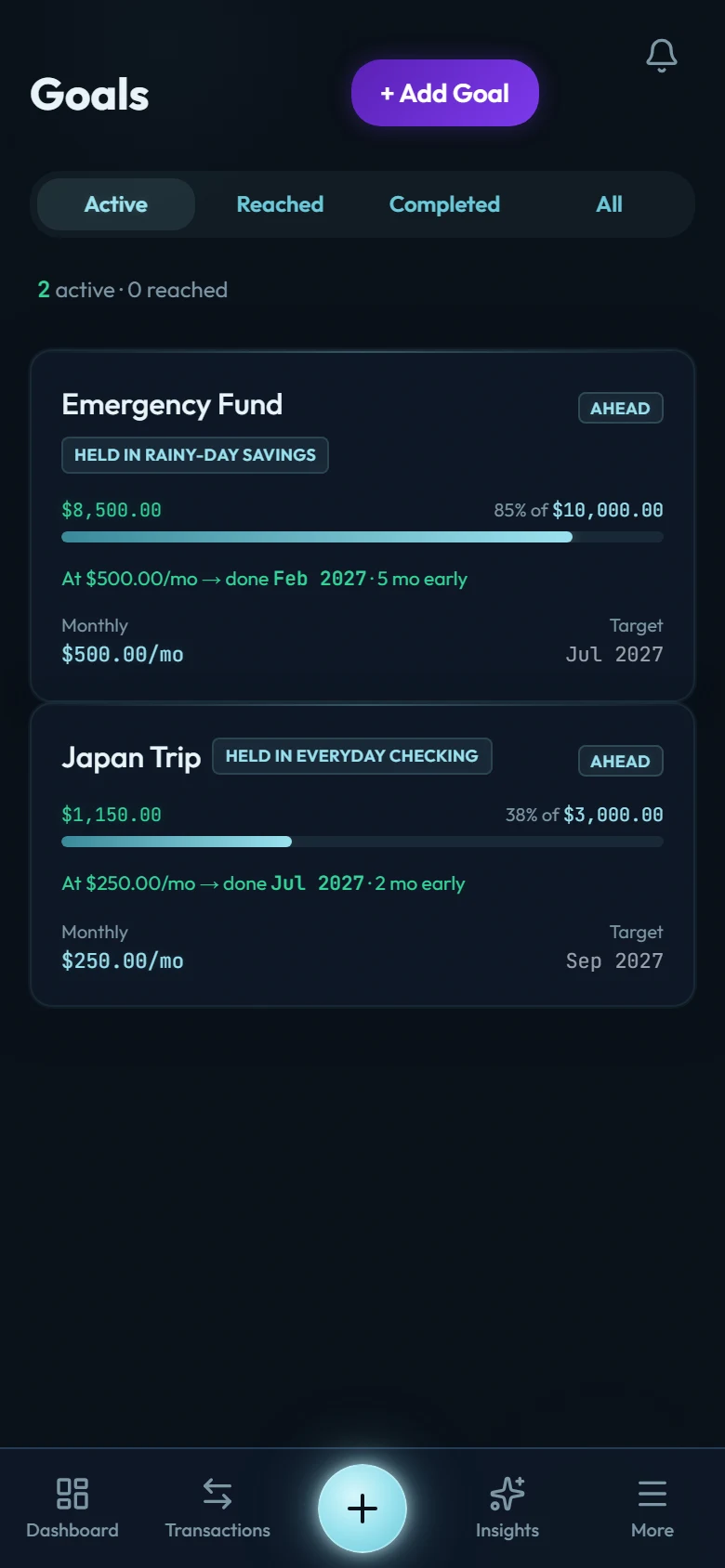
Wealth Mutant is the personal finance app we built for exactly this. A goal in the app is backed by a real account, and its card shows the month it will be done at your monthly amount, in a line like "At 200/mo → done Mar 2027". Future Self turns on after 3 complete months, builds your projection from your recent complete months, and carries your saving pace 10, 20 and 30 years ahead. You note each purchase yourself in a few seconds, a small daily habit that makes you notice, and no bank login is ever shared. You pay for it once.
The help page on Goals and Funding covers how a goal is backed by a real account and shows the month it will be done.
More free tools
- How much is my hourly pay a year?Hourly to salary calculator
- How many hours of my life does this cost?Hours of your life calculator
- How big should my emergency fund be?Emergency fund calculator
- If I lost my job, how long would my savings last?Runway calculator
- How long will it take to double my money?Rule of 72 calculator
- When will I be debt free?Debt payoff calculator
- How much interest is my credit card costing me?Credit card interest calculator
- When is my credit card bill due?Credit card billing cycle calculator
- What does paying extra on my mortgage do?Extra mortgage payment calculator
- What is my net worth?Net worth calculator
- How much do I need to stop working, and when will I get there?FIRE calculator
- Can I stop saving for retirement yet?Coast FIRE calculator
Checked on 13 Nov 2026 against a separate re-calculation of every figure in the milestones and the examples.
Next, run these sums on your own money
7 days free · no card needed