Free calculator
Coast FIRE Calculator: When to Stop Saving
Coast FIRE is the point where what you have invested could grow to your retirement number with nothing more added. Find that number, and the month you get there.
Nothing you type is saved or sent anywhere, and there is nothing to sign up for. The only copy is one you print or download yourself.
Your answer, example
3 years 11 months
until the Coast point, at about age 33. From then, what you have invested would grow to your FIRE number by 65 with nothing more added.
Your Coast number today
What you would need invested today to reach your FIRE number by 65 with nothing more added.
$70,247
What you have
71% of your Coast number
$50,000
Still to go
$20,247
Your FIRE number
$2,500 × 12 ÷ 4%, which is 25 times a year of spending
$750,000
What you have today, left alone, by 65
$50,000 growing 7% a year for 35 years
$533,829
If you keep adding until 65
Your pot at 65, adding $500 a monthIf you keep adding, your pot reaches your FIRE number in 26 years 8 months, at about age 56.
$1,389,536
If the return were lower
- At 6% a year: the Coast point in 10 years 9 months, at about age 40. Coast number $97,579.
- At 5% a year: the Coast point in 24 years 9 months, at about age 54. Coast number $135,968.
What would change it
- The earliest Retire at age that still gives you a Coast point is 57. Retire at takes whole years, and the Coast point has to come before the age you pick.
From your numbers: age 30, retiring at 65, $50,000 invested, adding $500 a month, spending $2,500 a month once you stop, 7% a year after inflation, 4% withdrawal rate.
To compare two plans, keep this answer as A. Then change a number and B shows beside it.
Your pot by age
Year by year
| Age | Keep adding | Stop at the Coast point | Coast line |
|---|---|---|---|
| 30 | $50,000 | $50,000 | $70,247 |
| 31 | $59,690 | $59,690 | $75,165 |
| 32 | $70,059 | $70,059 | $80,426 |
| 33 | $81,153 | $81,153 | $86,056 |
| 34 | $93,024 | $92,524 | $92,080 |
| 35 | $105,726 | $99,000 | $98,525 |
| 36 | $119,316 | $105,930 | $105,422 |
| 37 | $133,859 | $113,346 | $112,802 |
| 38 | $149,419 | $121,280 | $120,698 |
| 39 | $166,068 | $129,769 | $129,147 |
| 40 | $183,883 | $138,853 | $138,187 |
| 41 | $202,945 | $148,573 | $147,860 |
| 42 | $223,342 | $158,973 | $158,210 |
| 43 | $245,166 | $170,101 | $169,285 |
| 44 | $268,518 | $182,008 | $181,135 |
| 45 | $293,504 | $194,749 | $193,814 |
| 46 | $320,239 | $208,381 | $207,381 |
| 47 | $348,846 | $222,968 | $221,898 |
| 48 | $379,456 | $238,576 | $237,431 |
| 49 | $412,208 | $255,276 | $254,051 |
| 50 | $447,252 | $273,145 | $271,835 |
| 51 | $484,750 | $292,265 | $290,863 |
| 52 | $524,873 | $312,724 | $311,223 |
| 53 | $567,804 | $334,615 | $333,009 |
| 54 | $613,741 | $358,038 | $356,320 |
| 55 | $662,893 | $383,100 | $381,262 |
| 56 | $715,485 | $409,917 | $407,950 |
| 57 | $771,759 | $438,611 | $436,507 |
| 58 | $831,973 | $469,314 | $467,062 |
| 59 | $896,401 | $502,166 | $499,757 |
| 60 | $965,339 | $537,318 | $534,740 |
| 61 | $1,039,103 | $574,930 | $572,171 |
| 62 | $1,118,030 | $615,175 | $612,223 |
| 63 | $1,202,483 | $658,237 | $655,079 |
| 64 | $1,292,846 | $704,314 | $700,935 |
| 65 | $1,389,536 | $753,616 | $750,000 |
Made in your browser when you click. Nothing is sent anywhere.
The app tests Coast FIRE on your investment and retirement accounts, using what you put in and spend in an average month.
See it in the appWhat this assumes
- Your return is a yearly figure after inflation. A 7% return means your money grows 7% over a full year, and the calculator turns that into the monthly growth that adds up to it.
- Wealth Mutant's Future Self adds one 12th of the yearly rate each month, which comes to a little more than the yearly rate. Its numbers can differ slightly from these.
- Spending and any pension or other income are in today's money. Because the return is after inflation, every figure here stays in today's money.
- Growth is the same every year. Real returns rise and fall, so the rows under your answer show lower returns beside yours.
- Tax, fees and health costs are not included.
What this is not for
This shows what a set of numbers does. It does not predict returns, and it does not tell you when to stop saving.
How the sum works
FIRE stands for financial independence, retire early. Your FIRE number is the pot that could pay your spending for good: $2,500 × 12 ÷ 4%, which is 25 times a year of spending. A pension that starts later comes off first, and the years before it are paid from the pot.
Your Coast number is that FIRE number brought back to today at your return: $750,000 ÷ (1 + 7%) for each of the 35 years left. If you already hold that much, you are at the Coast point. If not, the calculator steps forward a month at a time: the pot grows by that month's share of the yearly return, then your deposit goes in. The Coast point is the first month the pot reaches what it would need by then.
To reach the Coast point by an age you pick, the calculator finds the smallest monthly amount that does it.
An example
You are 30 and have $50,000 invested. You add $500 a month, will spend $2,500 a month once you stop, and plan to retire at 65, with 7% a year after inflation. Your FIRE number is $750,000. Your Coast number today is $70,247, so you are 71% of the way. You reach the Coast point in 3 years 11 months, at about age 33.
Questions people ask
What is Coast FIRE, and how is it worked out?
Coast FIRE is the point where what you have invested would grow to your FIRE number by your retirement age with nothing more added. You still earn what you spend until then. Your Coast number is your FIRE number brought back to today at your expected return.
What return should I use?
Use a return after inflation, so every figure stays in today's money. The calculator starts at 7% and shows the answer at 6% and 5% as well. A point or two lower can move the date by years, so read those rows too.
Does it count Social Security, a State Pension, or CPP and OAS?
Yes, if you add it under Add detail: the monthly amount in today's money and the age it starts. Your own statement has the figure. If it starts after you retire, the pot pays the years in between. Left empty, your investments cover everything. UK: the State Pension and when you can take a private pension.
What is the 4% rule?
It says you can take 4% of your pot in your first year of retirement, then adjust for prices. It comes from US studies of 30-year retirements (Bengen, 1994, and the Trinity study) and equals a pot of 25 times a year of spending. For a longer retirement, type 3.5% and see what it does.
Is Coast FIRE the same as retiring early?
No. At the Coast point you still earn enough to cover what you spend. You only stop adding to retirement savings. It also rests on a return nobody can promise, which is why the calculator shows lower returns beside yours.
Keep reading
- What is Coast FIRE? How it compares with lean, fat and barista FIRE, and how to work out your own number.
- Savings rate: how to work yours out in a minute, and why it says more about your future than your salary does.
- Why the first 100,000 is the hardest, and how long it takes at each monthly amount and growth rate.
What the app does with your own numbers
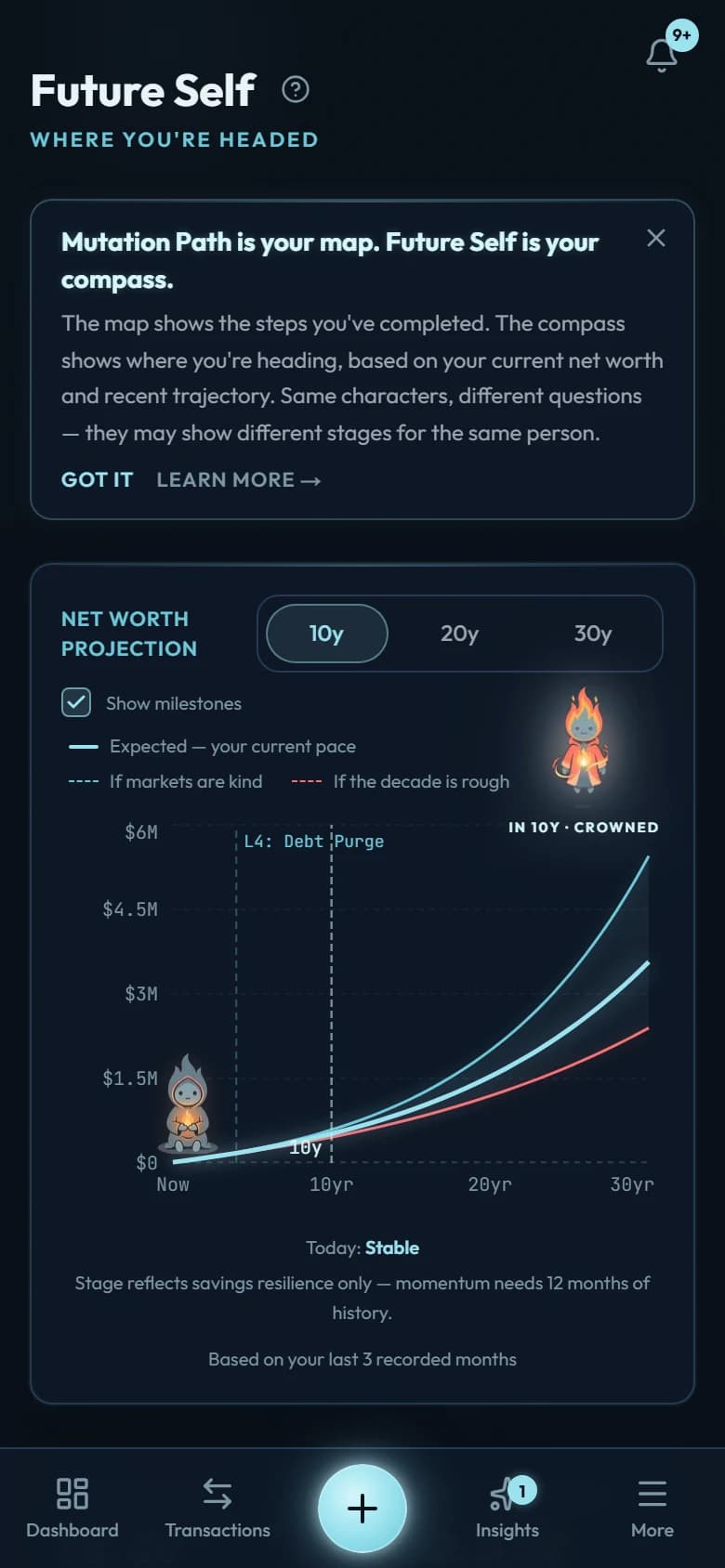
Wealth Mutant is the personal finance app we built for exactly this. It runs a Coast FIRE test on your real investment and retirement accounts, using what you put in and spend in an average month, and Future Self shows where your current pace leads 10, 20 and 30 years ahead. You note each purchase yourself in a few seconds, a small daily habit that makes you notice, and no bank login is ever shared. You pay for it once.
Checked on 16 Oct 2026 against a separate re-calculation of every figure in the example, and the two GOV.UK pages linked above.
More free tools
- How much is my hourly pay a year?Hourly to salary calculator
- How many hours of my life does this cost?Hours of your life calculator
- How big should my emergency fund be?Emergency fund calculator
- When will I reach my savings goal?Savings goal calculator
- If I lost my job, how long would my savings last?Runway calculator
- How long will it take to double my money?Rule of 72 calculator
- When will I be debt free?Debt payoff calculator
- How much interest is my credit card costing me?Credit card interest calculator
- When is my credit card bill due?Credit card billing cycle calculator
- What does paying extra on my mortgage do?Extra mortgage payment calculator
- What is my net worth?Net worth calculator
- How much do I need to stop working, and when will I get there?FIRE calculator
Next, run these sums on your own money
7 days free · no card needed