Free calculator
Credit Card Interest Calculator: Payoff Time
Type your balance and your APR, the yearly rate your card charges. See what one month of interest costs, how long a payment takes to clear the card, and what paying only the minimum adds.
Nothing you type is saved or sent anywhere, and there is nothing to sign up for. The only copy is one you print or download yourself.
Your answer, example
You save $6,018 and 13 years 8 months
Paying $200 a month clears the card in 2 years 10 months. Paying only the minimum, it takes 16 years 6 months and costs $7,811 in interest.
Only the minimum
16 years 6 months
Interest $7,810.99
Keep paying $143.17
4 years 9 months
Interest $3,157.78
Your $200 a month
2 years 10 months
Interest $1,792.98
Paying $200.00 a month, the card is clear in 2 years 10 months and the interest comes to $1,792.98.
Total interest
$1,792.98
Total you pay
$6,792.98
Interest in month 1
Balance × APR ÷ 12, the schedule's month. A cycle of 30 days or fewer costs a little less, and one of 31 days a little more.
$93.17
Last payment
Whatever clears the balance.
$192.98
Paying only the minimum
The minimum starts at $143.17 and falls as the balance does, until it reaches the least it can be, $35.00. It takes 16 years 6 months and costs $7,810.99 in interest.
That is 13 years 8 months longer than your plan, and $6,018.01 more in interest.
A card that adds each day's interest to the next day's balance would cost about $24.82 more on this plan.
From your numbers: a balance of $5,000 at 22.36% a year, paying $200 a month, and a minimum of 1% of the balance plus the month's interest, at least $35
Each card in the app shows the bill you owe now and its due date, apart from newer spending.
See it in the appWhat you owe on each path
- Only the minimum
- Keep paying $143.17
- Your $200 a month
| Years from now | Only the minimum | Keep paying $143.17 | Your $200 a month |
|---|---|---|---|
| 0 | $5,000 | $5,000 | $5,000 |
| 1 | $4,432 | $4,335 | $3,578 |
| 2 | $3,928 | $3,504 | $1,804 |
| 2.8 | $3,553 | $2,656 | $0 |
| 3 | $3,482 | $2,467 | $0 |
| 4 | $3,086 | $1,174 | $0 |
| 4.8 | $2,820 | $0 | $0 |
| 5 | $2,736 | $0 | $0 |
| 6 | $2,425 | $0 | $0 |
| 7 | $2,149 | $0 | $0 |
| 8 | $1,905 | $0 | $0 |
| 9 | $1,689 | $0 | $0 |
| 10 | $1,497 | $0 | $0 |
| 11 | $1,327 | $0 | $0 |
| 12 | $1,174 | $0 | $0 |
| 13 | $999 | $0 | $0 |
| 14 | $782 | $0 | $0 |
| 15 | $510 | $0 | $0 |
| 16 | $170 | $0 | $0 |
| 16.5 | $0 | $0 | $0 |
- Only the minimum: paid off in 16 years 6 months
- Keep paying $143.17: paid off in 4 years 9 months
- Your $200 a month: paid off in 2 years 10 months
- $6,018 more interest on the minimum
A little more each month
+$25 a month
Paid off 5 months sooner, $278 less interest
+$50 a month
Paid off 8 months sooner, $478 less interest
+$100 a month
Paid off 1 year 1 month sooner, $750 less interest
Where your money goes
Only the minimum: $5,000 of what you owe today and $7,810.99 of interest, $12,810.99 in all.
Your $200 a month: $5,000 of what you owe today and $1,792.98 of interest, $6,792.98 in all.
Why paying only the minimum takes so long, with a worked example
Month by month
Each month, the interest (balance × APR ÷ 12, rounded to 2 decimal places) is added, then the payment is taken off. There are no new purchases, the rate stays the same, and the last payment is whatever clears the balance. A card that charges interest every day comes out slightly higher.
| Month | Payment | Interest | Balance |
|---|---|---|---|
| $2,400.00 | $978.12 | $3,578.12 | |
| $2,400.00 | $625.47 | $1,803.59 | |
| $1,992.98 | $189.39 | $0.00 |
Made in your browser when you click. Nothing is sent anywhere.
How the sum works
One cycle's interest is your balance × your APR ÷ 365 × the days in the billing cycle. A UK APR (FCA, CONC App 1.2) or an EU one counts interest on interest, as does a compound purchase rate, so for those the page uses the simple rate under the rate typed, 12 × ((1 + rate)^(1/12) − 1), unless you choose Simple or nominal rate.
To pay the card off, each month the page adds interest of balance × APR ÷ 12, rounded to 2 decimal places, and takes off your payment or that month's minimum, whichever is more: paying less than the minimum counts as a missed payment. For a set number of months, it finds the smallest payment that clears the card in time, or the first minimum if that is more.
The minimum is a share of the balance before that month's interest, plus that interest if you switch it on, or your floor if that is more. In the US, Regulation Z (section 1026.7(b)(12)) says a card issuer must put this statement, with a bold heading, on each periodic statement, with some exceptions: "Minimum Payment Warning: If you make only the minimum payment each period, you will pay more in interest and it will take you longer to pay off your balance".
A worked example
Take $5,000 at 22.36%. One 30-day cycle costs $5,000 × 22.36% ÷ 365 × 30 = $91.89. In the monthly schedule, month 1 adds $93.17 of interest ($5,000 × 22.36% ÷ 12). Paying $200.00 a month, the card is clear in 2 years 10 months and the interest comes to $1,792.98. Paying only the minimum (1% of the balance plus the month's interest, at least $35), it takes 16 years 6 months and costs $7,810.99. A card that adds each day's interest to the next day's balance would cost about $24.82 more on the $200.00 plan.
Questions people ask
How do you calculate credit card interest?
Multiply your balance by your APR, divide by 365, and multiply by the days in the billing cycle. A balance of 1,000 at 21.9% for 30 days is 1,000 × 21.9% ÷ 365 × 30 = 18.00. On a UK or EU card, use the simple rate under the compound purchase rate instead, as How the sum works explains.
Do you pay interest if you pay the card in full?
On most cards, not on purchases, if you pay the whole statement balance by the due date and paid the last statement in full too. The gap between the end of the cycle and the due date is the grace period. Cash advances usually have no grace period, so check your agreement.
Why is month 1 of the payoff schedule a little different from this month's interest?
The one-cycle figure works from the days in your cycle ÷ 365. The schedule uses APR ÷ 12, so every month is 1 ÷ 12 of a year, about 30.4 days. A cycle of 30 days or fewer costs a little less than the schedule's month, and one of 31 days a little more.
Why does paying only the minimum take so long?
Many minimums are the month's interest plus a share of the balance, so only that share pays the card down. As the balance falls, the minimum falls with it, and each month pays off a little less. The minimum-only path above shows it with your numbers.
Can I use it for a cash advance or a balance transfer?
Yes, one rate at a time. A card can charge a different APR for purchases, cash advances and transfers, and the Financial Consumer Agency of Canada says you pay interest on a cash advance from the day you take it, usually at a higher rate than for purchases. Run each part of the balance with its own rate.
What this assumes
- Each month the interest (balance × APR ÷ 12, rounded to 2 decimal places) is added, then your payment is taken off.
- There are no new purchases, fees or late charges after today.
- The rate stays the same. An offer such as 0% for a while is not counted.
- You pay once a month, on time, and the last payment is whatever clears the balance.
- The minimum follows the rule you set. A card that charges interest every day comes out slightly higher.
What this is not for
This is a calculator, not advice. Your statement has the final figures, and your card agreement has the rate, the minimum rule and the way interest is worked out.
What the app does with your own numbers
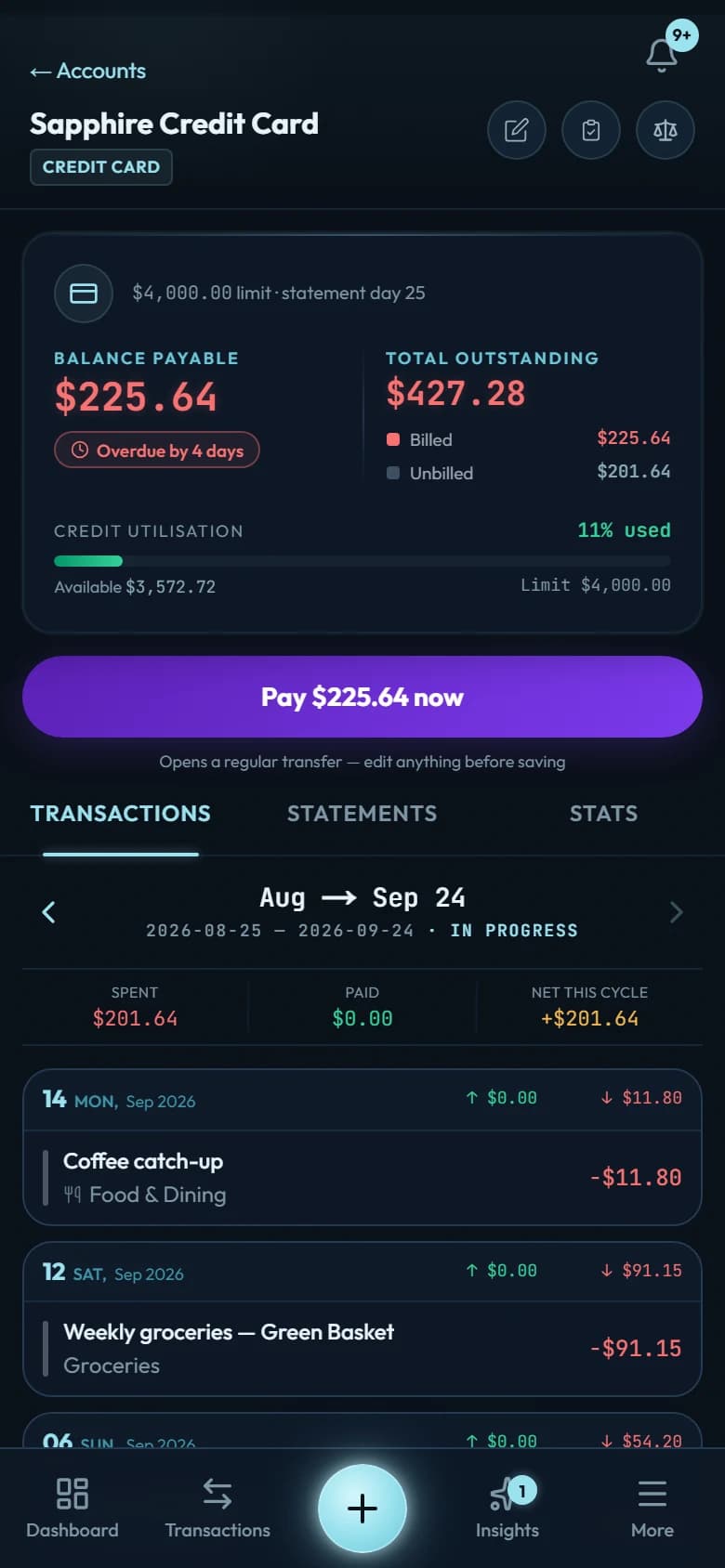
Wealth Mutant is a personal finance app that keeps card debt in plain view. Each credit card shows the bill that is payable and its due date, apart from newer spending that is not billed yet, and the app reminds you before the due date, beside your loans, budgets and net worth. You note each purchase yourself in a few seconds, a small daily habit that makes you notice what is building up, and no bank login is ever shared. You pay for it once.
How credit card accounts work explains the card page, and How loan accounts work covers the prepayment simulator.
Checked on 29 Oct 2026 against a separate re-calculation of every figure in the example, and the CFPB page on Regulation Z section 1026.7.
More free tools
- How much is my hourly pay a year?Hourly to salary calculator
- How many hours of my life does this cost?Hours of your life calculator
- How big should my emergency fund be?Emergency fund calculator
- When will I reach my savings goal?Savings goal calculator
- If I lost my job, how long would my savings last?Runway calculator
- How long will it take to double my money?Rule of 72 calculator
- When will I be debt free?Debt payoff calculator
- When is my credit card bill due?Credit card billing cycle calculator
- What does paying extra on my mortgage do?Extra mortgage payment calculator
- What is my net worth?Net worth calculator
- How much do I need to stop working, and when will I get there?FIRE calculator
- Can I stop saving for retirement yet?Coast FIRE calculator
Next, run these sums on your own money
7 days free · no card needed