
The minimum payment on a credit card is the least you must pay by the due date to keep the account in good standing. Many issuers set it at about 1% of the balance plus that month's interest and fees, with a floor of $25 to $40 on US cards. So it covers the interest and barely more.
Paying only that is an easy habit to fall into, and the price is time. On a $3,000 balance at 24% a year, minimum payments set that way take 12 years 6 months and cost $4,442 in interest, about 1.5 times what you borrowed.
How is the minimum payment on a credit card calculated?
Your card agreement spells out the formula, built from the same parts on most cards: a percentage of the balance, this statement's interest and fees, and a flat floor for low balances. Anything past due is added on top, and the total never exceeds what you owe.
A Chase cardmember agreement adds any past-due amount to "the larger of: (a) $35 (or total amount you owe if less than $35); or (b) the sum of: (i) 1% of the new balance", plus the interest and late fees billed on that statement. American Express's agreement for its Optima card starts from "the highest of" 3 amounts: interest plus 1% of the balance, 2% of the balance, or $40. Read plainly, the common pattern is a dollar floor or a percentage of the balance plus the month's interest, whichever is larger. Other issuers use a flat 2% to 4% of the balance, US Bank notes.
Run an example through either formula. A $3,000 balance at 24% a year grows by 2% a month, so this month's interest is $60. Add 1% of the balance, $30, and the minimum is about $90. Only that $30 reduces what you owe. On a $1,000 balance the formula gives about $30 ($10 plus $20 of interest), below both floors, so the Chase card asks for $35 and the Amex card for $40.
What happens if you only pay the minimum payment on a credit card?
Here is that $3,000 at 24% APR, the yearly rate, worked month by month. The assumptions: interest of 2% of the balance each month, no new purchases or fees, and a typical minimum, the larger of $35 or 1% of the balance plus the month's interest. A minimum payment calculator runs this loop: add the interest, subtract the payment, repeat. The free credit card interest calculator runs it on your own balance, rate and minimum rule. The sums work the same way in pounds or rupees. As for the rate, that Chase agreement lists purchase rates of 17.74% to 27.49%, so 24% is realistic.
| How you pay | Monthly payment | Time to clear | Interest paid |
|---|---|---|---|
| Minimum only | $90, falling to $35 | 12 years 6 months | $4,442 |
| Keep paying $90 | $90 | 4 years 8 months | $1,993 |
| Pay $118, the 36-month payment | $118 | 3 years | $1,232 |

Interest takes most of each early payment: $682 of the $1,023 paid in the first year. The minimum also shrinks with the balance, $81 by month 12 and $50 by month 60, so each month pays down less. After 5 years of minimum payments you have paid $4,076, more than you borrowed, and still owe $1,641.
A $25 floor stretches the first row to 15 years 3 months, and a $40 floor, as on the Amex card, trims it to 11 years 5 months.
Put your card next to everything else you owe.
See what is payable and by when, what you have spent since the statement and how much of your limit is in use.
No card needed.
What is the minimum payment warning on a US credit card statement?
The Credit CARD Act of 2009 ordered a minimum payment warning on credit card statements, and Regulation Z (12 CFR 1026.7(b)(12)) now fixes its first line word for word: "Minimum Payment Warning: If you make only the minimum payment each period, you will pay more in interest and it will take you longer to pay off your balance."
The box sits next to the minimum payment due and gives your own figures: how long minimum payments would take (in months under 2 years, otherwise in whole years), what that would cost in total, usually the payment that would clear the balance in 36 months with its total cost and saving, and a toll-free number for credit counseling. If the minimum would not even cover the interest, the box says you will never pay it off.
The rule does not cover a statement that follows 2 cycles in a row paid in full, so the box may be missing from it. In the example, the 36-month payment works out at about $118, the last row of the table.
How do the UK and India regulate the minimum payment on a credit card?
In the UK, a lender must set the minimum at no less than "the interest, fees and charges that have been applied to the customer's account, plus one percentage of the amount outstanding" (FCA CONC 6.7.5R, for agreements from 1 April 2011). The FCA also targets what it calls persistent debt: each month the lender checks whether, over the last 18 months, you paid less in principal (the part you borrowed) than in interest, fees and charges. If so, it must notify you, explain that paying more would cut the cost and the time, and give contact details for not-for-profit debt advice. Balances that dipped below £200 in that time are exempt.
If another 18 months pass the same way, the lender must take reasonable steps to help you repay faster, and if you do not respond it must suspend or cancel use of the card (CONC 6.7.27R to 6.7.35R). Read in pounds, the example is persistent debt: the first 18 months of minimum payments total £1,489, and only £496 of that reduced the debt.
In India it is the minimum amount due, which the RBI's card rules define as "the minimum amount of money, as a part of the total bill amount, that a cardholder has to pay to not be treated as an overdue bill". Issuers must set it "so as to ensure there is no negative amortization", so paying it covers at least the month's interest and charges.
The RBI's own example is Rs 10,000 owed at 2% a month: Rs 200 of interest plus an indicative Rs 50 of tax and other charges, so the minimum cannot be below Rs 250. Card terms must also explain that the interest-free period stops while any of the last bill is unpaid, and every statement must warn that paying only the minimum stretches repayment over months or years.
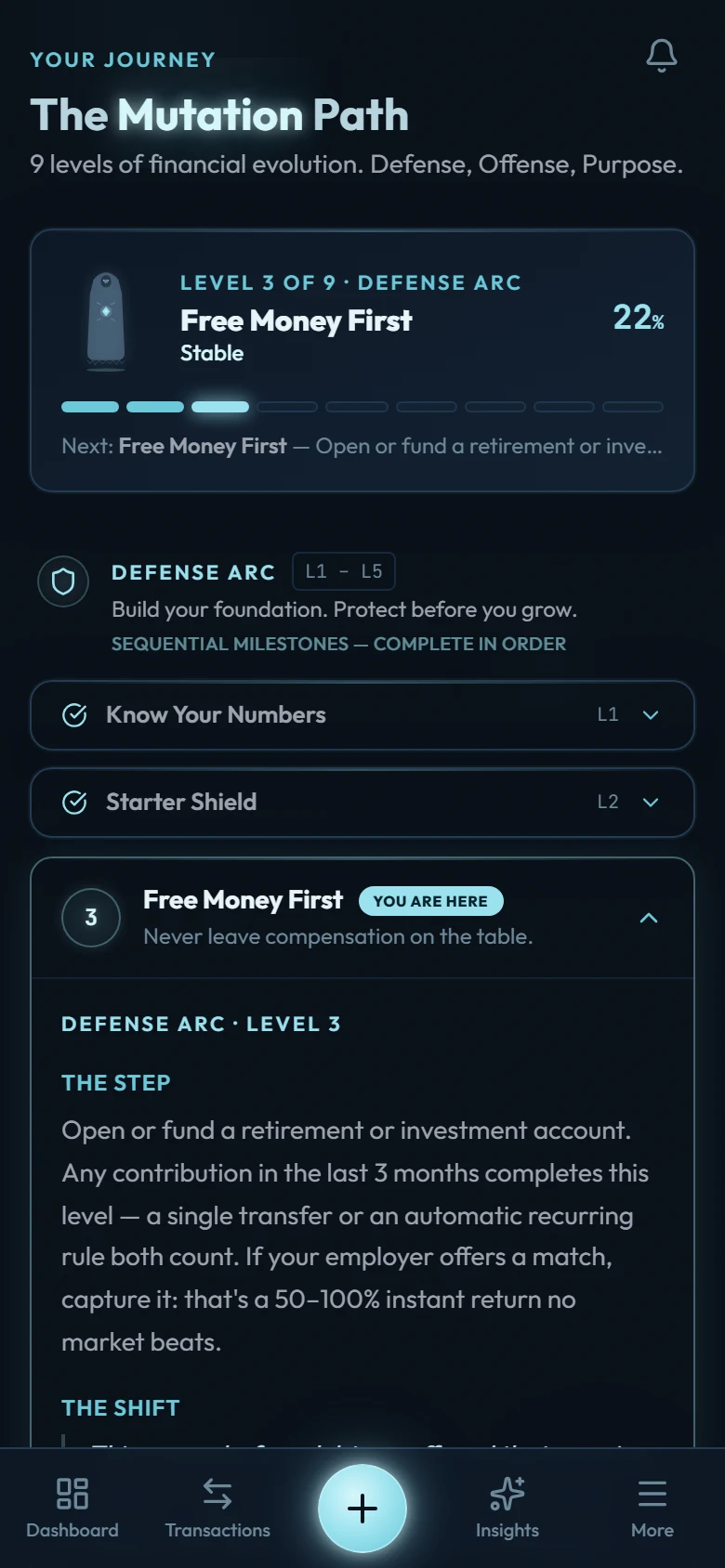
Wealth Mutant is the personal finance app we built for exactly this. Each card is a real account that shows what is payable and by when, and a card that carried interest on any of its last 3 statements holds back Debt Purge, Level 4 of the 9-level path. You note each purchase yourself in a few seconds, a small daily habit that makes you notice what you owe, and no bank login is ever shared. You pay for it once.
See every card and loan as a real account.
Watch a card's balance fall as you pay it down. One payment for the app, and no renewal after it.
Buy — $99 onceWhat should you pay instead of the minimum?
The cheapest payment is the full statement balance: on most cards, the CFPB says, paying it by the due date means no interest on purchases (which balance to pay is its own question). When that is out of reach, a fixed amount beats the minimum.
Choose a fixed payment and keep it
Pick an amount at least as big as the first minimum and keep paying it as the minimum falls. In the example, paying the same $90 every month saves $2,448 and 7 years 10 months. A US statement's 36-month payment is a ready-made target. Set it to leave your bank account automatically, so the decision is made once.
Stop adding to the balance
Once a balance carries over, you lose the interest-free period, and the CFPB says you are charged interest "on purchases in the new billing cycle starting on the date each purchase is made". Put everyday spending on a debit card or a card you pay in full.
If even the minimum is hard, call first
Contact the issuer before the due date. The CFPB says: "Many card companies are willing to work with you to change your payment if you're facing a financial emergency." Say why you cannot pay the minimum, what you can afford and when normal payments could restart.
With more than one card, pay the minimum on each and send everything extra to one, in the order that avalanche or snowball suggests.
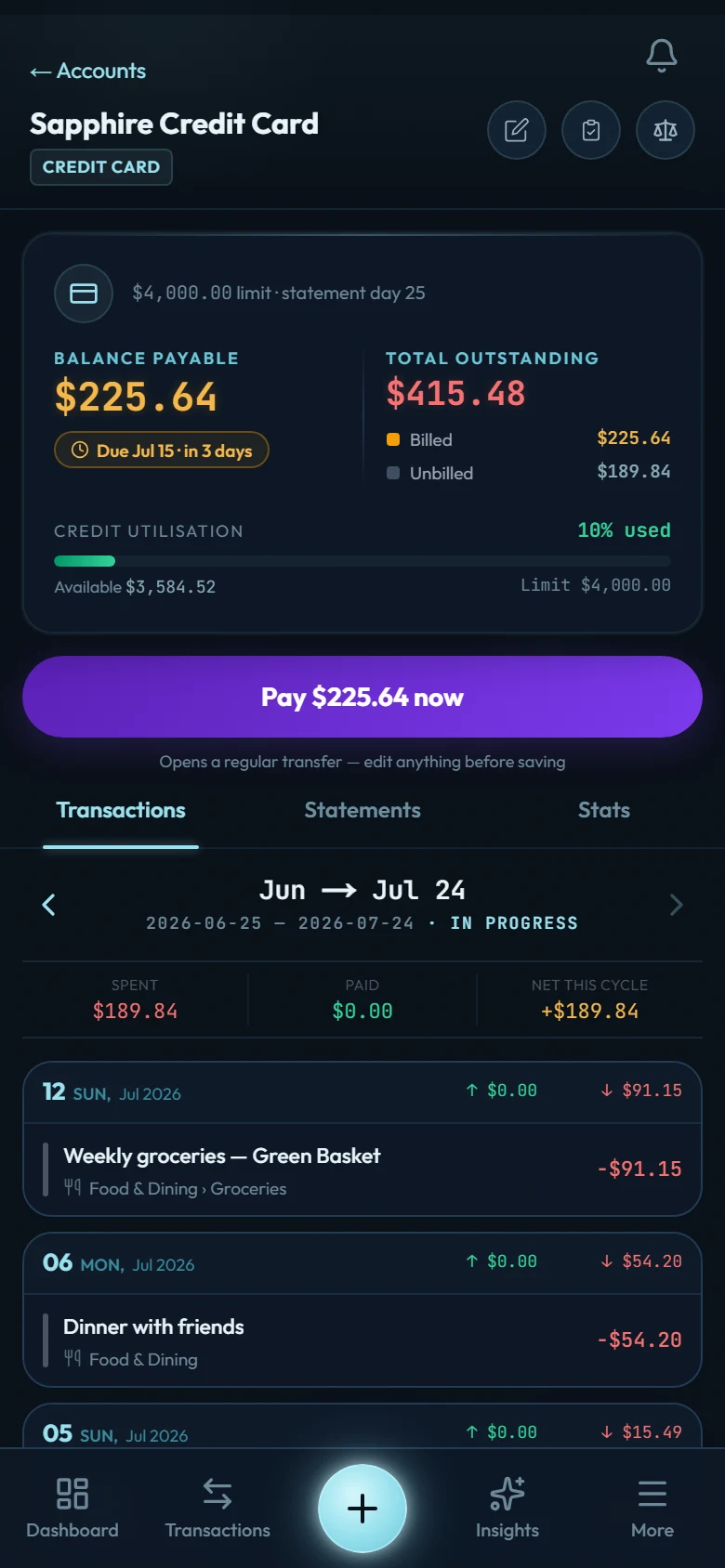
Pay now opens an ordinary transfer, so you can change the amount before you save it. Whatever you leave unpaid stays in Balance payable until a transfer covers it.
What changes when you stop paying the minimum?
The payment stops shrinking, so more of it reduces the debt each month: $30 of the first $90, $37 of the 12th and $60 of the 36th. The interest on your statement falls with it, from $60 to $53 to $30. Once the card is paid off, 3 statements in a row with no interest on them lift its hold on Level 4 of the 9-level path.
Common questions
What happens if I miss the minimum payment?
Paying less than the minimum, or nothing, can bring a late fee and, on some cards, a higher penalty rate. One Chase card agreement lets the issuer apply it to new purchases if the minimum is late, and to the whole balance after 60 days. Issuers may also report late payments to the credit bureaus. In India, a bank may charge a late fee, or report you as past due, only once the account is more than 3 days past due.
Does paying only the minimum hurt my credit score?
Paying on time builds a record, but carrying the balance keeps your utilization, the share of your limit in use, high. Citi's guide says paying only the minimum "may not help lower your credit utilization" and that paying the full statement balance is typically better for your credit.
Why does my minimum payment change every month?
With a percentage formula it falls as the balance does, from $90 to $50 by month 60 in the example, and rises with new purchases, fees or a rate increase.
Add your card to Wealth Mutant with its statement day, due day and what you owe today, then record your fixed payment as a transfer on each due date. How card accounts work shows each step, the tour walks you through the other screens, and paying off debt covers the wider picture.