
A credit card cash advance is cash you borrow against your card's limit. It usually costs a fee, a higher APR (the yearly interest rate) than a purchase, and interest that starts the same day, with no interest-free period.
On Chase Freedom Unlimited's terms (its pricing page, read 11 November 2026), a $500 cash advance held for 30 days costs at least $36.95: a $25.00 fee plus $11.95 of interest. The same $500 spent on the card and paid off in full by the due date costs $0.
How does a credit card cash advance work?
You draw cash from your card's available credit at an ATM, a bank counter or with a check (cheque) from your card company. You repay it like any other card payment. Unlike a debit card withdrawal, which uses your own money, it is a short-term loan. The CFPB (the US consumer finance regulator) calls it expensive. At an ATM you also need the card's PIN, and the ATM may add its own fee.
The cash usually sits in its own balance with its own APR, and your statement must show both. Many cards also cap cash at a lower limit, often a share of the card's limit, shown in your card's terms or on your statement.
How to calculate cash advance interest and fees: a $500 example
Chase's pricing page lists a cash advance fee of $10 or 5%, whichever is greater, a cash advance APR of 28.74%, and interest from the transaction date. For $500 held for 30 days (the sums work in any currency):
- Fee: 5% of $500 is $25.00, above the $10 minimum.
- Interest: 28.74% ÷ 365 is 0.0787% a day, or 39 cents on $500. Chase's card agreement charges interest on that interest too, so 30 days come to $11.95.
- Total: $25.00 + $11.95 = $36.95, or 7.4% of the cash in a month.
- The same $500 as a purchase, paid in full by the due date: $0.
The fee is the bigger cost of a 30-day loan. These sums assume nothing is repaid and leave out interest on the fee itself: Chase adds fees to the balance on a date it chooses, and a fee added on day 0 would cost 60 cents more. How to calculate credit card interest has the full method.

Chase beside a second real card:
| Chase Freedom Unlimited | Capital One (Visa Signature, World Mastercard) | |
|---|---|---|
| Cash advance fee | $10 or 5%, whichever is greater | $5 or 5%, whichever is greater |
| Cash advance APR | 28.74% | 25.99% to 28.99% |
| Purchase APR | 18.49% to 27.99% after 0% intro | 18.49% to 28.99% |
Capital One's figures come from its card agreement in the CFPB's database (terms as of 30 June 2026). Both issuers charge interest on cash from the transaction date, both compound it daily on a 365-day year, and both cash APRs move with the US Prime Rate. Capital One also treats its fee as a cash advance, so the fee is charged interest too.
Try it on the card you use most
Add its statement day and due day, and its page shows what you owe and when it is due.
No card needed.
Cash advance vs purchase: what is the difference?
A purchase can cost nothing. The CFPB calls the time between your bill closing and its due date the grace period, and says you may not be charged interest in it if you pay your balance in full and were not already carrying one. That period typically applies only to purchases, so a cash advance gets none of it. On a card with a 31 October statement and a 25 November due date, the purchase side looks like this:

Even carried for 30 days at the top of Chase's purchase range (27.99%), the same $500 purchase costs $11.63 in interest and no fee, against $36.95 for cash. Of that $25.32 gap, $25.00 is the fee.
What counts as a cash advance?
Whatever your card company says counts. Capital One's agreement defines it as "a loan in cash or things we consider cash equivalents, including wire transfers, travelers' checks, money orders, foreign currency, lottery tickets, gaming chips, and wagers". Its own guide to cash advances adds that issuers might also count payments through apps such as Venmo, paying bills or paying off other debt. If a payment is not a shop purchase, look for "cash advance" in your agreement first.
Interest on cash builds every day, so it helps to see what a card owes before the bill comes.
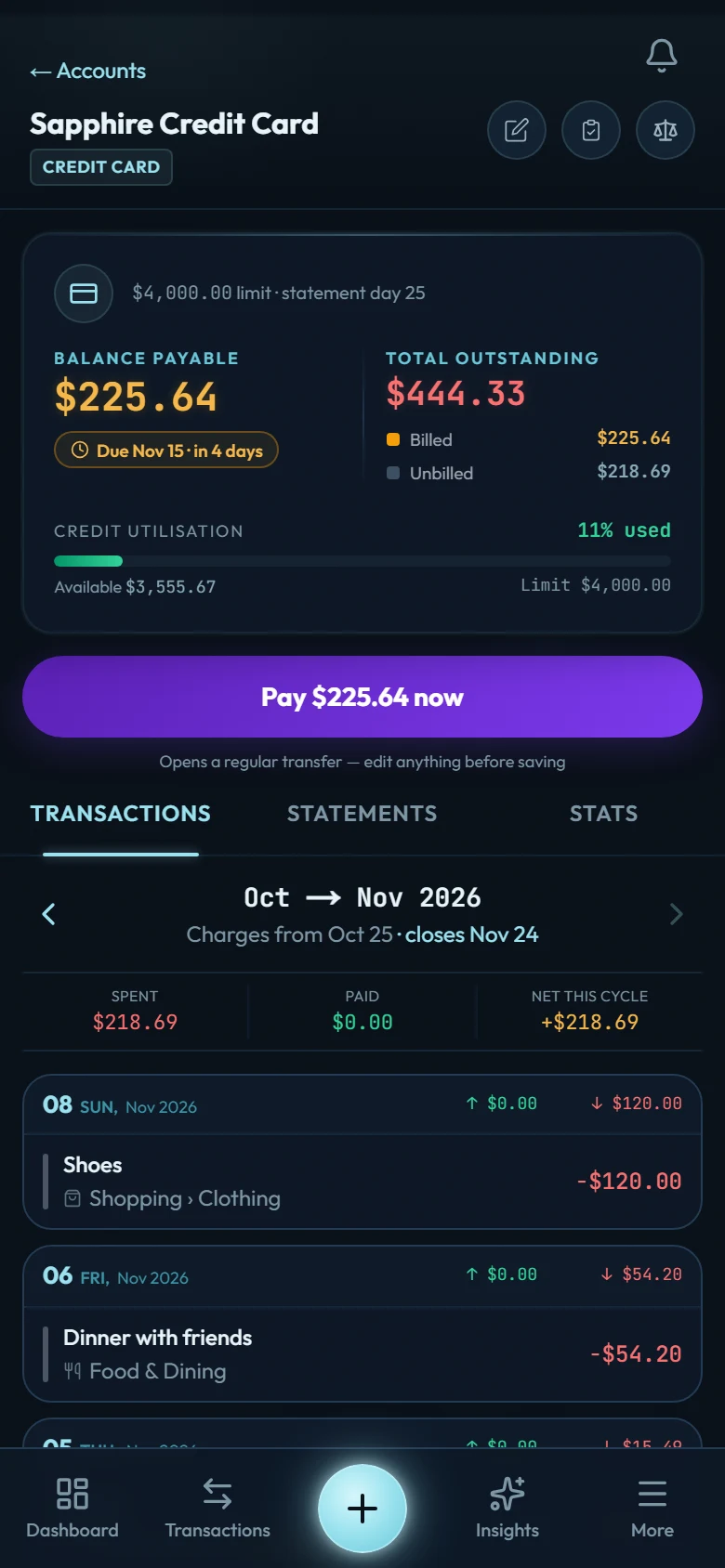
Wealth Mutant is the personal finance app we built for exactly this. A card's page shows the total it owes, split into what is billed and what is not billed yet, beside the share of its limit in use. You add what goes on the card yourself, in a few seconds, a small daily habit that makes you notice, and no bank login is ever shared. You pay for it once.
Keep every card in view
Each card's balance, due date and limit used, alongside your budgets, loans and net worth. One payment, yours for life.
Buy — $99 onceDo cash advances work the same in the UK, India and Canada?
| Where | What the source says |
|---|---|
| UK | Santander's Everyday No Balance Transfer Fee card (read 11 November 2026) charges a 3% fee on cash withdrawals (minimum £3) and 29.9% a year on cash "from the day it's withdrawn", against 24.9% on purchases. Santander says cash gets no interest-free period, even if you pay in full. Other cards differ, so read your summary box. |
| India | SBI Card's terms sheet (read 11 November 2026): a 2.5% fee (minimum Rs 500) and 3.75% a month (45% a year) on unsecured cards from the date of withdrawal, with no free credit period. Rs 10,000 held for 30 days costs Rs 870 (the Rs 500 minimum fee plus Rs 370) before taxes. The Reserve Bank of India requires every card's most important terms and conditions (MITC) to list the cash advance fee, the finance charges on cash and the cash withdrawal limit. |
| Canada | The Financial Consumer Agency of Canada says cash advances get no interest-free grace period: interest runs from the date you get the cash, usually at a higher rate than on purchases. |
What to do instead of a credit card cash advance
Cost each option as the example does, then try in order:
Pay by card if the shop or biller takes cards
If your card company counts it as a purchase, there is no cash fee and, paid in full by the due date, no interest.
Use your emergency fund
It carries no fee and no interest. The runway calculator tells you how long your savings would last.
Borrow more cheaply
The Federal Reserve's average rate on 24-month personal loans from banks was 11.90% in August 2026 (its 6 November release), against 28.74% for Chase's cash. For any loan, overdraft or line of credit, read its fees and rate first.
Ask for time
For a bill you cannot pay, ask the biller for a payment plan. For a card bill, the CFPB says to call your card company right away: many will change your payment in an emergency.
If you already took one, pay it back fast. With no interest-free period, the CFPB says, "the sooner you pay off all or some of your balance, the less interest you will pay." Pay more than the minimum (the smallest payment your card company accepts) when you can: the CFPB says the part above it must generally go to the highest-rate balance first, usually the cash. Minimum payments have their own guide.
Common questions
Is a credit card cash advance a bad idea?
It is an expensive way to borrow, the CFPB says. The $500 example costs $36.95 in a month, against $0 for a purchase paid in full. Sometimes it is the only option in an emergency, and then the plan is to take only what you need and repay it fast.
If I repay a cash advance straight away, is it free?
No. The fee can be charged each time you take cash, and interest runs from the day of the transaction. Repaid after 1 day, the example still costs $25.39: $25.00 plus 39 cents.
Does a cash advance hurt my credit score?
It adds to your balance, which raises your credit utilization ratio (what you owe against your limit). Capital One says a higher ratio could cause your scores to drop. [The credit utilization ratio](/blog/credit-utilization-ratio) explains it.
What changes when you know the daily cost
At 28.74%, a $500 cash advance costs about 40 cents a day after a $25.00 fee on day 0. Find your card's cash advance fee and APR in its pricing table (the summary box in the UK, the MITC in India), then count the days you would need the money.
What is APR on a credit card explains why one card has several, and the interest-free period guide shows what purchases get that cash does not. To keep watch on a card yourself, add it to Wealth Mutant and note each charge as you make it: its page keeps the running total in view before the statement comes (the tour shows the rest).