
What is APR on a credit card? It is the yearly interest rate the card charges on money you borrow with it, such as a balance you carry past the due date.
APR stands for annual percentage rate. On most cards, if you pay your full statement balance (the amount your last bill shows) by the due date, purchases cost you no interest at all.
It feels confusing because one card has several APRs, each charged a little at a time, every day. The Federal Reserve's latest average for card accounts at US banks that were charged interest is 22.36%, as of August 2026.
How does APR work on a credit card?
Your card does not charge you once a year. The CFPB, the US consumer finance regulator, says many issuers work out interest daily: the APR divided by 365 or 360, depending on the issuer, times what you owe at the end of each day.
Say your APR is 24% and you leave $1,000 unpaid:
- 24% ÷ 365 = 0.0658% a day
- On $1,000, that is about $0.66 a day
- Over 30 days: $19.73, close to 2% of the balance (24% ÷ 12)
The numbers work the same in any currency, with one catch in the UK and the EU: there the APR already counts interest on interest, so the daily sum starts from the card's simple rate instead (Barclaycard prints it beside the compound one). That is the short version, with no new spending, no payments and no interest on interest. How to calculate credit card interest works through the full one, including the average daily balance, and the free credit card interest calculator does the same sum on your own numbers.
What are the types of APR on a credit card?
One card usually has several APRs, one for each kind of balance, and the CFPB says your statement must show each with the balance under it. Here is a real card's table, from Chase Freedom Unlimited on 28 October 2026.

The picture leaves out 3 details. The CFPB says an introductory rate has to last at least 6 months, and Chase's lasts 15. Transfers and cash advances add a fee on top of the APR: at Chase, 3% or $5 to transfer in the first 60 days and 5% or $10 for cash, whichever is greater. And a penalty APR "could potentially remain in effect indefinitely," says Chase.
What is a good APR for a credit card?
There is no single good number, but 2 yardsticks help. The first is the average: the Federal Reserve's figures for credit card plans at commercial banks, from its G.19 release of 7 October 2026.
| All accounts | Accounts assessed interest | |
|---|---|---|
| August 2026 (preliminary) | 21.19% | 22.36% |
| Q2 2026 (revised) | 20.94% | 22.15% |
| 2021 | 14.60% | 16.45% |
"All accounts" is the stated APR averaged across the reporting banks' card accounts. "Accounts assessed interest" divides finance charges by the balances that were charged interest, so it is closer to what people who carry a balance pay. Both are about 6 points higher than in 2021: 6.6 points for all accounts and 5.9 for accounts assessed interest.
A rate below those averages beats the typical card. On 28 October 2026, Chase's regular purchase APR ran from 18.49% to 27.99%, "based on your creditworthiness and other factors," and Capital One's Quicksilver started at 18.74% after its 0% offer. Even those low ends were only 2 to 3 points under the all-accounts average.
The second yardstick is 0%. Pay in full and purchases cost nothing, and an introductory 0% offer does the same for a carried balance while it lasts. For scale, the same release shows 11.90% for a 24-month bank personal loan, so a balance left on a card costs almost twice as much.
See which card is due next
Add a card's statement day and due day, and Wealth Mutant shows what is payable and how long you have left to pay.
No card needed.
APR vs interest rate: what is the difference?
On a US credit card, there is none: the interest rate and the APR are the same number. The CFPB says a card's rate is typically stated as a yearly rate and called the APR, and Regulation Z, the rule behind it, defines a card's APR as the periodic rate (the rate for one day or month) times the number of periods in a year. Fees sit outside it: Chase lists its transfer, cash advance and late fees (up to $40) separately.
On a loan, the APR usually runs higher than the rate, because it counts fees too. Regulation Z defines it as a measure of cost that "relates the amount and timing of value received by the consumer to the amount and timing of payments made." Borrow $10,000 over 60 months at 10%, with a 3% fee ($300) taken from the loan, and you receive $9,700 and pay $212.47 a month. The APR works out to 11.32%, not 10%.
APR vs APY: what is the difference?
APY, the annual percentage yield, is what a savings account pays over a year once compounding is counted. Compounding means interest earns interest. US deposit rules (Regulation DD) define APY as "a percentage rate reflecting the total amount of interest paid on an account, based on the interest rate and the frequency of compounding," while the plain deposit rate "does not reflect compounding." So 4% a year, added to the balance each month, is a 4.07% APY.
Cards quote APR but compound too: on cards that use a daily rate, the CFPB says each day's interest is added to the balance, "which means that interest is compounding on a daily basis." On a US card, a 24% APR left unpaid for a year then costs about 27.1%. For a saver, the APY is the bigger, truer number. For a borrower, the US APR is the smaller number, so an unpaid balance costs a little more than the rate says. A UK APR is not the smaller number: Barclaycard says its APR "will usually be the same as the compound purchase rate."
How do you avoid paying APR on a credit card?
Pay your statement balance in full by its due date, every month. The current balance also holds what you have bought since, which is not due yet. Statement balance vs current balance explains the difference.
The interest-free period, which the CFPB calls the grace period, can disappear in 2 ways. Pay only part of the bill and, the CFPB says, you may lose it for that month and the next, so new purchases are charged from the day you make them. Take cash, and there is no interest-free period at all: interest usually starts that day. The interest-free period guide counts the days.
The rule is easy. Keeping track of it across a few cards is harder, because each has its own statement date (the day your bank closes the bill), due date and payable amount.
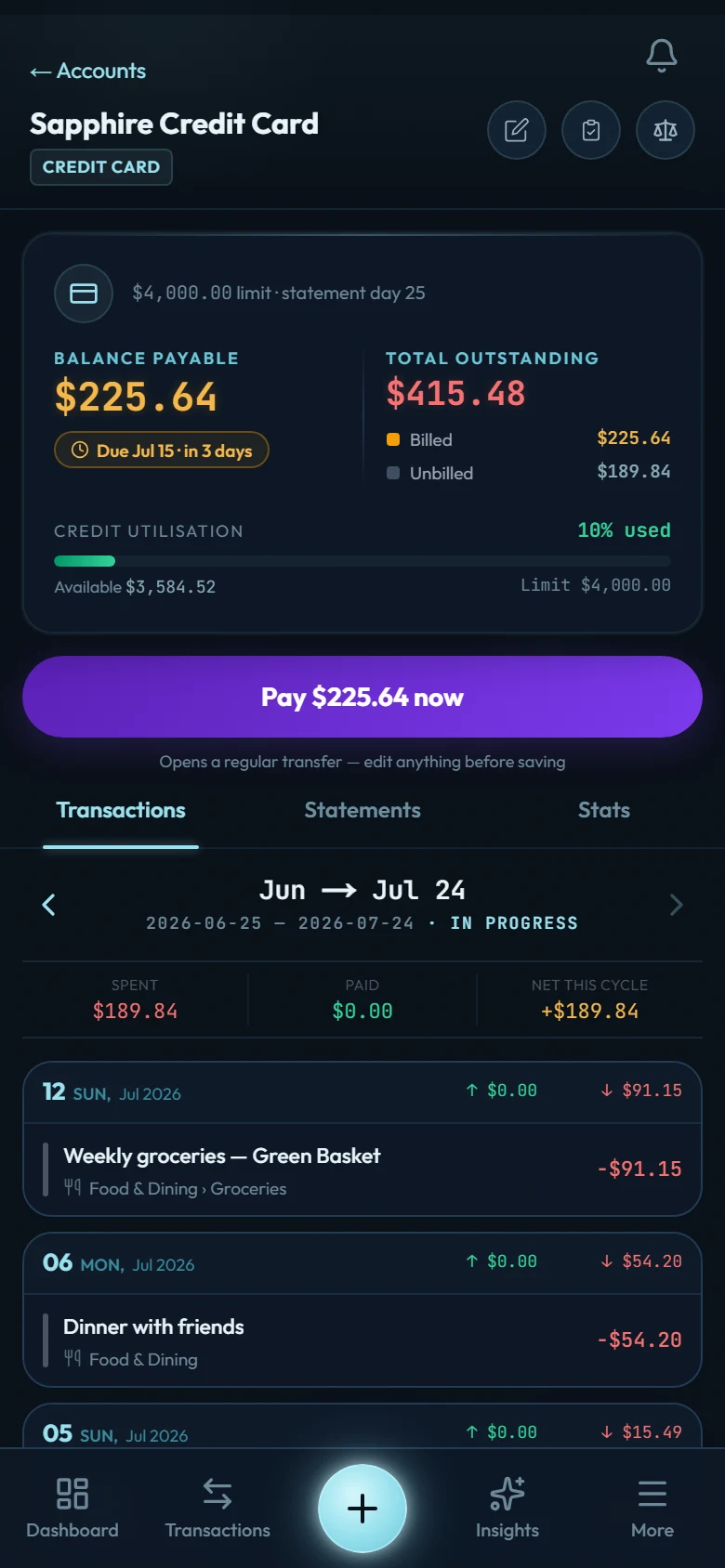
Wealth Mutant is the personal finance app we built for exactly this. Each card shows what is payable and by when, what you have spent since the last statement, and how much of your limit you are using, and it reminds you ahead of the due day. You note each purchase yourself in a few seconds, a small daily habit that makes you notice what goes on the card, and no bank login is ever shared. You pay for it once.
Keep every card's due date in view
Cards with their due dates, plus budgets, loans and net worth, in one place. One payment, yours for life.
Buy — $99 onceHow to pay less APR when you carry a balance
If a balance is already on the card, these 3 steps keep the interest down.
Find the APR on each balance
Your card issuer's statement lists each balance with its own APR. Start with the purchase APR, then any transfer or cash line.
Pay more than the minimum
Anything above the minimum (the smallest payment your issuer accepts) generally goes to the highest-rate balance first, the CFPB says, which is the avalanche order. What paying only the minimum costs has its own guide.
Clear it, then pay in full
With no balance carried, new purchases get their interest-free period back, as long as each statement balance is paid by the due date. The calculator below works out your next due date.
Work out your next due date
Type the day of the month on your statement and how your due date is set. You get the next due date, how many days away it is, and how many days a purchase today has to pay.
If it falls on a weekend, you will see the weekday.
Working out your dates.
How is APR shown in the UK and India?
UK. The Financial Conduct Authority (FCA) requires an ad that quotes a rate to carry a "representative example" that includes the rate, any other charge, the amount of credit and the representative APR (rule CONC 3.5). The FCA says "representative" means at least half of consumers get that rate or better, and a UK APR counts fees as well as interest, which a US card's APR does not. Barclaycard's page on 28 October 2026 shows the effect:
| Avios | Avios Plus | |
|---|---|---|
| Purchase rate | 29.9% | 29.9% |
| Monthly fee | £0 | £20 |
| Representative APR | 29.9% | 80.1% |
Both examples assume a £1,200 limit, and all 4 rates are variable. The purchase rate is the same, yet the APRs are 50 points apart, because Avios Plus charges £20 a month, or £240 a year, and the APR counts it. In 2026 the FCA asked for views on whether to change how APRs appear in credit ads, so these rules may change.
India. The Reserve Bank of India (RBI) directions for card-issuing banks, updated 1 October 2026, say issuers must quote a yearly APR for situations such as purchases, balance transfers, cash advances and late payment, and show the annual fee with equal prominence. Pages there often state the rate per month: IndusInd Bank lists 1.79% to 3.95% a month, or 21.48% to 47.40% a year, so multiply the monthly rate by 12. RBI's own example uses 2% a month, the same as the 24% APR above.
Common questions
Is 0% APR really free?
The interest is, while the offer lasts. A balance transfer often carries a fee (on Chase's card, 3% or $5, whichever is greater, in the first 60 days), the regular rate starts when the offer ends, and a minimum payment 60 days late can end it early. An offer of "no interest if paid in full" by a set date is different: the CFPB calls it deferred interest, and if any of that balance is left when time is up, you can owe all the interest back to the day you bought it.
Can my card's APR change?
Yes. A variable APR moves with a benchmark rate such as the prime rate. For other rises, US rules generally require 45 days' notice, bar an increase on new purchases in the first year, and protect the balance you already have, with a few exceptions such as a payment more than 60 days late.
How do I get rid of a penalty APR?
In the US, if it began because you were more than 60 days late, the issuer must restore your old rate after 6 consecutive on-time minimum payments. For other triggers, check your card agreement.
What changes when you know which APR applies
Next time a statement arrives, you can tell which balance each APR is charging and which date keeps purchases at 0%.
Start with your latest statement: find the purchase APR, the due date and the statement balance. Then see what your balance costs in how to calculate credit card interest and how the dates line up in the billing cycle guide. In Wealth Mutant, each card's page keeps the due date and payable amount on one screen, and the tour shows the rest.