
Your credit utilization ratio is the share of your credit limit you are using: your card balance divided by your limit. The balance that counts is usually the one on your last statement, so a card you pay off every month can still show a high ratio.
The reported balance is the part you can change. Below: the formula, how it works across several cards, what counts as good, how to lower it, and what differs in the UK, Canada and India.
What is a credit utilization ratio, and how do you calculate it?
Divide what you owe on a card by its credit limit (the most the card lets you borrow), then multiply by 100, as Experian's guide does. A card with a 2,000 limit and 1,500 on it works out to 1,500 ÷ 2,000 = 0.75, which is 75%. Read the amounts in your own currency: the ratio comes out the same.
Only revolving credit counts: credit you can borrow, repay and borrow again, like a card. FICO, the company behind the FICO Score, measures the ratio on revolving accounts, and in the UK Experian says overdrafts count while loans and mortgages do not. FICO says the category this ratio belongs to, "amounts owed", makes up about 30% of a FICO Score, second only to payment history at 35%.
Lenders weigh the ratio themselves, too. The Financial Consumer Agency of Canada (FCAC), part of the Government of Canada, says lenders look at your utilization rate to judge how you manage your available credit.
Per card or overall: which ratio counts?
If you have more than one card, you have more than one ratio: one for each card, and one overall. The overall ratio adds up every balance and divides by every limit. Experian says FICO and VantageScore scores look at both.
Take 2 cards:
| Limit | Balance | Ratio | |
|---|---|---|---|
| Card A | 2,000 | 1,500 | 75% |
| Card B | 8,000 | 500 | 6% |
| Both cards | 10,000 | 2,000 | 20% |
The overall ratio is 2,000 ÷ 10,000, not the average of 75% and 6%, which would be about 41%. At 20% it looks comfortable, yet card A is using 75% of its limit.
Pay 500 toward either card and the overall ratio falls to 15%. Only a payment on card A also brings its 75% down, to 50%. That matters because, Experian says, the highest ratio on a single card can be a factor even when your overall ratio is low.
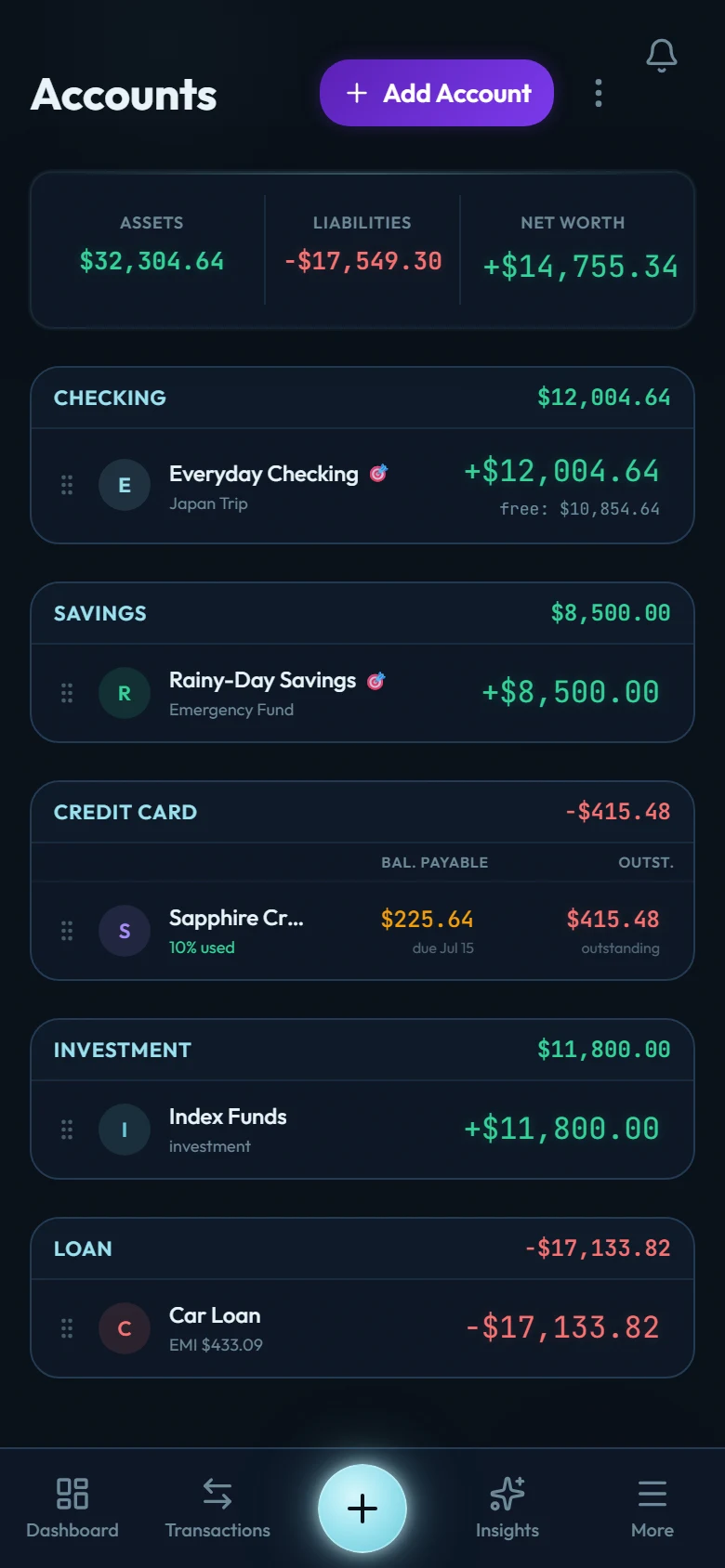
Wealth Mutant, a personal finance app, shows each card's own percentage used in its accounts list once the card has a limit, so a card near its limit is easy to spot even if your cards together look fine.
See each card's utilization on your own numbers
Wealth Mutant shows how much of each card's limit you are using, with the card's statement day on the same page.
No card needed.
When is your credit utilization ratio reported?
In the US, the balance behind your ratio is usually reported around your statement date, the day your billing cycle (the stretch of days one bill covers) closes and the bill is added up. Card issuers send the credit bureaus (the companies that keep your credit file) an update on each card generally once a month. Experian says they tend to report your balance around the statement closing date, not the bill's due date.
FICO adds that the balance on your credit report is typically the balance from your latest monthly statement, so a card you pay in full each month will not necessarily show as $0.

Take card A again: a 2,000 limit with 1,500 spent this cycle. Pay it all on the due date and the statement had already closed at 1,500, a 75% ratio. Pay 1,200 a few days before the statement date and the last 300 by the due date, and the statement shows 300, a 15% ratio.
With card B unchanged, the overall ratio falls from 20% to 8%. The same 1,500 is paid, and as long as the whole bill is in by the due date, no interest is charged either way. Experian's advice matches: pay down balances before the statement date, and still pay the bill in full by the due date to avoid interest.
Send the early payment a few days ahead, so it has reached the card before the cycle closes. To see what your issuer actually sent, check your credit report: it shows the balance and limit each issuer reported. What the statement date means shows where to find yours, when to pay your credit card bill covers paying twice a month, and statement balance vs current balance explains why the bill and today's balance differ.
What is a good credit utilization ratio?
Lower is better, and Experian says there is no hard line where a ratio turns from bad to good, so the figures you hear are guidance from whoever publishes them, not a rule. Experian gives under 30% overall as a general rule of thumb and says under 10% could be even better for your scores. The CFPB, the US consumer finance regulator, says many experts recommend using less than 30% of your total credit limit.
The 30% in FICO's breakdown of a score is a different number: the weight of the whole "amounts owed" category, which FICO says can vary from one person to another. FICO's page on amounts owed gives no target percentage and says part of the science of scoring is determining how much is too much for a given credit profile. A ratio of 0% is not the goal either: in some cases, FICO says, a low ratio can have a more positive impact than using none of your available credit.
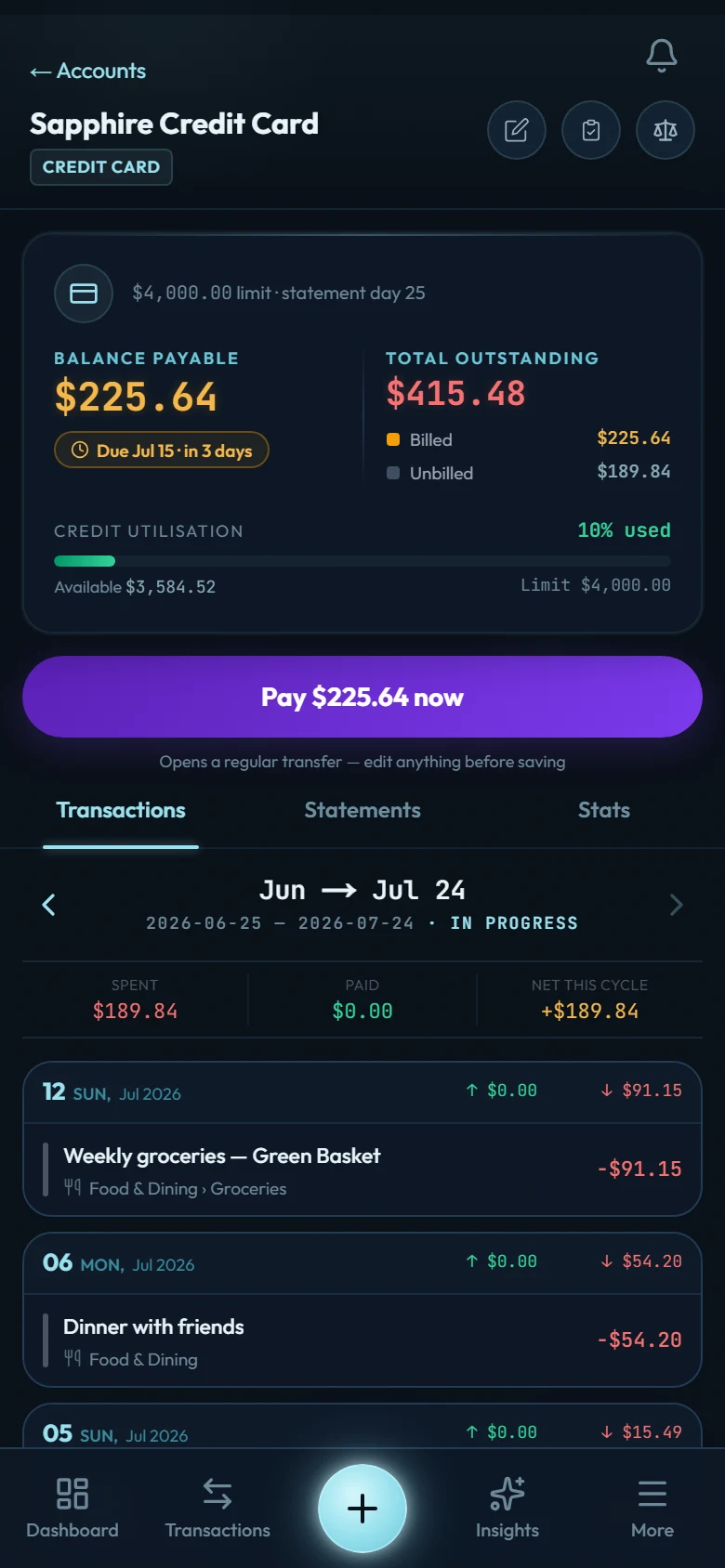
Wealth Mutant is the personal finance app we built for exactly this. Give a card its limit and statement day, and the card's page shows the share of the limit in use next to what you owe, billed and not yet billed. You note each purchase yourself in a few seconds, a small daily habit that makes you notice where the money goes, and no bank login is ever shared. You pay for it once.
Keep every card's limit in view
A personal finance app for your cards, loans, budgets and net worth, with each card's limit and statement day beside what you owe.
Buy — $99 onceHow to lower your credit utilization
The ratio is made of 2 numbers, so there are 2 ways to lower it: shrink the balance or raise the limit, as Experian puts it.
Find each card's limit and statement date
Both are usually on your statement or in your card's app. In Wealth Mutant you set them once on the card.
Pay down before the statement date
Send most of the cycle's spending a few days before the cycle closes, then the rest by the due date. This is the move for a card you already pay in full.
Pay the card nearest its limit first
Extra money can help most on the card with the highest ratio, like card A above.
Raise the limit, or keep old cards open
A 3,000 limit turns card A's 1,500 into 50%, not 75%. Experian UK says to avoid raising the limit if you might overspend, and the CFPB says closing a card can increase your ratio. A limit request sometimes brings a hard credit check, which Experian says can lower your scores a little for a while, so ask your issuer first.
On a card's page in Wealth Mutant, the percentage used counts what you owe today, so it falls as soon as you record a payment, while what your issuer reports is usually the balance around the statement date. The app works from your own entries and shows the ratio, not a credit score.
How credit utilization differs in the UK, Canada and India
| Where | Guidance | What differs |
|---|---|---|
| US | Under 30% as a rule of thumb, under 10% could be better, says Experian | Issuers tend to report around the statement date |
| UK | Below 25%, a rule of thumb from Experian UK | 3 credit reference agencies, each scoring its own way, and a report can take around 4 to 8 weeks to update |
| Canada | Less than 30% of your total limit, says the FCAC | Lenders may see heavy use as higher risk even when you pay in full |
| India | Below 30%, with 10–20% ideal, says CRIF High Mark | The Reserve Bank of India (RBI) sets 4 reporting dates a month |
India differs most on timing. From 1 July 2026, the RBI's rules for commercial banks and non-bank finance companies have each lender send the credit bureaus its credit information as on the 9th, 16th, 23rd and last day of the month, or more often if lender and bureau agree. At month-end the lender sends all its active accounts; on the other 3 dates, only the accounts that changed, including any change in the amount owed.
India has 4 credit bureaus registered with the RBI: TransUnion CIBIL, CRIF High Mark, Equifax and Experian. CRIF High Mark says your report reflects the balance reported around the statement closing date and that utilization is calculated across all your cards combined, not per card. Whichever date your lender uses, the move is the same: bring the balance down before it.
What changes once you know the date
Your ratio stops being a number that turns up on a report and becomes a date on your calendar: the day each card's statement closes. Pay down before it, keep each limit in view, and the number your lender sees is usually one you chose.
Common questions
Is 30% credit utilization good?
It is at the top of a common rule of thumb, which is guidance, not a cut-off. Experian gives under 30% overall as a general rule of thumb and says people with excellent scores tend to stay below 10%. The CFPB says many experts recommend using less than 30% of your total credit limit. Lower is better.
Is 0% credit utilization good?
It is not the goal. FICO says that in some cases a low ratio has a more positive impact on your score than using none of your available credit, and Experian says a very low rate could be better than 0%.
Does paying my card in full each month mean 0% utilization?
Not necessarily. FICO says the balance on your credit report is typically the balance from your latest monthly statement, so a card you pay in full can still show a balance. Paying before the statement date lowers the balance that gets reported.
How long does credit utilization take to update?
Until your issuer next reports. Experian says US issuers generally send updates to the credit bureaus monthly, and most scores use only the latest reported numbers, so a lower ratio can help your scores the next month. Newer models such as FICO 10 T and VantageScore 4.0 also look at the trend over time. In the UK, Experian says a report can take around 4 to 8 weeks to update. In India, the RBI sets 4 reporting dates a month.
Do I need to carry a balance to build credit?
No. The CFPB says you don't need to carry a balance on credit cards to get a good score, and that paying off the balance in full each month helps get you the best scores and keeps your interest costs as low as possible.
Your next step
Write down 3 things for each card: its limit, its statement date and the balance on your last statement. Divide the balance by the limit and you have the ratio your credit report probably shows. Then add the cards to Wealth Mutant to keep each limit and statement day in view, and the tour shows the other screens. What APR is covers the interest side of the same card, and when your credit limit comes back explains how available credit returns after a payment.