
Statement balance vs current balance comes down to timing. Your statement balance is what you owed when your last bill closed; your current balance is what you owe right now. To avoid interest, pay the statement balance in full by the due date.
Seeing 2 numbers for one card is normal. One billing cycle with real dates shows which purchases sit in each balance, which one to pay, and when the answer changes.
What is the difference between statement balance and current balance?
Your statement balance is the total on your bill: what you owed when the billing cycle (the days one bill covers) closed on your statement date. It covers the cycle's charges, fees and interest, plus anything unpaid from before, minus payments and credits, as Capital One lists it. On a US statement the rules call it the "new balance": the account balance outstanding on the closing date.
Your current balance is what you owe right now. Chase describes it as your most recent statement balance plus other transactions since your last statement was generated, so it moves with every purchase, payment and refund. American Express calls it the total balance. Capital One notes that pending transactions are not included, so check how your card shows them.
Take one card. Its statement date is 20 November and its due date is 15 December, and last month's bill was paid in full. From 21 October to 20 November you spent $1,200 on it. The amounts are in dollars; the numbers work the same in pounds, rupees or any other currency.

On 20 November both balances are $1,200. On 24 November you buy $90 of groceries. The statement balance stays $1,200, because that bill has closed, and the current balance becomes $1,290. A $270 phone repair on 3 December takes it to $1,560, where it stands on 10 December. Both purchases go on the next bill, which closes on 20 December and is due on 15 January.
See both balances on your own card
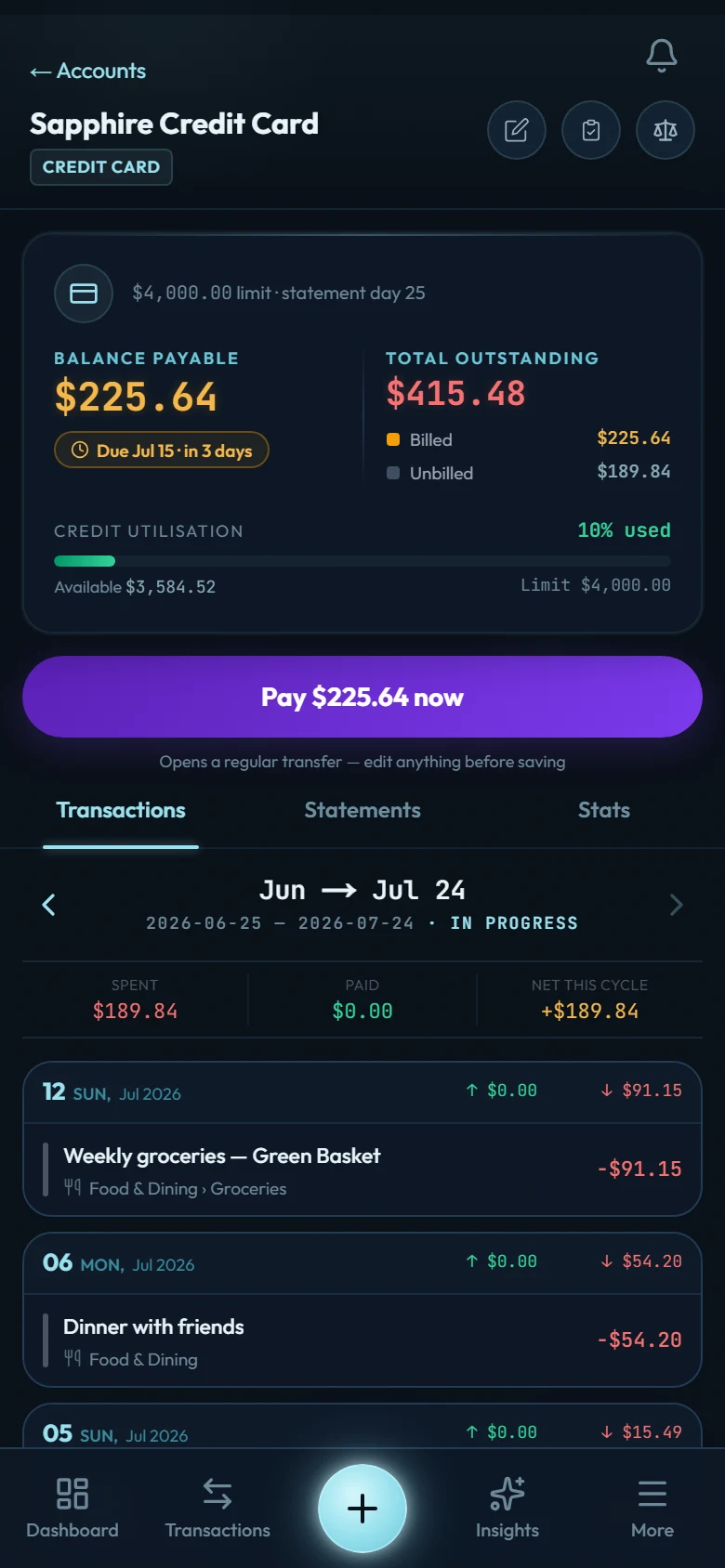
Add a card's statement and due days, and Wealth Mutant shows what is billed, what is not yet, and the total you owe.
No card needed.
Should you pay the statement balance or the current balance?
Pay the statement balance, in full, by the due date. Capital One says you can avoid paying interest on new purchases by paying off your statement balance on time every month. That works because of the grace period: from the statement date until the due date, you are not charged interest if you pay in full. Most cards have one, and the CFPB, the US consumer finance regulator, says the way to keep it is to pay your bill in full each month and on time.
Here is what each payment does to both balances if you make it on 10 December and pay nothing else before the due date:
| You pay on 10 December | Still owed on the $1,200 bill | Current balance after | What happens to interest |
|---|---|---|---|
| $1,200, the statement balance | $0 | $360 | None. The $360 goes on the next bill. |
| $1,560, the current balance | $0 | $0 | None. The $360 is paid 36 days before it is due. |
| $35, the minimum payment | $1,165 | $1,525 | Charged on what is left, and on new purchases. |
Your card's payment screen usually offers a 3rd amount, the minimum payment. Experian defines it as the smallest amount you can pay on your credit card each month and avoid a late fee and other penalties. The $35 above is assumed; your card company sets the real one.
Pay only the minimum and the grace period goes, so interest starts on the unpaid part and on new purchases. Still, if the full statement balance is out of reach this month, pay at least the minimum by the due date. Capital One says that can help keep your account in good standing and help you avoid late penalties.
What is the remaining statement balance?
It is what is left of the bill after a part payment or a refund. American Express defines it as the statement's "New Balance" adjusted for payments, returned payments, applicable credits and amounts under dispute since your last statement closing date.
Say you pay $1,000 on 10 December instead of $1,200. The statement balance still reads $1,200, the remaining statement balance is $200, and the current balance is $560: the $200 plus the $360 of newer purchases. Pay the $200 by 15 December and the whole bill has been paid in time.
When does paying the current balance make sense?
If you pay in full every month, the statement balance is enough. Two situations call for the current balance.
- You carry a balance. If last month's bill was not paid in full, new purchases are charged interest from the day you make them. The CFPB warns that you may lose your grace period for the month that you don't pay in full and for the month after. Citi says that if you have carried a balance, you can generally avoid further interest charges once you pay your current balance; check whether a purchase after that payment gets a grace period.
- You want a lower balance reported. In the US, Experian says, card issuers tend to report your balance to the credit bureaus around your statement closing date, so paying the balance down before that date can lower your utilization rate (how much of your limit you are using). When to pay your bill shows this with numbers.
Wealth Mutant is the personal finance app we built for exactly this. Each card's page shows both balances at once: what is left to pay on the bill and its due date, beside the total you owe today, including what you have spent since the statement. You note each purchase yourself in a few seconds, a small daily habit that makes you notice where the money goes, and no bank login is ever shared. You pay for it once.
Keep the bill and the spending apart
Cards, loans, budgets and net worth in one personal finance app, each card's bill kept apart from the spending after it.
Buy — $99 oncePay the right balance in 3 steps
Find both numbers and the due date
Your statement shows the statement balance and its due date. Your card's app shows the current balance.
Pay the statement balance in full, on time
Automate it, or pay a few days early, so a slow transfer cannot make you late. In the UK, Barclaycard and Santander offer a direct debit for the full balance, a fixed amount or the minimum. The Co-operative Bank spells its full option out: "full payment of the statement balance".
Check what is left
A few days before the due date, check what is still unpaid: the remaining statement balance, or Balance payable in Wealth Mutant. If it is not $0, pay it.
Not sure when your next bill is due, or which bill a purchase made today lands on? Try it with your card's statement and due days.
Work out your next due date
Type the day of the month on your statement and how your due date is set. You get the next due date, how many days away it is, and how many days a purchase today has to pay.
If it falls on a weekend, you will see the weekday.
Working out your dates.
How the 2 balances work in the UK, India and Canada
The idea is the same everywhere; the wording and rules differ.
| Where | Pay this by the due date | If you pay less |
|---|---|---|
| US | The statement balance (the "new balance" in the rules) | Interest on the unpaid part, and on new purchases from the day you make them |
| UK | The statement balance in full, on time. Santander gives up to 56 days interest-free on purchases this way | Interest on new purchases as well as the unpaid part |
| India | The "total amount due". The "minimum amount due" only keeps the bill from being overdue | The interest-free credit period is lost, and interest may run from each transaction's date |
| Canada | The balance in full. Federally regulated issuers must give a grace period of at least 21 days | Interest until you pay the balance back in full |
What changes once you know which is which
The payment screen stops being a guess. The statement balance is the bill, with a deadline. The current balance adds what you have spent since, and that newer part has no deadline yet.
Common questions
Should I pay my statement balance or my current balance?
Pay the statement balance in full by the due date to avoid interest, if last month's bill was paid in full. Pay the current balance if you are carrying a balance or want a lower balance reported.
If I pay only the statement balance, will I be charged interest on the rest?
Not on purchases made after the statement date, if your card has a grace period (most do), you were not carrying a balance, and you pay the statement balance in full by the due date. Those go on the next bill.
Why is my statement balance higher than my current balance?
Because you paid, or got a refund, after the statement closed. The statement balance is a snapshot that does not change when you pay. The current balance does.
I paid my statement balance in full. Why was I charged interest?
Check the bill before it. If that one was not paid in full, the CFPB says you may lose your grace period for that month and for the month after, so interest can still appear. A cash advance also costs interest from the day you take it, generally with no grace period.
Your next step
Before your next payment, open your card's app and find 3 things: the statement balance, the current balance and the due date. To keep them in view every month, enter the card in Wealth Mutant with its statement and due days, and take the tour for the rest of the app. The billing cycle, date by date and the interest-free period explain the dates behind both numbers.