
Here is how to calculate credit card interest: multiply your average daily balance by your daily rate and by the days in the billing cycle. The daily rate is your APR, the yearly rate on your card, divided by 365. The billing cycle is the month or so that one statement covers. Pay the whole statement balance, the total on your latest bill, by the due date each month and, on most cards, the interest on purchases is $0.
It looks harder than it is. Your statement gives you the APR and the dates, and the sums fit on a phone calculator. Below, one month is worked out twice with real dates, so you can run the same sums on your own card.
How is credit card interest calculated?
Your card states its rate per year, but many issuers charge interest by the day. The sum takes 3 numbers.
The daily periodic rate, or daily rate, is your APR divided by 365. Some issuers divide by 360 instead, according to the CFPB, the US agency that enforces consumer finance law, so your card agreement has the last word.
The average daily balance is what you owed at the end of each day in the billing cycle, added up and divided by the days in the cycle. A purchase lifts it from the day you make it. A payment lowers it from the day it lands.
The days in the billing cycle are usually 28 to 31, and the number is on your statement. How billing cycles work covers the dates around it.
Capital One and Chase both publish this method on their own sites. Regulation Z, the federal rule behind US card statements, gives issuers model wording for the average daily balance that says the same thing. Issuers vary it a little. The same rule has model wording for an average that leaves new purchases out. Under Capital One's own card agreement, each day's interest is added to the next day's balance before the average is taken.
How to calculate credit card interest: a worked example
Here is one card, one month and one set of choices. The method does not change with the currency, so read the $ as pounds, rupees or Canadian dollars if you prefer.
- APR: 21.9%, just under the 22.36% the Federal Reserve reports as the average rate on US card accounts charged interest in August 2026 (preliminary), and it divides neatly by 365.
- Days in the year: 365, so the daily rate is 21.9% ÷ 365 = 0.06%, or 0.0006 as a decimal.
- Billing cycle: 1 to 30 September 2026, which is 30 days.
- Balance on 1 September: $1,000. You have been carrying a balance, so no new purchase gets an interest-free stretch.
- 10 September: you buy something for $200.
- 16 September: you pay $500.
- Interest is added to the balance when the cycle closes, not each day.
| Dates | Days | Balance each day | Balance × days |
|---|---|---|---|
| 1–9 Sep | 9 | $1,000 | $9,000 |
| 10–15 Sep | 6 | $1,200 | $7,200 |
| 16–30 Sep | 15 | $700 | $10,500 |
| Total | 30 | $26,700 |
Turn the APR into a daily rate
21.9 ÷ 365 = 0.06% a day, or 6 cents for every $100 you owe.
Find the average daily balance
Add up each day's balance (the table's last column: $26,700), then divide by the 30 days: $26,700 ÷ 30 = $890.
Multiply by the days in the cycle
$890 × 0.0006 × 30 = $16.02 of interest for September.
Now check it a second way, day by day. A $1,000 balance costs $0.60 a day, so 9 days is $5.40. A $1,200 balance costs $0.72 a day, so 6 days is $4.32. A $700 balance costs $0.42 a day, so 15 days is $6.30. And $5.40 + $4.32 + $6.30 = $16.02. It has to match, because the average balance is just those 30 days squeezed into one number.

The $16.02 joins the balance when the cycle closes, so the 30 September statement shows $700.00 + $16.02 = $716.02. If your issuer adds each day's interest to the next day's balance, as Capital One's card agreement does, the same month comes to about $16.17. That is 15 cents more, from the same formula.
See the bill before it is due
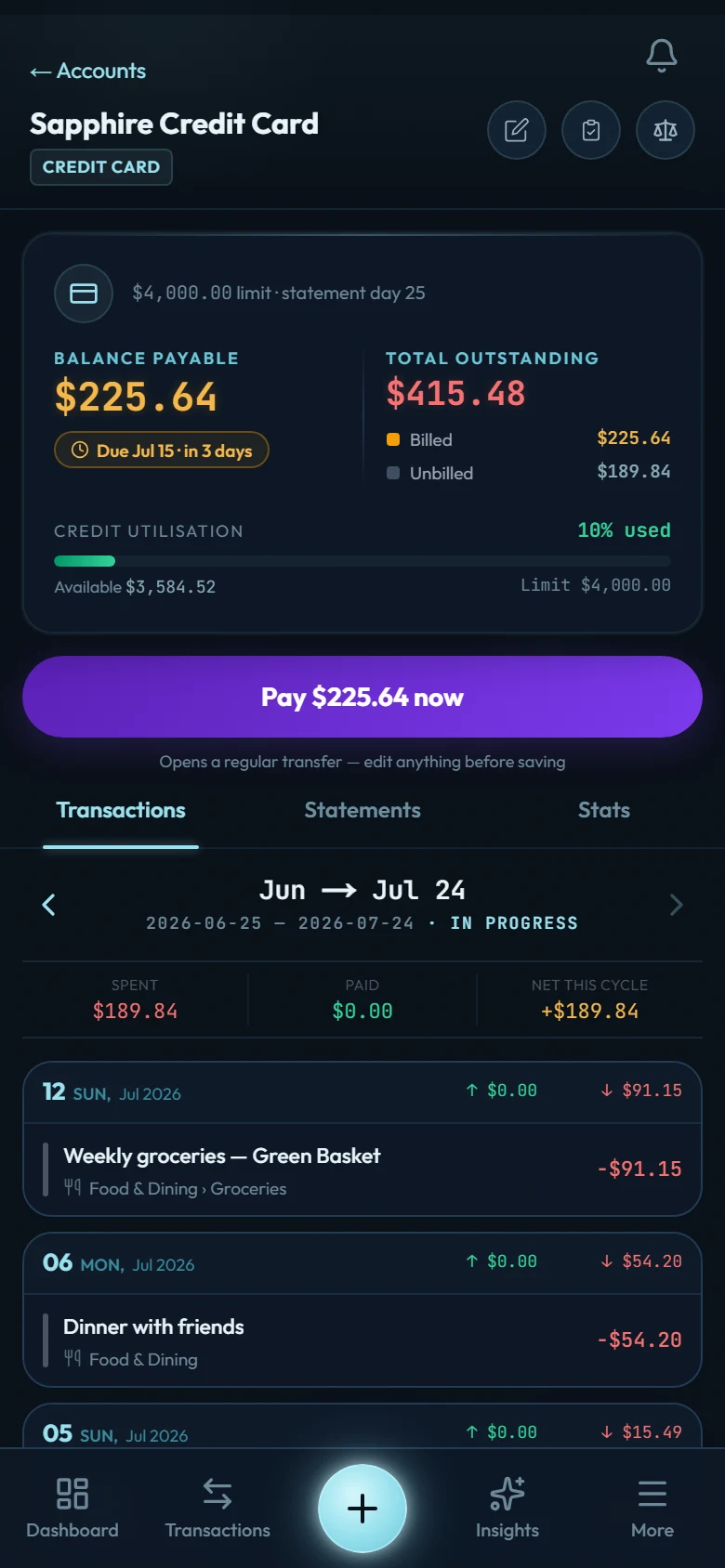
Each card in Wealth Mutant shows the bill you owe and its due date, kept separate from newer spending, beside your budgets, loans and net worth.
No card needed.
Why is there no interest when you pay the statement balance in full?
The reason is the grace period: the time between the end of a billing cycle and the due date. The CFPB says that during it you may not be charged interest "as long as you pay your balance in full by the due date". US rules do not require a grace period, but most cards give one on purchases. Pay the whole statement balance, the total on your latest bill rather than the current balance with newer purchases on top, and none of the sums above apply to those purchases. Statement balance vs current balance shows the difference.
Pay less and the grace period goes. The CFPB says you are then charged interest on whatever is left unpaid, and "on purchases in the new billing cycle starting on the date each purchase is made". That is why the $200 in the example costs $0.12 a day from the day you buy it ($200 × 0.0006), where on a card you pay in full it would cost nothing. The CFPB adds a tip worth keeping: if you pay in full some months and not others, "you may lose your grace period for the month that you don't pay in full and for the month after."
How long a purchase stays free depends on the day you make it. On a card whose bill closes on 31 October and is due on 25 November, a 1 October purchase gets 56 days and a 31 October one gets 26, with the purchase day and the due date both counted. The interest-free period guide shows how to count it for your own dates.

Cash advances are the exception. The CFPB says interest on them generally starts on the date of the transaction, so the sums above apply from day one.
What is trailing interest on a credit card?
Trailing interest, which some issuers call residual interest, is the interest that builds between the day your statement closes and the day your payment lands. When you carry a balance, the CFPB says, most card companies charge interest "from your billing date until the time they receive your payment".
Take the same card. The 30 September statement shows $716.02, due on 23 October. You pay all $716.02 on the 23rd and buy nothing else. The balance sat at $716.02 for the 22 days from 1 to 22 October:
$716.02 × 0.0006 × 22 = $9.45
Check it another way: $716.02 × 22 = $15,752.44, and $15,752.44 × 0.0006 = $9.45. So the October statement shows $9.45 for a month in which you spent nothing and paid in full. It can look like a mistake, but it is ordinary interest for the days after the statement closed. Regulation Z's own examples assume the same pattern, with a payment received on the 25th and a statement that reflects "trailing or residual interest that accrued on the $1,000 balance from April 1 through April 24".
You can stop it in 2 ways. One is to ask the issuer for the payoff amount, the sum that clears the card today, before you pay off a balance. Citi suggests requesting your current payoff amount, "including any residual interest accrued since your last statement". The other is to pay the next statement in full as well. Capital One says that if you carry a balance, "you may have to pay in full for 2 consecutive billing cycles" to bring the interest on your statement down. With nothing carried, there is no trailing interest. The hard part is knowing which number to pay, and when.
Wealth Mutant is the personal finance app we built for exactly this. For each card, it shows the bill you owe and its due date apart from any spending since, and it reminds you before that date. You note each purchase yourself in a few seconds, a daily habit that makes you notice what is building up, and no bank login is ever shared. You pay for it once.
Know which number to pay, and when
Your cards, loans, budgets and net worth in one personal finance app. One payment, and it is yours.
Buy — $99 onceHow is credit card interest calculated in the UK, India and Canada?
Barclaycard in the UK and SBI Card in India use the same sums: a daily rate on a daily balance. What changes from country to country is how the rate is quoted and when interest starts.
| Where | What differs |
|---|---|
| UK | Barclaycard works out interest at a daily rate. If you do not clear the statement in full, HSBC UK says you are usually charged from the date each transaction was added to your account. Barclaycard shows a simple rate beside a compound rate (which includes interest on interest) and uses the simple one for each month's interest, so start there if your statement lists both. It adds that most issuers show only the compound rate. |
| India | Rates are often stated per month. SBI Card lists a finance charge of up to 3.75% a month (45% a year) and works its examples as (3.75 × 12) × (days ÷ 365) × the balance, the same sums with the monthly rate multiplied by 12 first. The Reserve Bank of India's rules for banks say that if the total amount due is not paid by the due date, interest "may be levied from the date of transaction on the outstanding amount" and not on the total amount due. |
| Canada | The Financial Consumer Agency of Canada says you pay interest until the balance is paid in full, and federally regulated issuers must give at least 21 days of grace. Cash advances get none. |
How to check the interest on your own card
Find your numbers on the statement
In the US, look for the box called Interest Charge Calculation. U.S. Bank says it holds your APR and the balance subject to interest. In the UK, Barclaycard prints its rates on the first page; in India the Reserve Bank requires the statement to show how the unpaid amount used for interest was worked out.
Rebuild the daily balances
Start from the balance on the first day of the cycle and note each purchase and payment date, as in the table above. Chase points out that many statements do not list daily balances, so you work them out from the activity.
Run the sums and compare
Type the average daily balance, the APR and the days into the free credit card interest calculator, or do the sum by hand. If your answer is within a few cents of the statement, you have your card's method. If the statement is about 1% higher, look for a 360-day year or interest added daily. If it is further off, look for several APRs on one card (purchases, cash advances and promotions can each have their own) or, on a UK card, a compound rate where the sums need the simple one.
Pay the whole statement balance by the due date
For purchases, that one habit makes the other 3 steps unnecessary.
What changes when you can see the daily cost
At 21.9%, every $1,000 you carry costs 60 cents a day. A week of carrying it is $4.20, and paying in full costs nothing.
When you pay matters too. The same $500 paid on 28 September instead of the 16th leaves the average balance at $1,090 and the interest at $19.62, which is $3.60 more. Capital One makes the same point: paying earlier, or more than once a month, may reduce interest if you carry a balance. When to pay your credit card bill goes through the timing, and one extra payment shows the same effect on a loan.
Common questions
How do you calculate credit card interest per month?
Multiply your average daily balance by your daily rate (APR ÷ 365) and by the days in the billing cycle. For a quick estimate, use balance × APR ÷ 12: on $1,000 at 21.9% that gives $18.25, against exactly $18.00 for a 30-day month and $18.60 for a 31-day one.
How much interest will I pay on $5,000?
At 21.9%, a balance that stays at $5,000 for a 30-day cycle costs $90.00 in interest, and $1,000 costs $18.00. Paying some off or adding purchases changes the average daily balance, and the interest with it.
Do I pay interest if I pay my credit card in full?
Not on purchases, if you pay the whole statement balance by the due date and were not already carrying a balance. Cash advances usually cost interest from the day you take the cash. If you were carrying a balance, trailing interest can still appear on the next statement.
Is credit card interest compounded daily or monthly?
It depends on the issuer. The CFPB says that with a daily rate, each day's interest is generally added to the next day's balance, which compounds it daily. Capital One's card agreement works that way. Other issuers, such as Barclaycard in the UK, charge interest on the previous month's interest. Your card agreement says which yours does.
Start with your last statement: find the 3 numbers and run the sums above. If you are carrying a balance, the avalanche vs snowball guide compares 2 ways to pay it down. To keep each card's bill in view, see how a card is set up in Wealth Mutant, and the tour shows the rest.