
The 100 envelope challenge is a savings game: draw a numbered envelope and fill it with that many dollars. Fill all 100 envelopes, numbered 1 to 100, and you have saved $5,050, because 1 + 2 + … + 100 = 100 × 101 ÷ 2.
That sounds like a lot, but nobody pays it at once. How often you draw sets what each week costs. This guide gives the cost at 3 paces, the hard part, smaller versions, a cash-free way and a printable 100-box tracker.
How does the 100 envelope challenge work?
Fidelity, Thrivent and Ramsey Solutions publish the same rule. It takes 4 moves.
Number the envelopes
Write 1 to 100 on 100 envelopes, one number each. Slips of paper or the tracker below work as well.
Draw one on a set day
Pick one at random. Going in order is allowed too.
Put in that many dollars
Envelope 27 gets $27, envelope 3 gets $3 and envelope 100 gets $100.
Mark the number and repeat
Mark its box so you can see what is left. Each number is used once, until all 100 are full.
Why $5,050? Add the smallest envelope to the biggest, 1 + 100, then 2 + 99, all the way to 50 + 51. Each pair makes 101, and 50 pairs make 50 × 101 = 5,050. The average envelope holds $50.50.

The tracker also opens as a page of its own for printing. It prints dark, as it looks here, so mark the boxes with a white or silver pen, or mark up a screenshot on your phone.
These envelopes only save. Putting cash into envelopes by kind of spending, known as cash stuffing, is a different method: envelope budgeting without the cash.
How long does the 100 envelope challenge take?
About 3 months at 1 envelope a day, and just under 2 years at 1 a week. With each envelope averaging $50.50 over the whole challenge, 3 common paces look like this:
| You draw | You finish in | An average week costs |
|---|---|---|
| 1 envelope a day | 100 days (about 14 weeks) | $353.50 |
| 2 a week | 50 weeks | $101 |
| 1 a week | 100 weeks (just under 2 years) | $50.50 |
Fidelity suggests "once or twice a week" if daily is too much, and Thrivent suggests weekly. Choose by the last column, with room to spare: the most expensive possible week is almost twice the average. If that would not fit, slow down or shrink the amounts. For a total and a finish date of your own, the savings goal calculator gives the amount to save each month.
Track the challenge against real money
Each draw becomes a transfer to the challenge's savings account, and the goal's bar follows that balance.
No card needed.
Is the 100 envelope challenge realistic?
It depends on how you handle the big envelopes. A single envelope can ask $100, and the money is not spread evenly: envelopes 51 to 100 hold $3,775, about three quarters of the $5,050, and the biggest 25 (76 to 100) hold $2,200 on their own.
An average week hides that. At 2 random draws a week, the cheapest possible week is $3 (envelopes 1 and 2) and the most expensive is $199 (100 and 99). Expect 6 or 7 of the 50 weeks to ask $150 or more. Go in order and the problem moves to the end: CNN's analysis called it "backloaded", and at 1 a day the last week, envelopes 94 to 100, asks $679.
Three ways to keep the big ones manageable:
- Decide the redraw rule before you start: if an envelope is more than this week has room for, put it back and draw again, once a week at most.
- Pair them. Draw a number and fill its partner too, the envelope that makes 101 with it (27 goes with 74). Every pair is $101, so a $101 deposit each week finishes all 100 envelopes in 50 weeks, and the draw only decides which pair is next.
- Count down. Ramsey Solutions suggests you "start backward (with 100!)", so the challenge gets easier as the months go by.
Draw on payday, when the money is there.
Can you do the 100 envelope challenge without cash?
Yes. Fidelity, Thrivent and Ramsey Solutions each describe a digital version. In the simplest, you draw a number and transfer that many dollars into a savings account instead of filling an envelope. Fidelity notes that not everyone wants that much cash at home, and Thrivent that cash earns no interest.
Open a savings account, or a savings pot in your banking app, for the challenge alone. Draw from a jar of slips, or use an online random number generator as Fidelity suggests, and draw again if the number is already marked. Transfer that many dollars from the account you spend from, then mark the box. Fidelity's hybrid works too: keep paper envelopes and bank the cash once a week.
The weak spot is the paper tracker. A box can be marked whether or not the money moved.
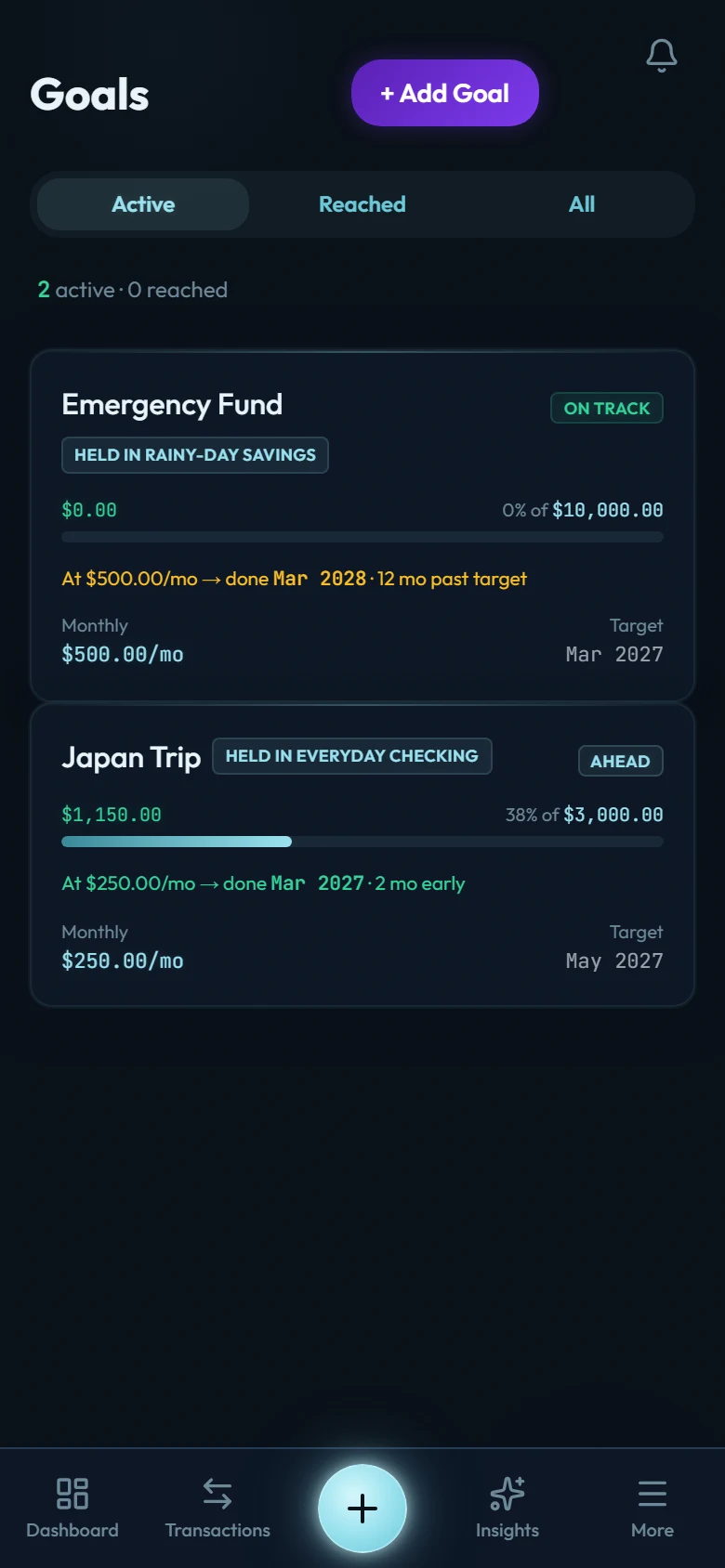
Wealth Mutant is the personal finance app we built for exactly this. Give the challenge a goal with a target of $5,050, held in its own savings account and set to mirror that account. Its progress is then the account's balance, so it moves when you record a transfer, and a box marked only on paper changes nothing. You note each transfer yourself in a few seconds, a small daily habit that makes you notice where your money goes, and no bank login is ever shared. You pay for it once.
Let the goal count the money for you
The goal follows your savings balance, the transfers never count as spending, and your cards and loans sit in the same personal finance app.
Buy — $99 onceIs there a smaller version of the challenge?
Yes, and Fidelity suggests it: halve the amounts or stretch the time when $5,050 does not fit.
| Version | How many | Total | Average week (2 a week) |
|---|---|---|---|
| Full: $1 to $100 | 100 | $5,050 | $101 |
| Half the amounts: 50 cents to $50 | 100 | $2,525 | $50.50 |
| 50 envelopes: $1 to $50 | 50 | $1,275 | $51 |
| 25 envelopes: $1 to $25 | 25 | $325 | $26 |
The sums work in any currency: £1 to £100 makes £5,050 and 50p to £50 makes £2,525. In rupees, Rs 1 to Rs 100 makes only Rs 5,050; multiply each envelope by 10 and it is Rs 50,500.
Who should skip the 100 envelope challenge?
Two groups should wait or shrink it. The first is anyone whose essentials already take most of their pay: Fidelity says the challenge is not realistic for everyone, for instance when "your monthly essential expenses are already close to your monthly income".
The second is anyone whose card balance is costing interest. Take the $3,000 at 24% a year that the minimum payment guide works through. It costs $60 of interest a month, $720 over a year while the balance holds, and envelope cash earns nothing. Thrivent suggests putting the finished $5,050 toward high-interest debt, which "could reduce the total interest you pay over time".
For everyone else, the challenge saves exactly what you put in. A flat $101 a week also makes $5,050 in 50 weeks, so what you gain is a game and a tracker you can see. Thrivent calls the challenge "a short-term motivator, not a long-term strategy", so decide what the money is for before the first draw: a first emergency fund, a trip, a down payment.
Common questions
How do you do the 100 envelope challenge on a biweekly or monthly paycheck?
Paid every 2 weeks, draw 4 envelopes a payday and finish in 25 paydays, just under a year, at $202 a payday on average. Paid monthly, draw 8 or 9 and finish in 12 months, at about $421 a month.
Is the 100 envelope challenge worth it?
It is worth it if the game keeps you saving, since a flat $101 a week gives the same $5,050 in 50 weeks. It is worth less while a card balance costs you interest.
Can you do the 100 envelope challenge digitally?
Yes: draw a number, transfer that many dollars into a savings account and mark the box. Fidelity and Thrivent both describe this version.
Your next step
Choose a pace from the table and make the first draw when you are next paid. Then create the goal in Wealth Mutant, for $5,050, with the challenge's savings account behind it and Mirror as its tracking mode, and record each draw as a transfer into that account. A transfer bookmark, made in Settings with the amount left blank, saves the typing: tap the star, tap the bookmark, type the amount you drew, save. The goal's bar climbs with every draw. To look around the app first, take the tour.
For other challenges, from the 52-week to a no-spend month, see the savings challenge guide. When the last box is marked, keep a transfer going every payday at the same percentage of your pay: that percentage is your savings rate.