
Impulse buying is buying something you had not planned to buy, decided in the moment the urge arrives. How to stop impulse buying comes down to one move: put something between the urge and the payment. Willpower is the usual advice, but the checkout was built to get past willpower. An action works better. Before you pay, enter the purchase in the app where you keep your money, as if you had already bought it, and look at what it does to your month. Then decide.
The ways that work, starting with the one that asks the least of your willpower:
- Enter it before you pay. It takes a few seconds, and you delete the entry if you walk away.
- Price it in hours of your life. A price looks different once you see it as time.
- Wait a set time. A day for small things, 30 days for big ones.
- Keep a wish list, and let what goes on it sit for a week.
- Make paying slower. Remove saved cards and turn off one-tap checkout.
- Cut the prompts. Unsubscribe from sale emails and turn off shop notifications.
The rest of this article is how each one works, which suits which buy, and why the first one does what the others can't.
What impulse buying is, and its 4 kinds
An impulse buy is decided and paid for almost at once, with nothing in between. In 1962 the marketing researcher Hawkins Stern sorted impulse purchases into 4 kinds (Stern, 1962):
- Pure impulse: something you never meant to buy, bought on the spot.
- Reminder impulse: you see it and remember you need it, or that you think you do.
- Suggestion impulse: you see it for the first time and decide on the spot that you need it.
- Planned impulse: you went in for one thing, open to whatever the offers would add.
Only the first sounds like impulse buying. The other 3 each come with a reason that sounds sensible at the checkout, so the methods below work on the moment of paying, whatever the reason.
Why the urge wins at the checkout
The wanting peaks before you pay. Anticipating something good releases dopamine, the brain's signal that a reward is on its way, before the thing arrives (Schultz, Dayan and Montague, 1997). That is why opening the box is often a bit flat: the best part was the 10 seconds before you paid.
The purchase is doing a job for a feeling. Tired, bored, stressed, lonely, celebrating: researchers describe impulse buying as one way people manage their mood, chasing a good one or escaping a bad one (Verplanken and Sato, 2011).
Paying takes one tap, and thinking again takes effort. Your card is saved, the page says only 2 are left, and returns are free, so the decision feels like one you can undo. Many shops add "buy now, pay later", which splits the price into instalments at the checkout, so the number in front of you is only part of what you will pay.
What else the money could do is nowhere in sight. Shane Frederick and colleagues asked 150 students whether they would buy a film they wanted, on sale for $14.99. When the other choice read "Not buy", 75% said they would buy it. When the same choice read "Keep the $14.99 for other purchases", 55% did (Frederick and colleagues, 2009). One line of words moved 1 in 5 of them. Every method below brings back some version of that line.
See it on your own numbers.
Budgets, cards, loans and net worth in one place, and where your current pace leads.
No card needed.
The rules people use, compared
Most advice on impulse buying is a rule like one of these. Each works on some buys and breaks on others:
| The rule | What it asks of you | Where it breaks |
|---|---|---|
| 24-hour rule: wait a day before any unplanned buy | Remembering to wait, just when you least want to | "Only 2 left", and sales that end tonight |
| 72-hour or 30-day rule: wait 3 days, or 30, for bigger things | A list, and patience | Small buys never reach the list |
| Wish list: note it down, look again in a week | Checking the list | The list lives in an app you never open |
| Cash only: leave the cards at home | Carrying cash | Most online shops don't take it |
| Remove saved cards from shops and the browser | 10 minutes, once | New shops ask for a card again |
| Enter it first: type the price into your money app before you pay | A few seconds, every time | It has to become a habit |
The waiting rules ask for the same thing the urge is best at beating: a decision to stop, made in the moment. Entering the price first asks for an action instead. You don't have to win an argument with yourself; you only have to type a number, and the pause comes with it.
Why an app that imports from your bank can't stop an impulse buy
Most money apps connect to your bank and sort your spending for you. Monarch's site says "Connect your accounts and Monarch will do the heavy lifting to categorize your finances". Copilot connects to "16,000+ banks". Rocket Money asks you to "Link your checking, savings, credit cards, and investments accounts". That is useful for seeing where the money went.
At the checkout it can't help, for a plain reason: a bank reports a purchase only after it has happened. By the time the app shows it, the money has gone. Nothing in that flow stands between you and the Pay button.
One exception is fair to name. YNAB plans your money before you spend it ("The YNAB Method is beautifully simple: Give every dollar a job", says its own guide), and it lets you enter your own transactions instead of linking a bank. That works at the checkout too, as long as you open the app before you pay.

We made the longer case about bank-synced apps, and what they are good at, in Why Automated Budgeting Apps Don't Change Your Spending. For impulse buying the point is only the timing.
The enter-it-first rule, step by step
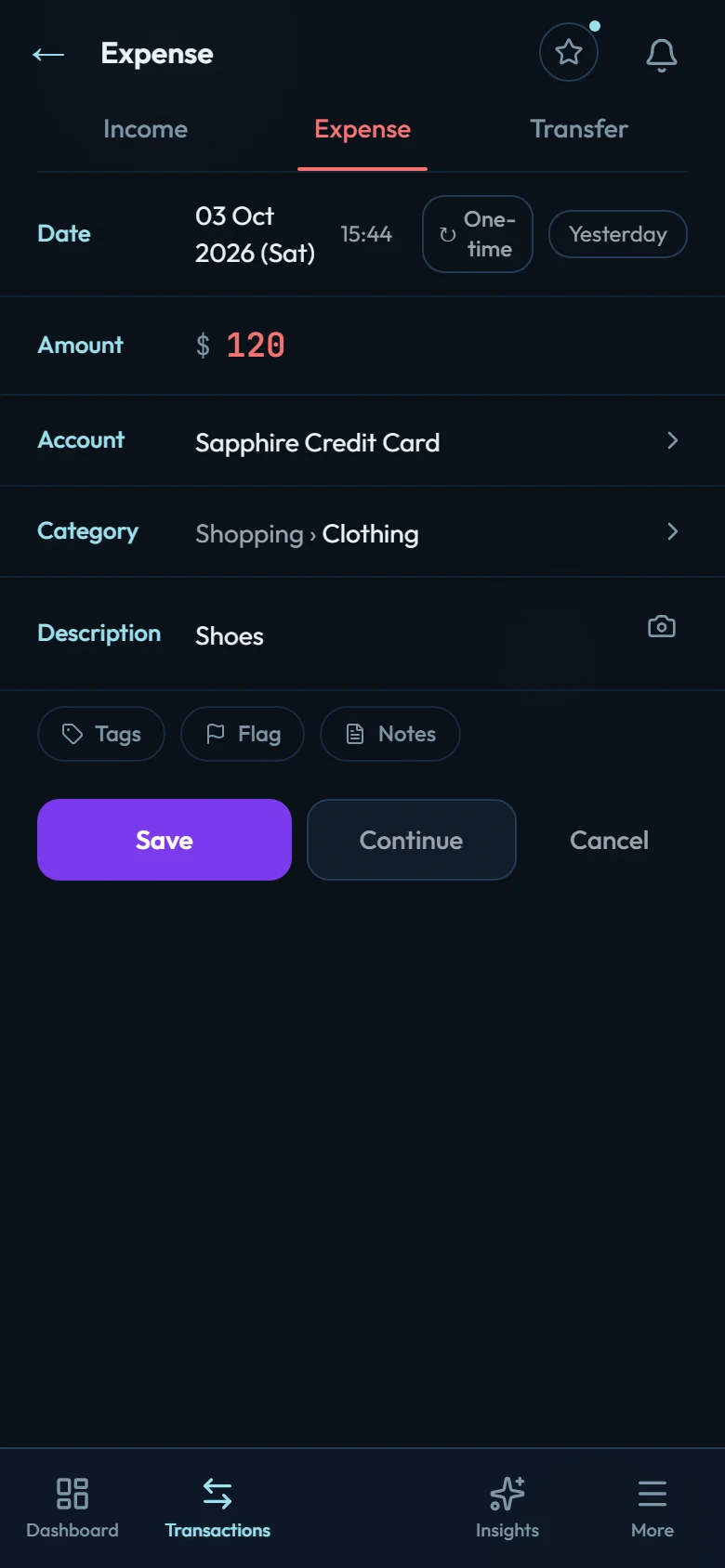
Say you see a pair of shoes for 120. Before you pay, enter them as an expense: 120, Clothing, today's date and the card you would pay with. Save the entry, then look at your month.
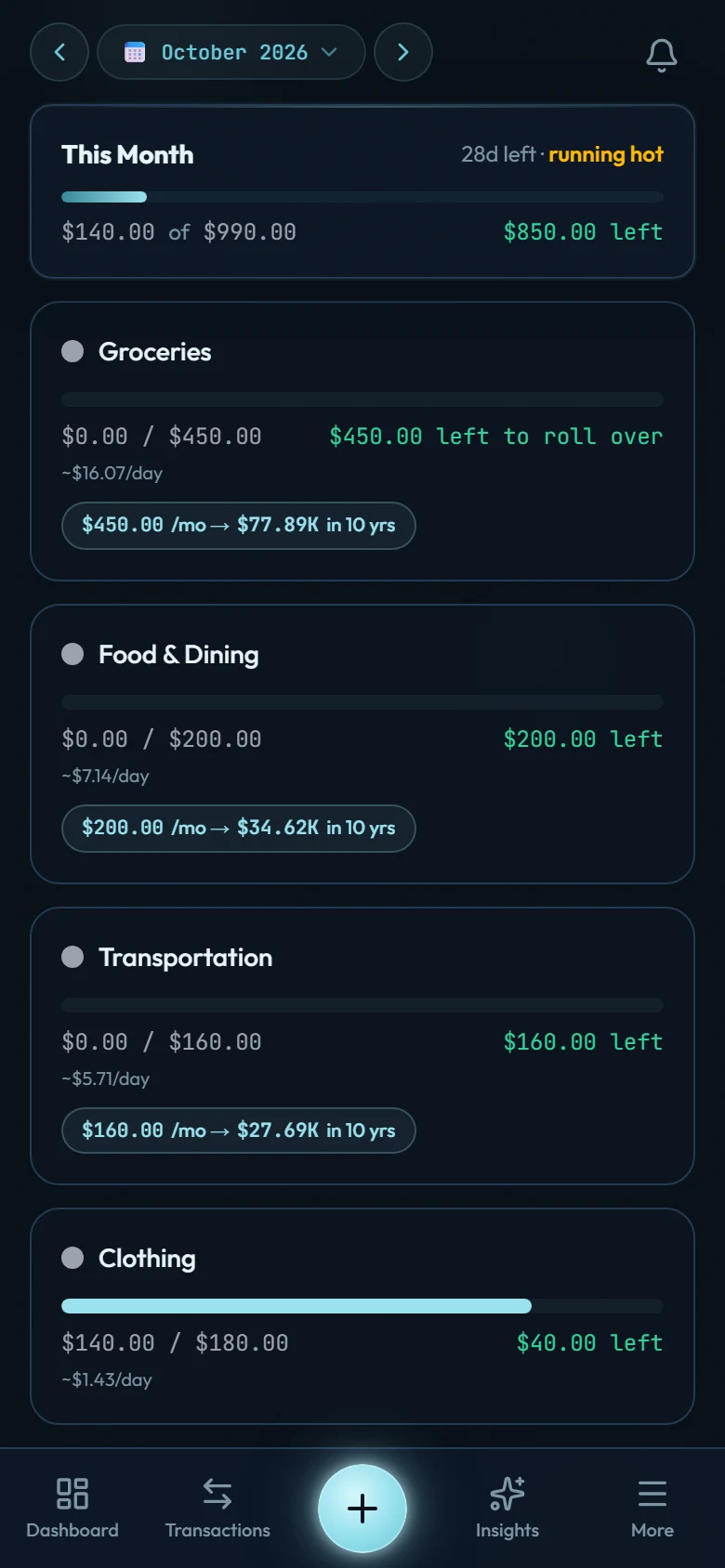
Say your Clothing budget is 180 for the month, you have spent 20 of it, and 28 days are left: 160 to go, about 5.71 a day. With the shoes counted, it has 40 left, about 1.43 a day. Give that a few seconds. If the shoes still feel right, buy them: the entry is already done. If they feel wrong, don't buy them, and delete the entry.
Entering the amount yourself may help on its own. In a lab study by Dilip Soman, people paid a series of expenses either by writing cheques by hand or by signing card receipts, and afterwards the card group rated themselves more likely to buy one more thing. Part of the reason, he found, is the writing: an amount you have written out is one you remember (Soman, 2001).
In Wealth Mutant it goes like this:
Pick your line
Choose a price above which you always enter a purchase before you pay, an amount that would make you stop and think anyway. For some people that is 50, for others 500.
Enter it, then look
Tap the + button (the form opens on Expense), fill in the amount, the account or card and the category, and tap Save before you press Pay. Then open Budgets (under More on a phone): the category's card shows what is left and about how much a day. If the entry takes a budget to 80% of its limit or more, that budget's alert shows in the app at once.
Buy it, or delete it
If you still want it, pay: the entry is already done. If you decide against it, open the entry, tap Delete and confirm. It never happened, so it shouldn't count, and the alert is ready again for the day you really cross the line.
If the same thing tempts you week after week, such as a weekend food order, make a bookmark for it: set it up in Settings → Bookmarks with its category and account, and leave the amount blank. Entering it first then takes the + button, the bookmark star in the form, the bookmark, the price, and Save.
Wealth Mutant is the personal finance app we built for exactly this moment. It gives the pause a place to happen: the budget moves the second the entry is saved, and What If shows the same price as hours of your life and as your net worth years from now. You note each purchase yourself, in a few seconds, a small habit that makes you notice, and no bank login is ever shared. You pay for it once.
Ready to take control?
See your budgets, cards, loans and net worth in one place. One payment, yours for life.
Buy — $99 oncePrice it in hours before you pay
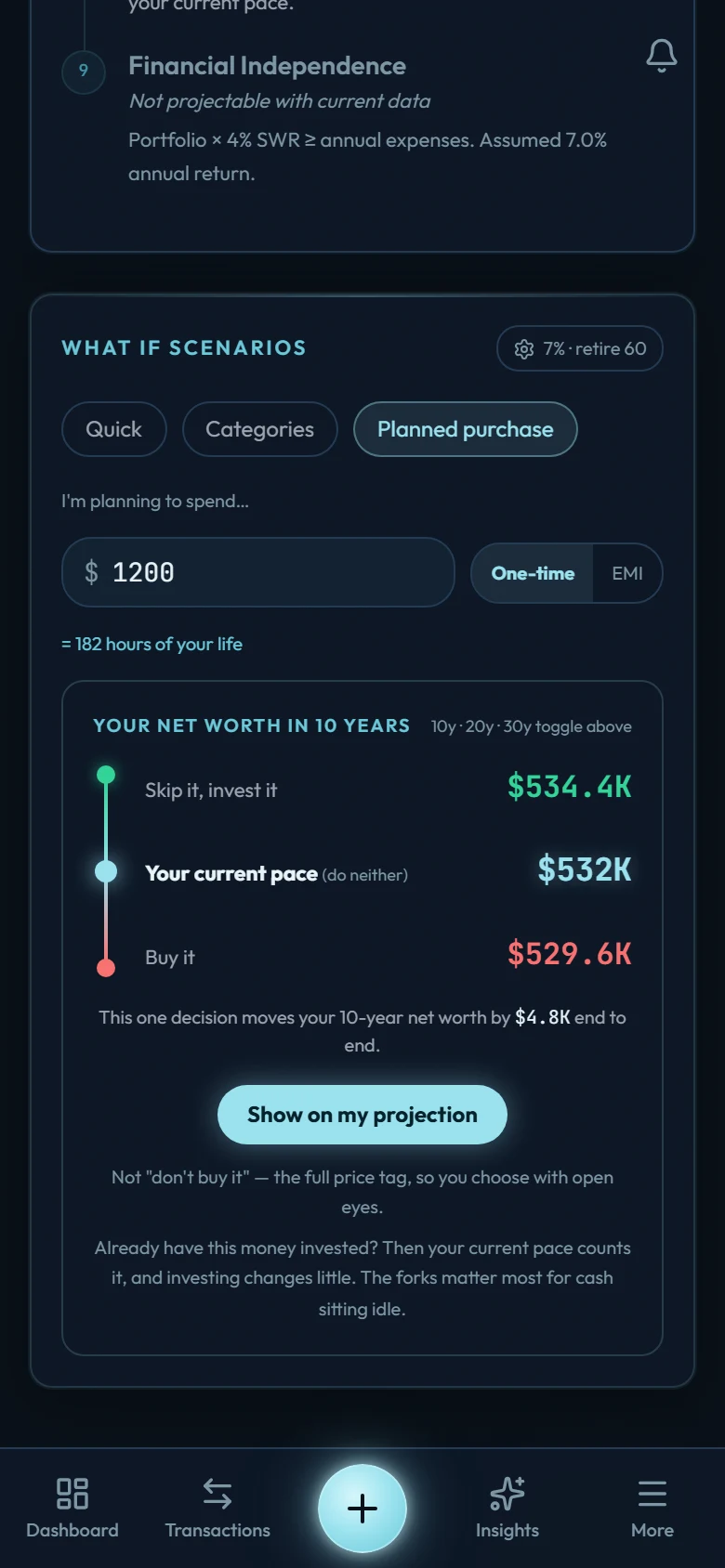
A price is easy to say yes to. The same price as time is harder. Work out your rate: your take-home pay for a year, divided by the 8,760 hours in a year, sleep and weekends included, because that is the time your money is spread across. On 36,000 a year that is about 4.11 for every hour of your life, so the 120 shoes cost about 29 hours.
To skip the sum, use our free Hours of Your Life calculator: it works out any price against any pay, with no sign-up.
Inside Wealth Mutant your rate comes from the income you have recorded, and the Future Self page goes one step further. Open What If, choose Planned purchase and type the price. When it has your earning rate, it shows the cost in hours of your life, and where your net worth would stand 10, 20 or 30 years out if you skip it and invest the money, keep your current pace, or buy it. Try it with something bigger than shoes, such as a new phone:
Find your impulse total with one flag
Wealth Mutant has 6 colour flags, and you can rename them. Call one "Impulse" in Settings → Flag labels, and flag each impulse buy as you enter it. At the end of the month, open the filter sheet on Transactions, choose the flag and the month, and the result shows the total. Save it as a view, and next month the number is one tap away (how flags and filters work).
Keep the regretted buys in the record. A purchase you regret happened, so its entry shows you a pattern: the day of the week, the shop, the mood.
How to stop impulse buying online
- Remove saved cards from shops and from your browser, and turn off one-tap or express checkout where a shop offers the setting.
- Unsubscribe from sale emails and turn off shop app notifications. You can't be tempted by a sale you never hear about.
- Treat "buy now, pay later" as the full price. Enter the whole amount, not the first instalment, because that is what your month will carry.
- Keep the app one tab away. Entering the price first works the same in a browser as in a shop.
The goal isn't zero
A life with no impulse buys at all usually means gritting your teeth, and nobody grits their teeth forever. The goal is that impulse buys become conscious, occasional and yours: a spontaneous dinner you will remember, bought with a few seconds of awareness and entered without flinching.
Give it time. Phillippa Lally's team at University College London followed people building a daily habit: the typical person took 66 days to make it about as automatic as it would get, and missing a day made no lasting difference (Lally and colleagues, 2010). If the guilt is the loudest part for you, start here instead: How to Stop Feeling Guilty About Spending Money.
If you feel you can't stop buying, or worry about money is keeping you awake, a doctor or a counsellor can help with what a habit can't fix. If debt is behind it, many countries offer free debt advice from people who will go through your numbers with you.
Common questions
How long should you wait before buying something on impulse?
A day is usually enough for small things, which is the 24-hour rule, and 30 days suits anything big. Any wait helps, because the wanting peaks before you pay and fades after. Entering the price in your money app before you pay gives you a short version of that wait in a few seconds.
What is the 30-day rule for spending?
Note down anything you want that you had not planned to buy, and buy it only if you still want it 30 days later. It works well for bigger buys. Small ones rarely make it onto the list, which is where entering the price first helps.
Is impulse buying a sign of a shopping addiction?
Not on its own: buying on impulse now and then is common. If you feel you can't stop buying, spend money you don't have, or hide what you buy, talk to a doctor or a counsellor. That is more than a habit can fix on its own.
Is buy now, pay later an impulse buy?
It makes impulse buying easier, because the checkout shows the instalment instead of the price. Before you agree to it, enter the full price in your money app and see it the way your month will carry it.
Start with one purchase. The next time something tempts you, enter it as an expense before you pay, open Budgets and watch the category's daily figure move. Then decide. The free trial of Wealth Mutant runs 7 days, needs no card, and nothing charges you when it ends.