
Shiny object syndrome is the pull to drop what you are doing for the next new thing before the first one has had time to work. With money, it looks like a new side hustle every few months, a new investing idea, a new budget method, or a new job taken for the bigger number on the offer letter. Most people feel that pull at some point, and I have felt it too.
This article is about telling a real opportunity from a shiny one. The answer I trust is the one written in your own numbers, kept long enough to show you a pattern.
What is shiny object syndrome?
Wikipedia describes it as a concept "wherein a lot of focus and attention are devoted to an idea for only a short period of time, then abandoned before being thoroughly developed", and adds that people who fear missing out may be especially prone to it. It is not a medical condition. Entrepreneur, writing about business owners, says plainly that "SOS isn't a diagnosable affliction": it is a habit of thinking, and habits can be changed.
Most of what is written about it covers teams and companies. With your own money it tends to show up in a few places:
- a side hustle dropped for a newer one before the first had a full year to earn
- an investing idea swapped for whatever did well last month
- a budget method abandoned in its second month, then a third method after that
- a course or certificate started and left half done
- a new job taken for the salary alone
Each switch feels like progress on the day you make it. The cost shows up later: the thing you left needed more time than you gave it, and the new thing starts again from zero.
Why shiny object syndrome hits hardest during financial stress
My own life has not always gone smoothly. There have been hard stretches, months when commitments took almost everything that came in, and low points that were hard on my mind as well as my bank balance. Those are exactly the months when a quick fix looks brightest. When money is tight, it is easy to panic and make a short-term decision you would never make on a calmer day.
What kept me steady in those months was the record. Long before Wealth Mutant existed, I tracked my money by hand in a spreadsheet, and later in the app. By my hardest stretch I had about 5 years of my own numbers to look at.
Those years showed me patterns I could not have seen month by month. Some tight months were seasonal and had passed before. Some commitments had an end date. Some changes I had made earlier had helped, and some had not. With that in front of me, I could tell when to stay put and ride a bad month out, and when it was time to get up and change something.
If the worry itself is what keeps you up at night, financial anxiety is not a math problem covers that side. This article is about the decisions you make while it is going on.
Start the record that shows your patterns
Note what comes in and goes out, and watch your months line up into something you can read.
No card needed.
Consistency is the edge people call luck
People who seem lucky with money are often the ones who were still there when something finally paid off. Consistency is key, and with money it means keeping one direction long enough to find out whether it works, then judging it on evidence instead of on how you feel that week.
How to stay consistent when progress is slow:
- Decide in advance how long you will give it. A side hustle might get 12 months, a new budget method 3. Write the date down and judge it on that date.
- Keep a record you can look back on. You cannot stay with something when you cannot see whether it is moving. A list of what came in and what went out, kept every day, becomes that record.
- Change one thing at a time. If you switch your job, your budget method and your investments in the same month, you will never know which change helped.
Daily habits are a different subject, and money habits covers how good and bad ones build on each other. Here the question is bigger: whether to keep going on a whole path at all.
Is a new job a real raise or an illusion?
Moving jobs can pay. The Federal Reserve Bank of Atlanta's wage growth tracker shows that, averaged over the 12 months to September 2026, median hourly pay grew 4.4% a year for US workers who had switched jobs, against 3.5% for those who stayed. So job hopping is not the problem. Hopping without seeing the whole offer is.
The salary is only part of a job. In June 2026, benefits were 31.6% of what US employers spent per hour on their workers, and wages and salaries the rest, according to the Bureau of Labor Statistics' employer costs for employee compensation. In the UK, an employer must pay at least 3% into your workplace pension, and many pay more. A new offer can raise the salary and take some of that away.
Here is a worked example, before tax, and the math is the same in any currency.
| Current job | New offer | |
|---|---|---|
| Salary | 60,000 | 69,000 (15% more) |
| Employer's retirement contribution | 1,800 (3%) | None |
| Extra commute cost | none | 2,400 a year |
| Extra health cover cost | none | 1,800 a year |
| Hours a week | 40 | 45 |
| What the job is worth to you a year | 61,800 | 64,800 |
| Per hour worked | 29.71 | 27.69 |
The headline says 15% more. The whole offer is worth 3,000 a year more, about 5%, and it pays less for every hour you work. That does not make it a bad move. The extra 3,000 might be worth 5 more hours a week to you, or the new job might teach you more. It does mean you choose it knowing what it is. Hourly to salary shows the conversion, and the free hours of your life tool turns any amount into time.
In Wealth Mutant, the inputs for this are already in your record: your pay and raises as income, insurance and commuting as spending, and your retirement savings as an account in your net worth. The What If panel on the Future Self page lets you add the offer's real gain as a monthly amount. Here, 3,000 a year is 250 a month. The app then shows what that gain adds to your net worth 10 and 20 years out, and how much more each hour of your life earns.
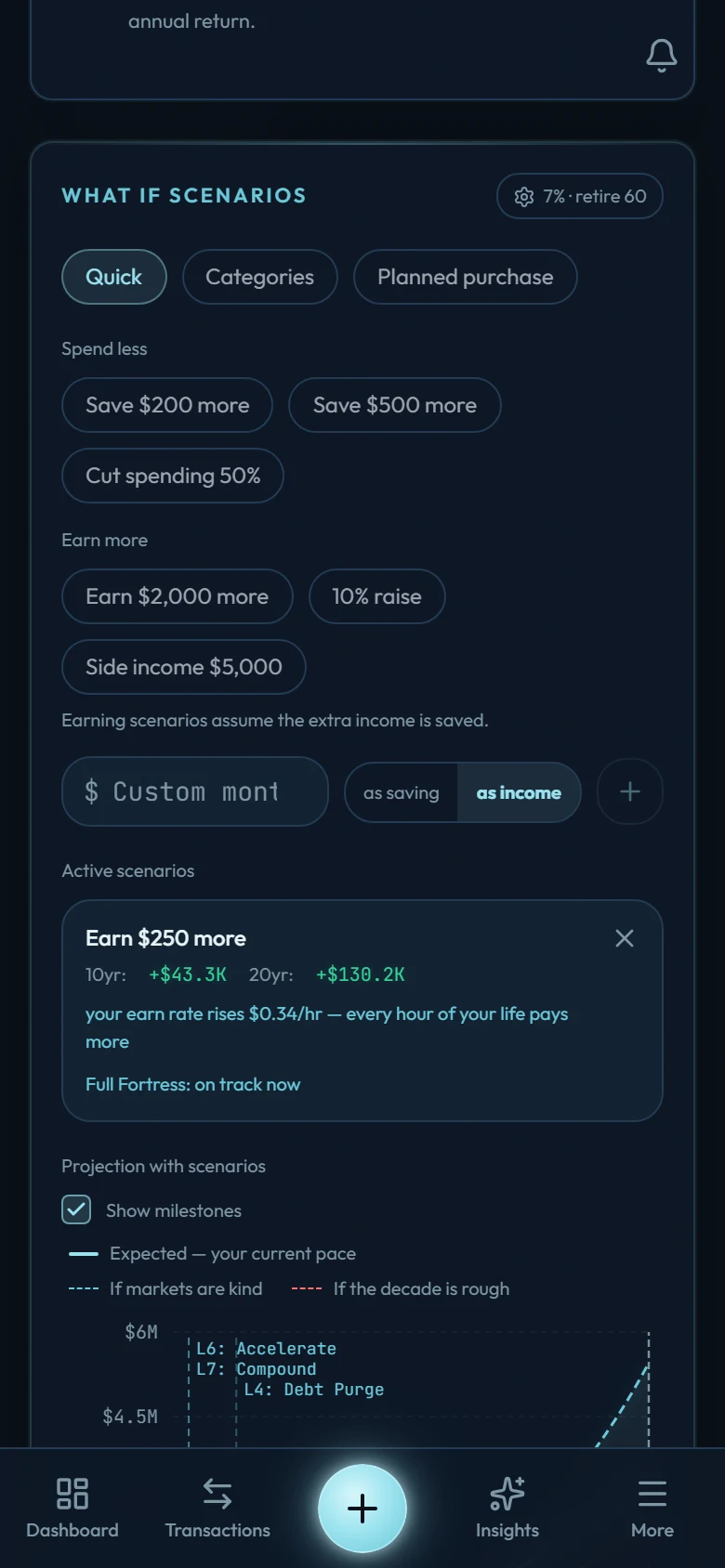
Wealth Mutant is the personal finance app we built for exactly this. It keeps years of your own numbers in one place, so a big decision rests on your record instead of your mood: what each hour of your life earns, where your net worth is heading, and how many months your savings would last. You note each purchase yourself in a few seconds, a small daily habit that makes you notice, and no bank login is ever shared. You pay for it once.
Make the big calls on your own numbers
A personal finance app with your net worth, money per hour, Future Self and your runway in one place. One payment, yours to keep.
Buy — $99 onceWhen to stay, when to jump, and when to ride it out
Staying the course means keeping your direction until your own numbers give you a reason to change it. New chances still get a look, and 2 questions sort most of them.

Is it better on your own numbers? Count the whole change: the money in, the money out and the hours. If it is not better, stay the course, and you have lost nothing by checking.
Could your savings carry you through it? A job change can leave a gap between pay days, and a new venture can take months to earn. The free runway calculator shows how many months your money would last at your current spending. If the answer is too few, ride it out for now: keep going where you are and build the cushion first. If it is enough, jump, and do it on purpose.
A hard month on its own is rarely a reason to jump. Look back at your record first. If the same squeeze has come and gone before, it is probably a season to ride out.
Common questions
What causes shiny object syndrome?
It is not a medical condition. Wikipedia describes it as attention given to an idea for a short time and then dropped before it is developed, and notes that people who fear missing out may be more prone to it. With money, a new idea often looks better than an old one simply because the old one's slow months are the ones you can see.
How do you stop shiny object syndrome?
Decide in advance how long you will give each plan before judging it, keep a record of your money so you can see whether it is working, and change one thing at a time. When something new comes along, check it against your own numbers before you drop what you have.
Is it worth changing jobs for more money?
It often pays: in the Atlanta Fed's tracker, median pay growth over the 12 months to September 2026 averaged 4.4% for US workers who had switched jobs, against 3.5% for those who stayed. Compare the whole offer, though: retirement contributions, insurance, commuting and hours can turn a 15% raise into much less, or into less pay per hour worked.
What does staying the course mean?
Keeping your direction through good months and bad ones, and changing it when your own numbers give you a reason. A bad week or a new idea on its own is rarely that reason.
How do you make money decisions when you are stressed?
Avoid big decisions in the worst week if you can. Look at your record to see whether the squeeze has happened before, check how many months your savings would last, and give yourself a date to decide instead of deciding in the moment.
Your next step
Pick the one thing you are most tempted to drop, or the one you are most tempted to jump to. Before you decide, write down what it would change over a year: money in, money out and hours. If you already keep years of records in a spreadsheet, the template workbook brings them into Wealth Mutant. After 3 months of records, Future Self shows where your current course leads. You can see every screen on the tour.