
Money habits are the things you do with money so often that you no longer decide each time: writing down a purchase, checking a card before its due date, moving some pay into savings. On any single day, one of them changes almost nothing. Repeated for a year, they add up, and they add up in both directions.
That is the idea at the heart of Darren Hardy's book The Compound Effect. His site sums it up in one line: "Small, seemingly insignificant, moment-to-moment choices compound into massive success." Below are the 8 good money habits worth building, the 6 bad ones that compound the other way, and how to make the good ones last, with help from The Compound Effect and Atomic Habits.
What are money habits, and how do they compound?
A money habit is a choice you have stopped making. You don't decide each time whether to write down a coffee or open your card statement. You just do it, or you just don't, and whichever it is happens again next week.
This kind of compounding has nothing to do with interest rates. Hardy's point is about behaviour: each choice makes the next one easier or harder. Write down this week's spending, and next week the delivery fees stand out. Once they stand out, you order less. Order less and there is money left at the end of the month, which makes another week of writing things down feel worth it. The loop feeds itself.
The opposite loop runs just as well. Skip looking, and the leaks carry on unseen. The month runs short before payday, the shortfall goes on a card, and a balance with interest turns the statement into something you'd rather not open. So you look even less.
Atomic Habits puts a number on the shape. Get 1% better each day for a year and you end up about 37 times better; get 1% worse each day and you fall close to zero. Money doesn't move 1% a day, and the 37 is about getting better at anything. What carries over is the direction: whichever loop you are in tends to keep going.

8 good money habits that compound
None of the habits below takes more than a few minutes a day, and each one feeds the next. The order matters: the first is the one everything else runs on.
1. Write down every spend, the same day
Hardy's first instruction for changing any part of your life is to track it: "Track every action that relates to the area of your life you want to improve." For money, that means every purchase, written down on the day you make it.
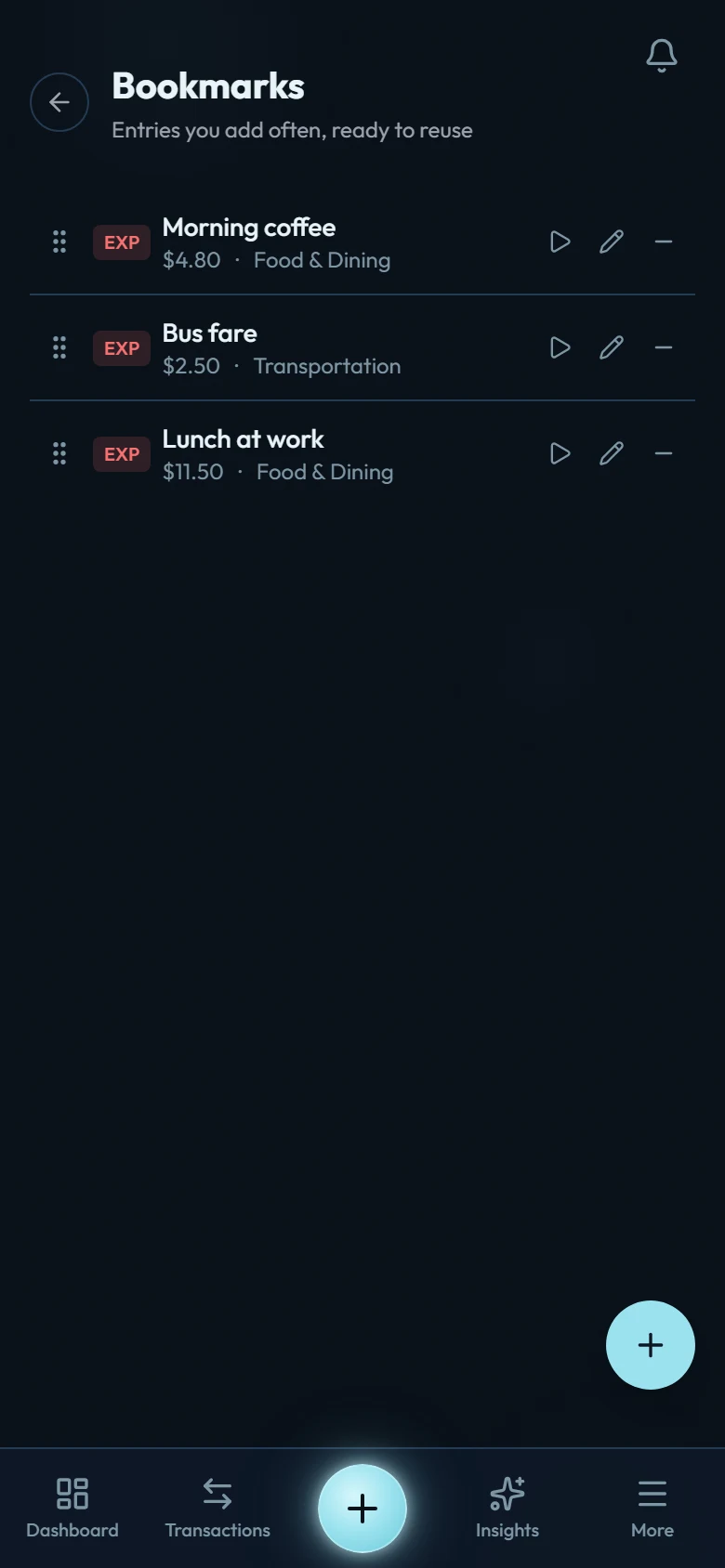
In Wealth Mutant an entry is an amount, a category and Save, and the help centre says most take under 30 seconds. A purchase you repeat, like a morning coffee or a bus fare, can be saved as a bookmark, so the form arrives filled in.
Every other habit on this list reads from that record. Why looking comes before saving makes the longer case, and the research on writing it down explains why the list changes what you buy next.
2. Read your week, once a week
Hardy builds his days around routines at the start and the end, the two parts of a day he says you can almost always control. The money version is one fixed slot each week, say Sunday evening, to read what you spent. Don't fix anything yet. Just read it.
Wealth Mutant sends a weekly digest to Smart Insights with your week's summary, and if your recording slips, a reminder nudges you back without guilt. A problem spotted in week 1 costs far less than one found in month 3.
Start the first habit today
Add a few purchases to Wealth Mutant and watch them build your balances, your budgets and your first level on the Mutation Path.
No card needed.
3. Plan the month before it starts
A budget is a decision made once, ahead of time, so you aren't deciding every purchase on the spot. In Wealth Mutant you can plan category by category, or with 3 Flex buckets, and the 3-number version suits anyone who finds 20 categories too many. Budget bars change colour as you near a limit, and an alert arrives at 80% and at 100%, early enough to change course.
Each month's plan gets sharper, because you set it with last month's real numbers in front of you.
4. Save ahead for the bills you know are coming
A yearly insurance bill, a software renewal, gifts in December: none of them is a surprise, yet each one lands like one if nothing was set aside. A sinking fund divides the bill by the months left, so a $480 bill due in 12 months is $40 a month.
In Wealth Mutant a goal can carry a monthly contribution, and its card shows when you'll finish at that pace. When the bill arrives, it is already covered.
5. Pay the card in full by the due date
Pay off the whole statement balance before its due date, and on many cards those purchases never collect interest; the interest-free period explains when that holds. Wealth Mutant shows each card's amount payable with its due date and reminds you before the due day.
Kept up, this means the card never charges you interest. Let it slip and you meet bad habit 3 below.
6. Price a want in hours of your work
At $15 an hour, a $90 pair of shoes is 6 hours of your work. Seen as time, a purchase you'd have made without thinking gets a second look.
Wealth Mutant works out your money per hour from your own income, and its What If builder shows a purchase you are planning as hours of your life before you buy it. To try the idea first, the free Hours of Your Life calculator needs no account. Fewer purchases you regret leaves more for the ones you want.
7. Pay yourself on payday
Move a set amount to savings the day your pay arrives, before any spending starts. Pick an amount you could keep up in your worst month: a modest transfer that runs every month beats a big one you abandon in month 2. Set up the transfer at your bank, and a recurring rule in Wealth Mutant records it on schedule.
Month after month, that lifts your savings rate without asking for willpower each time.
8. Check your net worth once a month
Net worth is what you own minus what you owe, and every habit above shows up in it. Money you save lifts it, and so does a card you pay down. Checked monthly, it shows the direction long before it shows a big change, and one bad week becomes a dip in a longer line.
Wealth Mutant keeps it in Reports. Once 3 full months are on record, Future Self projects where your pace is heading.
Wealth Mutant is the personal finance app we built to run habits like these in one place. Every purchase you record feeds the whole picture: balances, budgets, cards and loans, goals, net worth, money per hour, Future Self and the 9-level Mutation Path. You note each purchase yourself in a few seconds, a daily habit in the spirit of Kakeibo that makes you notice where your money goes, and no bank login is ever shared. You pay for it once.
Run all 8 habits in one place
Record a purchase in seconds, read your week, plan the month and watch your net worth move. Wealth Mutant is a personal finance app you buy once.
Buy — $99 once6 bad money habits that compound the other way
Hardy's sharpest warning is about bad habits: in the moment, they cost nothing you can feel. If the first bite of a fast-food burger gave you a heart attack, he writes, you would not take a second one. The cost comes later, from the repeats, by which point it looks like bad luck.
Money works the same way. One $6 delivery fee changes nothing. Three a week is $18 a week, or $936 a year, and nobody ever decided to spend $936 on delivery fees. Hardy asks readers to list the actions they could stop that may be pulling their results down. For money, that list usually holds some of these:
- Not looking. You check your balance when a payment fails, not before. The other 5 hide behind this one.
- Spending first, planning later. Every purchase is decided on the spot, and by the 20th the month has decided itself.
- Paying only the minimum. It keeps the card in good standing and the balance alive. How the minimum payment is set shows how long that takes to clear.
- Keeping subscriptions you forgot. $15 a month for something you stopped using is $180 a year. Here is how to find them.
- Buying at the checkout. One unplanned purchase is a treat. The same one every week is a habit with a price, and how to stop impulse buying has the fixes.
- Letting each raise become spending. The new salary disappears into a nicer version of the old month, and that one has a name: lifestyle creep.
How to break a bad money habit
The Compound Effect gives several ways to remove a bad habit, and 3 of them carry straight over to money.
- Find the trigger. Notice when the habit fires: a time of day, a mood, certain company. For spending, that might be late at night with a shopping app open, or the end of a long day.
- Clean house. Hardy's version is to clear the junk food out of the cupboards. Yours is to take your saved card out of shopping apps and unsubscribe from sale emails.
- Take a 30-day break. Hardy calls it a vice fast: pick one vice and stop for 30 days, to prove you are still in charge. For money, that could be a month with no food delivery.
How do you make a good money habit stick?
Starting is the hard part. Hardy compares it to a space shuttle, which burns more fuel in the first few minutes of a flight than in the rest of the trip, because it has to break free of gravity. Once a habit has momentum, keeping it going takes far less effort.
James Clear's Atomic Habits adds the practical side. His 4 laws are to make a habit obvious, attractive, easy and satisfying. For money, obvious is a fixed cue, such as recording a purchase right after you pay. Easy is a bookmark that turns the entry into 2 taps. Satisfying is seeing the result straight away: in Wealth Mutant, every save updates your balance, budgets and Mutation Path progress at once, with no sync step.
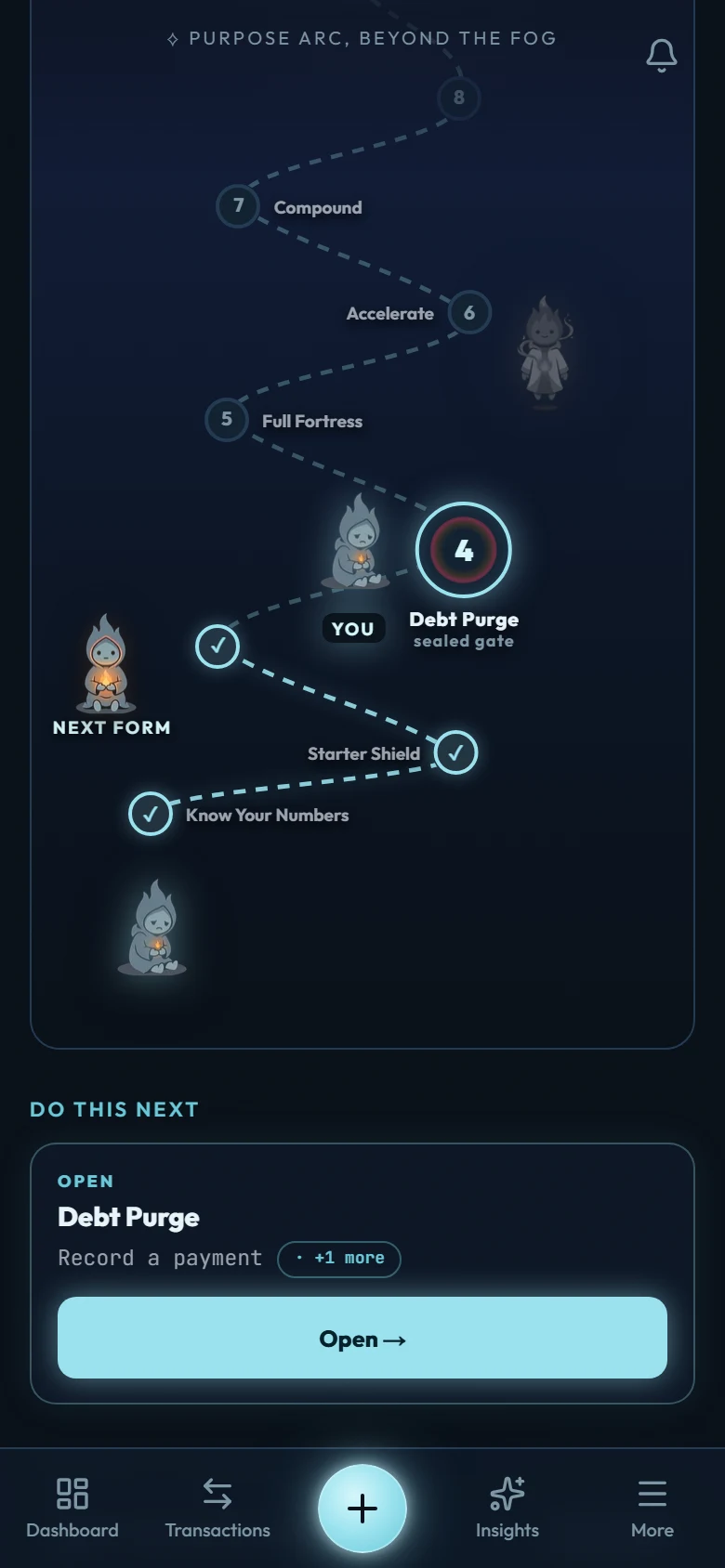
Clear also argues that a habit lasts when it matches who you think you are: "Every action is a vote for the type of person you wish to become." Each purchase you record is a vote for being someone who knows where their money goes. The Mutation Path starts there. Level 1 completes once you've saved 5 transactions, typed in or imported, with no deadline, and 8 more levels follow.
How long does a habit take? Hardy suggests tracking one area for 3 weeks. A study of 96 volunteers in the European Journal of Social Psychology found it can take much longer: the time to reach 95% of each person's own limit of automaticity ranged from 18 to 254 days. The same study found that missing one opportunity did not materially affect the habit forming.
So expect months, and expect to miss days. After a longer gap, catch-up from a statement shows which rows you've already recorded and which are new, and never duplicates one.
How to build good money habits in your first week
Day 1: record one purchase
An amount and a category, then Save. It is the first of the 5 entries Level 1 asks for.
Day 2: choose your cue
Pick something you already do every day, like paying for lunch, and record the purchase straight after it.
Day 3: bookmark what repeats
Save the coffee, the commute and the usual lunch, so each one is 2 taps from now on.
Days 4 to 6: read each day's entries
Change nothing yet. You are collecting real numbers.
Day 7: read your week, then plan one thing
Choose one budget for next month, or one amount to move to savings on payday that you would still manage in a tight month.
Common questions
What are good money habits?
Habits you can repeat without deciding each time: recording what you spend, reading your week, planning the month ahead, saving for bills you know are coming, paying your card in full, saving on payday and checking your net worth monthly. Start with recording, because the others run on its numbers.
What are bad money habits?
Not looking at your money, spending before planning, paying only the card minimum, keeping subscriptions you forgot, buying on impulse at the checkout, and letting each raise become spending. Each one costs little on the day and a lot over a year.
Is the compound effect the same as compound interest?
No. Compound interest is interest earning interest. The compound effect, in Darren Hardy's book, is about choices: repeated over time, they build up results, good or bad. This article is about the choices.
How long does it take to form a money habit?
It varies a lot. In a study of 96 volunteers in the European Journal of Social Psychology, the time to reach 95% of each person's own limit of automaticity ranged from 18 to 254 days. The habits were eating, drinking and activity, not money. Plan on months, not weeks.
What are good financial habits for young adults?
Three that cost little: record your spending from your first pay, save part of every payment on the day it arrives, and take any money your employer adds to a retirement plan (a 401(k) match in the US, a workplace pension in the UK, a group RRSP in Canada).
Your next step
Record one purchase today, then read it back tomorrow. That is habit 1, and the rest build on it. Your first week in Wealth Mutant walks through the start, and the tour shows where each entry ends up, from budgets to net worth. If you're just starting out with money, financial literacy for young adults covers the basics around it.