
A money diary is a record of everything you spend over a short period, often a week. Each line says what you bought, what it was for and how you felt when you bought it.
The point is to see your real habits before you decide what to change. Nobody else has to read it, and there is nothing to pass or fail. Below: a 7-day template, what a week can show you, and what to do on day 8.
What is a money diary?
A bank statement shows who you paid, when and how much. A money diary adds what a statement cannot: why you bought it, whether you needed it and how you felt.
It is also called a spending diary. Unlike a budget, it sets no targets.
The US government uses diaries too. The Census Bureau runs the Consumer Expenditure Diary Survey for the Bureau of Labor Statistics: households keep two 1-week diaries of all their purchases, to "capture small everyday purchases like food, meals, personal care products and gasoline."
You may also know Money Diaries as a column. Refinery29 publishes other people's weeks of spending, with headlines such as "A Week In Dallas, TX On A $53,000 Salary". This guide is about the private kind, which only you read.
How do you keep a money diary for 7 days?
You need a page and 7 days. Each purchase gets one line with 7 columns: day, time, what, amount, need or want, how you felt and whether it was worth it. Copy those headings into a notebook, a spreadsheet or a notes app.

The first 4 columns are facts a bank or card app mostly has already. The last 3 are the diary's own, and they are the reason to keep one.
Start in an ordinary week
A holiday or a birthday shows an unusual version of you. If no week is ordinary, start anyway and note what was different.
Write each purchase when it happens, or each evening
Cash, card and automatic payments such as direct debits all count, from the bus fare to the school-gate snack. In the evening, go through your receipts and card app to catch what you missed.
Fill in the last 3 columns the same day
One word is enough for how you felt: hungry, tired, bored, pleased. For need or want, use your own rule and keep it the same all week. For worth it, write yes, so-so or no.
Write “not sure” instead of guessing
A “not sure” shows which purchases slip past you. A guessed amount hides them.
Change nothing this week
Spend as you usually would, because a week on your best behaviour shows you very little.
Try the diary on your phone
Note a purchase in seconds with its category and a description, and see your balance update straight away.
No card needed.
What can a money diary show you?
A week is short, so look for clues rather than answers.
Purchases you would not have listed from memory. Everyday spending is easy to forget one purchase at a time. In its spending tracker, the US Consumer Financial Protection Bureau (CFPB) says many people who track their spending for a month find they are spending in little ways "that add up and sometimes don't match their priorities."
A feeling that keeps turning up. A statement cannot tell you which of your wants were bought tired. In the example page above, the 2 wants carry the words tired and bored. If one word keeps coming back beside your own wants, that is the lead to follow, and how to stop impulse buying covers the research on moods and spending.
What slipped past, and what was unusual. The lines you only caught in the evening and the amounts you wrote as "not sure" show where you pay without looking. A week that was not typical is a reason to run another. A week with nothing to change is a result too.
A notebook is enough for 7 days. To keep the record going after that, each entry should take seconds.
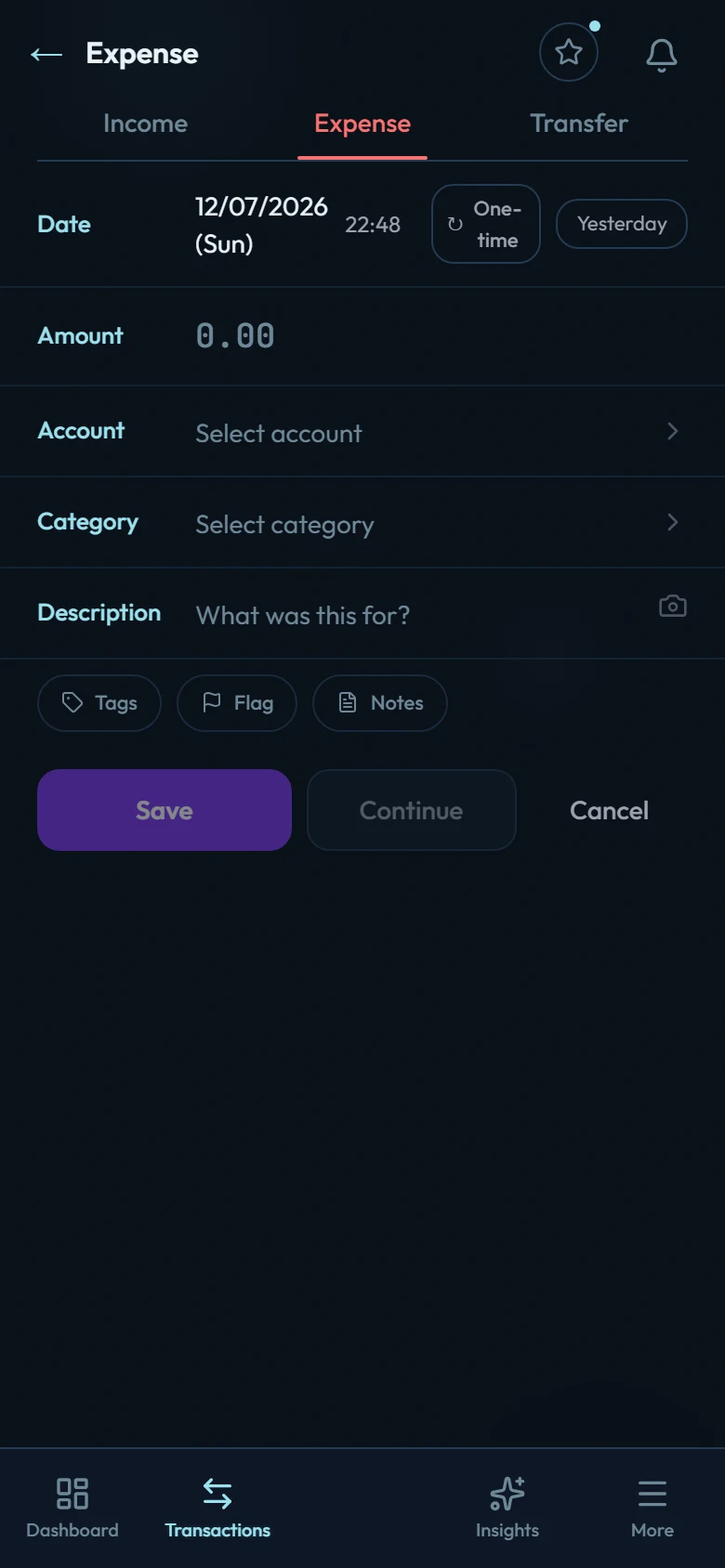
Wealth Mutant is a personal finance app built around this habit of writing each purchase down. Each one takes a few seconds to note: an amount, an account and a category, with an optional description, tags and notes where the why and the feeling can go. Because you write it yourself, you look at what you spend as you spend it. No bank login is ever shared, and you pay for it once.
Keep your money diary going
Each purchase you note updates your account balance and monthly summary as soon as you save it, in a personal finance app you buy once.
Buy — $99 onceWhat do you do on day 8?
Add up the week, then sort every line into a category such as food at home, eating out, transport or shopping. Here is a made-up week:
| Category | Spent | Marked so-so or no |
|---|---|---|
| Food at home | $61.00 | $0.00 |
| Eating out | $58.50 | $22.00 |
| Transport | $24.00 | $0.00 |
| Shopping | $43.00 | $18.00 |
| Week total | $186.50 | $40.00 |
Read the dollars as pounds, euros or rupees if you like: the totals do not change. Of the $186.50, $40 was marked so-so or no, about 21% of the week's spending: a $22 takeaway bought tired and an $18 phone case bought bored. To see that $40 as time, type it into the free hours of your life calculator with your take-home pay.
Now choose 1 change you could keep on a bad day. Here it could be a meal in the freezer for the tired nights. If a line turns out to be a subscription you forgot, how to cancel subscriptions shows how.
How does a week become a habit?
Your first diary lasts a week. A habit is the same page, kept up and looked at on a schedule. Kakeibo, the Japanese household account book, works that way.
Chase UK's guide describes it as "keeping a diary of every penny you spend", written down once a day, with a plan at the start of the month and a review at the end. Wealth Mutant's daily entry is in the same spirit.
To keep yours going, cut it to what you will really write: an amount and a category take seconds, and the note is optional. Look at the page at the same time each week and run through day 8 again. The research on why writing it down works is in the science of writing down what you spend, and manual expense tracking gives a routine that survives a busy week.
Common questions
What should a money diary include?
Every purchase that week, one line each under the 7 headings, whether you paid in cash, by card or automatically. A bill that comes once a month, such as rent, may not fall in your 7 days, so read it off your statements. The US survey above splits the work the same way: its diary is there for everyday purchases, and a separate interview survey asks about rent and other regular bills.
How long should you keep a money diary?
Start with a 7-day money diary: a week shows your daily habits, and the US survey above uses two 1-week diaries in a row. The CFPB prefers a month, because it “lets you see all of your income and expenses in one place”, and suggests “just one or two weeks” if a whole month seems too hard. So if the first week helps, carry on until you have a whole month.
Is a money diary the same as a budget?
No. A money diary records what you spent, and a budget plans what you will spend. The diary can feed a budget later, because you read your real numbers off it.
Your next step
Copy the 7 headings today and start your 7 days tomorrow. To keep it on your phone, add your first purchase in Wealth Mutant and put the why in the description and the feeling in the notes. By day 8 you will have a page that says where a week of your money went.