
Living paycheck to paycheck means each pay is gone by the time the next one arrives, with little or nothing left over. It happens at high incomes as well as low ones, and it can change.
This guide shows how common it is, by the Federal Reserve's closest measure, and why the money runs out early. Then come 5 steps out, in order, with a worked example.

What does living paycheck to paycheck mean?
It describes how a month ends, whatever the income. The pay lands, bills and daily spending use it up, and the last days before the next pay run on whatever is left. You can live this way and still pay every bill on time. What marks it is how little is left, and that a surprise in those last days has nothing between it and a card or a late fee.
The same idea has other names, such as "payday to payday" and "living month to month". Paid weekly, every 2 weeks or monthly, the pattern is the same.
How common is living paycheck to paycheck?
The Federal Reserve's household survey never uses the phrase. Its closest question, put to nearly 13,000 US adults in October 2025 (report published May 2026), asks how often the statement "I have money left over at the end of the month" applies to you.
Of all adults, 41% said always or often and 28% said sometimes. The rest, about 3 in 10, said never (12%) or rarely (18%).
| Family income | Never | Rarely | Never or rarely |
|---|---|---|---|
| Less than $25,000 | 29% | 25% | 54% |
| $25,000 to $49,999 | 19% | 25% | 44% |
| $50,000 to $99,999 | 9% | 20% | 29% |
| $100,000 or more | 4% | 11% | 15% |
| All adults | 12% | 18% | 30% |
We added the last column from the report's rounded figures, so a total can be a point out. The pattern is far more common at lower incomes, and it reaches higher ones too: 15% of adults in families with $100,000 or more.
The same survey shows the harder end. In the month before it, 16% of adults did not pay all their bills in full, and 28% either missed a bill or found paying them difficult. The share who could cover a surprise bill is in the emergency fund guide.
In the UK, the Financial Conduct Authority's Financial Lives survey asked how much keeping up with bills and credit commitments weighs on people. In its May 2024 survey (published in May 2025), 13% of adults (7.3 million) called it a heavy burden and 47% (25.6 million) called it somewhat of a burden. That is a question about how heavy the bills feel, a different measure from the Federal Reserve's, so the 2 countries' figures do not compare directly.
See where this month's pay goes
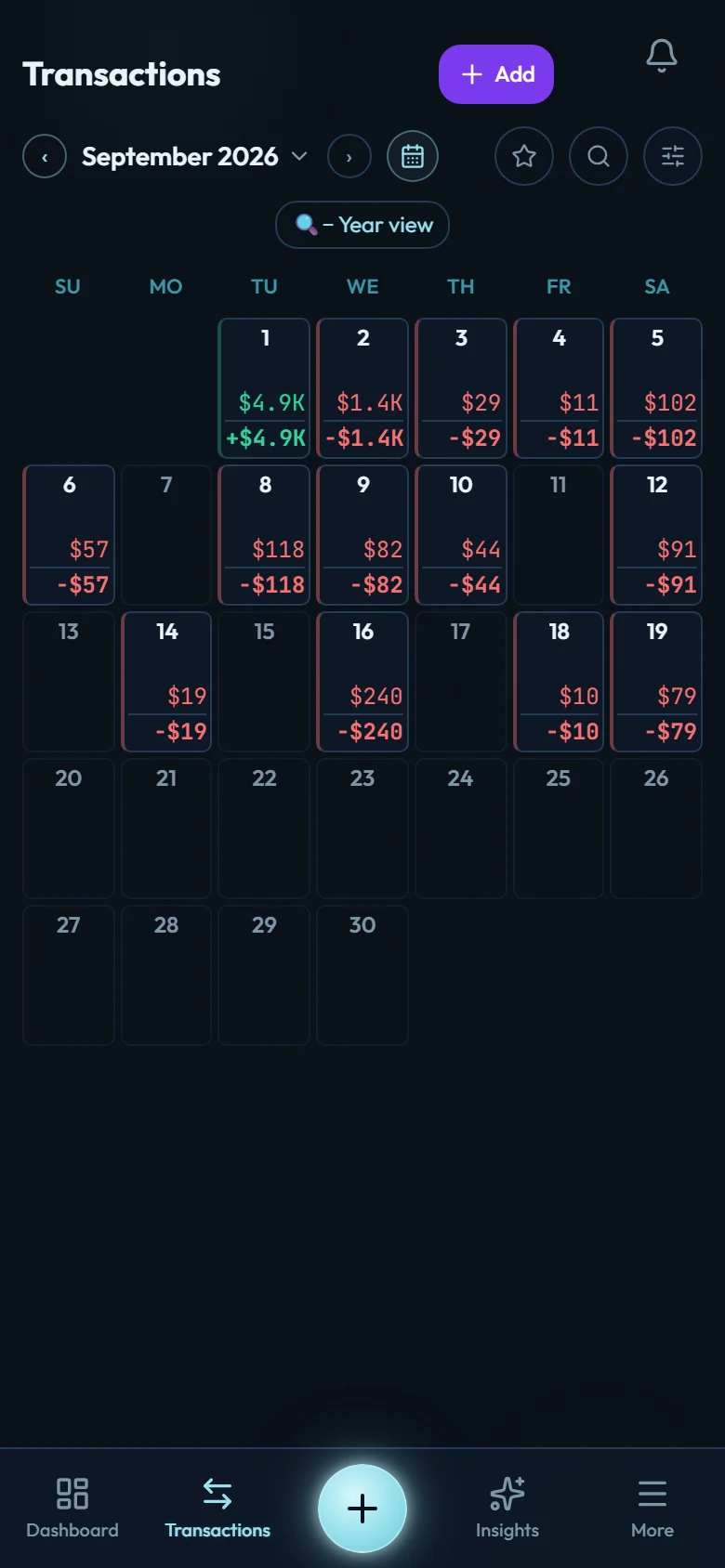
Each day on the calendar shows what came in and what went out, from the spending you note as you go.
No card needed.
Why does the money run out before the next pay?
A raise or a better job lifts the pay, and rent, the car and the extras often rise to match it. That is why more pay does not fix this on its own, and lifestyle creep explains how to catch it.
Some costs also arrive in lumps, and a month's pay is not built for lumps. In the Federal Reserve's survey, 59% of adults had a major unexpected expense in the prior 12 months, most often a vehicle repair or replacement (30%). For the 3 most common kinds, the median cost (the middle one) was $1,000 to $1,999 among those who knew the amount. Yearly bills, such as an insurance renewal, land the same way, only on a date you could see coming.
Then nothing sits in between. Among adults who missed a bill or found paying bills difficult in the month before the survey, 68% could not cover a $500 emergency expense from savings. Of those who struggled, 42% paid a bill late and 23% put a bill on a card to pay over time, so the next month starts behind.
A card balance makes that start worse. It turns last month's spending into this month's payment, so part of the pay is spoken for before it lands.
Why is the middle of the month the hard part?
The pay lands on one day, and the bills land on their own. If yours lands on the 1st and the rent leaves on the 2nd, the biggest bill is gone on day 2, and the weeks after it run on what is left. By the 15th the big bills may be paid, with half the month still to come.
One repair or one costly week then decides whether the money reaches the next pay. If you have tried a budget and watched it fall apart around then, why your budget fails by the 15th covers the 4 flaws in how most budgets are built. Either way, the squeeze is easier to handle when you can see it coming.
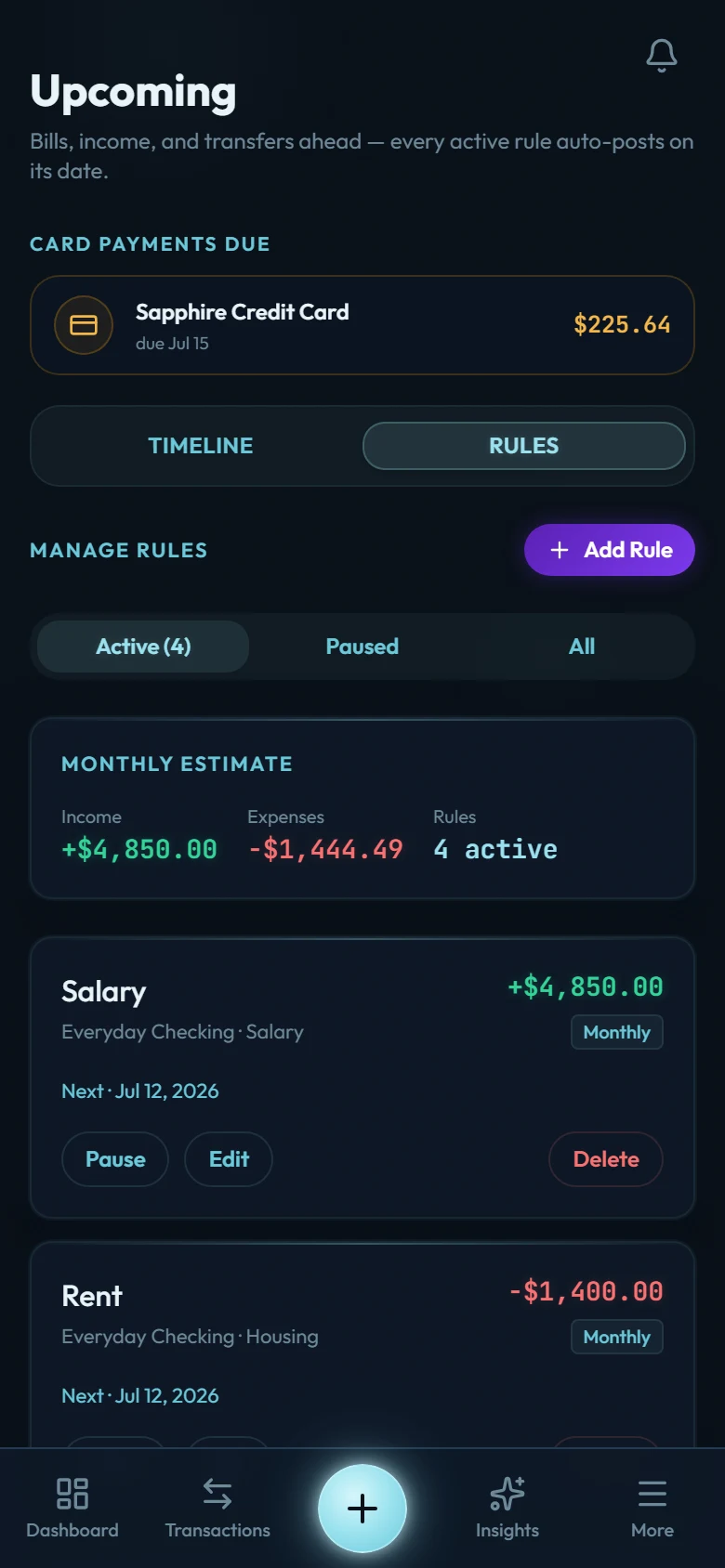
Wealth Mutant is the personal finance app we built for exactly this. Its month calendar shows what came in and what went out on each day, and Upcoming lists the next dates of the bills you set to repeat, so you can see where the pay goes and which bills are coming. You note each purchase yourself in a few seconds, a small daily habit that makes you notice where the money goes, and no bank login is ever shared. You pay for it once.
See the bills before they land
A month calendar of what came in and went out, and repeating bills posted on their dates, in one personal finance app.
Buy — $99 onceHow do you stop living paycheck to paycheck?
Five steps, in this order. The buffer comes first because it stops the cycle from restarting. Steps 2, 3 and 5 find the money to fill it, and step 4 keeps the yearly bills off a card. Here is the example month before and after, in dollars (it works the same in any currency):
| Where the $3,000 of pay goes | Before | After |
|---|---|---|
| Bills that repeat | $1,650 | $1,650 |
| Subscriptions | $90 | $52 |
| Yearly bills, a year's worth spread over 12 months | $250 | $250 |
| Food, fuel and everything else | $1,010 | $848 |
| Into the buffer | $0 | $200 |
| Total | $3,000 | $3,000 |
Before, nothing is left, and each yearly bill goes on a card when it lands. After, the yearly bills are set aside on each payday and $200 goes to the buffer.
Start a buffer of 1 month of essentials
A buffer is savings that sit between you and a surprise, the first stage of an emergency fund. Open a savings account of its own and move something into it on each payday, even $25. The target is 1 month of essentials, the costs you could not skip: in the example, the $1,650 of repeating bills plus $550 of the food and fuel, or $2,200. The free emergency fund calculator takes your own month of essentials and what you can add each month, and shows the month you would get there. How much emergency fund do you need covers the target, where to keep it and when to use it.
See where the money goes
You cannot trim what you have not seen. Write down every purchase for 7 days in a money diary. If looking at your balance feels hard, start with why people avoid it.
Cancel what you forgot
Check your statements for charges you no longer use or forgot you had. In the example, 3 forgotten subscriptions cost $38 a month together, or $456 a year. How to cancel subscriptions gives each company's own steps.
Set money aside for bills you know are coming
List the bills that arrive once or twice a year and divide each cost by the months until it is due. In the example, yearly bills come to $3,000, which is $250 a month, so $250 moves to a separate account on each payday and the lumps are paid from it, not from a card. What are sinking funds shows the method. In Wealth Mutant, a recurring rule with the Yearly repeat puts each bill's date on the Upcoming screen before it arrives.
Then the rest
Send what you freed to the buffer on payday, before it can join your spending, and give everyday spending one number to watch, as flex budgeting does. In the example, the $200 is the $38 from step 3 plus $162 trimmed from everyday spending once the diary showed where it went, and $2,200 takes 11 months at that pace. If the first 4 steps free very little, the bigger levers are one large fixed cost, a card balance or the pay itself, and each deserves a plan of its own.
What changes when you stop living paycheck to paycheck?
The pay still lands on its day and the bills still come. What changes is the lowest point of the month, which stops being zero. In the chart at the top, the $600 repair that pushed the money below zero comes out of the buffer instead, which still holds $1,600.
Yearly bills come out of the money set aside for them, and the number in your account stops being a surprise.
Common questions
How do I know if I'm living paycheck to paycheck?
Three signs point to it: your balance is close to zero in the last days before each pay, a surprise bill goes on a card or is paid late, and 1 month of essentials is more than you have saved. One sign can be a bad month. All 3 over several months is the pattern this guide is about.
Can you live paycheck to paycheck on a high income?
Yes. In the Federal Reserve's survey, 15% of adults in families with $100,000 or more said they never or rarely had money left over at the end of the month, and 7% did not pay all their bills in full in the month before. Spending tends to rise with pay, which lifestyle creep explains.
How long does it take to stop living paycheck to paycheck?
It depends on how much you can move into the buffer each month. In the example, $2,200 takes 11 months at $200 a month and 22 months at $100. The cycle loosens sooner than that: from the first month a yearly bill is paid from set-aside money instead of a card.
Your next step
Tonight, work out what 1 normal month of essentials costs you, and open a savings account for the buffer. Then, in Wealth Mutant, add your repeating bills as recurring rules and open the month calendar to see what each day brought in and took out. The tour shows the screens around them.
Once that first month is saved, your savings rate, what you keep of each pay, shows how fast the next goal will build.