
Financial literacy for young adults means knowing how money comes in and goes out, how saving works, what interest earns and what it costs, and how cards and loans behave, before you meet them for real. Nobody taught me any of it, not at school and not in college.
I learned it after I finished school, went to university and moved away from home, when money stopped being somebody else's job and became mine. Back then, the value of money did not matter much to me, so the decisions I made in my young, energetic years were not very efficient or stable.
Now, in my 30s, I know how much it matters, and I wish someone had given me all of this much earlier. What follows is the list I wish I'd had at 18: 9 lessons, each with a short sum you can check yourself.
What does financial literacy for young adults include?
My list is short on purpose. None of it needs a finance degree. All of it is something I had to learn by living through it, instead of having someone sit me down and explain it.
Every sum below uses dollars and invented numbers, to show how the thing works. Every currency works the same way, so swap in your own.
9 money lessons I wish I'd had at 18
1. Know what comes in and what goes out
This is the base of everything else. Tracking means writing down your income and your spending, so you can see where you are heading instead of guessing.
Try it with snacks. Say you buy a snack and a drink for $6 a day. That feels like nothing. Over 30 days it is $180, and over a year more than $2,000. Nobody decides to spend $2,000 a year on snacks. It happens in $6 pieces that were never added up.
Not tracking costs you the chance to choose. You find out what happened after it has happened. Of all the money habits that build on each other over the years, this is the one the rest run on. Writing it down takes a few seconds per purchase, and there is real science behind why writing works.
2. Save before you need to
Saving has two jobs, and they are different. The first is a buffer for surprises: a month or more of your essential spending, set apart. If your essentials cost $2,000 a month, a 1-month buffer is $2,000.
The second is money for things you know are coming. A sinking fund (money set aside a little at a time for a known bill) turns a shock into a plan. A $600 insurance bill due once a year is $50 a month. Put $50 aside each month and the bill, when it arrives, is already paid. Here is how sinking funds work.
Without both, every surprise becomes a card balance. How much of your income you keep matters too: your savings rate is the share of what you earn that you keep.
See where your money goes, from the first week
Add your accounts and a few days of spending to Wealth Mutant, and watch the whole picture take shape from your own entries.
No card needed.
3. Understand interest: what it earns and what it costs
Interest is the price of using money. When you save, the bank pays you for using yours. When you borrow, you pay for using theirs. The same idea runs in opposite directions, and the rates are rarely close.
Say $1,000 earns 4% a year in a savings account: that is $40 over the year. Say $1,000 sits unpaid on a card at 24% a year: that is about $240, and more once interest is charged on interest. The card's rate is called APR, the yearly price of borrowing, and what APR means on a credit card is worth a read before you own one.
Not knowing this makes borrowing feel cheap and saving feel pointless. Seen side by side, you can tell which one is working for you.
4. Know how a credit card works
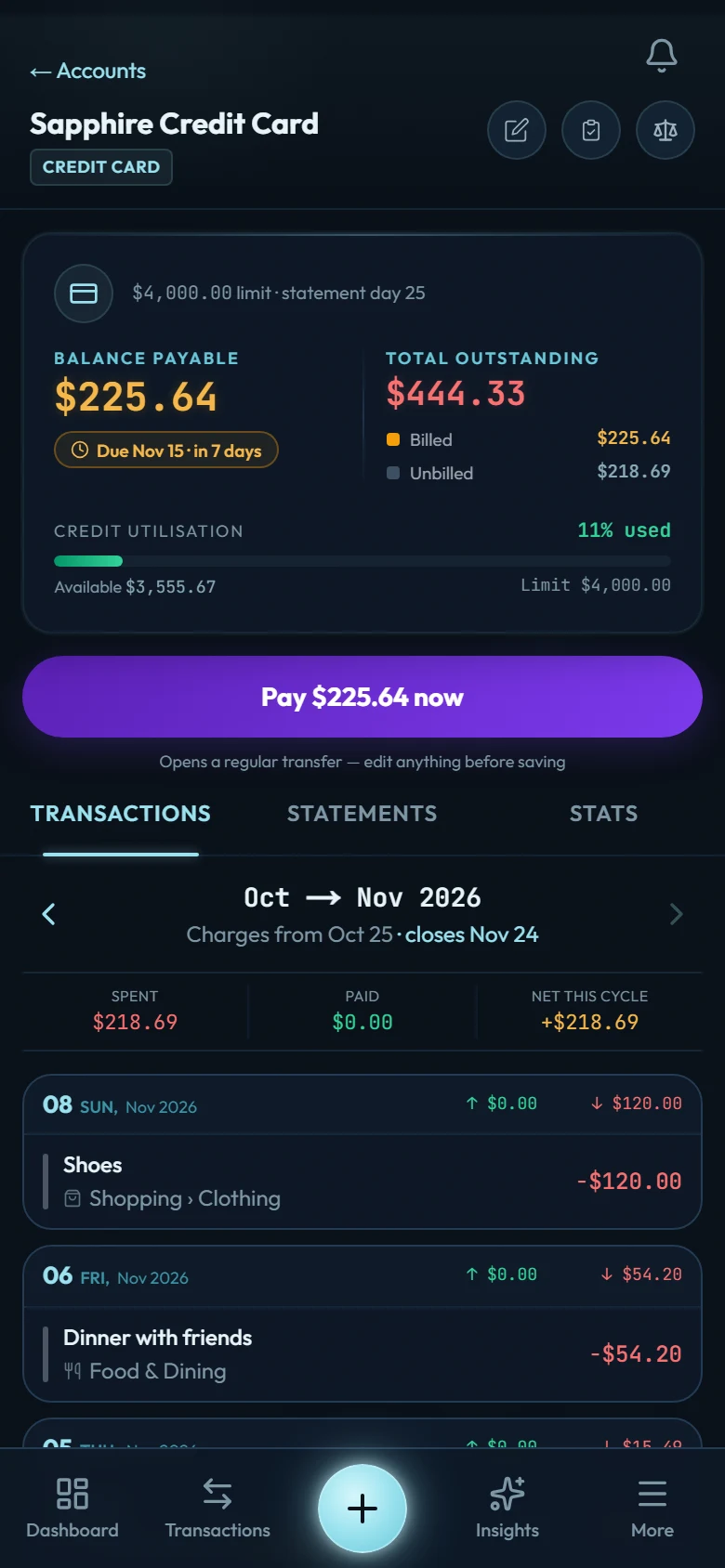
I needed at least a year to work out how the billing cycle and card interest fit together. A billing cycle is the stretch of days, usually about a month, whose purchases land on one bill. It closes on the statement date, and the payment is due some days after.
Say your cycle closes on the 25th with a $500 statement, due on the 20th of the next month. Pay the full $500 by the 20th and many cards charge no interest on those purchases. Pay part of it, and interest begins on the rest. The rules differ by country and card, so read your own card's terms.
What mixes people up most is the difference between the two dates, and between the statement balance and the current balance. These pages explain each: how billing cycles work, the interest-free period and statement balance vs current balance.
5. Never mistake the minimum payment for a plan
The minimum payment is the smallest amount your card lets you pay without being late. It keeps the account in good standing. It does not make the debt go away.
Take a $2,000 balance at 24% a year, with no new purchases. That is 2% interest a month, so the first month's interest is $40. Pay only $50, and just $10 of it reduces what you owe. At $50 a month it takes about 82 months, nearly 7 years, and you pay roughly $4,064 in all for a $2,000 balance.
Knowing this early is the cheapest lesson on the list. How a minimum payment is set and how card interest is worked out show the sums on real statements.
6. Learn what a loan payment is made of
A loan payment, often called an EMI (equated monthly instalment), is the same amount every month. Inside it are 2 parts: interest, the price of borrowing, and principal, the part you actually borrowed.
Borrow $10,000 at 12% a year for 12 months and the payment is about $888.49. In month 1, $100 of it is interest and about $788.49 is principal. Over the 12 months you pay about $10,661.85 in all, which is $661.85 more than you borrowed. Early on, more of each payment is interest; later, more is principal. What your EMI is made of walks through the shift.
Lenders also look at how much of your income already goes to debt payments, called your debt-to-income ratio. It is one of the things lenders weigh when you apply, so it is better to know it before you do.
7. See compound interest on both sides
Compounding means interest earns interest. It works for you in an investment and against you in a debt, using the same formula.
Put $1,000 into something that grows 7% a year and leave it for 30 years: about $7,612. That rate is invented for the example. Real returns vary, and some years are negative. The point is the shape: most of the growth comes late. On the other side, $1,000 left alone on a card at 24% a year, with interest added monthly, becomes about $3,281 in 5 years.
A quick estimate: divide 72 by the yearly rate to get the years to double. At 7% that is about 10 years. The rule of 72 has a table. I learned compounding slowly, by meeting it in real life. I would rather you meet it on a page first.
8. Learn how credit scores and utilisation work
A credit score is a number lenders use to guess how safely you repay. Scales and rules differ across the US, UK, Canada and India, and what a good credit score is compares them.
One piece you control right away is utilisation: the share of your card limit you are using. With a $4,000 limit and a $1,000 balance, you are using 25%. In general, the lower that share sits, the better it looks to lenders. How credit utilisation works shows where the lines tend to fall.
Not knowing it means a high balance on a card can quietly weigh on your score, even when you pay on time.
9. Follow net worth, the one number
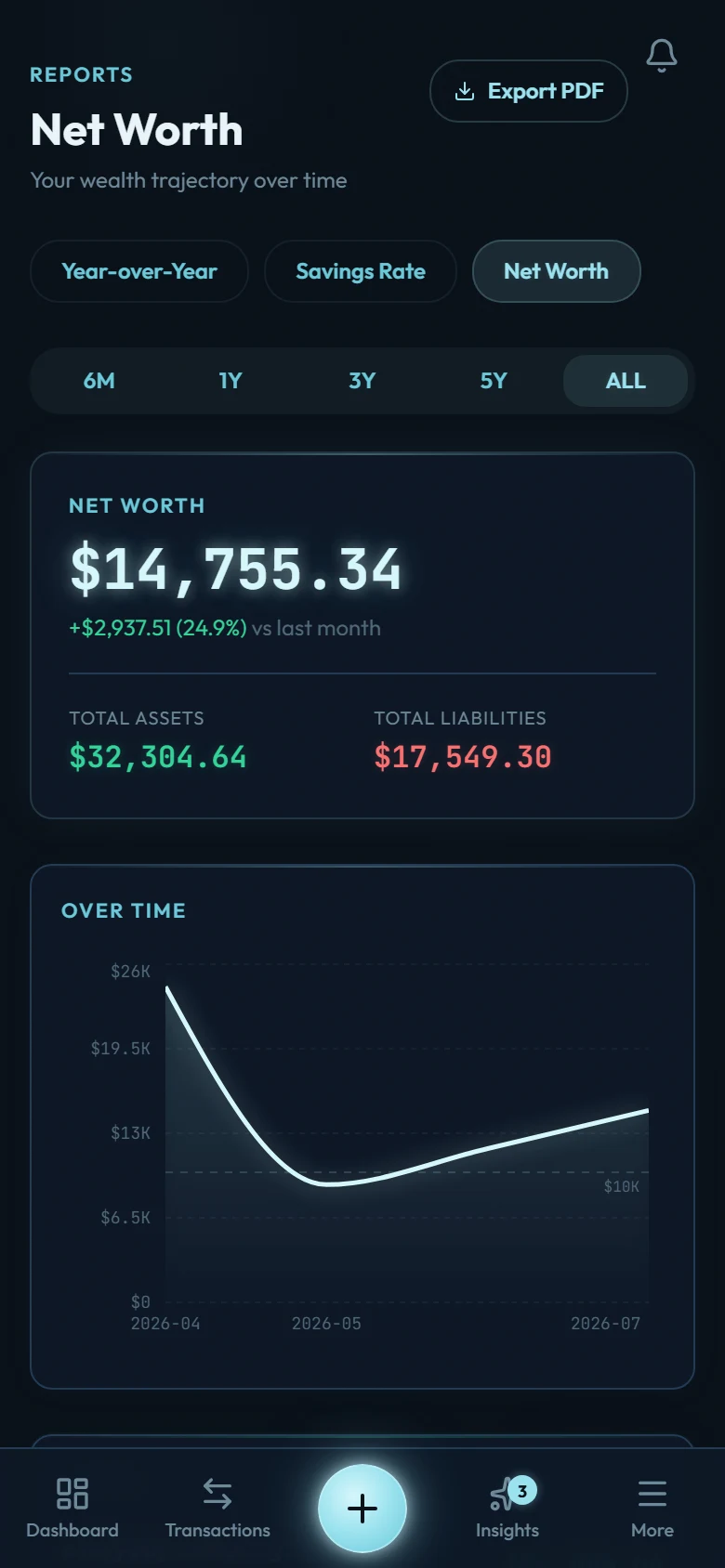
Net worth is what you own minus what you owe. Say you hold $3,000 in savings and a $9,000 car, and you owe $1,000 on a card and $6,000 on a loan. You own $12,000, you owe $7,000, and your net worth is $5,000.
It is useful because it moves in both directions. Saving raises it, and so does paying down debt out of what you earn. A purchase on credit does not raise it, because the debt cancels out what you bought, and it falls if the thing loses value. How to track your net worth explains what counts.
What system did I use to learn it?
Even though I learned the hard way, I did have a system. I used an Excel spreadsheet at first, to track my finances. Later I moved to an app. As I kept learning, the spreadsheet kept growing in what it did.
One thing kept happening. The personal finance app I was using never met all my needs in one place. So I ended up using an app and the spreadsheet together. A spreadsheet beside an app works, but it means keeping two things in step.

Wealth Mutant is the personal finance app I built for exactly this. It brings what I learned about money, from many different sources, into one place: cards and loans, net worth, goals, Future Self and a 9-level path. You note each purchase yourself in a few seconds, a daily habit in the spirit of Kakeibo that makes you notice where your money goes, and no bank login is ever shared. You pay for it once.
Everything I had to learn, in one place
Cards, loans, net worth and goals sit together in Wealth Mutant, built from the entries you make yourself.
Buy — $99 onceHow can parents help a teen build financial literacy?
If you are a parent, here is the opportunity I see: personal finance is something teens, and people about to start college, are almost never exposed to. A parent can change that early.
I think Wealth Mutant is the best gift a parent can give a teenager or a student. Few other gifts give back as much: the habit it builds keeps paying off long after a new phone has been replaced.
Wealth Mutant is open to anyone aged 13 or older, and each person has their own account, as the Terms say. So the practical version is this: sit with your teen, or your student, while they set it up on their own phone, and pay for it as your gift. Then let the first months of recording do the teaching. Seeing their own money move teaches more than a lecture.
What else is coming to the app?
A game. We are building a personal finance simulator into the app that you play like a game: you live a life, make its money choices and watch where they lead, without risking your own money. It is being built now and will be part of the app.
Questions people ask about financial literacy for young adults
Common questions
What is financial literacy for young adults?
It is knowing how money works before life tests you on it: tracking what comes in and goes out, saving, interest, credit cards, loans, compounding, credit scores and net worth. This guide covers each with a worked example.
What should a teenager learn first about money?
Start with tracking and saving. Writing down what you earn and spend shows where your money goes, and a starter buffer stops a surprise from turning into debt. Cards, loans and compounding come next, ideally before you hold a card.
At what age should you start learning about personal finance?
As soon as you earn or spend your own money. I wish I had learned it by 17 or 18. There is no age that is too early for the basics, and no age that is too late to start.
How do you learn personal finance if school never taught it?
Take one lesson at a time and apply it to your own money. Track for a week, work out one sum from this list with your own numbers, and read the deeper page on whichever one surprised you.
Can a 13-year-old use Wealth Mutant?
The Terms say you must be at least 13, with one account per person. A teen can have their own account. A parent can sit with them while they set it up and pay for it as a gift.
Your next step
Pick one lesson and do its sum with your own numbers today. Then spend 7 days writing down every purchase. Your first week in Wealth Mutant shows how to start, and the tour shows where those entries turn up, from net worth to goals. If you want to see where all of this can lead in the long run, coast FIRE and the other finish lines is the far end of the same road.