
Your debt-to-income ratio (DTI) is your total monthly debt payments divided by your gross monthly income, written as a percentage. If you pay $1,900 a month toward debts and earn $5,000 a month before tax, your DTI is 38%.
Lenders use it to judge whether you can carry another payment. Below: how to work yours out, what counts as debt, what lenders in the US, UK, Canada and India look for, and how to lower it.
How do you calculate your debt-to-income ratio?
The CFPB, the US consumer finance regulator, says to add up all your monthly debt payments and divide them by your gross monthly income. Gross income is what you earn before tax and other deductions come out. Multiply by 100 to get a percentage.
Here is a worked example for someone earning $60,000 a year, or $5,000 a month:
| Monthly payment | Amount |
|---|---|
| Housing: mortgage or rent | $1,400 |
| Car loan | $300 |
| Student loan | $150 |
| Credit card minimum | $50 |
| Total | $1,900 |
$1,900 ÷ $5,000 = 0.38, so the DTI is 38%. Whatever currency you earn in, the division works the same way. That is all a debt-to-income ratio calculator does: add the payments, divide by income, multiply by 100. The CFPB's own example is the same sum: $2,000 of payments on $6,000 of income is 33%.
Use each debt's monthly payment, not its balance. For a card, the payment is the minimum, the smallest amount it asks for each month (what paying only the minimum costs). Under Fannie Mae's guide, lenders use the minimum on your credit report, and 5% of the balance when the report shows none and nothing documents a lower payment.
Check your list against that credit report too. Fannie Mae's guide asks a borrower to explain any debt that shows on the report but not on the application.
What counts as debt in your debt-to-income ratio?
US mortgage lenders count recurring payments on money you owe. They leave out everyday living costs and what comes out of your pay before you see it. This follows Fannie Mae's guide and the federal mortgage rule:
| Usually counted | Usually left out |
|---|---|
| Housing payment, mortgage or rent | Income tax and other taxes |
| Car, student and personal loans | Retirement contributions, such as a 401(k) or pension |
| Credit card payments, at the minimum | Commuting costs and union dues |
| Child support and alimony | Food, clothing, gasoline and health care |
| Lease payments | Voluntary deductions from pay |
For the home you will live in, Fannie Mae's guide counts the new home's full payment in place of your rent: the loan payment plus items such as property tax, insurance and any association dues.
A loan nearly paid off may drop out. Fannie Mae's guide requires a car, student or personal loan to be counted when more than 10 payments remain, though one with fewer should still be counted if it significantly affects your ability to pay. Lenders can also be stricter than Fannie Mae, so ask yours what it counts.
Wealth Mutant, a personal finance app, keeps every card and loan in its accounts list beside your other accounts, and a loan shows its monthly payment (the EMI, the fixed monthly loan payment).
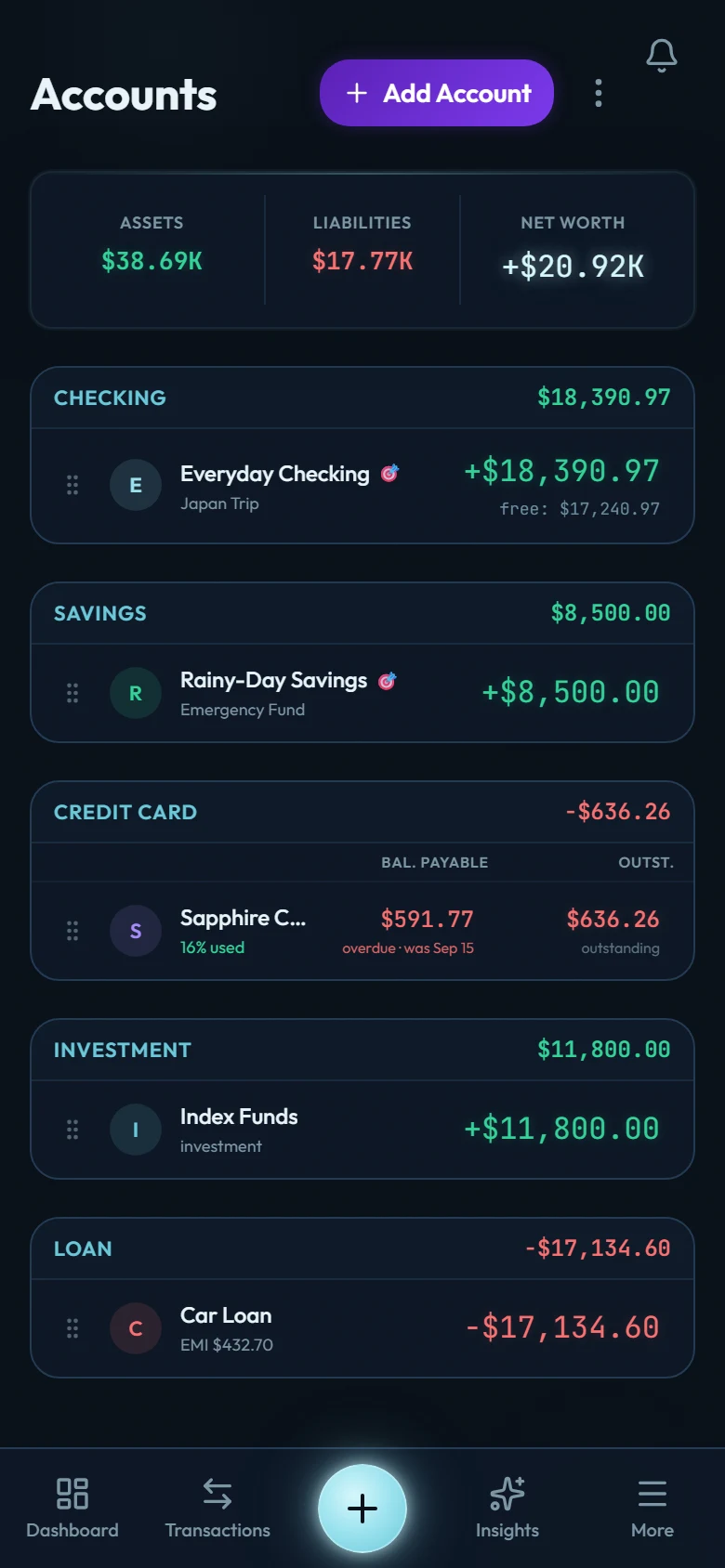
Put every loan payment in one list
Add your cards and loans to Wealth Mutant and see each one's payment beside what you still owe.
No card needed.
What is the difference between front-end and back-end debt-to-income ratios?
Lenders look at your numbers two ways. The front-end ratio counts only your housing payment. The back-end ratio counts housing plus your other debt payments, which makes it the full DTI above. The FDIC's consumer guide says lenders consider both and calls them the front-end and back-end ratios.

What is a good debt-to-income ratio?
There is no single good number, because each lender sets its own limit. The CFPB says different loan products and lenders will have different DTI limits. Even the federal mortgage rule leaves the number to the lender: it makes a lender consider your DTI or your residual income (what is left after debts) but does not prescribe a specific ratio.
Fannie Mae's Selling Guide, the rulebook for loans lenders deliver to Fannie Mae, sets the maximum total DTI, the back-end ratio, at 36% for a loan reviewed by a person. That can go up to 45% if you meet its credit score and reserve requirements for that range (reserves are the savings you would still have after the loan closes). For a loan run through its automated Desktop Underwriter (DU) system, the maximum is 50%. Government-backed loans, such as FHA, VA and USDA loans, follow their own agency's rules instead.
You will also see 43%. It was the DTI cap in the CFPB's old definition of a "qualified mortgage", its name for a home loan with less risky features. The CFPB removed that cap and replaced it with limits on the loan's annual percentage rate (APR, the interest rate plus other charges), mandatory for applications from 1 October 2022. The FDIC's consumer guide says lenders usually want housing at 25% to 28% of gross income or less, and housing plus long-term debt at 33% or 36% or less.
Read all of these as lenders' limits, not rules for living. The FDIC's guide adds that qualifying for a loan does not mean you can afford to be comfortable with those monthly payments, so the number that suits your life may sit below the lender's.
How do lenders in the UK, Canada and India use it?
UK. The FCA's responsible lending rules for mortgages set no DTI limit. They require a lender to show the loan is affordable, and to take account of your income after income tax and National Insurance, your committed spending (loans and credit cards included) and basic household costs. A lender may also cap loans at a multiple of your income.
Separately, the Bank of England's Financial Policy Committee recommends that mortgages at loan-to-income ratios of 4.5 or higher stay within 15% of all new mortgages, counted across lenders rather than lender by lender. A ratio of 4.5 means a loan of 4.5 times your yearly income, such as £180,000 on £40,000.
Canada. The same two ideas have other names. The FCAC says housing costs (mortgage payments, property taxes, heating and 50% of condo fees) shouldn't be more than 39% of gross household income, the gross debt service (GDS) ratio. Total debt shouldn't be more than 44% of gross income, the total debt service (TDS) ratio. You may still qualify a little above either. Banks also make you pass a stress test: you must show you could afford the payments at 5.25% or at your own rate plus 2%, whichever is higher.
India. Lenders use FOIR, the fixed obligation to income ratio, which is the same sum. HDFC Bank's guide says an acceptable FOIR typically ranges between 40% and 55%, and its total monthly debt takes in "all existing EMIs, credit card payments, rent, and living expenses", a wider list than the US one.
Whatever a lender's limit, the first job is the same: know every monthly payment you owe. Wealth Mutant is the personal finance app we built for exactly this. Each loan's page shows its monthly payment, what you still owe and its payoff date, and the accounts list keeps your loans and cards together. It does not work out a debt-to-income ratio for you, so the dividing stays yours. You note each purchase yourself in a few seconds, a small daily habit that makes you notice where the money goes, and no bank login is ever shared. You pay for it once.
Keep each loan's payoff date in view
A personal finance app for your loans, cards, budgets and net worth, with each loan's payment beside what you still owe. One payment, yours for life.
Buy — $99 onceHow do you lower your debt-to-income ratio?
Two things move it: the payments on top and the income below. These steps start with what costs nothing and end with what takes longest, and the numbers continue the 38% example.
Hold off on new borrowing
A new car loan at $400 a month would lift 38% to 46%. Fannie Mae's guide also has the lender recalculate your DTI if it learns of new debt up to the day the loan closes, so a loan taken mid-application still counts.
Clear the loan with the biggest payment for what is left
The ratio counts monthly payments, so a debt's balance matters only through the payment it creates. Say $4,000 is left on both the car loan and the student loan. Clearing the $300 car loan takes the example to 32%, while clearing the $150 student loan only reaches 35%. A loan with 10 or fewer payments left may not count at all: Fannie Mae's guide requires one only when more than 10 remain, or when it significantly affects your ability to pay.
Lower a payment you cannot clear
Stretching a loan's term cuts the payment but adds interest overall (why). If you prepay a loan and your lender offers the choice, a lower payment is what lowers the ratio; a shorter term leaves the payment, and so the ratio, as it was (one extra payment covers the choice).
Raise the income a lender can count
Another $500 a month makes it $1,900 ÷ $5,500, or 34.5%. Fannie Mae measures its limits against stable monthly income. A co-borrower's income counts too, and so do their debts.
Show what offsets a ratio you cannot lower
A ratio above a lender's limit is not always a no. The federal rule lets a lender accept a higher ratio in light of savings other than the home or your residual income, and Fannie Mae's 45% depends on your credit score and reserves.
A loan's page in Wealth Mutant shows what you still owe, the monthly payment and the schedule month by month, so you can see when its payments end.
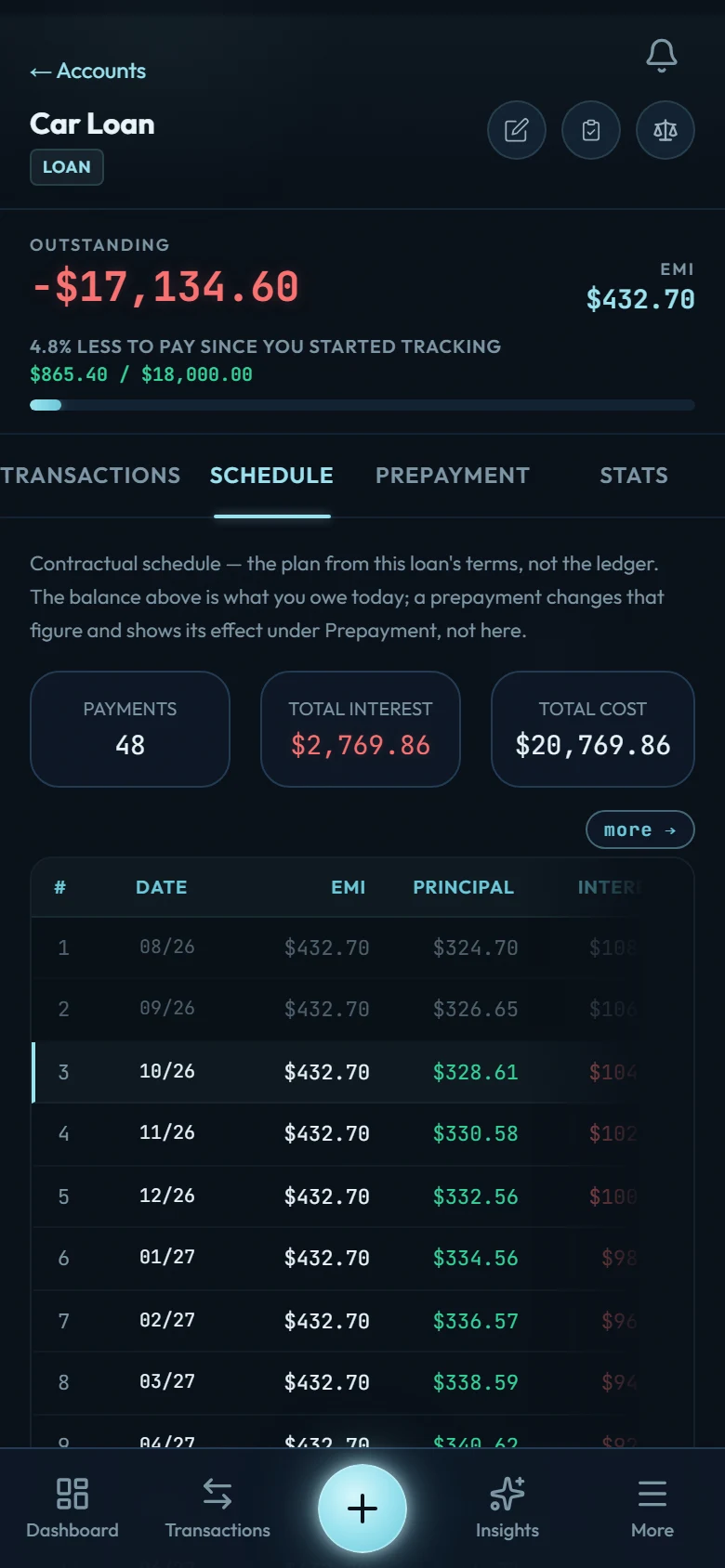
What changes when you know your ratio
Your DTI stops being a number you first hear from a lender on approval day. You know which payments move it, how far you sit from a lender's limit, and what a new loan would do before you sign for it. How much to borrow is then your decision, with the lender's limit as one input.
Common questions
Is rent included in debt-to-income ratio?
It can be, as your housing payment. Fannie Mae's guide lists a "housing payment (mortgage or rent)" among a borrower's liabilities, and HDFC Bank's guide counts rent in India's FOIR. When you buy the home you will live in, Fannie Mae's guide counts the new home's payment instead of your rent.
Do lenders use gross or net income?
Gross income, before tax, in the US and Canada; HDFC Bank's guide to India's FOIR uses gross income too. The UK works differently: the FCA's mortgage rules ask lenders to take account of income net of income tax and National Insurance, plus committed spending and basic household costs.
Does my debt-to-income ratio affect my credit score?
Not directly. FICO says its scores are calculated from your credit report and that your salary is not one of the things they factor in. Lenders weigh your income separately, and that is where DTI comes in. What you owe on your accounts does count toward the score.
What is the 28/36 rule?
It is a common lender rule of thumb: housing costs at no more than 28% of gross monthly income, and housing plus your other debts at no more than 36%. The FDIC's consumer guide does not use the name but gives the same top figures: 25% to 28% for housing, and 33% or 36% for housing plus long-term debt. Fannie Mae's maximums on the total go up to 45% or 50%, depending on how the loan is assessed.
Your next step
Write down each monthly payment and your gross monthly income, then divide. To see the payments side by side, add your loans and cards to Wealth Mutant and the tour shows what else it keeps in one place.
Your card balance against its limit is a different ratio, and one credit scores weigh: see credit utilization ratio. What your EMI is made of explains the split inside each payment, debt avalanche vs snowball helps you pick which debt to clear first, the debt payoff calculator shows the month each plan ends, and the debt payoff page shows how the app tracks them.