
Should you pay off debt or save? Usually both, in an order the numbers support: a starter buffer of 1 month of essentials, any employer match on retirement savings, then high-interest debt, then the rest of your emergency fund. Cheap debt comes last. A card charging 22.36% costs far more than a savings account pays, but a surprise with no cash behind it lands on that same card.
Below are the steps in order, a worked example with every number shown, and the cases where the order changes.
Should you pay off debt or save first? The order
Save a starter buffer: 1 month of essentials
Count only the bills that would not stop: housing, food, utilities, getting to work, insurance, and each debt's minimum payment, the smallest amount the lender will take. Keep it in a savings account you can reach, then stop. The full fund comes at step 4.
Take any employer match
If your employer adds money when you put money into a retirement plan, contribute enough to get all of it before you send extra to debt.
Pay off high-interest debt
Card balances you carry and anything else charging well into double digits. Every dollar you pay off saves that rate in interest, far more than the savings rates in the table below.
Finish the emergency fund
Build toward 3 to 6 months of living costs, nearer 6 if your income swings or others depend on it. How much emergency fund covers where to land.
Weigh low-rate debt against investing
A car or home loan at a rate near what savings pay is a real choice. Keep making its payments on schedule and split the surplus as suits you. Nobody can promise what an investment will return, and investments can fall.
In the US, the Financial Industry Regulatory Authority (FINRA) puts both sides on record. Pay off a card charging 20% and "you're saving that 20 percent", yet with high-interest debt "you'll have to decide how to balance" clearing it against an emergency fund.
What does $2,000 do on a card, in savings and on a car loan?
Here the same $2,000 goes 4 ways, all on day 1. The assumptions: a $4,000 card balance, paid $150 a month whether or not you use the $2,000, with no new purchases; a new $18,000 car loan over 60 months at a payment of $361.03, unchanged, with no prepayment fee; interest added monthly at the yearly rate divided by 12 (some card issuers work interest out daily, so yours may differ a little). The method is the same in any currency, with your own rates.
| Where the $2,000 goes | Rate | Over the next 12 months |
|---|---|---|
| Pay down the card | 22.36% | $496.00 less interest |
| Prepay the car loan | 7.54% | $156.12 less interest |
| Savings at a bank's top advertised rate | up to 3.65% | up to $73.00 earned |
| Savings at the national average | 0.39% | $7.80 earned |
The card rate is the Federal Reserve's August 2026 figure for US bank card accounts charged interest, and the car rate is its 60-month new-car loan rate at commercial banks. The savings rates are Barclays US's advertised "up to 3.65% APY" (the yearly yield, as of 7 October 2026) and the FDIC's national average for savings, 0.39% (16 November 2026). Savings interest here is before tax.
Paying the card saves nearly 7 times what the higher savings rate earns. Prepaying the car loan saves about twice what that savings rate earns, and ends the loan sooner. In the UK, the Bank of England's quoted rate for credit card lending was 24.88% in October 2026, a different measure from the US one, and the order holds there too.
See your debts and savings side by side
Add your cards, loans and savings accounts to Wealth Mutant and see what you owe beside what you have set aside.
No card needed.
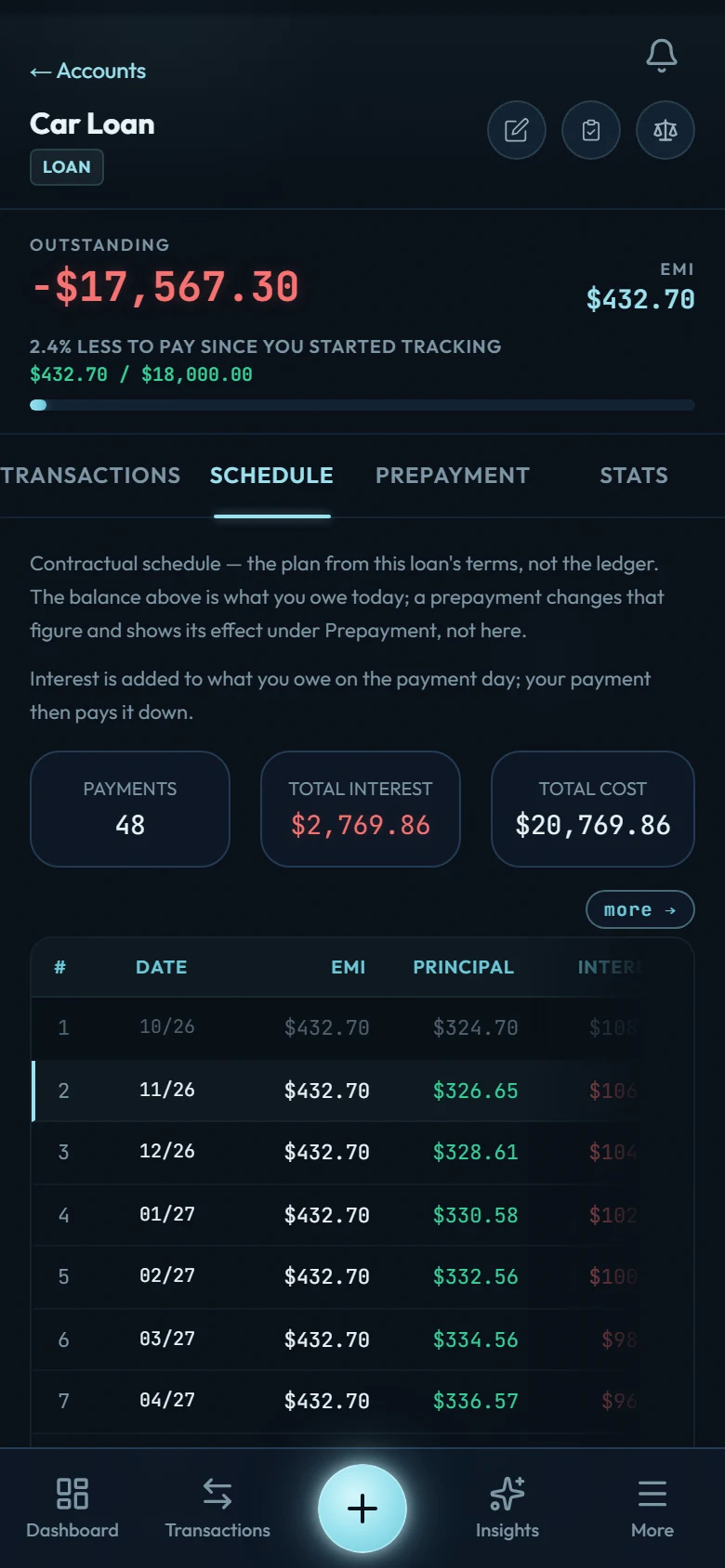
The free loan prepayment calculator runs the same sums on your own loan. One extra payment explains why early prepayments do most of the work, and why a flat-rate loan is the exception. For a card, the free credit card interest calculator shows a month of interest on your own balance and rate, and how long a payment takes to clear it.
Why save a starter buffer before you pay off debt?
On interest alone, the buffer loses. Each $1,000 held in savings instead of on the card gives up $211.50 a year at 3.65% and $244.10 at 0.39%.
What it buys is a surprise that stays off the card. Say a $600 repair arrives with no cash. On the card, repaid in 12 equal payments of $56.26 at 22.36%, it costs $75.12 in interest, and the balance you were clearing grows again. The CFPB, the US consumer finance regulator, says a reserve fund "can help you avoid relying on other forms of credit or loans that can turn into debt".
If the card is already near its limit, the fallback can cost more. Canada's Financial Consumer Agency says an emergency fund helps you "avoid high-cost loans (such as a payday loan or a credit card cash advance)". Stopping at 1 month keeps the buffer's cost low while the card is cleared.
How does an employer match fit in before debt?
A match is money your employer adds when you contribute. The IRS gives an example from a US 401(k) plan: 50% of your contributions up to 5% of salary, so $1,200 contributed on a $30,000 salary brings an extra $600. That is a 50% gain on the money you put in, more than the 22.36% the card charges, which is why it comes before the card.
The plan has a different name in each country (in the US a 401(k), in the UK a workplace pension) and different rules. In the UK, if you are automatically enrolled, GOV.UK puts your employer's minimum at 3% of your earnings, within a total minimum of 8%, since April 2019. In the US, the IRS notes that your plan's documents give the formula and how long you must work before the match is yours, so read them before you count on it.
Two limits. A match applies only to money you contribute, up to the plan's limit: in the IRS example, contributions up to 5% of salary, or $1,500 a year on $30,000. And invested money can lose value, which is one reason the buffer comes first.
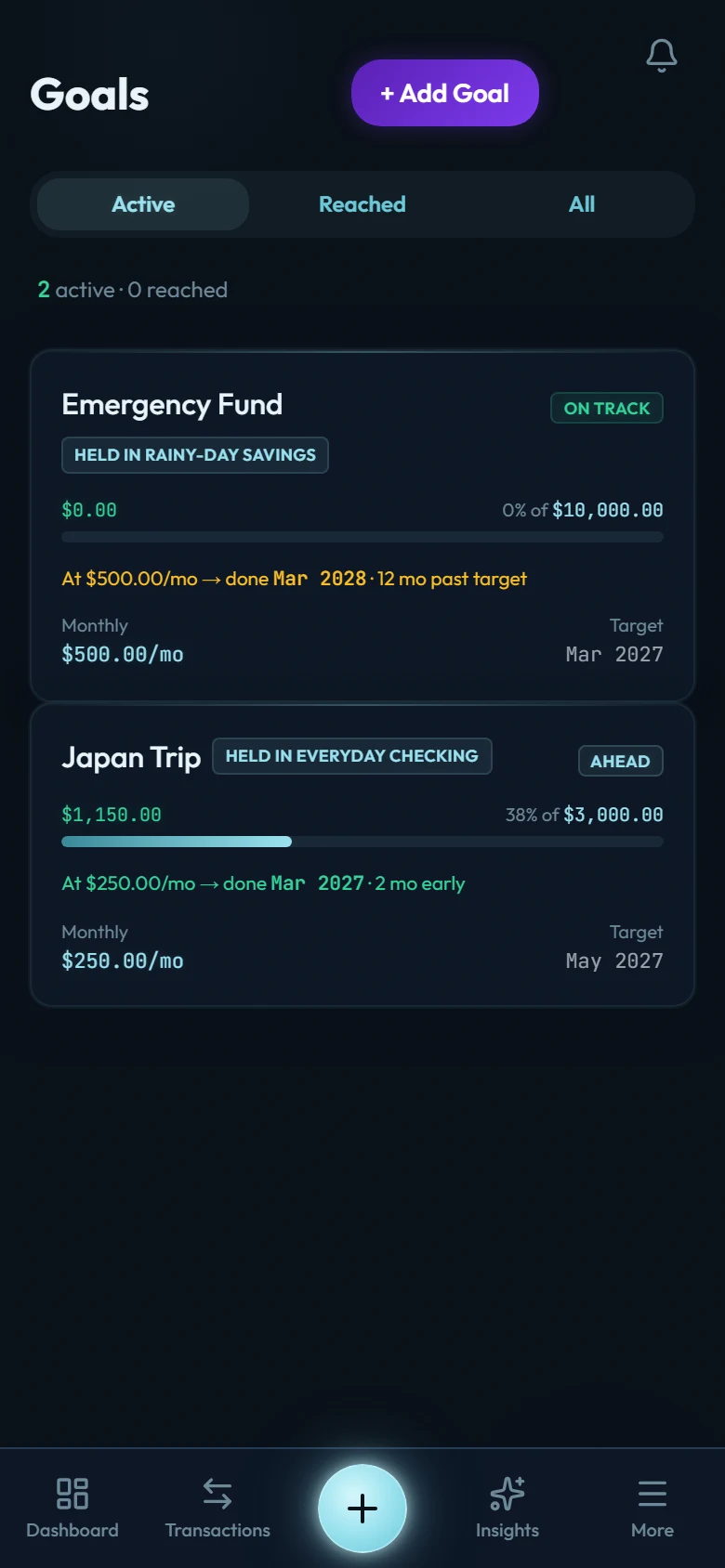
Wealth Mutant is the personal finance app we built for exactly this. It holds every card, loan and savings account in one list, works out each scheduled loan's interest month by month, and backs each goal with money in a real account. You note each purchase yourself in a few seconds, a small daily habit that makes you notice where the money goes, and no bank login is ever shared. You pay for it once.
Build the buffer while the debt comes down
Hold your starter buffer as a goal in your own savings account, and let each scheduled loan post its interest so you see what it costs.
Buy — $99 onceWhen should you pay off debt or save in a different order?
The order is a default, and 4 situations bend it.
You have no cash at all. Build the 1-month buffer before the first extra card payment, even if saving that month takes a while. Pay the minimum on every debt meanwhile, since paying only the minimum is the costly habit to leave afterwards.
The balance is at 0% for a limited time. In the US, the CFPB says an introductory rate must last at least 6 months, unless you are more than 60 days late on a payment. Divide the balance by the months left: $2,400 over 12 months is $200 a month, and the debt is gone by the end date. Put the spare cash to the buffer. Check the card's terms first, because with deferred interest a balance not cleared in time means "you would owe all of the interest back to the original date of the charge".
The debt is cheap. On $2,000, a 3% loan costs $60.83 in a year and savings at 3.65% earn $73.00. The gap is $12.17 before any tax on the interest, and savings rates can change at any time. When rates sit this close, splitting the spare cash is a fair answer. Lenders also look at your monthly payments against income, so if one cheap loan has a heavy payment, debt-to-income ratio shows what clearing it would free.
Your income swings. FINRA's guide says a variable income might call for a bigger reserve than a stable job does. Make the first buffer bigger than 1 month, and aim for the top of the 3-to-6-month range.
With several debts, avalanche vs snowball covers which to clear first.
How does Wealth Mutant follow this order?
Mostly, with one difference worth knowing. On the 9-level Mutation Path, Levels 2, 3 and 4 open together, so the buffer, the match and the debt can all be worked on at once, and Level 5 follows once all 3 hold.
Level 2, Starter Shield, holds once the accounts that count toward your emergency fund cover 1 month of your average monthly spending. Level 3, Free Money First, holds when you have paid into a retirement or investment account in the last 3 months, or one already has money in it. A match is never part of its test. Level 4, Debt Purge, goes by the type of debt, not its rate: any loan still owing counts against it unless it is a home loan or one you cannot clear early, and a card that carried interest blocks it until 3 statements in a row carry none. Level 5, Full Fortress, needs 6 months of your average monthly spending.
The difference is in step 5. A 3% car loan you chose to keep still blocks Level 4, so Level 5 stays closed until the loan is paid, even with the full fund saved.
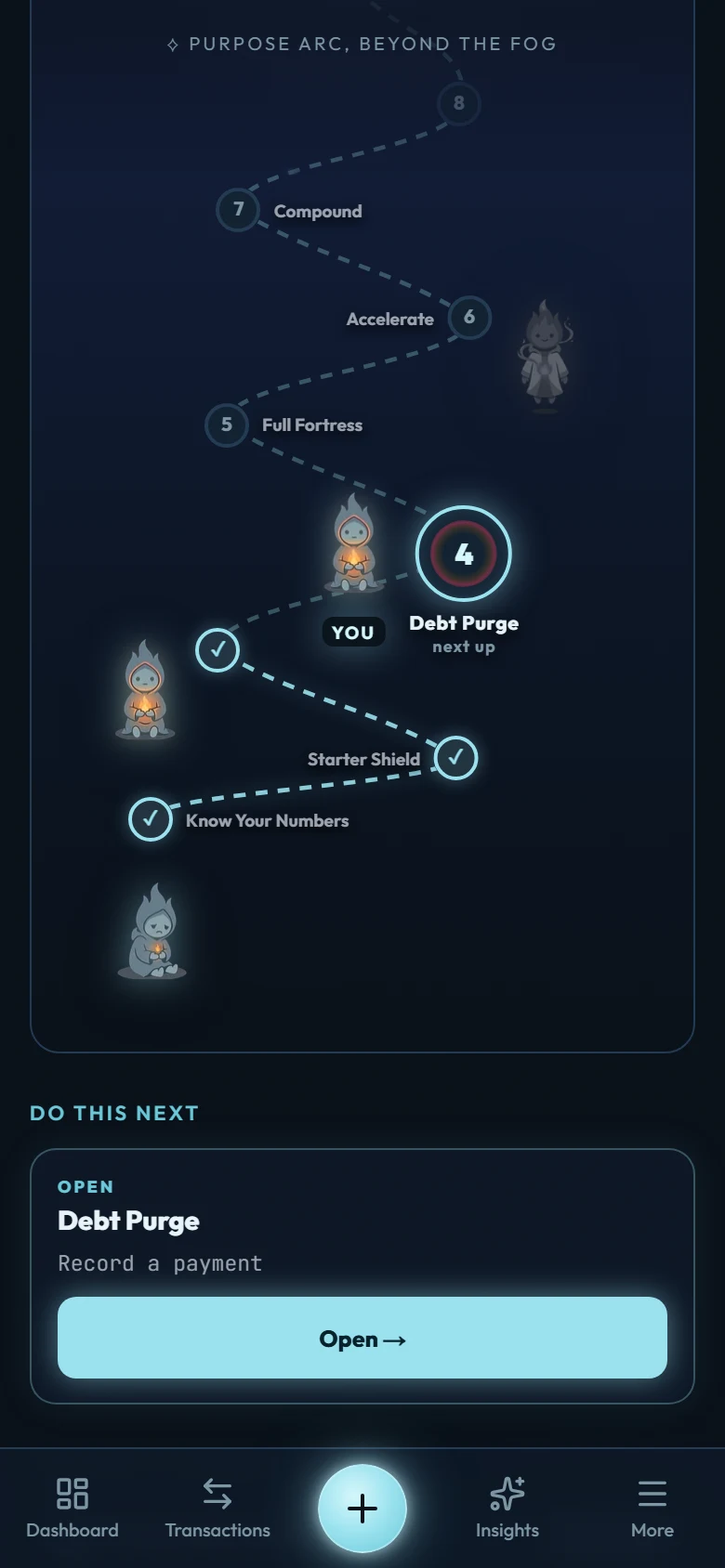
To start, add each loan and card with what you still owe, and back a goal with your savings account.
Common questions
Should I pay off my credit card or save?
If you have no cash set aside, save 1 month of essentials first, then pay the card. In the example above, $2,000 paid to a card at 22.36% saves $496.00 in interest over 12 months, against at most $73.00 earned in savings.
Should I use my savings to pay off debt?
Keep 1 month of essentials, and savings above that can go to a high-interest card. Leave the buffer alone, so the next surprise is paid in cash rather than on the card.
Should I stop saving for retirement to pay off debt?
Keep contributing enough to get any employer match, since it is an immediate gain. Past the match, high-interest debt usually comes first. That is a general guide and not tax or investment advice.
How much should I save before I pay off debt?
Save 1 month of essentials first, then clear high-interest debt. For the full fund that comes after, FINRA and Canada's FCAC both point to 3 to 6 months of expenses.
Should I pay off a 0% balance early?
Not necessarily. Make sure it is cleared before the offer ends, and check whether it is deferred interest, which charges all the interest back to the date of purchase if any of the balance is left.
Your next step
List each debt with its rate, then the balance in your savings account. If the savings cover less than 1 month of essentials, start there. Then follow the order. The tour shows the screens that keep it in view.