
How many credit cards should I have? There is no single right number. Experian says there is no ideal one, and Chase says no fixed limit exists on how many you can own.
What matters is what each extra card changes:
- your credit utilization, how much of your credit limits your balances use
- the average age of your accounts
- your hard inquiries, the lender checks of your credit report that follow an application
- your annual fees
- how many statement days (when a bill is added up) and due days (the last day to pay it) you have to keep track of
How many credit cards should I have for my credit score?
FICO, which makes the FICO Score, publishes the weight of each category it scores. A new card mostly touches 3 of them: amounts owed (30%), length of credit history (15%) and new credit (10%). It can also help your credit mix (10%) if it adds a new kind of account, FICO says.
More cards can lower your utilization. Every card you add raises your total limit. Chase says that can lower the ratio if your overall spending does not increase, and FICO says an unused new card can do the same, which "could mean an increase in your credit score". The balance that counts is the one your issuer reports, generally your last statement balance.
The average age of your accounts falls. FICO looks at your oldest account, your newest account and the average age of all of them. A card you open today is 0 years old, so it pulls the average down, and FICO says that even after a long history opening a new account can still lower your score.
An application leaves a hard inquiry. FICO says it can lower your score by a few points, and FICO Scores count only the inquiries from the last 12 months. Lenders also count recent accounts: Chase says a lender might be more likely to deny your application if you opened several new accounts in the past year or two.
Take the same spending on 2 cards and on 4: statement balances of 1,800 in all, a 5,000 limit on every card, and 2 cards you already have that are 8 and 4 years old. The 2 extra cards open today, and to keep it simple the cards are your only accounts. The amounts are in dollars, and the math works the same in any currency.

Split evenly, that is 18% on 2 cards and 9% on 4, while the average age halves from 6 years to 3 and you take on 2 hard inquiries. Which effect wins depends on your whole report: FICO says the exact impact of a single factor cannot be measured without it.
Put all 1,800 on one of the 4 cards and that card runs at 36%, while the total still reads 9%. Experian says each card's own ratio can affect your scores as well as the total, and that maxing out one card could hurt even when the total is low.
For the total, Experian's rule of thumb is under 30%, and under 10% could be even better. The CFPB gives the same figure from many experts: use less than 30% of your total limit. Neither number is a cut-off: Experian says no hard line separates a bad ratio from a good one.
The credit utilization ratio guide covers the rest, and what a good credit score is covers the scales.
See all your cards in one list
What each card owes, when it is due and how much of its limit you are using, side by side, with a reminder before each due day.
No card needed.
What is the average number of credit cards per person?
The Federal Reserve Bank of Atlanta published how many cards people hold. Its 2025 Survey and Diary of Consumer Payment Choice, completed by 6,079 US consumers, found that 80% had a credit card. Among those cardholders:
| Credit cards held | Share of cardholders |
|---|---|
| 1 | 22% |
| 2 | 23% |
| 3 | 18% |
| 4 | 14% |
| 5 | 7% |
| 6 or more | 16% |
The survey gives shares, not an average, but they show what is typical: line the cardholders up by how many cards they hold and the one in the middle has 3.
Count the 20% with no card too, and the middle person has 2. Whatever your number is, you are in ordinary company.
How many credit cards should you have in the UK, Canada and India?
What an application leaves on your credit file depends on where you live:
| Where | An application leaves | How long it stays |
|---|---|---|
| US | A hard inquiry | 2 years on your report; FICO counts the last 12 months |
| UK | A hard search that other lenders can see | Most stay 12 months, says Experian UK |
| Canada | A hard inquiry | 3 years with Equifax, 6 with TransUnion, says the Financial Consumer Agency of Canada (FCAC) |
In the UK, Experian says companies use a soft search to check your chances before you apply, and only you can see it on your report. Its rule of thumb is no more than 2 or 3 credit applications every few months.
India differs on closing. The Reserve Bank of India (RBI) credit card directions for commercial banks say a closure request must be honoured within 7 working days once your dues are paid.
If a card goes unused for more than a year, the bank must tell you before it starts closing it. If you do not reply within 30 days, it closes the card once any dues are paid. Any transaction counts as use, and so does a step you start yourself, such as generating a statement or changing your PIN.
How many credit cards is too many?
The most useful test is not a number. Experian says that if you are struggling to manage payments or keep track of your balances, you may have too many cards.
Each card brings 2 dates a month: a statement day and a due day. That makes 4 dates for 2 cards, 8 for 4 and 12 for 6.
A missed due date is the costly slip. Payment history is the biggest FICO category, at 35%, and Experian says a missed payment brings a late fee on top of interest and can damage your credit if you are 30 days late or more. In the Atlanta Fed survey, 8% of US cardholders had paid a late fee on their main card in the past 12 months.
Wealth Mutant is the personal finance app we built for exactly this. Add each card with its limit, statement day and due day, and the app lists what is payable on every card, when it is due, what you still owe and how much of each limit you are using. It reminds you ahead of each due day. You note each purchase yourself in a few seconds, a small daily habit that makes you notice how much sits on each card, and no bank login is ever shared. You pay for it once.
However many cards you hold, see every due date
A personal finance app for your cards, loans, budgets and net worth, with every card's payable and due date in one list.
Buy — $99 onceAnnual fees are the other cost of an extra card. In the Atlanta Fed survey, 21% of cardholders had paid one on their main card in the past 12 months. A card with a $95 annual fee costs $95 a year whether or not you use it, so it must give back more than that in rewards or perks you would use anyway. Chase says paying several fees for cards with overlapping benefits may not be worthwhile.
There are good reasons to hold more than 1. Chase lists a backup if a card is lost, stolen or frozen, and different rewards on different cards. Ask 3 questions to decide whether a card earns its place:
- Does its fee outweigh what it gives you? The US Consumer Financial Protection Bureau (CFPB) says closing a card may be right if it has annual fees or poor terms that outweigh the benefits.
- Is it easy for you to manage? FCAC lists that among its reasons to keep an account open, along with having no annual fee.
- What would closing it cost? The CFPB says it can raise your utilization ratio and lower your score, and FCAC says closing an older account also loses older credit history.
How do you keep track of several credit cards?
Each card is a row in the accounts list, so the due dates sit side by side.
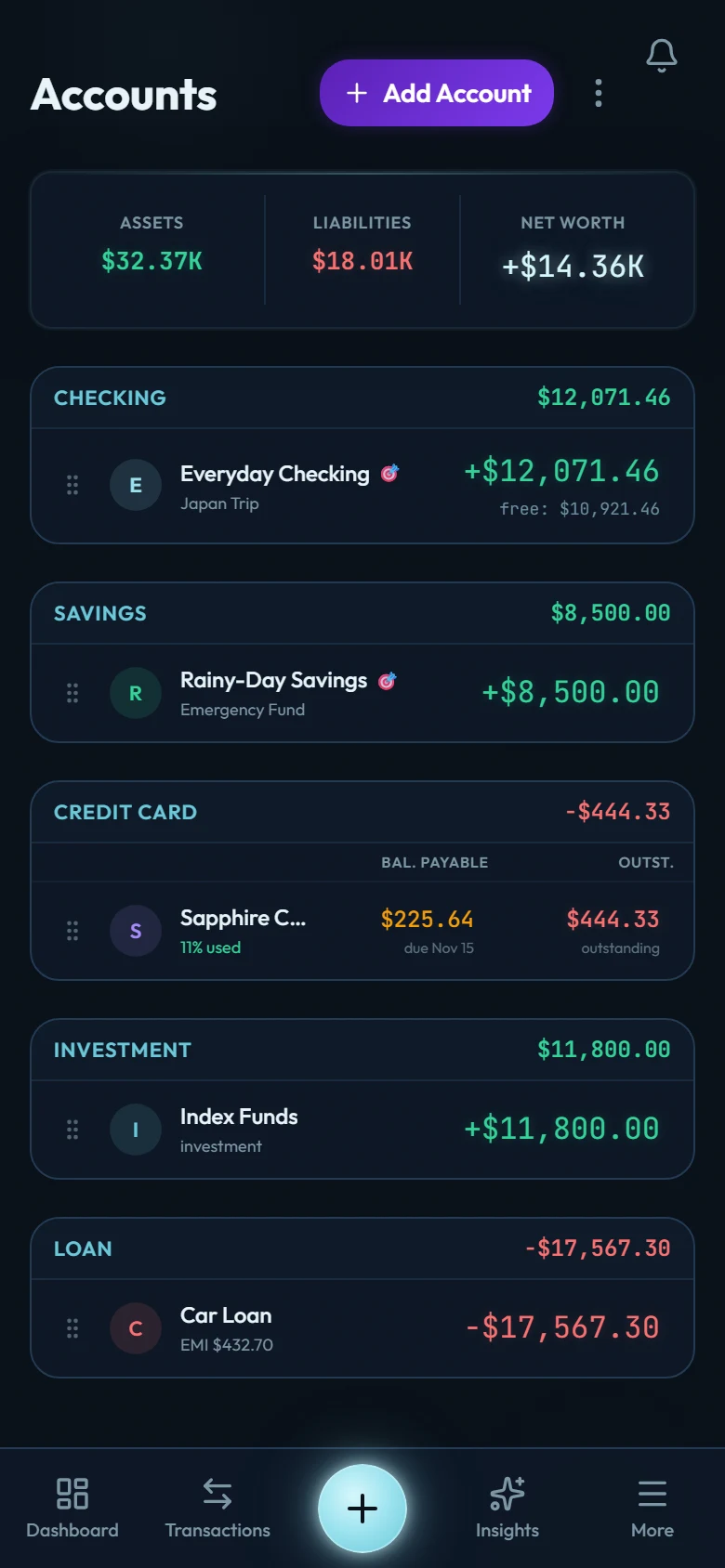
Write down each card's limit, statement day and due day
All 3 are on a statement or in the card's app. In Wealth Mutant you enter them once, when you add the card.
Line the due days up if you can
Experian says many issuers let you change your due date, and that aligning them all on the same day can make paying smoother. How to change your billing cycle covers which date to pick.
Pay the full statement balance automatically, with a buffer
Experian suggests automatic payments for the full amount due, with a buffer in your bank account, or balance and due date alerts instead. Statement balance vs current balance explains which of the two to pay.
Open a card in Wealth Mutant and its page keeps the limit, statement day, billed and unbilled spending, and the share of the limit used. That percentage counts what you owe today, which is not always the balance your issuer reports. The app does not show your credit score.
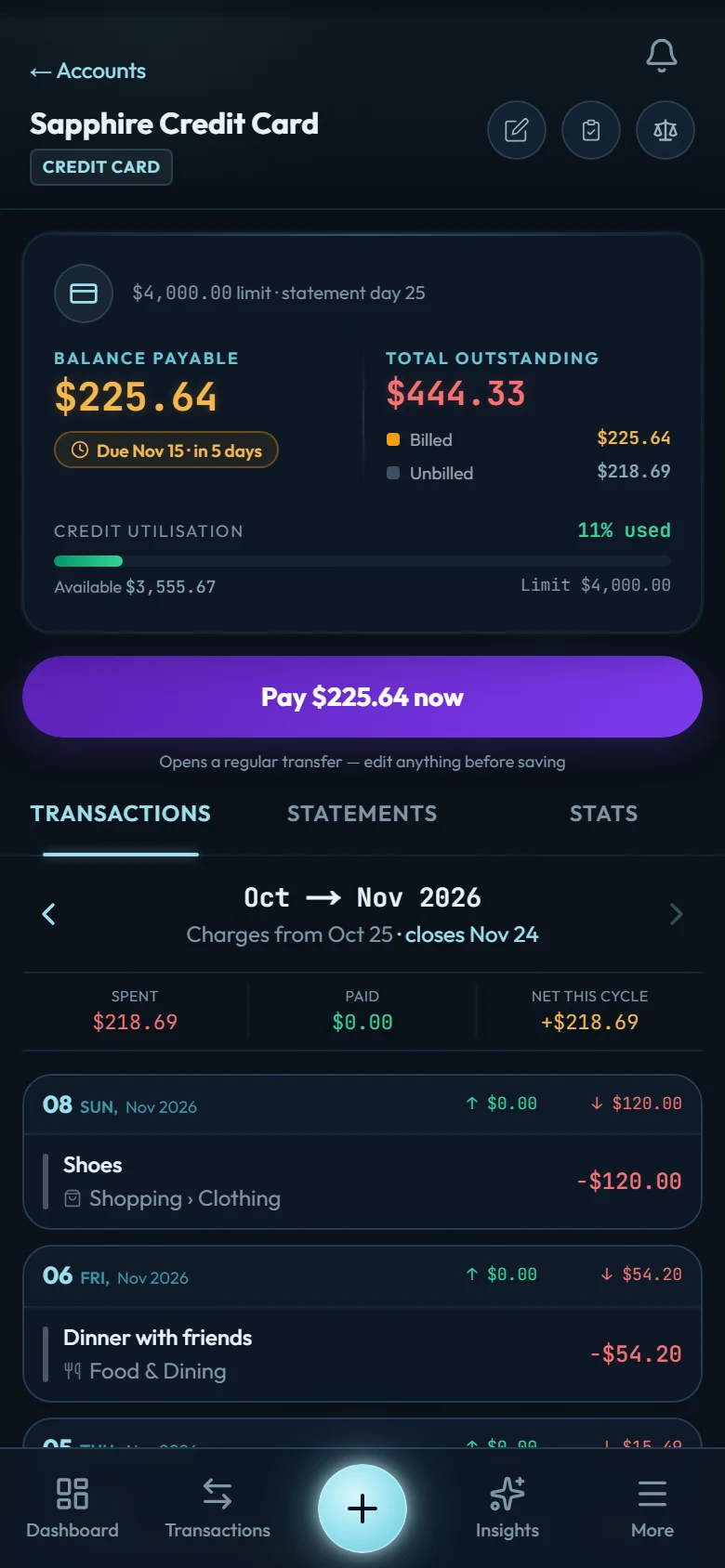
What changes once every date is in one place
Your card count stops being a number you worry about and becomes a list you can read in seconds: which bill is due next and which card is nearest its limit. Opening a 3rd card or closing a 4th becomes a decision you can work out.
Common questions
Does having more credit cards help your credit score?
Not by itself. A new card adds limit, which can lower your utilization, but it also brings a hard inquiry and lowers the average age of your accounts. Experian says opening cards only to raise your available credit might not be a good idea, and FICO says the impact of one factor cannot be measured without your whole report.
Is 3 credit cards too many?
No, 3 is typical. In the Federal Reserve Bank of Atlanta's 2025 survey the middle US cardholder held 3 cards, and 23% held 5 or more. Experian says that if you are struggling to manage payments or keep track of your balances, you may have too many.
Should I close a credit card I don't use?
Not automatically. The CFPB says closing a card can raise your utilization ratio and lower your score, but it may be right if the card has annual fees or poor terms that outweigh its benefits. For a card with a fee, Experian suggests asking the issuer whether you can switch to a no-fee card and keep the account open.
Does applying for a credit card hurt my credit?
It can, a little. FICO says a hard inquiry can lower your score by a few points, and Experian advises applying for one card at a time, since several at once could mean a bigger drop. Prequalification tools let you compare offers without damaging your credit, Experian says. Soft inquiries do not affect your score, and only you can see them on your report, say the CFPB and Experian UK.
Your next step
Write down 4 things for each card you hold: its limit, statement day, due day and annual fee. A card that fails the 3 questions above is the one to fix or close. Then add your cards to Wealth Mutant so the dates stay in front of you, and take the tour to see the rest of the app.