
Old money vs new money comes down to timing. Old money is wealth a family has held for many generations, and new money is wealth made recently.
What builds or burns wealth is the habit around it: preserving what you have, or displaying it. For your own finances that matters more than when the money arrived, and either habit is open to anyone at any income.
Next come the habits side by side, what research says about showing off, and 3 habits you can borrow.
What is the difference between old money and new money?
The Oxford Advanced Learner's Dictionary defines old money as "wealth that has been in a family for many generations" and new money as "wealth that has been made or acquired recently". Neither definition gives a number of years or an amount. The labels say when money arrived and nothing about how much there is.
The show-off image is spelled out in a related phrase. The same dictionary describes nouveau riche as "typical of people who have recently become rich and like to show how rich they are in a very obvious way". That is the stereotype in a sentence, and the dictionary marks the term as disapproving.
Quiet wealth and stealth wealth name one habit: not announcing what you have. The stealth wealth article covers it in full.
Old money vs new money habits, side by side
Popular descriptions of the labels boil down to 3 contrasts. Each shows up in what you do with money, so each can be checked against your own spending.

The first 2 contrasts are forks for the same money: a purchase can be chosen for the years you will use it or for who will see it, and a raise can go into investments that grow or into a nicer car. The third is about who knows your position: you and the people you share finances with, or everyone who sees what you buy.
These are tendencies people describe, not 2 kinds of person. A long-held fortune can be spent in public, and a first-generation earner can keep every purchase out of sight. Treat the habits as 2 ends of a dial, and look at where your own spending sits.
See which way your own spending leans
Your net worth, your savings rate and where your pace leads, built from your own entries.
No card needed.
What does research say about status spending?
Thorstein Veblen named the habit of spending to be seen in 1899. He called it conspicuous consumption and, in The Theory of the Leisure Class, explained why people display wealth at all:
In order to gain and to hold the esteem of men it is not sufficient merely to possess wealth or power. The wealth or power must be put in evidence, for esteem is awarded only on evidence.
A modern test came from the economists Kerwin Kofi Charles, Erik Hurst and Nikolai Roussanov, in the Quarterly Journal of Economics in 2009. Using US household spending data, they modelled spending on visible goods, such as clothing, jewelry and cars, as a status signal: "a costly indicator of a household's economic position". In their model, people cannot see each other's wealth, so they read the costly things they can see.
The model predicts that the richer a household's reference group (the people it compares itself with), the less it spends on visible goods, at the same income of its own. The authors found that prediction "strongly borne out in the data". So how much people spend to be seen depends on the incomes of the people they compare themselves with.
A second study, published in 2016, asked whether spending at the top spreads down. Marianne Bertrand and Adair Morse found that US households outside the richest group spent a larger share of their income where top earners in their state earned more. The share they put into more visible goods and services also rose with top incomes. They read that as "consistent with status-maintaining explanations" and estimate that these households "might have saved up to 3% more annually by the mid-2000s" had top incomes grown as fast as the median since the early 1980s.
The studies have limits. Both use US data. Neither sorts households by how long their money has been in the family, so neither tests the old-money story itself. And Bertrand and Morse stop at "consistent with": the data fit a status motive without proving it. What the studies do suggest is still useful: display behaves like a response to an audience, and it is paid for out of other spending or saving.
The numbers that show whether wealth is growing, your net worth (what you own minus what you owe) and your savings rate (the share of what you earn that you keep), are invisible from the outside. You have to look at them on purpose.
Wealth Mutant is the personal finance app we built for exactly this. It keeps those 2 numbers in front of you month by month, and its What If panel prices a planned purchase in future net worth before you buy. You note each purchase yourself in a few seconds, a small daily habit in the spirit of Kakeibo that makes you notice where the money goes, and no bank login is ever shared. You pay for it once.
Keep the numbers that matter in view
Net worth, savings rate and a price tag on every planned purchase, in one personal finance app you buy once.
Buy — $99 onceHow do you build an old money mindset on an ordinary income?
Take the habits and leave the label. None of them needs inherited money. The examples use dollars, and the habits travel to any currency.
Spend below your means by a margin you can name
Your savings rate turns this into a number. If $4,000 comes in a month and $3,400 goes out, you keep $600, a savings rate of 15%. Name the rate you want, then watch what each raise does to it. Lifestyle creep shows how raises disappear, and the savings rate explains the number.
Buy to keep the things you use most
Say a $300 coat really lasts 10 winters: that is $30 a winter. A $90 coat that lasts 2 winters costs $45 a winter, so 10 winters take 5 coats and $450. This only works for things you use often and that truly last, because a durable purchase you stop using is the most expensive kind.
Let net worth grow out of sight
Keep the number between you and anyone you share money with, and check it once a month. It can swing in a single month: the line below drops in its first month, then climbs. Read the direction across several months. The net worth guide lists what counts and what doesn't.
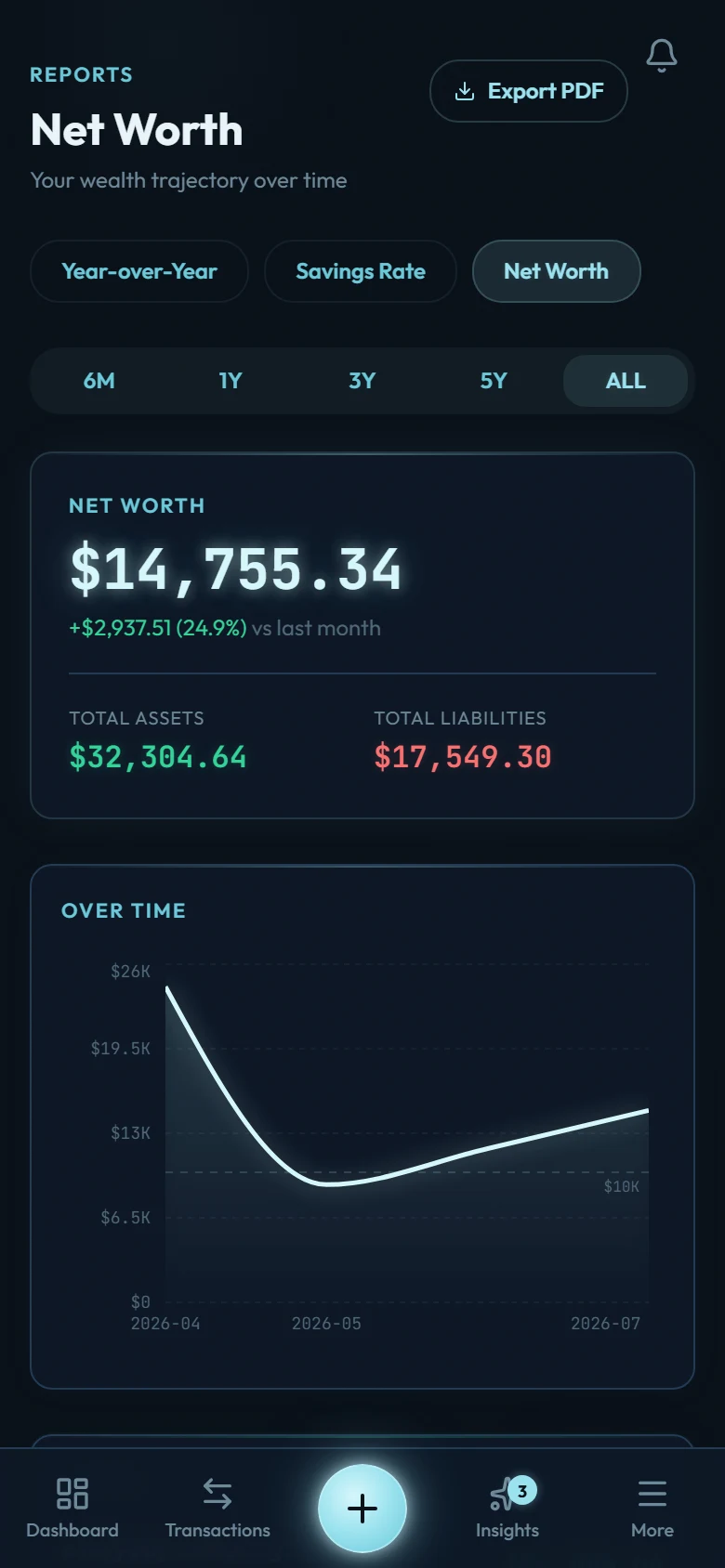
What changes when you track net worth instead of how things look?
The first change is the question you ask before a big purchase: what will this do to my net worth 10 years from now? The What If panel in Future Self answers it 3 ways. On the example account below, set to a 7% yearly return, the planned purchase is $24,000 paid at $1,100 a month for 24 months. Net worth 10 years out comes to $568.4K if you skip it and invest the money, $519.1K if you carry on as you are, and $469.7K if you buy it. The choice stays yours, and the panel says so: its job is to show the full price tag.
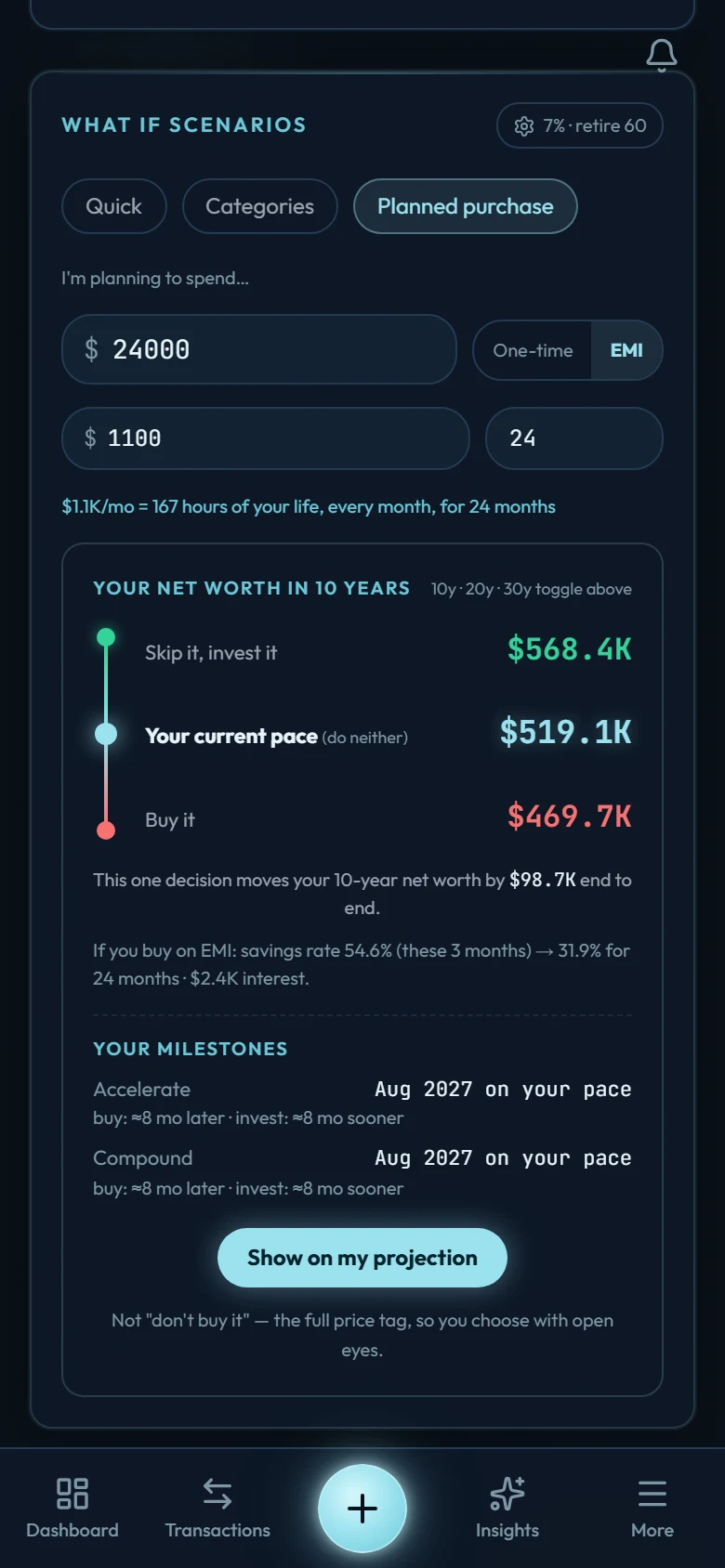
The second change is the time frame. Old money is measured in generations, and Future Self carries your own pace 10, 20 and 30 years ahead, so a decade stops being abstract. Some purchases will still pass the 10-year question, such as a laptop you will use every day for years or a course that could lead to better pay. You buy those knowing their full price.
Common questions
How many generations does it take to become old money?
The Oxford Advanced Learner's Dictionary gives no number. It says only “many generations”, so where the line falls is a matter of opinion.
Is old money richer than new money?
Not by definition. The labels describe how long wealth has been in a family, not how much there is, so a recent fortune can be larger than a long-held one.
How can you tell old money from new money?
Spending cannot tell you. The label depends on how long the money has been in a family, and a coat or a car shows only what someone bought.
Is quiet wealth the same as old money?
No. Quiet wealth, also called stealth wealth, is a habit anyone can adopt at any income: not announcing what you have. Old money is about how long a family has held its wealth.
Your next step
This week, work out 2 numbers: your net worth, and last month's savings rate (what you kept divided by what came in). The free net worth calculator gives you the first from 5 boxes. A month later, work them out again and see which way each one moved. In Wealth Mutant, each account starts from what it holds today, and Reports draws both numbers month by month from what you record. The tour shows the app in action.
For the long view, read generational wealth. To see what families hold at each age, read average net worth by age.